

- Share
The (Re)Anchoring of US Firms’ Inflation Expectations




The views authors express in Economic Commentary are theirs and not necessarily those of the Federal Reserve Bank of Cleveland or the Board of Governors of the Federal Reserve System. The series editor is Tasia Hane. This paper and its data are subject to revision; please visit clevelandfed.org for updates.
Introduction
Inflation expectations began rising with inflation in the aftermath of the COVID-19 pandemic.1 The literature has documented that inflation expectations affect firms’ price-setting decisions, households’ consumption behavior, and workers’ actions in the labor market, circumstances implying that higher inflation expectations could increase inflation persistence.2 Given that inflation and inflation expectations can feed into each other, the degree to which inflation expectations are anchored around a central bank’s inflation objective may be an important metric for policymakers to monitor.
Taking advantage of the novel Survey of Firms’ Inflation Expectations (SoFIE), we explore the degree of anchoring of US firms’ medium-term inflation expectations, measured as expected inflation (on average) for the four years beginning one year from today. We consider an anchoring metric that combines two key components (Naggert et al., 2023; Kumar et al., 2015): 1) firms’ disagreement about future inflation and 2) misalignment between the mean of firms’ inflation expectations and the inflation objective of the Federal Open Market Committee (FOMC).3 The availability of data on individual firms’ subjective perceptions of the FOMC’s inflation objective is unique and allows us to gain additional insights into the drivers behind the misalignment component. Specifically, we decompose misalignment into two subcomponents: 2a) misalignment between firms’ inflation expectations and their subjective perceptions of the FOMC’s inflation objective and 2b) misalignment between firms’ subjective perceptions of the FOMC’s inflation objective and the FOMC’s actual 2 percent objective.4
We show that the anchoring of firms’ medium-term inflation expectations weakened significantly during the pandemic inflation surge because of increased disagreement about future inflation and greater misalignment between firms’ inflation expectations and the FOMC’s 2 percent objective. The heightened levels of disagreement continued to persist through the end of 2024. At the onset of the inflation surge in 2021, the misalignment component was entirely driven by the deviation of firms’ inflation expectations from their subjective perceptions of the FOMC’s inflation objective. However, as inflation continued to increase, the composition of the misalignment term changed such that in 2022 it was primarily driven by the deviation of firms’ subjective perceptions of the FOMC’s inflation objective from 2 percent. This component of misalignment continued to contribute to the unanchoring of firms’ inflation expectations in 2023. Since 2023, the anchoring of medium-term inflation expectations has strengthened substantially, but it remained somewhat weaker during 2025 than the prepandemic average.
Comparing the degree of unanchoring in the manufacturing versus services sectors, we find that the anchoring of medium-term inflation expectations weakened for firms in both sectors. However, the unanchoring in the manufacturing sector was more pronounced compared to the services sector, likely because of the notable pickup in goods-price inflation in 2021 (see, for instance, Hajdini et al., 2025). In both sectors, greater disagreement in firms’ expectations was the principal source for the dramatic rise and sustained increase in unanchoring in 2021 and 2022. In 2021, the aggregate misalignment between firms’ expectations and their subjective perception of the FOMC’s objective was very similar across the manufacturing and services firms, whereas in 2022 the deviation of this subjective perception and 2 percent was much more concentrated in the services sector.
Survey of Firms' Inflation Expectations
Our analysis is based on the Survey of Firms' Inflation Expectations (SoFIE), which is a quarterly survey of chief executive officers and other top executives that has been running since 2018:Q2. Survey data are collected during January, April, July, and October, the first month of each quarter. The surveyed firms represent various industries within either the manufacturing sector or the services sector.5 In this Economic Commentary, we make use of the following three questions in the survey:
- 1-year inflation expectations, asked each quarter: “What do you think will be the inflation rate (for the Consumer Price Index) over the next 12 months? Please provide an answer in an annual percentage rate.”
- 5-year inflation expectations, asked each fourth quarter: “What do you think will be the average inflation rate (for the Consumer Price Index) over the next 5 years? Please provide an average annual percentage rate.”
- Inflation objective perception, asked each second quarter: “What annual inflation rate do you think the US Federal Reserve is trying to achieve on average? Please provide an average annual percentage rate.”
Following Candia et al. (2024), we interpret the latter question as measuring firms’ familiarity with the FOMC’s inflation objective. That is, we view firms’ reported subjective perceptions of the FOMC’s inflation objective as an indication of their knowledge and informedness about the stated numerical value of this goal of monetary policy.
We are interested in measuring the anchoring of firms’ medium-term inflation expectations at the FOMC’s 2 percent objective. To mitigate concerns that the five-year inflation expectations also embed short-term inflation expectations, we construct a measure of firms’ four-year/one-year-forward inflation expectations. This is possible in each fourth quarter, when we observe both one-year and five-year inflation expectations. Specifically, we construct a four-year/one-year-forward measure of inflation expectations as the average annual inflation over a four-year horizon starting one year ahead:
(1)
We then use as our measure of medium-term inflation expectations observed in year t.6
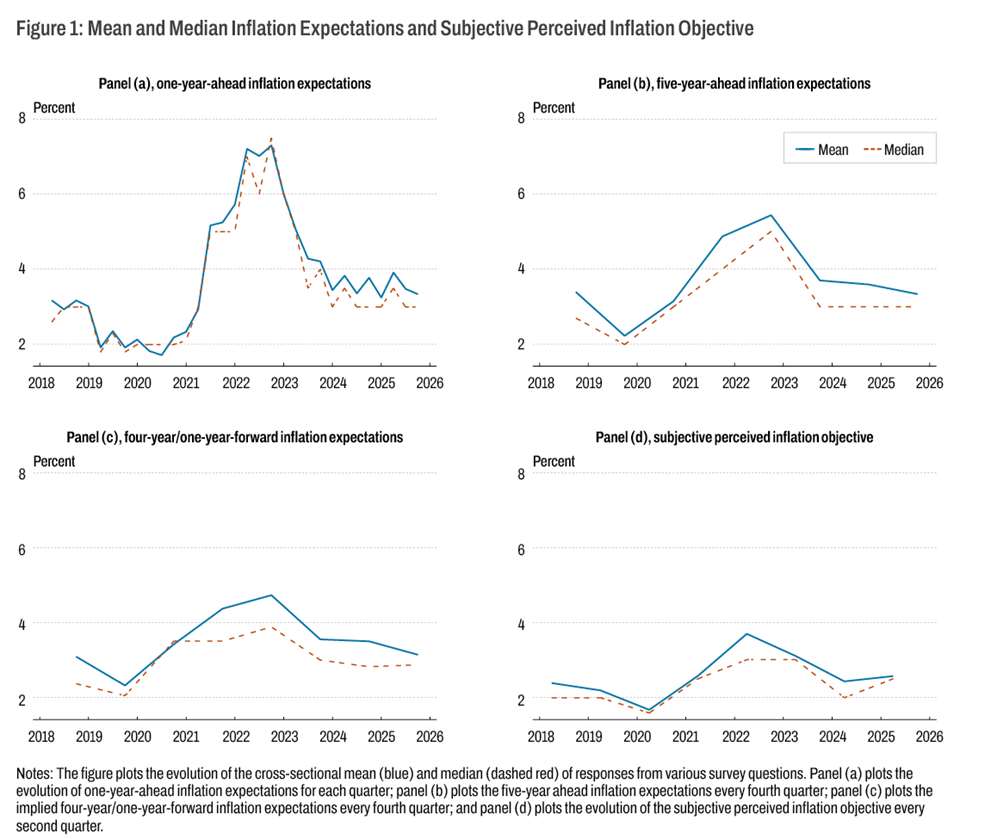
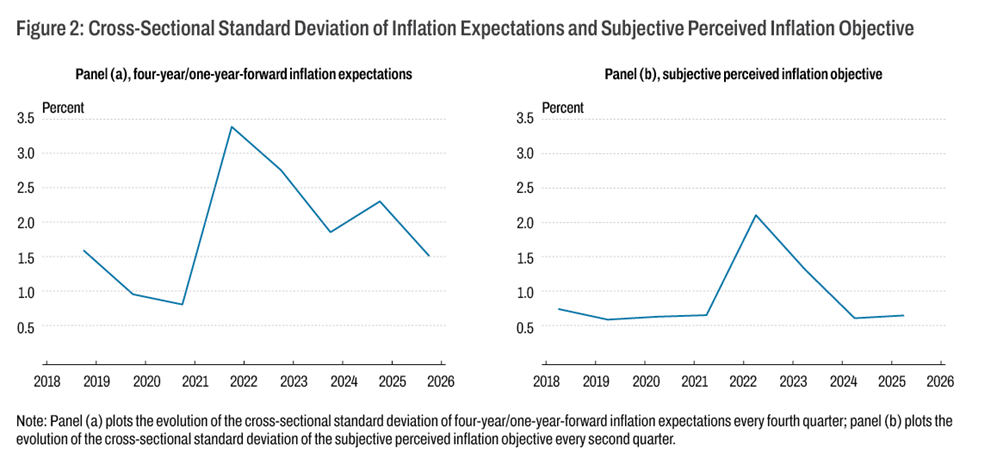
Figure 1 plots the evolution of firms’ one-year and five-year inflation expectations, along with the implied medium-term inflation expectations and their subjective perceptions of the FOMC’s inflation objective.7 Firms’ inflation expectations started to rise substantially early in 2021, while their perceived inflation objective rose significantly from 2 percent to values close to 4 percent later in 2022. Figure 2 plots the dispersion in firms’ medium-term inflation expectations and in their subjective perceived inflation objective. The dispersion in medium-term inflation expectations rose sharply during the inflation surge. Since then, the dispersion in firms’ medium-term inflation expectations and the inflation objective receded and in 2025 is generally comparable to levels seen in 2018.
Measure of Anchoring
Our measure of anchoring of inflation expectations builds on Naggert et al. (2023). The degree of inflation expectations’ anchoring is computed as the average squared deviation of the individual firms’ inflation expectations from the central bank’s inflation objective:
(2)
Equation (2) posits that inflation expectations in the United States are perfectly anchored if all firms report medium-term inflation expectations at the FOMC’s 2 percent inflation objective, in which case unanchoringt = 0. The appealing feature of this anchoring measure is that it reflects a combination of firms’ disagreement about future inflation and the degree of misalignment of average expected future inflation from 2 percent:
(3)
The formulation of this measure is consistent with Kumar et al. (2015) who emphasize that anchoring entails more than the alignment of the consensus mean with the inflation objective.
Our survey data enable us to further decompose the misalignment of average expected inflation and the FOMC’s inflation objective into two subcomponents: a) the degree of misalignment between the mean of expected inflation and the mean of the subjective perceived inflation objective and b) the degree of misalignment between the mean of the subjective perceived inflation objective and the FOMC’s inflation objective. The first subcomponent could be associated with firms’ beliefs that the Fed would achieve its inflation objective on average over the medium term, as it relates to the proximity of firms’ expected medium-term inflation expectations to their subjective perceptions of the inflation objective.8
The second subcomponent could be associated with firms’ informedness about the FOMC’s inflation objective. Divergence in this subcomponent could be explained by various factors, including the possibility that expanded debate at the time by outside commentators about the desired inflation goal may have obscured firms’ ability to understand the FOMC’s actual inflation objective.9 Formally, the misalignment component can be decomposed as
(4)
where denotes firm i’s subjective perceived inflation objective observed in year t.10
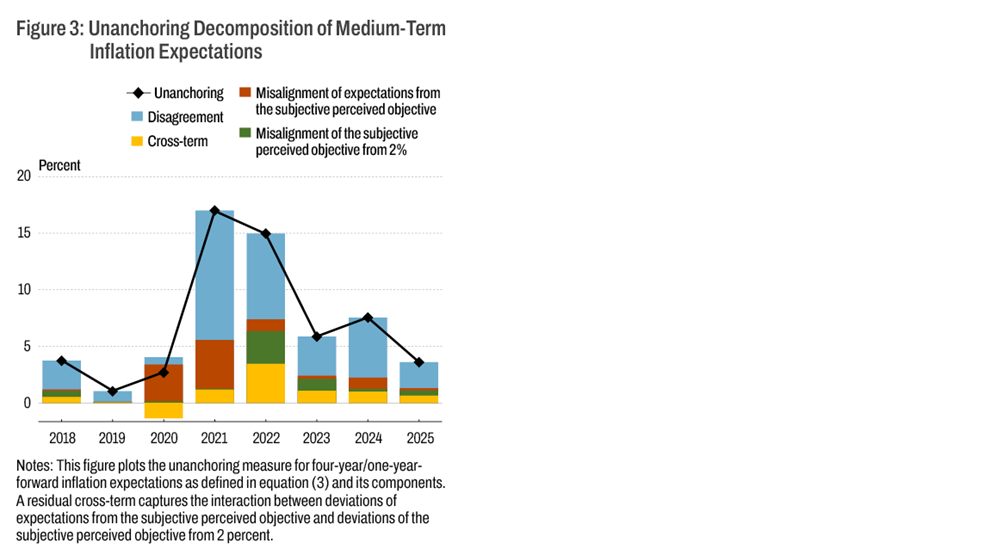
We plot the evolution of our unanchoring measure and its components in Figure 3. The anchoring of firms’ medium-term inflation expectations weakened significantly during the inflation surge. Since 2023, the anchoring of inflation expectations has strengthened substantially, but as of 2025 it is somewhat weaker compared to the prepandemic average.
Different components of the unanchoring measure played key roles at different times. At the onset of the inflation surge, unanchoring was driven primarily by disagreement across firms about medium-term inflation (blue bars). Later in 2022, disagreement across firms declined. However, as inflation proved to be more persistent than previously anticipated, the degree of unanchoring remained relatively high because firms’ subjective perceptions about the FOMC’s inflation objective started to deviate from 2 percent, as shown by the emerging green bar in 2022. Our measure of unanchoring rapidly decreased in 2023, coinciding with the significant slowdown in inflation. The degree of unanchoring has leveled off at a somewhat higher value than the prepandemic average, resulting primarily from the relatively higher disagreement across firms about inflation in the medium term.
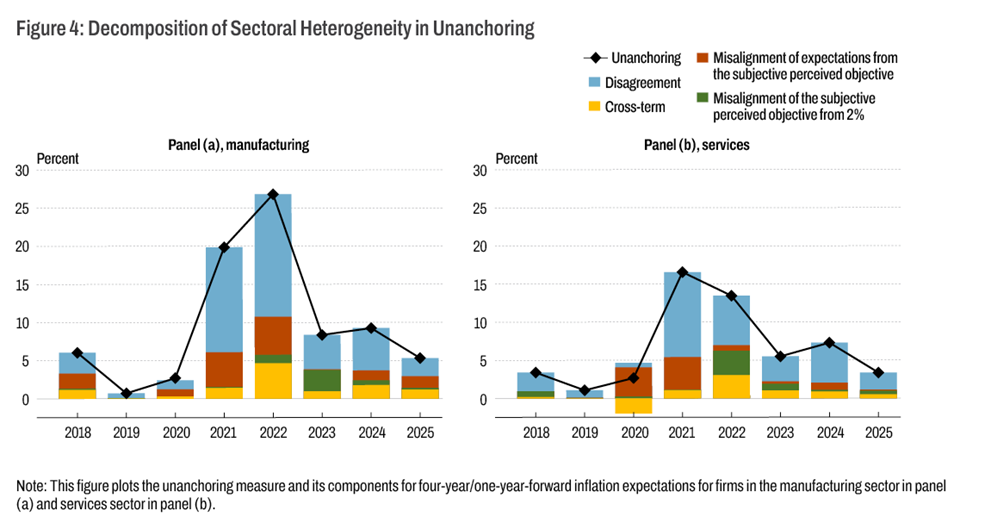
Finally, we look at the anchoring of medium-term inflation expectations of firms in the manufacturing versus services sectors, depicted in Figure 4. While the anchoring of medium-term inflation expectations weakened for firms in both sectors, the unanchoring was more pronounced for firms in the manufacturing sector. This result is consistent with the sharp rise in goods-price inflation in 2021. The key driver of unanchoring in both sectors in 2021 was disagreement in inflation expectations, although the misalignment between firms’ expectations and their subjective perception of the FOMC’s objective also played a meaningful role. The decomposition also shows that a deviation between firms’ perceptions about the inflation objective and the FOMC’s objective of 2 percent emerged in 2022 and 2023, although this development was more important in the services sector.
Conclusion
This Economic Commentary explores a unique survey of US firms’ inflation expectations to study the degree of anchoring of firms’ medium-term inflation expectations. We document that anchoring weakened significantly during the inflation surge. A decomposition of our unanchoring measure reveals that the weakening in anchoring was driven primarily by disagreement across firms about medium-term inflation. In 2022, the year when inflation peaked, disagreement across firms decreased, but unanchoring remained high because firms’ subjective perceptions about the FOMC’s inflation objective started to deviate from 2 percent. Compared to 2021 and 2022, the anchoring of firms’ inflation expectations has been notably stronger since 2023. The degree of anchoring in 2025 is similar to that in 2018 but remains somewhat weaker than the prepandemic average. Finally, we show that there was greater unanchoring in the manufacturing sector than in the services sector.
References
- Baumann, Ursel, Annalisa Ferrando, Dimitris Georgarakos, Yuriy Gorodnichenko, and Timo Reinelt. 2025a. “Do Inflation Expectations Become More Anchored during a Disinflation Episode? Evidence for Euro Area Firms.” AEA Papers and Proceedings 115(May): 266–270. doi.org/10.1257/pandp.20251019.
- Baumann, Ursel, Annalisa Ferrando, Dimitris Georgarakos, Yuriy Gorodnichenko, and Timo Reinelt. 2025b. “Firms’ Inflation Expectations in a Monetary Union.” Working Paper No. 2025-29. Federal Reserve Bank of San Francisco. doi.org/10.24148/wp2025-29.
- Candia, Bernardo, Olivier Coibion, and Yuriy Gorodnichenko. 2024. “The Inflation Expectations of US Firms: Evidence from a New Survey.” Journal of Monetary Economics 145(July): 103569. doi.org/10.1016/j.jmoneco.2024.103569.
- Coibion, Olivier, Dimitris Georgarakos, Yuriy Gorodnichenko, and Maarten van Rooij. 2023. “How Does Consumption Respond to News about Inflation? Field Evidence from a Randomized Control Trial.” American Economic Journal: Macroeconomics 15(3): 109–152. doi.org/10.1257/mac.20200445.
- Coibion, Olivier, Yuriy Gorodnichenko, and Tiziano Ropele. 2020. “Inflation Expectations and Firm Decisions: New Causal Evidence.” Quarterly Journal of Economics 135(1): 165–219. doi.org/10.1093/qje/qjz029.
- Garciga, Christian, Edward S. Knotek II, Mathieu Pedemonte, and Taylor Shiroff. 2023. “The Survey of Firms’ Inflation Expectations.” Economic Commentary, no. 2023-10 (May). doi.org/10.26509/frbc-ec-202310.
- Hajdini, Ina, Edward S. Knotek II, John Leer, Mathieu Pedemonte, Robert W. Rich, and Raphael S. Schoenle. 2023. “Low Passthrough from Inflation Expectations to Income Growth Expectations: Why People Dislike Inflation.” Working Paper No. 22-21R. Federal Reserve Bank of Cleveland. doi.org/10.26509/frbc-wp-202221r.
- Hajdini, Ina, Adam Shapiro, A. Lee Smith, and Daniel Villar. 2025. “Inflation Since the Pandemic: Lessons and Challenges.” Working Paper No. 2025-16. Federal Reserve Bank of San Francisco. doi.org/10.24148/wp2025-16.
- Kumar, Saten, Hassan Afrouzi, Olivier Coibion, and Yuriy Gorodnichenko. 2015. “Inflation Targeting Does Not Anchor Inflation Expectations: Evidence from Firms in New Zealand.” Brookings Papers on Economic Activity 2015(2): 151–225. doi.org/10.1353/eca.2015.0007.
- Naggert, Kristoph N., Robert W. Rich, and Joseph S. Tracy. 2023. “The Anchoring of US Inflation Expectations since 2012.” Economic Commentary, no. 2023-11 (July). doi.org/10.26509/frbc-ec-202311.
- Pilossoph, Laura, and Jane M. Ryngaert. 2024. “Job Search, Wages, and Inflation.” Working Paper No. 33042. National Bureau of Economic Research. doi.org/10.3386/w33042.
Endnotes
- See Hajdini et al. (2025) for a summary of the behavior of inflation expectations across consumers, firms, financial markets, and professional forecasters during this period. Return to 1
- See, for instance, Coibion et al. (2020), Coibion et al. (2023), Baumann et al. (2025b), Hajdini et al. (2023), and Pilossoph and Ryngaert (2024), among many others. Return to 2
- See Baumann et al. (2025a) for a similar analysis of the anchoring of firms’ inflation expectations during the disinflationary period in the euro area. Return to 3
- As we discuss later, we follow Candia et al. (2024) and interpret "firms’ subjective perceptions of the FOMC’s inflation objective" as a measure of firms’ knowledge and familiarity with the FOMC’s inflation objective. Return to 4
- We refer the reader to Candia et al. (2024) and Garciga et al. (2023) for more details on the survey. Return to 5
- We use one-year inflation expectations in the fourth quarter to align with the date of five-year inflation expectations. Return to 6
- We trim the top 5 percent and bottom 5 percent of the responses for each question to remove outliers. Return to 7
- Our measure of medium-term inflation expectations only imperfectly captures expectations about the ability of the Federal Reserve to stabilize inflation in the long run. For example, this subcomponent of unanchoring may be overstated if the FOMC looks through persistent inflation shocks. Return to 8
- As discussed earlier, our interpretation of the second component is consistent with the intention in Candia et al. (2024) to use the inflation objective question to assess firms’ familiarity with the FOMC’s inflation objective. However, we recognize that the question wording could result in the divergence in the second subcomponent reflecting firms’ belief that the FOMC’s inflation objective was (temporarily) different from 2 percent. Return to 9
- The cross-term that appears in equation (4) is the covariance between inflation expectations’ deviations from the subjective perceived objective and deviations of the subjective perceived objective from the FOMC’s inflation objective. That is, the cross-term . Return to 10
Suggested Citation
Cline, Alexander, Christian Garciga, Ina Hajdini, Timo Reinelt, and Robert W. Rich. 2026. “The (Re)Anchoring of US Firms’ Inflation Expectations.” Federal Reserve Bank of Cleveland, Economic Commentary 2026-11. https://doi.org/10.26509/frbc-ec-202611
This work by Federal Reserve Bank of Cleveland is licensed under Creative Commons Attribution-NonCommercial 4.0 International


