
- Share
Community Issues and Insights
Community Issues Survey
Twice a year, the community development team at the Cleveland Fed administers the Community Issues Survey (CIS). Its goal is to collect information such as the quote below from direct service providers to monitor economic conditions and identify issues impacting low- and moderate-income (LMI) households in the region. Respondents are asked about jobs, housing, financial well-being, access to credit, and other issues that have a significant impact on the welfare of the communities they serve.
Eastern Kentucky electric rates are among some of the highest in the country, with most bills almost doubling in the past few months. Some of our residents, especially the elderly, are receiving bills in excess of their monthly income.
Latest Survey
Read the report based on the March 2026 survey.
Key Findings
- Job availability: Only 8 percent of respondents said that job availability for LMI workers had increased in the past six months, a sideways move from the September 2025 survey (7 percent). Most respondents (51 percent) said that there had been no change.
- Affordable housing availability: Sixty-one percent of respondents said that the availability of affordable housing had continued to decrease over the past six months. This share has exceeded 50 percent since the March 2022 survey.
- Financial well-being and access to credit: Seventy-two percent of respondents reported that financial well-being for LMI people had decreased over the past six months, while 78 percent said that access to credit had remained unchanged over the past six months.
- Top concerns for LMI households: Respondents’ top concerns were the cost of housing, the continued impact of price increases on households’ budgets, and the shortage of affordable housing.
- Trends for nonprofit organizations: A large majority of nonprofit organizations reported that demand for their services had increased over the past six months, consistent with responses to previous surveys, while their capacity, or ability to fulfill the demand, had remained steady. Forty-eight percent of respondents said that funding had decreased over the past six months, the highest share since the survey began in March 2018. Organizations cited federal funding cuts as their primary concern.
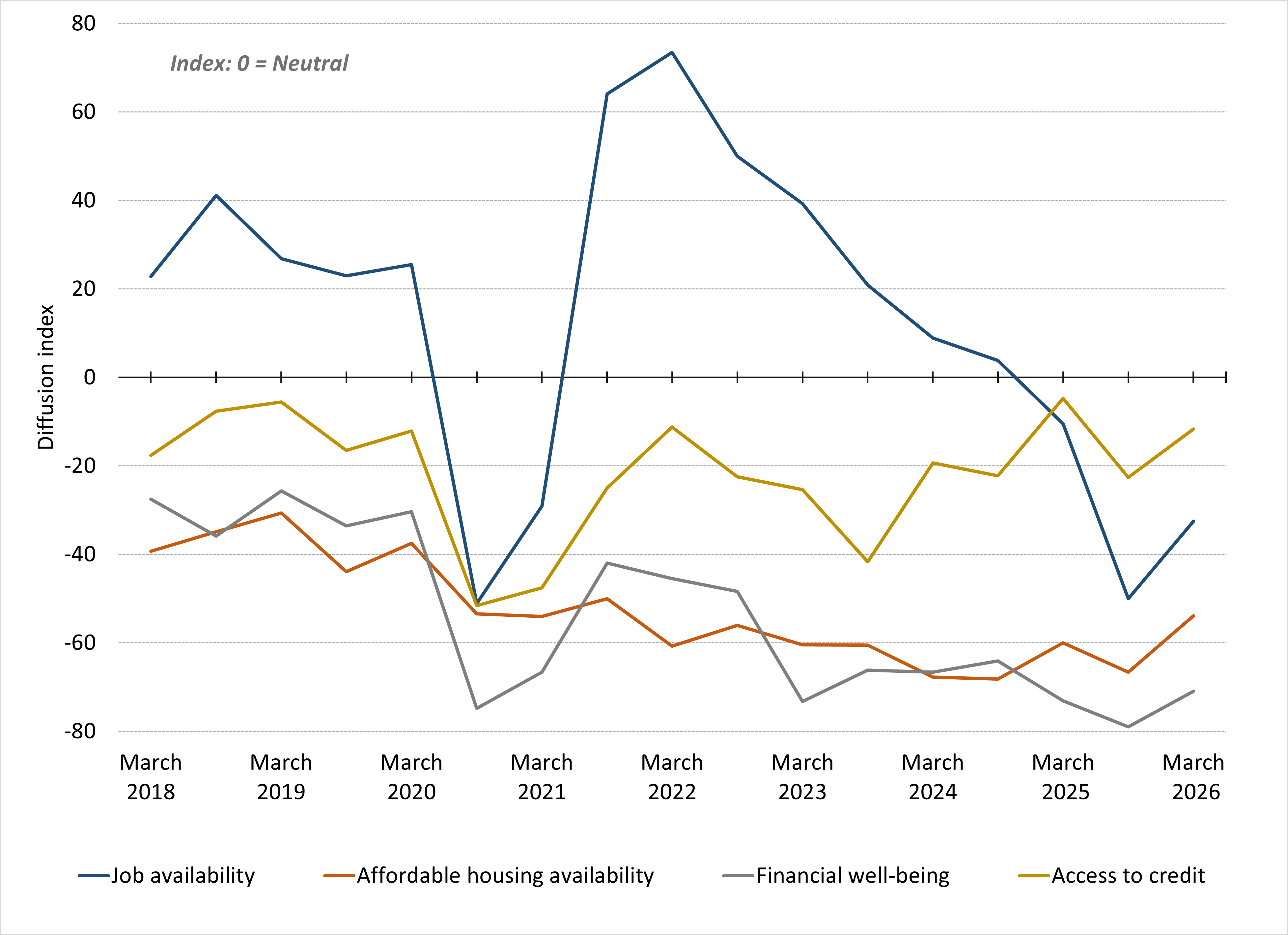
A diffusion index was built for each survey question to observe trends in the responses over time; more information on how the indices are constructed can be found in the report. According to the March 2026 survey, all indexes rebounded from September 2025 levels, but they all remained below 0, which indicates worsening conditions, though at a slower rate.

Related Content

Community Development
Supporting low- and moderate-income communities in the Fourth District is a cornerstone of our mission at the Cleveland Fed. Find out how our Community Development team is promoting access to good jobs, housing, and credit for the residents within our district.

Notes from the Field
In Community Development's blog, Notes from the Field, members of our Community Development team discuss what they are seeing and hearing in their work on the ground. The blog shines a light on challenges facing lower income communities in our region, as well as on the critical role of community organizations, banking institutions, and education and workforce programs in addressing them.
Home Mortgage Disclosure Act
Home Mortgage Disclosure Act (HMDA) is a law that requires certain financial institutions to publicly disclose information about home mortgages. HMDA requires lenders to report information about the loan applications they receive (for example, application date, loan type, race, gender, and income of the borrower, and if the loan was approved or denied). Access publications using the HMDA ata along with a data tool that allows users to easily search, compare, and visualize data on mortgage lending for states, metros, counties, and local areas throughout the US.