

- Share
Expanding the Survey of Firms’ Inflation Expectations





The views authors express in Economic Commentary are theirs and not necessarily those of the Federal Reserve Bank of Cleveland or the Board of Governors of the Federal Reserve System. The series editor is Tasia Hane. This paper and its data are subject to revision; please visit clevelandfed.org for updates.
Introduction
Economic theory and empirical evidence suggest that beliefs about the future can affect behaviors in the present. For example, if a firm expects that higher inflation in the future will raise its production costs, it may be more likely to raise its prices today rather than accept impending margin compression. If this view is widely shared by many firms that raise their prices in response, then inflation could rise in the near term. Thus, monitoring inflation expectations is of particular interest to monetary policymakers to ensure that such self-fulfilling processes do not occur. While many papers examine inflation expectations of consumers and how those expectations relate to demographic, socioeconomic, and other characteristics, surveys examining the inflation expectations of price and wage setters are fewer in number.
The Survey of Firms’ Inflation Expectations (SoFIE) is one of the few US-based surveys that captures the inflation expectations of firms. Developed in 2018 by researchers Olivier Coibion and Yuriy Gorodnichenko and subsequently assumed by the Center for Inflation Research at the Federal Reserve Bank of Cleveland in 2023, it captures quarterly readings of firms’ short-term inflation expectations, and on a rotating basis it annually collects readings on several additional measures of inflation expectations. Starting in 2025, the Center expanded the number of questions asked of SoFIE respondents. These new questions relate to confidence in achieving the Fed’s perceived inflation objective; the perceived optimal inflation rate; the probability of low inflation over the next year; expectations for prices, costs, employment, wages, research and development (R&D) spending, and GDP growth; and beliefs about uncertainty within a firm’s sector. Information coming from these additional questions can help us better understand the determinants of firms’ inflation expectations at the individual firm level and how these inflation expectations affect firms’ other decisions.
In this Economic Commentary, we introduce these new survey questions and present some initial analysis of the collected survey responses. Going forward, the Center will present updates on this expanded set of SoFIE questions each quarter at clefed.org/SoFIE.
Survey of Firms’ Inflation Expectations
SoFIE is a nationally representative, quarterly survey of chief executive officers and other top business executives that has been fielded since 2018:Q2. Survey data are collected quarterly during January, April, July, and October. Firms are repeatedly sampled, providing a panel dimension to the data set. The questions comprising SoFIE are part of a longer privately run survey administered by an external company. Firms from various industries are surveyed, representing both the manufacturing sector and the services sector. For additional details on the survey, see Candia, Coibion, and Gorodnichenko (2024) and Garciga et al. (2023).
The original survey questions are as follows:
Q1. One-year inflation expectations, asked each quarter: “What do you think will be the inflation rate (for the Consumer Price Index) over the next 12 months? Please provide an answer in an annual percentage rate.”
Q2A. Inflation objective perception, asked each second quarter: “What annual inflation rate do you think the US Federal Reserve is trying to achieve on average? Please provide an average annual percentage rate.”
Q2B. Inflation perceptions, asked each third quarter: “What do you think the inflation rate (for the Consumer Price Index) has been over the last 12 months? Please provide an answer in annual percentage rate.”
Q2C. Five-year inflation expectations, asked each fourth quarter: “What do you think will be the average inflation rate (for the Consumer Price Index) over the next 5 years? Please provide an average annual percentage rate.”
Q2D. High inflation probability, asked each first quarter: “What do you think is the probability that the annual inflation rate (for the Consumer Price Index) over the next 12 months will exceed 5%?”
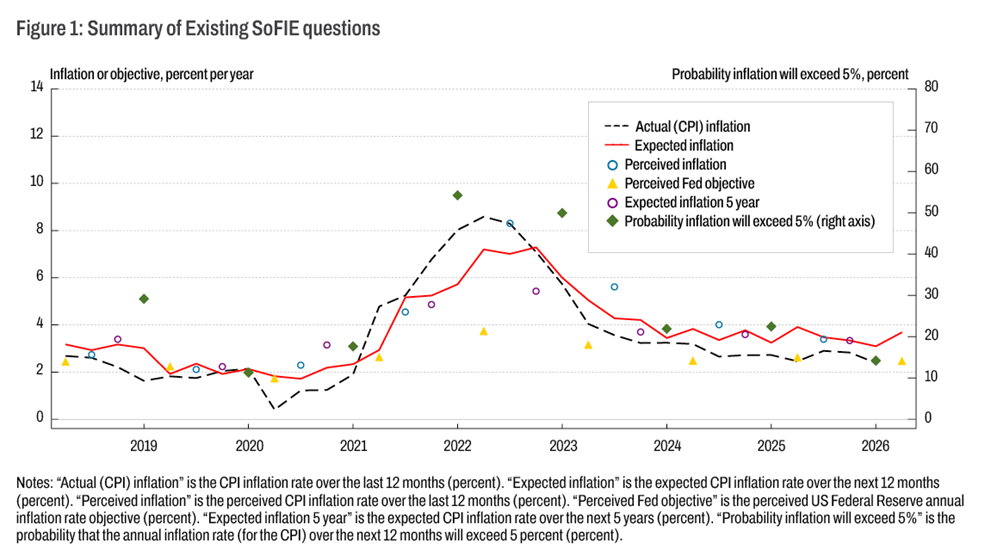
Figure 1 summarizes the responses to the original questions. Firms’ inflation expectations largely track actual CPI inflation. However, in recent years, their inflation expectations have remained somewhat elevated compared to realized CPI inflation. While five-year-ahead inflation expectations are less volatile than one-year-ahead inflation expectations, they also increased noticeably during the recent inflation surge. Cline et al. (2026) study the degree of anchoring of US firms’ inflation expectations using SoFIE data. Subjective perceptions of the Fed’s inflation objective increased from around 2 percent in 2019 and 2020 to 3.7 percent in 2022. Since 2022, these perceptions have steadily declined, with the most recent reading at 2.6 percent. Perceptions of past inflation tracked actual CPI closely until 2022 but have subsequently remained elevated compared to realized CPI inflation. The probability that inflation will exceed 5 percent over the next 12 months has largely moved with expected inflation. This probability increased from below 20 percent in 2021 to above 50 percent in 2022, at which point it started to decline steadily, to 14 percent in 2026.
New Questions
The Center added new questions to SoFIE during the survey waves fielded in 2025:Q3, 2025:Q4, 2026:Q1, and 2026:Q2. While our focus remains on firms’ inflation expectations in various forms, we now also have questions related to expectations for costs, employment, uncertainty, and GDP. The new questions are as follows:
Q2A.1. Confidence in achieving the perceived inflation objective, asked each second quarter: “How confident are you that the U.S. Federal Reserve will achieve this inflation rate in five years?” Likert scale: not confident at all, not very confident, somewhat confident, confident, very confident, don’t know.
Q2C.1. Perceived optimal inflation, asked each fourth quarter: “Looking further ahead, what inflation rate do you think is optimal for the U.S. economy over the five-year period between five and ten years from now? Please provide an average annual percentage rate.”
Q2D.1. Low inflation probability, asked each first quarter: “What do you think is the probability that the annual inflation rate (for the Consumer Price Index) over the next 12 months will be below 1%?”
Questions Q2A.1, Q2C.1, and Q2D.1 serve as follow-up questions to the original Q2A, Q2C, and Q2D questions. In addition, we have introduced the following Q3 questions that are unrelated to the original questions:
Q3A and Q3C. Price and unit cost expectations, asked each second and fourth quarter: “Twelve months from now, what do you expect will be the change in. . .”
- (Q3AC.1) average prices for your firm (relative to the current level; in percent): _____
- (Q3AC.2) average unit cost for your firm (relative to the current level; in percent): _____
Q3B. Employment, wages, and R&D spending expectations, asked each third quarter: “Twelve months from now, what do you expect will be the change in. . .”
- (Q3B.1) employment in your firm (relative to the current level; in percent): _____
- (Q3B.2) average wages in your firm (relative to the current level; in percent): _____
- (Q3B.3) R&D spending in your firm (relative to the current level; in percent): _____
Q3D. GDP expectations, asked each first quarter: “What do you think will be the average economic growth rate (as measured by the real GDP growth rate) over the next 12 months? Please provide an answer in annual percentage rate.”
Q3D.1. Confidence in sector outlook, asked each first quarter: “Compared to the average uncertainty you experience, how would you characterize the outlook in your sector over the next 12 months?” Likert scale: much more uncertain, more uncertain, same uncertainty, less uncertain, much less uncertain, N/A.
In this Economic Commentary, and on clefed.org/SoFIE, we remove outliers and report trimmed means for questions Q2C.1, Q3A, Q3B, Q3C, and Q3D, while we use all the data and report simple means for questions Q2A.1, Q2D.1, and Q3D.1. We apply survey weights to the responses. All reported means are calculated using post-stratification weights to make the sample representative relative to the distribution of annual payrolls by industry and firm size (see Garciga et al., 2023).
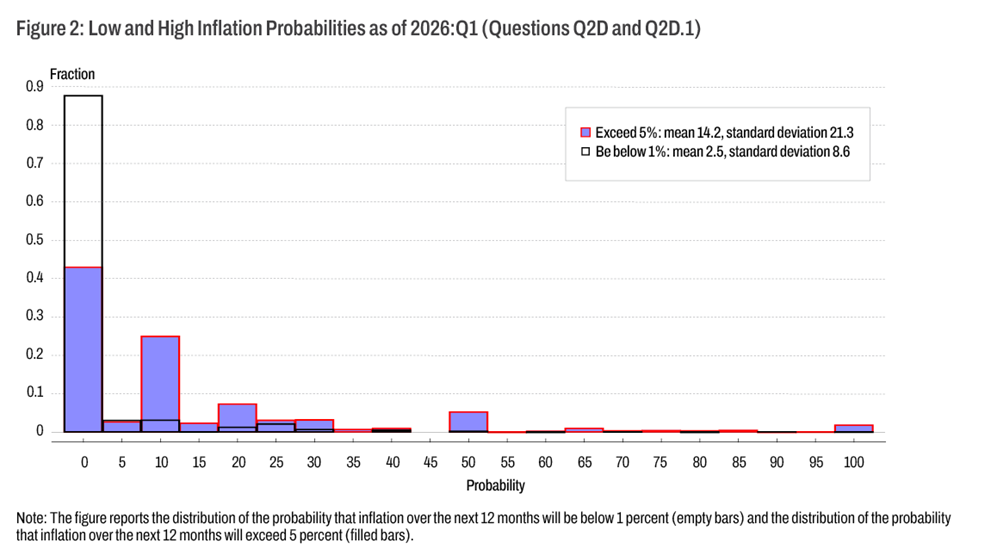
Figure 2 plots the responses to questions Q2D and Q2D.1 that were fielded in 2026:Q1. In terms of high inflation, firms assigned a 14.2 percent probability on average that inflation would be above 5 percent over the next year. In terms of low inflation, firms assigned low odds to such an outcome. On average, firms saw only a 2.5 percent probability that inflation would be below 1 percent over the next year, with almost 90 percent of firms attaching zero probability to such an outcome.1 These numbers imply that firms saw an 83 percent probability that inflation would be between 1 percent and 5 percent.
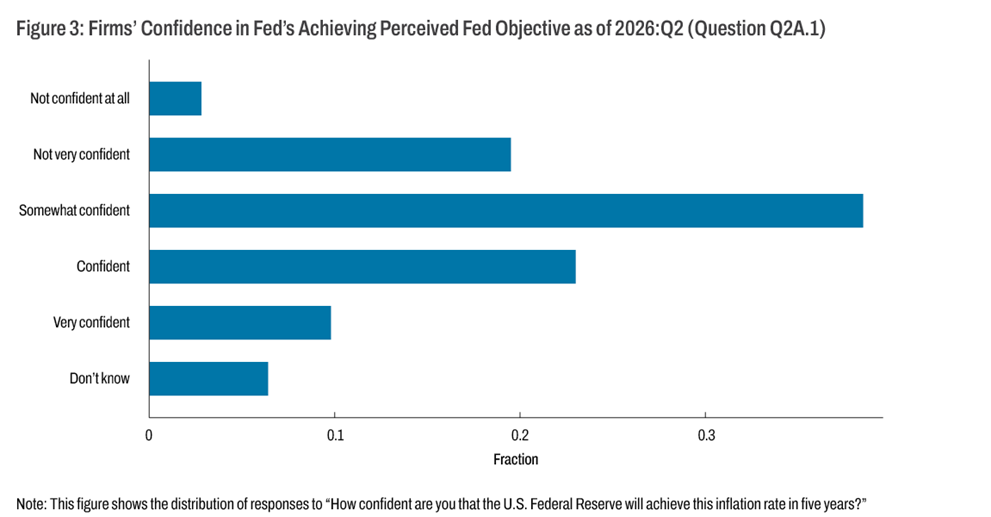
As a follow up to Q2A, which asks for the respondent firm’s perception of what the Fed’s inflation objective is, Q2A.1 now asks about the firm’s confidence that the Fed will achieve this inflation objective, see Figure 3. In 2026:Q2, firms’ average perception of the Fed’s objective was that it was 2.4 percent, and 38.5 percent of respondents selected that they were “somewhat confident” that the Fed would achieve this objective. However, there was considerable variation in these answers, with 22.3 percent of firms reporting that they were “not confident at all” or “not very confident” while 32.8 percent of firms stated that they were either “confident” or “very confident.”
Question Q2C.1 asks firms for their perceptions of the optimal inflation rate for the American economy. This question seeks different information than asking firms for their subjective perceptions of the Fed’s inflation target, and it is similar to recent work that has asked consumers for their beliefs about the optimal inflation rate (Pfajfar and Winkler, 2025).
As is visible in Figure 4, the mean response across firms using data from 2025:Q4 was 2.5 percent. About 35 percent of firms answered 2 percent exactly, a number in line with the Fed’s inflation objective. Nearly 70 percent of firms reported a number between 2 percent and 3 percent. Interestingly, no firms reported an optimal inflation rate of 0 percent or lower, and only about 5 percent of firms reported an optimal inflation rate of below 2 percent. Firms’ views about optimal inflation contrast sharply with those of consumers, who tend to prefer very low inflation.2 Specifically, consumers seem to be much more concerned with losing purchasing power, and they often answer 0 percent as their optimal inflation rate.3 Comparing firms’ responses to the optimal inflation question and their responses to the question about the Fed’s perceived inflation target, we observe that the average response is very similar across these two questions.
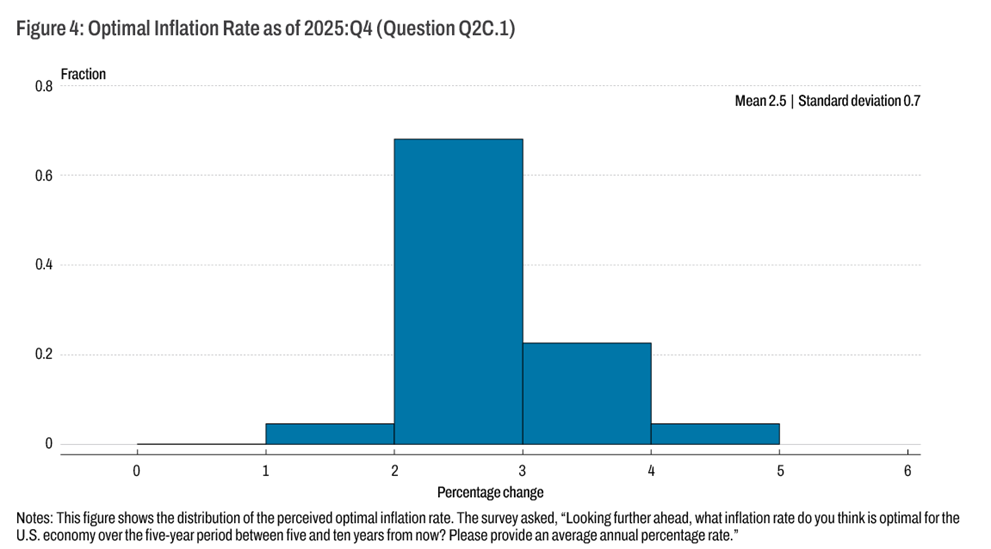
Figure 5 provides insights into firms’ views about economic conditions at the national level based on their expectations about growth in real (inflation-adjusted) GDP over the next 12 months. Importantly, the responses were collected in 2026:Q1 (January) and preceded the 2026 conflict in Iran and the subsequent surge in oil prices. On average, firms expected real GDP to grow at a robust pace of 3.2 percent. Over 40 percent of the growth expectations fell in the interval from 1 percent to 2 percent, while more than 30 percent of the growth expectations fell in the 2 percent to 3 percent range. Most of the remaining firms were anticipating even stronger growth, with a few responses noting growth expectations exceeding 5 percent. No firm believed that a decline in real GDP was on the horizon. By way of comparison, the Philadelphia Fed’s Survey of Professional Forecasters conducted in February 2026 showed that forecasters expected real GDP to expand 2.1 percent over the next 12 months, a slower pace than reflected in SoFIE.
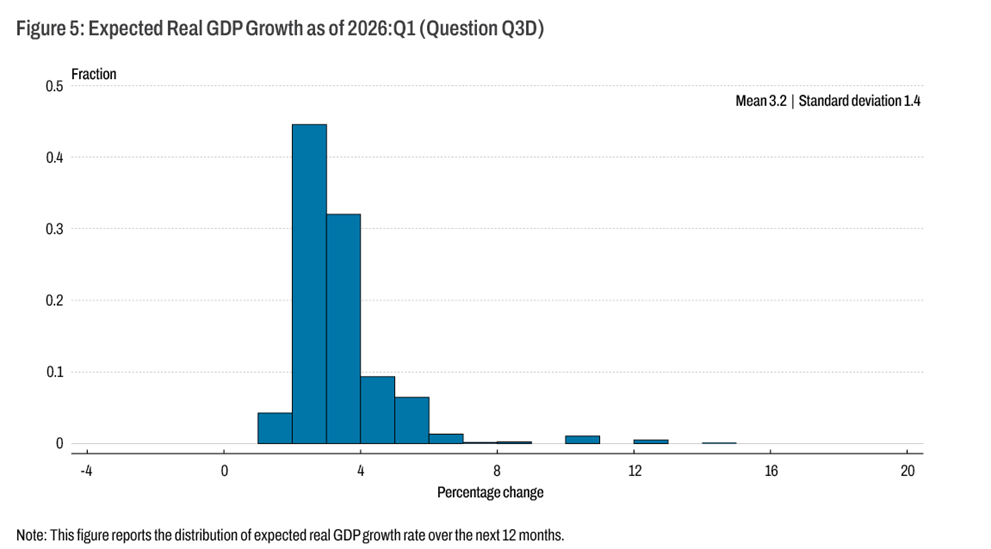
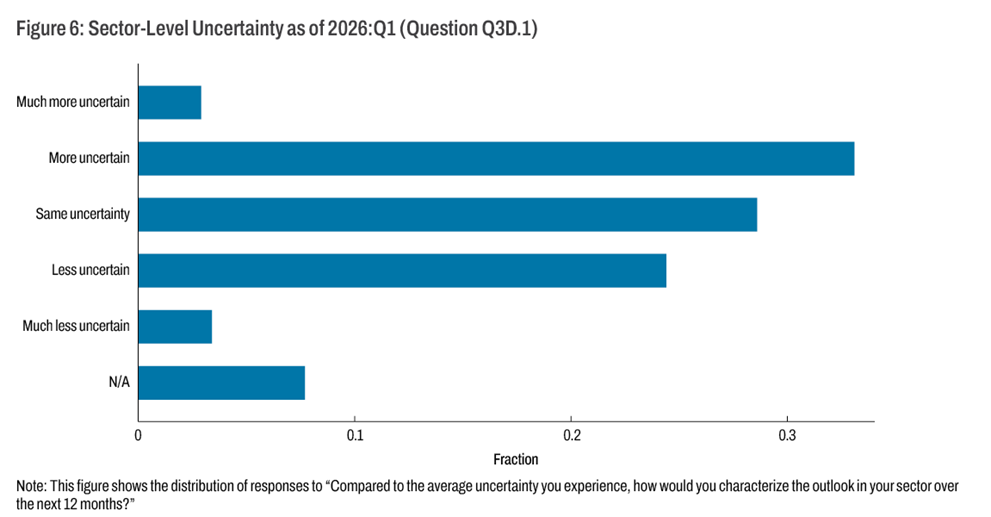
Figure 6 reports firms’ assessments of the uncertainty they will be facing in their sector over the next 12 months relative to the average uncertainty they experience. The degree of confidence that firms attach to the outlook in their sector is of particular interest. Research suggests that uncertainty plays a key role in economic and financial decision making, and heightened uncertainty can be especially problematic for firms’ long-term planning and capital-allocation decisions. By making it more difficult to evaluate investment opportunities, greater uncertainty can affect productivity growth, with long-run consequences for standards of living.
Based on responses collected in 2026:Q1 (January), we see that on balance there were more firms that indicated higher uncertainty than normal compared with lower uncertainty than normal. In particular, 33 percent of firms reported that they were now relatively more uncertain about the outlook in their sector, and this response was the most frequently selected among the six choices. However, 29 percent of firms indicated that the uncertainty attached to their current outlook was largely in line with what they have experienced on average in normal times.
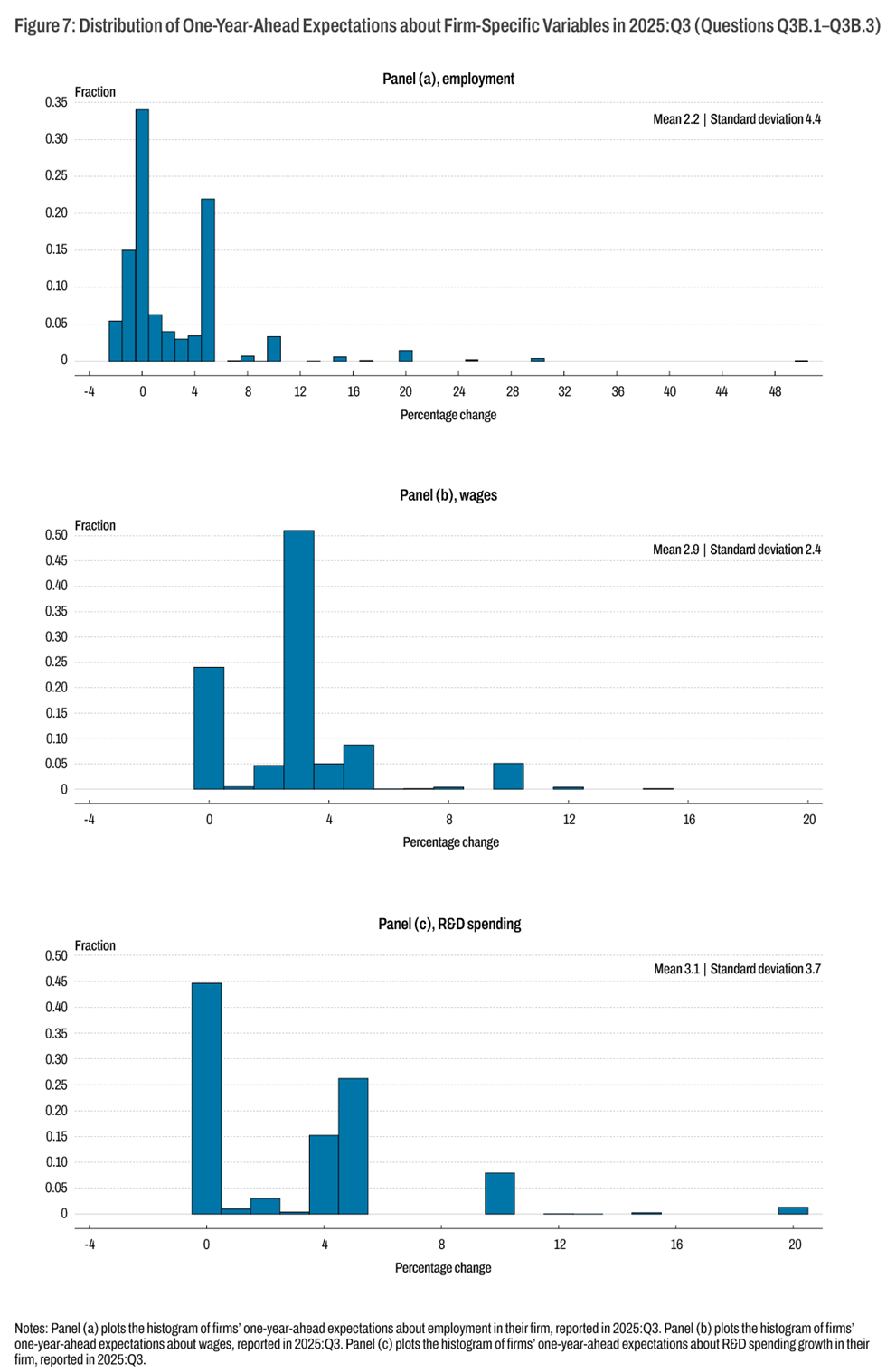
Finally, we examine firms’ expectations about their own economic conditions over the next 12 months in terms of prices, costs, employment, wages, and R&D spending. Firms’ expectations about their one-year-ahead employment, average wage growth, and R&D spending were collected in 2025:Q3, while their expectations about one-year-ahead average price growth and unit cost growth were collected in both 2025:Q4 and 2026:Q2.
Figure 7, panel (a) shows that, as of 2025:Q3, firms on average expected to increase employment by 2.2 percent in the next 12 months. While expectations about employment growth were positive on average, about 20 percent of firms expected to reduce their employment over this period, and 34 percent of firms anticipated no change in their future employment over the same period.
Figure 7, panel (b) shows that firms on average expected to increase their wages by 2.9 percent over the next 12 months. About half of firms expected to increase wages by 3 percent over the next 12 months. However, about a quarter of firms anticipated that they would not change the wages they paid their workers. No firm reported plans of cutting wages.4
Figure 7, panel (c) provides insights into firms’ planned R&D spending. Overall, firms expected to increase R&D spending by 3.1 percent in the next 12 months. However, spending plans varied greatly across firms. A little more than half of firms reported plans to expand their R&D spending, while a little less than half of firms indicated that they had no plans to increase their R&D spending. For those firms that did not plan to increase their R&D spending, this situation may have reflected elevated uncertainty surrounding the outlook for their sector, noted in Figure 6.
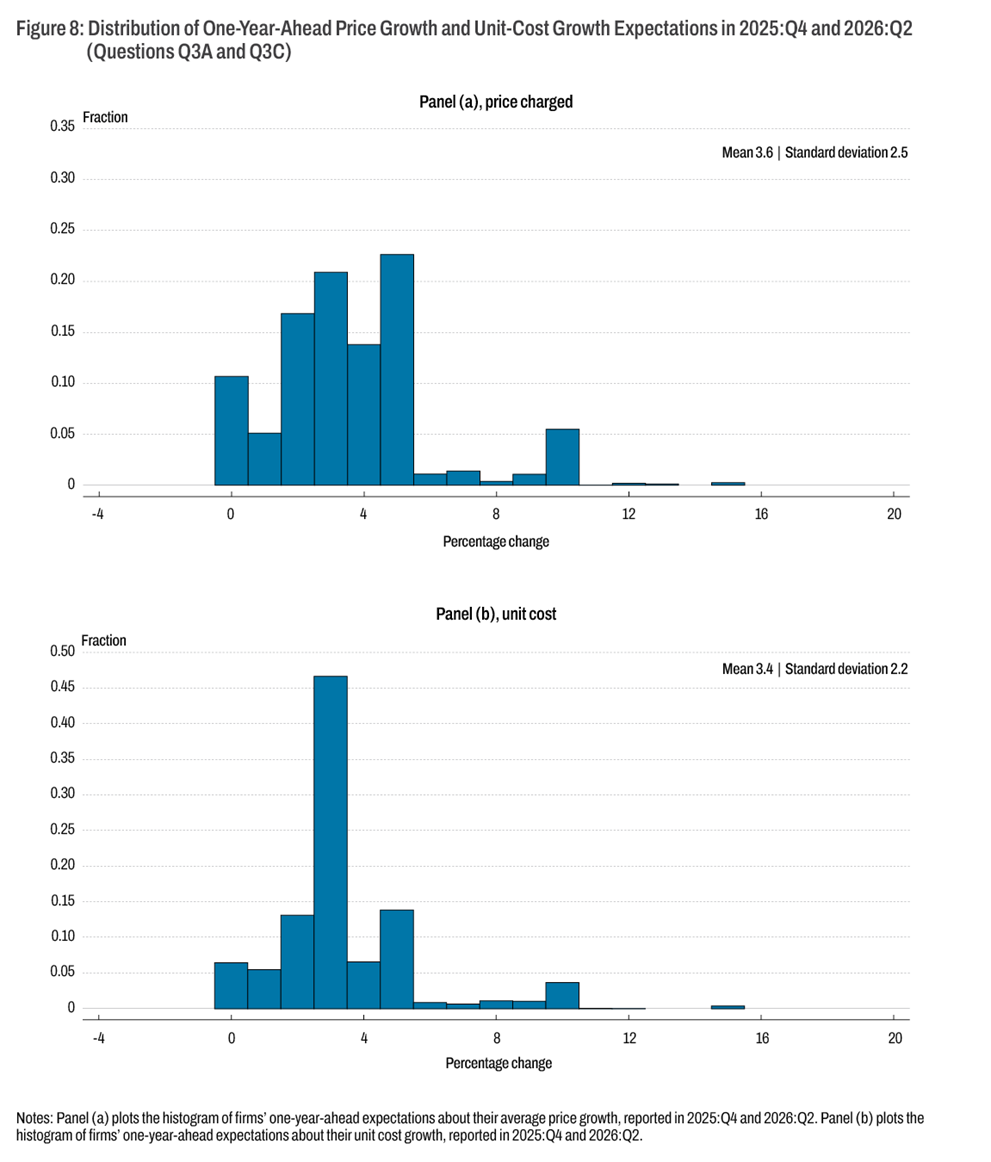
Figure 8 plots the distributions of firms’ one-year-ahead expectations for the growth rate of their average prices and average unit costs, combining the data reported in 2025:Q4 and 2026:Q2. Figure 8, panel (a) shows that firms’ expectations about their one-year-ahead price growth were, on average, 3.6 percent across these two quarters of data. No firm expected to lower its average price over the next 12 months. This finding is consistent with the fact that the share of actual price declines is typically much smaller than the share of actual price increases in the micropricing data (see, for instance, Montag and Villar, 2025). Moving to Figure 8, panel (b), firms’ one-year-ahead expectations about their unit cost growth were 3.4 percent. As with prices, no firm expected a decline in their future unit costs.
Similar questions about firms’ expectations for one-year-ahead price growth and unit cost growth can be found in the Atlanta Fed Business Inflation Expectations (BIE) survey. Note, however, that the SoFIE survey is nationally representative, while the BIE surveys firms only in the Sixth Federal Reserve District. Compared to the results documented in the BIE survey in November 2025, the average firm’s price growth expectations in SoFIE were 80 basis points higher, and the average firm’s unit cost growth expectations were 1 percentage point higher.5
Conclusion
This Economic Commentary introduces the new questions that were added to the Survey of Firms’ Inflation Expectations during 2025 and 2026. In addition to the original questions that focused on inflation expectations, these new questions asked firms about their confidence in the Federal Reserve’s achieving what they perceived to be the Fed’s inflation objective; the perceived optimal inflation rate; the probability of low inflation over the next year; expectations for prices, costs, employment, wages, R&D spending, and GDP growth; and beliefs about uncertainty within a firm’s sector. Going forward, answers to these questions will be reported on a quarterly basis and available at clefed.org/SoFIE.
References
- Afrouzi, Hassan, Alexander Dietrich, Kristian Myrseth, Romanos Priftis, and Raphael S. Schoenle. 2024. “Inflation Preferences.” Working Paper No. 32379. National Bureau of Economic Research. doi.org/10.3386/w32379.
- Candia, Bernardo, Olivier Coibion, and Yuriy Gorodnichenko. 2024. “The Inflation Expectations of US Firms: Evidence from a New Survey.” Journal of Monetary Economics 145(July): 103569. doi.org/10.1016/j.jmoneco.2024.103569.
- Cline, Alexander, Christian Garciga, Ina Hajdini, Timo Reinelt, and Robert W. Rich. 2026. “The (Re)Anchoring of US Firms’ Inflation Expectations.” Economic Commentary, forthcoming. Federal Reserve Bank of Cleveland.
- Fallick, Bruce C., Daniel Villar, and William Wascher. 2022. “Downward Nominal Wage Rigidity in the United States in Times of Economic Distress and Low Inflation.” Labour Economics 78(October): 102246. doi.org/10.1016/j.labeco.2022.102246.
- Garciga, Christian, Edward S. Knotek II, Mathieu Pedemonte, and Taylor Shiroff. 2023. “The Survey of Firms’ Inflation Expectations.” Economic Commentary, no. 2023-10 (May). Federal Reserve Bank of Cleveland. doi.org/10.26509/frbc-ec-202310.
- Hajdini, Ina, Edward S. Knotek II, John Leer, Mathieu Pedemonte, Robert W. Rich, and Raphael S. Schoenle. 2025. “Low Pass-Through from Inflation Expectations to Income Growth Expectations: Why People Dislike Inflation.” Inter-American Development Bank. doi.org/10.18235/0013365.
- Jain, Monica, Olena Kostyshyna, and Xu Zhang. 2024. “How Do People View Wage and Price Inflation?” Journal of Monetary Economics 145(July): 103552. doi.org/10.1016/j.jmoneco.2024.01.005.
- Montag, Hugh, and Daniel Villar. 2025. “Post-Pandemic Price Flexibility in the US: Evidence and Implications for Price Setting Models.” Finance and Economics Discussion Series, no. 2025-024 (March). doi.org/10.17016/feds.2025.024.
- Pfajfar, Damjan, and Fabian Winkler. 2025. “Households’ Preferences over Inflation and Monetary Policy Tradeoffs.” Working Paper No. 25-12. Federal Reserve Bank of Cleveland. doi.org/10.26509/frbc-wp-202512.
- Shiller, Robert J. 1997. “Why Do People Dislike Inflation?” In Reducing Inflation: Motivation and Strategy, edited by Christina D. Romer and David H. Romer. University of Chicago Press and National Bureau of Economic Research. nber.org/chapters/c8881.
- Stantcheva, Stefanie. 2024. “Why Do We Dislike Inflation?” Working Paper No. 32300. National Bureau of Economic Research. doi.org/10.3386/w32300.
Endnotes
- This probability is similar to the implied probability in the Survey of Professional Forecasters (SPF) for core CPI to be below 1.5 percent. In the SPF survey this probability can be calculated by adding the average individual probabilities for the four bins that capture core CPI inflation below 1.5 percent. Return to 1
- Shiller (1997) and Stantcheva (2024) discuss reasons for households’ aversion to inflation. Hajdini et al. (2025) and Jain, Kostyshyna, and Zhang (2024) present evidence of a labor market channel of why people dislike inflation. Return to 2
- Pfajfar and Winkler (2025) report a mean optimal inflation rate of 0.75 percent when consumers are asked for the optimal inflation rate for the American economy. When consumers are asked instead for the optimal inflation rate for them personally, the mean response is around 0 percent inflation or even slightly negative (see, for example, Afrouzi et al., 2024). Return to 3
- This result is consistent with the presence of downward wage rigidity; see, for instance, Fallick, Villar, and Wascher (2022) and references therein for a discussion of the evidence on downward wage rigidity in the United States. Return to 4
- We note that SoFIE collects responses during the first month of each quarter, whereas the BIE collects data on firms’ own price growth expectations every second month of each quarter. Return to 5
Suggested Citation
Candia, Bernardo, Ina Hajdini, Edward S. Knotek II, Damjan Pfajfar, and Robert W. Rich. 2026. “Expanding the Survey of Firms’ Inflation Expectations.” Federal Reserve Bank of Cleveland, Economic Commentary 2026-09. https://doi.org/10.26509/frbc-ec-202609
This work by Federal Reserve Bank of Cleveland is licensed under Creative Commons Attribution-NonCommercial 4.0 International


