

- Share
How Anchored Are Short-Run Inflation Expectations Today? A Look at What Consumers and Forecasters Are Telling Us
Policymakers emphasize the importance of “well-anchored” inflation expectations to ensure that price- and wage-setting behavior does not become entrenched in a high-inflation cycle, helping central banks to maintain price stability and achieve their inflation objectives. Motivated by concerns about trade tensions in the aftermath of high pandemic-era inflation, we examine the anchoring of consumers’ and professional forecasters’ one-year-ahead inflation expectations for evidence of recent weakening. While the inflation expectations of professional forecasters remain well-anchored, there has been a notable deterioration in consumers’ inflation expectations’ anchoring in 2025 comparable to that in the late 1970s.


The views authors express in Economic Commentary are theirs and not necessarily those of the Federal Reserve Bank of Cleveland or the Board of Governors of the Federal Reserve System. The series editor is Tasia Hane. This paper and its data are subject to revision; please visit clevelandfed.org for updates.
Introduction
The inflation expectations of households and businesses play a critical role in their consumption and investment decisions and in their price- and wage-setting behavior. Inflation expectations are also an object of considerable interest to policymakers. Inflation expectations are not only helpful to forecast inflation, but long-run inflation expectations also provide an indication of how credible the public finds a central bank’s commitment to achieving a stated inflation objective. In addition, economists and policymakers argue that “well-anchored” long-run inflation expectations—inflation expectations that are stable and consistent with an announced inflation objective—can help to attenuate the persistence of inflation in response to temporary shocks and, therefore, reduce the magnitude and duration of policy actions to maintain price stability.
There is wide acceptance among academics and central bankers that inflation expectations became unanchored during the 1970s. Because households and businesses based their decisions and behavior on shared beliefs of high and persistent inflation, the process of lowering inflation during the early 1980s was protracted and associated with substantial output losses and high unemployment rates. The experience of the 1970s and the importance of keeping inflation expectations well-anchored has proved to be a valuable and enduring lesson to policymakers. In response to recent trade and geopolitical developments, policymakers have continued to emphasize the importance of well-anchored inflation expectations, with some expressing concern that expectations might be less well-anchored today after high pandemic-era inflation, particularly the persistent and extremely elevated readings from 2021 through 2023:1
Near-term measures of inflation expectations have moved up, on balance, over the course of this year on news about tariffs, as reflected in both market-based and survey-based measures…. Our obligation is to keep longer-term inflation expectations well anchored and to prevent a one-time increase in the price level from becoming an ongoing inflation problem.
In this Economic Commentary, we examine one-year-ahead inflation expectations of consumers from the University of Michigan’s Surveys of Consumers (UMICH) and of professional forecasters from the Livingston Survey and the US Survey of Professional Forecasters (US-SPF).2 We apply a measure developed by Naggert, Rich, and Tracy (2023) to the survey series to determine if short-run inflation expectations’ anchoring has weakened recently.
While discussions of inflation expectations’ anchoring typically focus on survey responses at long-run horizons, we can gain important insights from an analysis at short-run horizons. Changes in short-run inflation expectations can have implications for the anchoring of long-run inflation expectations (Kumar et al., 2015). In addition, our data on short-run inflation expectations extend back to the 1960s and allow us to compare the degree of inflation expectations’ anchoring to that during the Great Inflation of the late 1970s, whereas there is an absence of such data for long-run inflation expectations. Hajdini (2023) and Jørgensen and Lansing (2025) also show that short-run inflation expectations are important for determining movements in inflation in Phillips curve models, with firmer anchoring allowing for greater efficacy of monetary policy.
We find that the inflation expectations of professional forecasters have largely remained well-anchored since the mid-1980s. While there was some deanchoring of professional forecasters’ inflation expectations during the pandemic era, it was far below that in the late 1970s, and their inflation expectations have subsequently reanchored. In contrast, the inflation expectations of consumers appear far from anchored throughout the sample period. Moreover, there are two episodes in which consumers’ degree of inflation expectations’ anchoring has been broadly comparable to that in the late 1970s. The first occurred during the pandemic era, and the second began in 2025. Regarding the latter, we find that the deterioration is related to recent results presented in Hajdini et al. (2025) indicating changes in UMICH respondents’ inflation expectations along their self-reported political affiliations. Specifically, the survey has witnessed a marked weakening in the inflation expectations’ anchoring of respondents identifying as a Democrat or Independent.
Measuring the Degree of Anchoring of Inflation Expectations
Despite its importance, no consensus has emerged on how to measure the anchoring of inflation expectations. The literature, however, has largely considered metrics that can be broadly classified into two categories, corresponding to “shock” anchoring and “level” anchoring.3 The first category captures the extent to which inflation expectations do not respond to shocks, while the second category captures the extent to which the properties of inflation expectations are consistent with a central bank’s inflation objective.4
Our analysis uses the following metric developed in Naggert, Rich, and Tracy (2023) to measure the anchoring of point forecasts of inflation at the individual level:
where denotes the inflation forecast of individual made at time for horizon , are the number of survey respondents at time , and denotes the inflation objective at time .
The measure in (1) falls into the level anchoring category, with increases (decreases) in the value denoting a weakening (strengthening) in inflation expectations’ anchoring. In addition to being intuitively appealing and easy to calculate, another attractive feature of (1) is that it affords the following decomposition:
where denotes the consensus (average) inflation expectation across the survey respondents.5
The two subcomponents in (2) each capture aspects of forecast behavior associated with expectations’ anchoring. The first subcomponent is the deviation (or distance) between the consensus forecast and the inflation objective, a misalignment term. The second subcomponent is the average deviation (or distance) of the individual inflation forecasts from consensus, a disagreement term. A key takeaway from (2) is that well-anchored inflation expectations extend beyond the condition that expectations are close, on average, to the inflation objective by also requiring that expectations are close to each other. The inclusion of both misalignment and disagreement terms in (2) is consistent with the discussion in Kumar et al. (2015) describing various operational characteristics associated with the anchoring of inflation expectations.6
The Inflation Expectations of Consumers and Professional Forecasters
Population segments vary in both their access to information and their familiarity with the types of information provided, leading to divergent inflation expectations. Because it is important to assess the robustness of results across different groups in the economy, we examine one-year-ahead inflation expectations of consumers from the UMICH and of professional forecasters from the Livingston Survey and the US-SPF. Respondents report their inflation expectations as point predictions, and the surveys provide data going back to the 1960s, allowing us to draw comparisons to the degree of inflation expectations’ anchoring in the late 1970s toward the end of the Great Inflation period.
The UMICH has been conducted monthly since January 1978 via telephone interviews (and now by web), drawing a nationally representative sample of usually 500 to 700 households. The UMICH elicits inflation expectations by asking about expected price changes over the next 12 months. While the official UMICH release reports a median, we trim the top and bottom 5 percent of the predictions from each cross-section to control for outliers.7 Between 1946 and 1976, the survey was fielded at a quarterly frequency and only with a qualitative question about respondents’ expectations for the direction of future price increases. Reis (2021) infers quantitative predictions from these data between 1966 and 1976, and we use his estimates of the mean during these earlier years in the UMICH.8
The Livingston Survey is a biannual survey (conducted in June and December of every year) of 10 to 50 economists in academia, business, and financial markets. Starting in 1946, respondents are asked to forecast the level of the consumer price index (CPI). These level forecasts are then converted into 12-month percentage changes using the latest value of the CPI available at the time of the survey. The US-SPF is a quarterly survey of 10 to 40 professionals working in research institutions and the financial services industry. The survey’s four-quarter-ahead CPI inflation forecasts start in only 1981:Q3. From the beginning of the SPF in 1968:Q4 to 1981:Q2, we apply an adjustment factor to convert four-quarter-ahead GDP deflator inflation forecasts at the individual level into CPI inflation forecasts.9
Figure 1 plots the one-year ahead inflation expectations from the UMICH, the Livingston Survey, and the US-SPF.10 The three series track each other very closely from the beginning of our sample period in the middle 1960s through the late 1990s. The measures steadily rise through the 1970s, peaking at values close to or above 10 percent in the late 1970s, before steadily declining during the next 20 years to around 2.5 percent by the late 1990s.
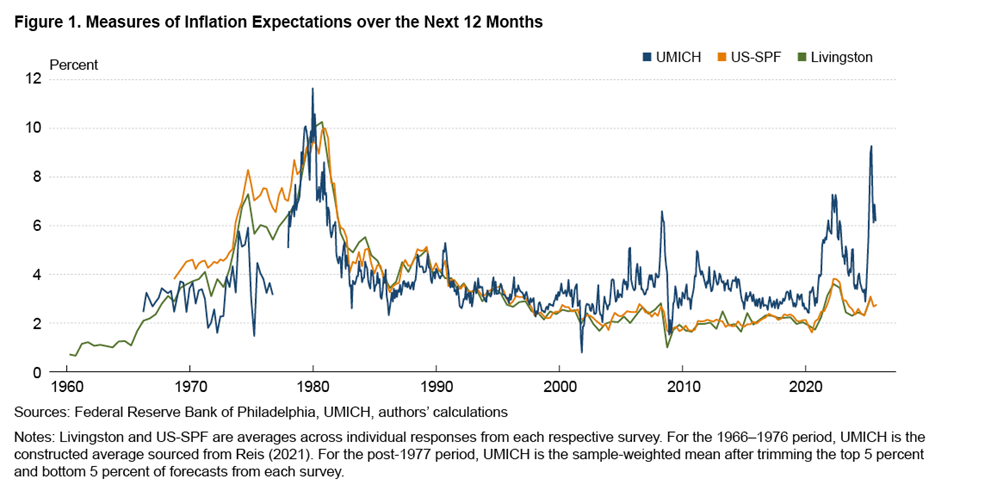
The remainder of the sample period, however, shows a marked divergence between the inflation expectations of professional forecasters and those of consumers. The Livingston Survey and US-SPF have been relatively stable, although they moved up during the pandemic era and remain somewhat elevated. In contrast, the UMICH increased during the 2000s and has remained notably above the Livingston Survey and US-SPF. Compared to the other two surveys, the UMICH showed a more dramatic rise during the pandemic era and has displayed occasional spikes that include one starting in 2025.
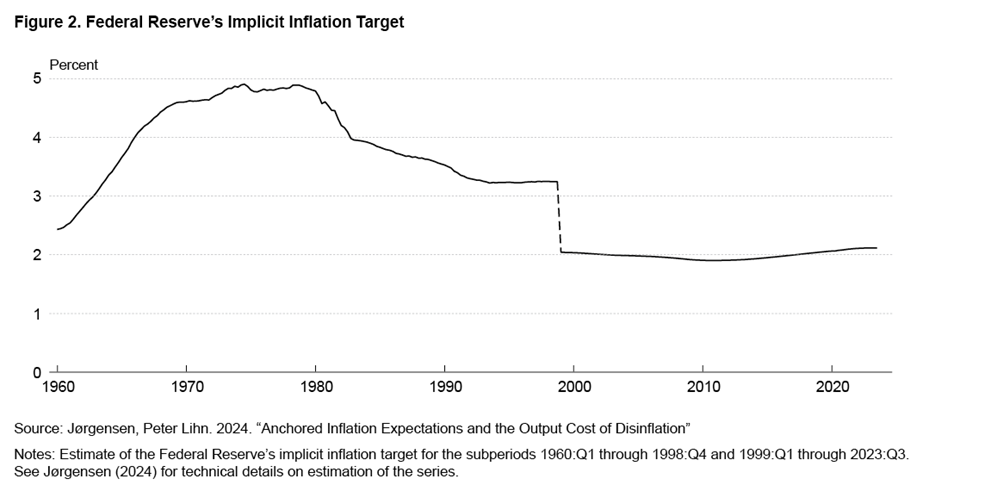
The calculation of the anchoring metric in (1) also requires data on the inflation objective, but explicit values are available starting in only January 2012, when the FOMC announced a 2 percent inflation objective.11 However, there are studies that provide estimates for the Federal Reserve’s inflation objective for the pre-2012 period. For example, Jørgensen (2024) develops a New Keynesian model in which individuals are unable to distinguish between temporary shocks to aggregate demand and aggregate supply and highly persistent shocks to the Federal Reserve’s inflation objective. While the principal focus of the study is on the relationship between inflation expectations’ anchoring and the cost of disinflations, a byproduct of the analysis is an estimated path of the Federal Reserve’s inflation objective since 1960.12
Figure 2 plots this estimated path from Jørgensen (2024) for the subperiods 1960:Q1 through 1998:Q4 and 1999:Q1 through 2023:Q3.13 There is a marked difference in the behavior of the series over the two subperiods. The estimated inflation objective was quite unstable during the first subperiod, with the series rising substantially throughout the 1960s and 1970s and then declining in the 1980s. In contrast, the estimated inflation objective was nearly constant at a value of 2 percent during the second subperiod. We use the estimated path of the Federal Reserve’s inflation objective from Jørgensen (2024) to calculate the pre-2012 values of the anchoring metric.
A Look at the Anchoring of Short-Run US Inflation Expectations
Figure 3 plots the anchoring measure from equation (1) for the one-year-ahead inflation expectations from the UMICH, the Livingston Survey, and the US-SPF. The graph displays several salient features. The qualitative behavior of the three anchoring series is remarkably similar during the 1970s and 1980s. The measures show a dramatic rise during the 1970s, with the Livingston Survey and the US-SPF reaching their highest recorded value during this episode, followed by a steady decline during the 1980s. The behavior of the measures is very consistent with the narrative that the 1970s witnessed an unanchoring of inflation expectations across all types of survey respondents.
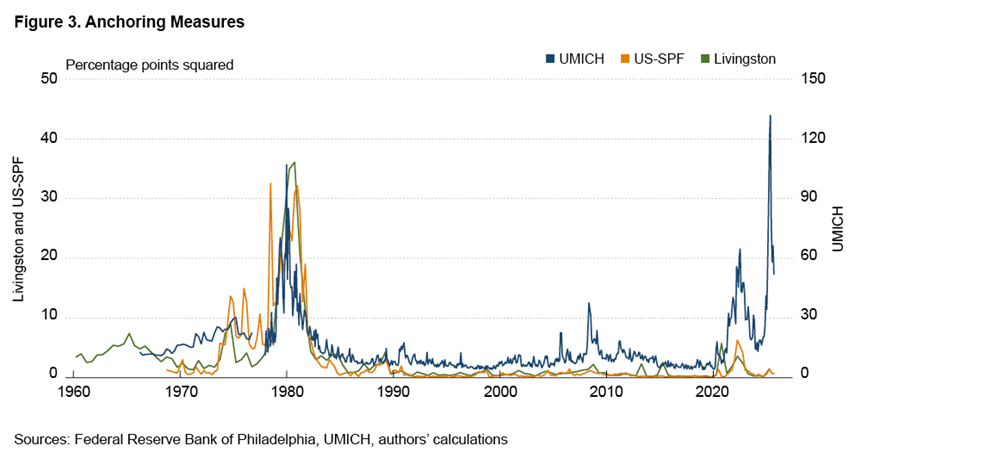
There are, however, notable differences in the anchoring measures of consumers and professional forecasters. One difference is that the scale for the UMICH is more than twice that of the Livingston Survey and the US-SPF, indicating that the anchoring of consumers’ inflation expectations is much weaker compared to that of professional forecasters.14 This finding might initially appear surprising for the pre-2000 period because the mean inflation expectations of consumers and professional forecasters as plotted in Figure 1 were broadly similar. However, the degree of anchoring depends on both the misalignment and the disagreement terms. The divergence in the anchoring measures of consumers and professional forecasters in the pre-2000 period is a consequence of consumers’ inflation forecasts displaying greater dispersion. This discussion serves as an important reminder that movements in the consensus forecast alone are not sufficient to gauge the degree of expectations’ anchoring.
A look at the behavior of the anchoring measures since 2020 reveals other differences. While the anchoring of inflation expectations for the Livingston Survey and the US-SPF weakened in the aftermath of the pandemic, the overall response was muted compared to that in the late 1970s, and expectations subsequently reanchored. In contrast, the degree of unanchoring of inflation expectations for the UMICH in the aftermath of the pandemic was similar to that in the late 1970s. Moreover, there is an additional episode starting in 2025 in which the extent of unanchoring has exceeded that in the late 1970s. Because of the markedly different behavior of the anchoring measure for the UMICH compared to the Livingston Survey and the US-SPF, the remainder of the discussion will focus on gaining a deeper understanding of the factors influencing its movements, with particular attention paid to the most recent episode.
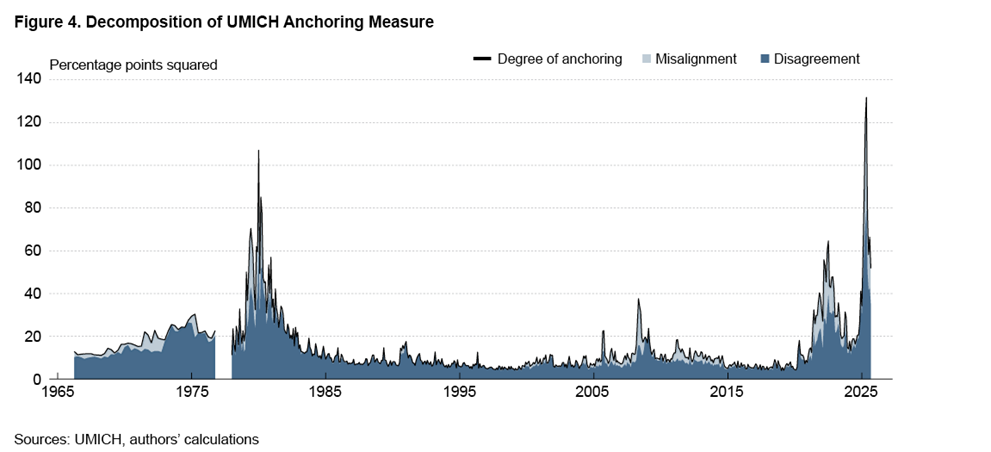
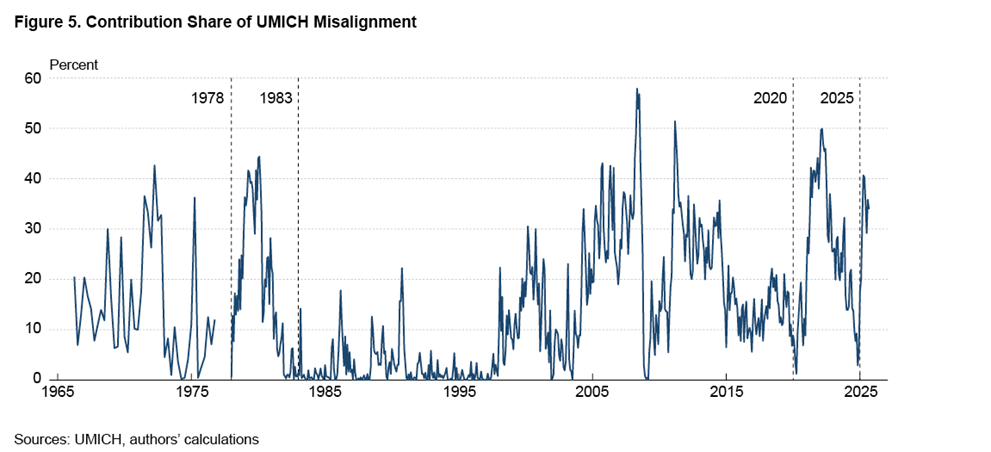
Figure 4 plots the UMICH anchoring measure and its two subcomponents: the misalignment between the consensus forecast and inflation objective and forecaster disagreement. A prominent feature of the data is that changes in the anchoring measure are principally driven by disagreement. This feature is evident from the anchoring measure’s movements largely coinciding with those of disagreement. However, when we look at episodes when there has been a sharp deterioration in anchoring, we see an enhanced role for the misalignment factor. This can be seen in Figure 5, which plots the share of the anchoring measure that is attributable to misalignment. While misalignment’s share tends to be low, it displays dramatic and sustained increases during episodes associated with a marked deterioration in the anchoring measure, such as in the late 1970s, the pandemic era, and more recently starting in 2025.
Self-Reported Political Affiliation and the Recent Unanchoring of Consumers’ Inflation Expectations
While the weaker anchoring of the UMICH inflation expectations in the late 1970s and early 2020s can be connected to specific well-known events,15 we now look to shed more light on this development in 2025. Hajdini et al. (2025) documented recent changes in the behavior of UMICH inflation expectations by self-reported political affiliation. As shown in the top panel of Figure 6, the average inflation expectations of respondents who identified as Democrat or as Independent has risen sharply, while the average inflation expectations of respondents who identified as Republican has instead retraced a decline from late 2024.
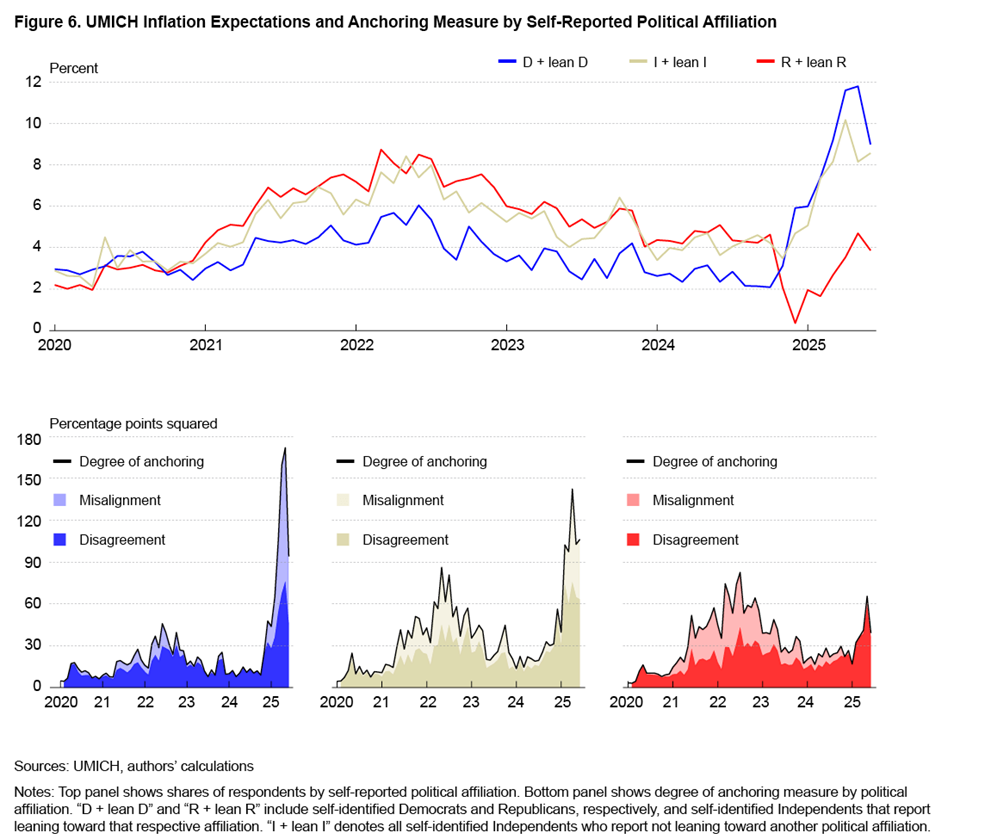
Another striking feature of the data is the divergent behavior of the anchoring measures across political affiliations. The bottom panel of Figure 6 shows that the anchoring measure for respondents identifying as Democrat or Independent weakened considerably starting in 2025. In contrast, the anchoring measure of respondents identifying as Republican showed a relatively more muted response during 2025. This divergent behavior is not related to forecast dispersion, since the level of within-group disagreement rose and was broadly similar for all three political affiliations. Rather, the divergence reflects a marked increase in the misalignment factor of respondents identifying as Democrat or Independent as their consensus forecasts increased and moved further above the inflation objective. The sharp rise in the anchoring metrics is consistent with our earlier results for the UMICH in which such episodes are characterized by greater disagreement and a significant contribution from the misalignment factor. While the consensus forecast for respondents who identify as Republican also moved above the inflation objective, the rise was much more modest and did not have a meaningful effect on the misalignment factor.
Taken together, the evidence in Figure 6 indicates that the recent and dramatic deterioration in the UMICH anchoring measure has largely resulted from changes in the behavior of inflation expectations across self-reported political affiliation and, specifically, with those of respondents identifying as Democrat or as Independent.16
Conclusion
This Economic Commentary examines short-run inflation forecasts from consumers and professional forecasters for recent evidence of weaker anchoring. Our sample period includes data from the late 1970s, a period which is widely regarded as an episode during which inflation expectations were unanchored. For professional forecasters, we find their inflation expectations have remained well-anchored during 2025. In contrast, there has been a dramatic deterioration in consumers’ inflation expectations’ anchoring during this same period, with the degree of unanchoring exceeding that in the late 1970s. Moreover, we demonstrate that this deterioration is linked to the self-reported political affiliation of survey respondents through changes in the distribution of their inflation expectations. Going forward, it will be of interest both to track movements in the aggregate UMICH anchoring metric and to extend our previous consideration of misalignment and disagreement to include demographic characteristics to monitor the effects of the composition of survey respondents.
References
- Armantier, Olivier, Argia Sbordone, Giorgio Topa, Wilbert van der Klaauw, and John C. Williams. 2022. “A New Approach to Assess Inflation Expectations Anchoring Using Strategic Surveys.” Journal of Monetary Economics 129(July): S82–S101. doi.org/10.1016/j.jmoneco.2022.05.002.
- Ball, Laurence, and Sandeep Mazumder. 2011. “Inflation Dynamics and the Great Recession.” Brookings Papers on Economic Activity 2011 (Spring): 337–381. doi.org/10.1353/eca.2011.0005.
- Ball, Laurence, and Sandeep Mazumder. 2019. “A Phillips Curve with Anchored Expectations and Short-Term Unemployment.” Journal of Money, Credit and Banking 51(1): 111–137. doi.org/10.1111/jmcb.12502.
- Bems, Rudolfs, Francesca Caselli, Francesco Grigoli, and Bertrand Gruss. 2021. “Expectations’ Anchoring and Inflation Persistence.” Journal of International Economics 132(September): 103516. doi.org/10.1016/j.jinteco.2021.103516.
- Bernanke, Ben S., Chairman. 2007. “Inflation Expectations and Inflation Forecasting.” Speech. Board of Governors of the Federal Reserve System. federalreserve.gov/newsevents/speech/bernanke20070710a.htm.
- Binder, Carola, Wesley Janson, and Randal Verbrugge. 2023. “Out of Bounds: Do SPF Respondents Have Anchored Inflation Expectations?” Journal of Money, Credit and Banking 55(2–3): 559–576. doi.org/10.1111/jmcb.12968.
- Board of Governors of the Federal Reserve System. 2012. “Federal Reserve Issues FOMC Statement of Longer-Run Goals and Policy Strategy.” Press Release. federalreserve.gov/newsevents/pressreleases/monetary20120125c.htm.
- Bundick, Brent, and A. Lee Smith. 2025. “Did the Federal Reserve Break the Phillips Curve? Theory and Evidence of Anchoring Inflation Expectations.” Review of Economics and Statistics 107(5): 1310–1326. doi.org/10.1162/rest_a_01357.
- Candia, Bernardo, Olivier Coibion, and Yuriy Gorodnichenko. 2023. “The Macroeconomic Expectations of Firms.” In Handbook of Economic Expectations, edited by Rüdiger Bachmann, Giorgio Topa, and Wilbert van der Klaauw. Academic Press. doi.org/10.1016/B978-0-12-822927-9.00018-5.
- Candia, Bernardo, Olivier Coibion, and Yuriy Gorodnichenko. 2024. “The Inflation Expectations of U.S. Firms: Evidence from a New Survey.” Journal of Monetary Economics 145(July): 103569. doi.org/10.1016/j.jmoneco.2024.103569.
- Clark, Todd, and Matthew Gordon. 2023. “The Impacts of Supply Chain Disruptions on Inflation.” Economic Commentary, no. 2023-08 (May). doi.org/10.26509/frbc-ec-202308.
- Hajdini, Ina. 2023. “Trend Inflation and Implications for the Phillips Curve.” Economic Commentary, no. 2023-07 (April). doi.org/10.26509/frbc-ec-202307.
- Hajdini, Ina, Edward S. Knotek II, John Leer, Mathieu Pedemonte, Damjan Pfajfar, Raphael S. Schoenle, and Taylor Shiroff. 2025. “Consumer Inflation Expectations Across Surveys and over Time.” Economic Commentary, no. 2025-07 (August). doi.org/10.26509/frbc-ec-202507.
- Hajdini, Ina, Edward S. Knotek II, John Leer, Mathieu Pedemonte, Robert W. Rich, and Raphael S. Schoenle. 2022. “Indirect Consumer Inflation Expectations.” Federal Reserve Bank of Cleveland, Economic Commentary 2022-03. doi.org/10.26509/frbc-ec-202203.
- Hajdini, Ina, Edward S. Knotek II, John Leer, Mathieu Pedemonte, Robert Rich, and Raphael Schoenle. 2024. “Indirect Consumer Inflation Expectations: Theory and Evidence.” Journal of Monetary Economics 145(July): 103568. doi.org/10.1016/j.jmoneco.2024.103568.
- Jørgensen, Peter Lihn. 2024. “Anchored Inflation Expectations and the Output Cost of Disinflation.” Working Paper. Department of Economics, Copenhagen Business School.
- Jørgensen, Peter Lihn, and Kevin J. Lansing. 2022. “Anchored Inflation Expectations and the Slope of the Phillips Curve.” Working Paper No. 2019-27. Federal Reserve Bank of San Francisco. doi.org/10.24148/wp2019-27.
- Jørgensen, Peter Lihn, and Kevin J. Lansing. 2025. “A Simple Measure of Anchoring for Short-Run Expected Inflation in FIRE Models.” Economics Letters 246(January): 112050. doi.org/10.1016/j.econlet.2024.112050.
- Kumar, Saten, Hassan Afrouzi, Olivier Coibion, and Yuriy Gorodnichenko. 2015. “Inflation Targeting Does Not Anchor Inflation Expectations: Evidence from Firms in New Zealand.” Brookings Papers on Economic Activity 2015(2): 151–225. doi.org/10.1353/eca.2015.0007.
- Mishkin, Frederic S. 2007. “Inflation Dynamics.” International Finance 10(3): 317–334. doi.org/10.1111/j.1468-2362.2007.00205.x.
- Naggert, Kristoph N., Robert W. Rich, and Joseph S. Tracy. 2023. “The Anchoring of US Inflation Expectations since 2012.” Economic Commentary, no. 2023-11 (July). doi.org/10.26509/frbc-ec-202311.
- Reis, Ricardo. 2021. “Losing the Inflation Anchor.” Brookings Papers on Economic Activity 2021 (Fall): 307–361. doi.org/10.1353/eca.2022.0004.
- “Transcript of Chair Powell’s Press Conference, July 30, 2025.” 2025. Board of Governors of the Federal Reserve System. federalreserve.gov/mediacenter/files/FOMCpresconf20250730.pdf.
- Williams, John C. 2006. “The Phillips Curve in an Era of Well-Anchored Inflation Expectations.” Working Paper. Federal Reserve Bank of San Francisco. frbsf.org/economic-research/wp-content/uploads/sites/4/Williams_Phillips_Curve.pdf.
Endnotes
- In this Economic Commentary, we use “pandemic era” and “pandemic” to refer to the period of the COVID-19 pandemic, generally spanning from late 2019 or early 2020 to May 2023. Return to 1
- The Livingston Survey and the US Survey of Professional Forecasters are currently fielded by the Federal Reserve Bank of Philadelphia. Return to 2
- There are other approaches to measure the degree of inflation expectations’ anchoring. Armantier et al. (2022) use strategic surveys, while Binder, Janson, and Verbrugge (2023) consider bounds anchoring at the individual level. Return to 3
- See Ball and Mazumder (2011) and Kumar et al. (2015) for a formalization of anchoring metrics. Return to 4
- See Naggert, Rich, and Tracy (2023) for the derivation. Return to 5
- Our focus is on measuring the extent of inflation expectations’ anchoring. Other studies have examined the effect of inflation expectations’ anchoring on various issues such as inflation persistence (Williams, 2006; Bernanke, 2007; Mishkin, 2007; Bems et al., 2021), the costs of disinflation (Jørgensen, 2024), and the slope of the Phillips curve (Ball and Mazumder, 2019; Jørgensen and Lansing, 2022; Bundick and Smith, 2025).
Return to 6 - Because outliers are a particularly prevalent feature of survey-based measures of consumers’ inflation expectations, statistical techniques such as reporting a median, trimming or winsorizing the data, or using robust estimation procedures are often used to manage their influence. Other surveys of consumers’ inflations expectations following these practices include the official UMICH survey releases, the New York Fed’s Survey of Consumer Expectations, the Indirect Consumer Inflation Expectations measure developed by researchers at the Cleveland Fed and Morning Consult (see Hajdini et al. 2022, 2024), and a daily consumer survey run by researchers at the Cleveland Fed. Return to 7
- The analysis in Reis (2021) ends in 1976. An early version of the current quantitative inflation expectations question in UMICH was fielded in 1977 at a quarterly frequency. However, we do not use responses from this earlier version of the question because the data are not readily accessible, and we instead allow for a short break in the series in 1977. Return to 8
- The adjustment factor is based on the average difference between the four-quarter changes in CPI inflation and GDP deflator inflation over this period and is equal to 0.84 percentage points. While four-quarter-ahead GDP deflator inflation forecasts are not directly available in the US-SPF, we infer these values as the difference between reported four-quarter-ahead forecasts of nominal GDP growth and real GDP growth. Return to 9
- The Livingston Survey and the US-SPF series are computed as an equal-weighted average, while the UMICH series incorporates the survey’s sample weights. Return to 10
- The announcement was part of the Federal Open Market Committee’s Statement of Longer-Run Goals and Policy Strategy released on January 25, 2012. See federalreserve.gov/newsevents/pressreleases/monetary20120125c.htm. Return to 11
- See Jørgensen (2024) for a more detailed discussion of the New Keynesian model and its estimation. We are grateful to Peter Jørgensen for providing these data to us. Return to 12
- Jørgensen (2024) splits the sample into these subperiods to account for a stronger anchoring of inflation expectations over time. Return to 13
- This result is consistent with results reported in Candia, Coibion, and Gorodnichenko (2023, 2024). Return to 14
- The weakening of inflation expectations’ anchoring in the late 1970s stemmed from multiple factors, including food- and oil-price shocks, accommodative monetary policy, and sustained fiscal deficits (Reis, 2021). The weakening in the early 2020s followed pandemic-related supply chain disruptions and demand surges (Clark and Gordon, 2023). Return to 15
- As noted in Hajdini et al. (2025), there has also been an important change in the political composition of UMICH survey respondents from the beginning of 2024 through the present. For our panel of respondents, the share identifying as Republican/Republican leaning has decreased from 40 percent to 30 percent, and the share identifying as Democrat/Democrat leaning has increased from 40 percent to 50 percent. We find that the political affiliation-driven weakening in inflation expectations’ anchoring would still occur even if changes in the composition of the survey followed national trends. Using Gallup polling as a reference, if the UMICH survey representatively sampled by self-reported political affiliation, then the anchoring metric’s recent peak would be only about 12 percent lower. Return to 16
Suggested Citation
Cline, Alexander, and Robert W. Rich. 2026. “How Anchored Are Short-Run Inflation Expectations Today? A Look at What Consumers and Forecasters Are Telling Us.” Federal Reserve Bank of Cleveland, Economic Commentary 2026-01. https://doi.org/10.26509/frbc-ec-202601
This work by Federal Reserve Bank of Cleveland is licensed under Creative Commons Attribution-NonCommercial 4.0 International



About Us
The Federal Reserve Bank of Cleveland (commonly known as the Cleveland Fed) is part of the Federal Reserve System, the central bank of the United States.