

- Share
SORCE Insights: The Relationship between Costs and Prices
Based on responses to the Cleveland Fed's Survey of Regional Conditions and Expectations (SORCE), this District Data Brief analyzes the relationship between expected changes in costs and prices among firms in the Fourth District, which covers Ohio, western Pennsylvania, eastern Kentucky, and the northern panhandle of West Virginia.


The views authors express in District Data Briefs are theirs and not necessarily those of the Federal Reserve Bank of Cleveland or the Board of Governors of the Federal Reserve System. The series editor is Harrison Markel.
Introduction
Researchers at the Federal Reserve Bank of Cleveland regularly survey business contacts about recent and expected near-term changes in their firms’ costs and prices as part of the Survey of Regional Conditions and Expectations (SORCE). Since 2021, periodic special questions added to the SORCE have extended the outlook horizon to 12 months and provided more detail about factors affecting firms’ pricing decisions. Recent District Data Briefs have explored how firms have navigated tariff-related uncertainty and responded to rising costs. We continue in this vein by analyzing the specific relationship between firms’ expected changes in costs and prices.
Firm Pricing Is about More than Costs
One way economists attempt to better understand inflation is to study how firms set prices. Researchers at the Cleveland, Atlanta, and New York Feds previously looked at firms’ price-setting behavior (Dogra et al., 2023), and here we update some of those results among our SORCE respondents based on questions asked during January 2026.
Basic economic theory would generally suggest that a profit-maximizing firm that faces an increase in input costs would, in turn, raise its selling prices. However, Fourth District SORCE respondents indicate that some other factors are at least as important as costs when setting prices and that firms may not necessarily pass 100 percent of their cost increases through to selling prices.
Figure 1 shows the average level of importance placed on different factors when firms make decisions about setting prices—a value of 1 indicates low importance, and a value of 5 indicates high importance. Among these factors, the strength of demand was assigned the highest average level of importance (4.3 out of a possible 5). Competitors’ prices (3.8) were also an important consideration. Lower on the list were factors reflecting input costs, namely, wages and labor costs (3.6) and nonlabor costs (3.5). Still, maintaining steady profit margins—which are inherently impacted by input costs—was assigned an average importance of 3.9.
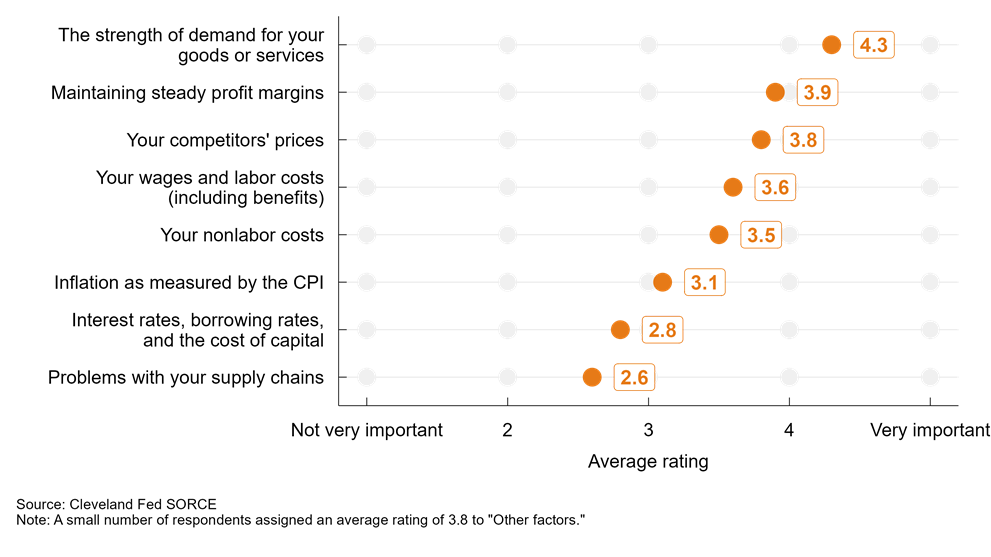
In recent conversations with some of the Bank’s Business Advisory Councils, participants indicated taking a two-pronged approach to maintaining steady profit margins when faced with rising costs: raising prices where possible (for example, on a subset of products or for new customers) alongside a strong focus on containing costs. On the latter point, some councilmembers noted pushing back on price increases from their suppliers, while others explored cost-cutting initiatives like upgrading to energy-efficient facilities and implementing automation and artificial intelligence.
Expectations for Price and Cost Growth Fell in January 2026
Figure 2 shows the means and medians of firms’ responses to the following question: “In percentage terms, by how much do you expect nonlabor costs to change over the next 12 months?”1 The red points indicate periods in which firms were asked about their overall costs rather than their nonlabor costs. In 2021 through early 2022, inflation in the overall economy was elevated, and firms expected relatively high cost growth. Expectations for cost growth slowed to a median of 5 percent in late 2022 and remained relatively stable through mid-2024 before falling slightly at the end of that year. In early 2025, as contacts noted that suppliers increased prices in anticipation of import tariffs, expectations for cost growth rose meaningfully. Since then, they have returned to a level closer to that reported between 2023 and 2025. Although firms continued to report tariff-related cost increases in recent months, some reported that tariff impacts had stabilized.
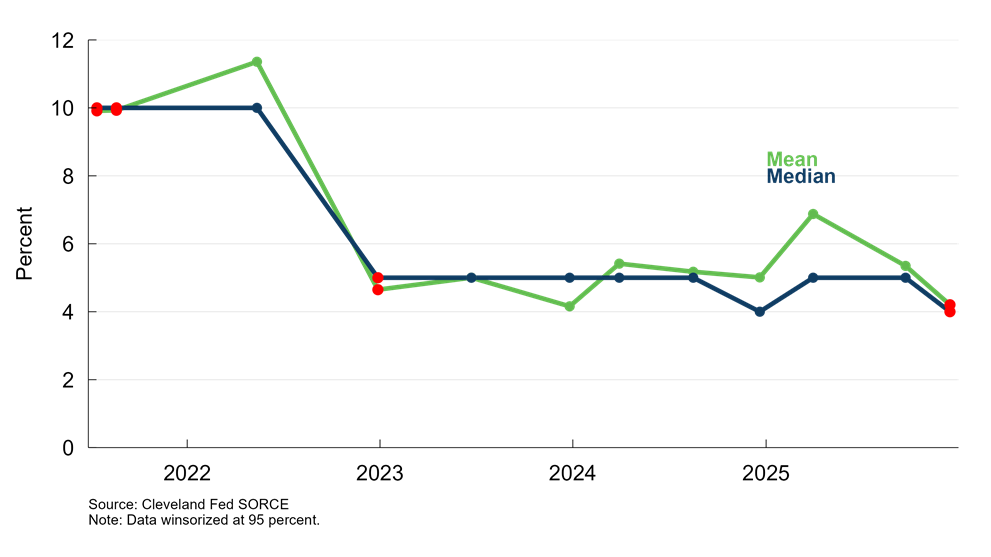
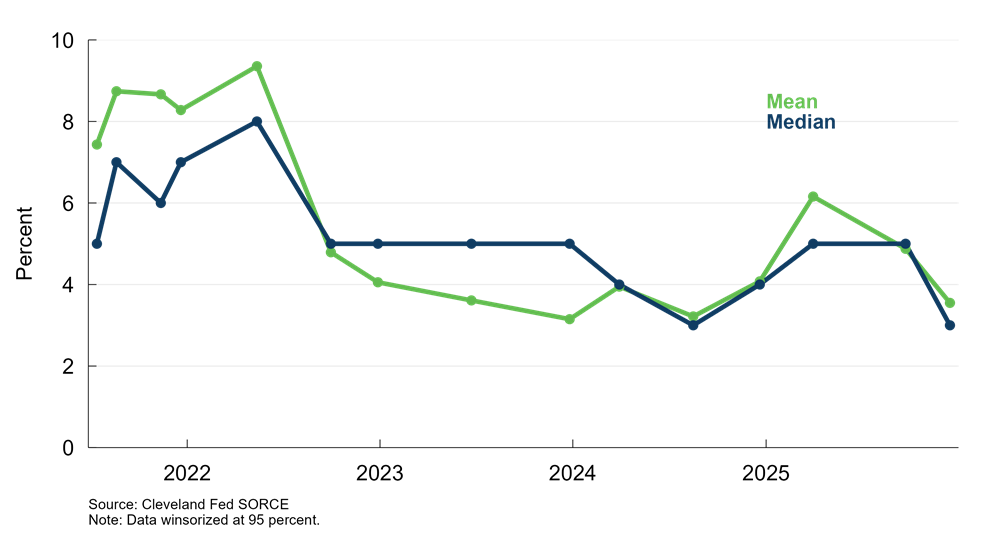
Figure 3 shows the corresponding means and medians of firms’ responses for expected price changes over the next 12 months. Firms expected relatively high and persistent price growth during the period of elevated inflation from 2021 through early 2022. As the rate of inflation slowed, respondents’ expectations for price growth drifted down, as well, and the median expectation reached a low of 3 percent in September 2024. Although price expectations rose again in early 2025, the median of respondents’ expectations returned to 3 percent in the January 2026 survey.
Firms Expect Price Increases to Cover Roughly Half of Cost Increases
Every survey round, we report nonlabor costs and prices diffusion indexes calculated using firms’ reports about changes during the eight weeks leading up to each survey. These indexes suggest that firms’ nonlabor costs have risen by more than their prices over the last year. The nonlabor costs index increased from 28 points at the end of 2024 to 49 points in January 2026, while the prices index increased from 22 points to 36 points over the same period.
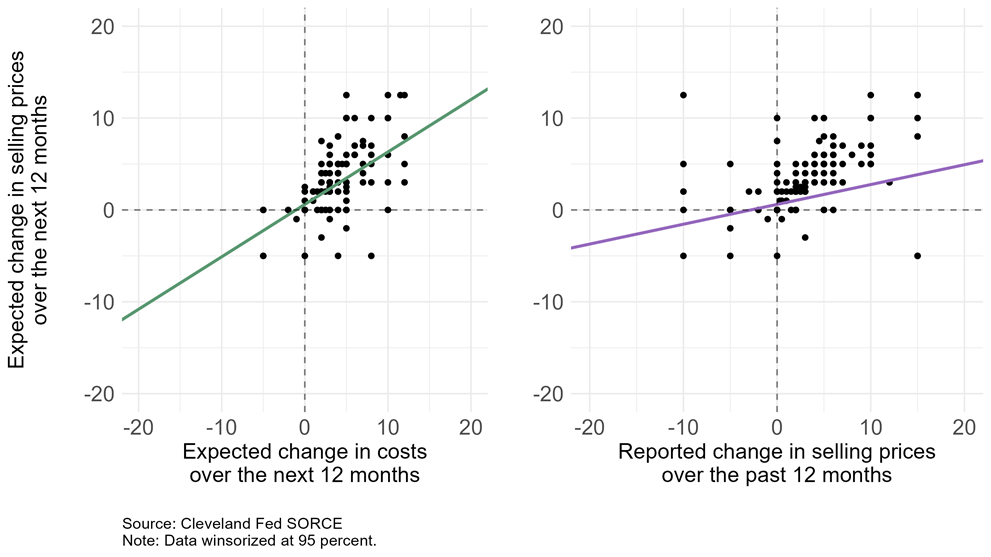
Figure 4 shows scatterplots of the relationships between firms’ expected 12-month changes in selling prices and both their expected 12-month changes in costs and their reported changes in selling prices over the past 12 months. Both scatterplots include regression lines illustrating the respective conditional relationships.2 The relationship between the expected change in prices over the next 12 months and the expected change in costs over the next 12 months (controlling for last year’s price and cost changes) suggests that for every 1 percentage point increase in their expected cost growth, firms expect that they will have an additional 0.6 percentage points of price growth (left panel). In other words, firms expect to pass through 60 percent of their expected cost increases in the year ahead, similar to estimates by Dogra et al. (2023) based on comparable data from a December 2022 and January 2023 survey. Additionally, the relationship between the expected change in prices and last year’s change in prices (controlling for expected cost increases and last year’s observed cost increases) suggests some inertia in price changes in that firms with larger price changes last year expect to increase prices by a greater amount this year (right panel). Specifically, firms expect their price growth to be 0.2 percentage points higher for every 1 percentage point of growth in their selling prices in the prior 12 months.
To further examine the nature of cost-to-price passthrough, we asked firms to imagine a hypothetical scenario in which their cost growth in 2026 ends up being 5 percentage points higher than they expected at the start of the year, and we then asked them what they expected would happen to their prices. The goal of this exercise is to obtain a causal estimate of firms’ cost-to-price passthrough rate. Under this scenario, respondents anticipated a median of 3 additional percentage points of price growth. Put differently, this result suggests a cost-to-price passthrough rate of 60 percent—if costs rise by 1 percent, firms will increase their selling prices by 0.6 percent—which aligns with the results we reported above and with prior research.
Conclusion
Firms’ expectations for cost and price growth rose sharply in early 2025 amid uncertainty about tariffs, but these expectations in early 2026 returned to levels similar to the postpandemic lows recorded from early 2023 through late 2024. Although dependent on several contributing factors, firms generally expect to pass through only 60 percent of the cost increases they anticipate in 2026 by raising prices. Given this limitation, some Fourth District contacts have also reported a strong focus on keeping their costs in check in various ways, including investment in new technologies.
The Cleveland Fed’s Research Department gathers and analyzes timely economic information from businesses and community contacts to inform our Beige Book contribution and to prepare for Federal Open Market Committee (FOMC) meetings. One way we obtain this information is through the Survey of Regional Conditions and Expectations (SORCE), a business conditions survey sent to firms across the Fourth District, which comprises Ohio, western Pennsylvania, eastern Kentucky, and the northern panhandle of West Virginia. The SORCE is administered eight times per year. In addition to the set of standard questions asked during each round of the survey, the Cleveland Fed routinely asks a set of “special questions” to explore timely issues that may be impacting businesses across the Fourth District. The SORCE Insights District Data Briefs share the results from the “special questions.” For more information on SORCE, visit https://clevelandfed.org/SORCE.
Footnotes
- To minimize the influence of extreme responses, the data in Figures 2–4 are winsorized at 95 percent. This means that values greater than the 97.5th percentile or less than the 2.5th percentile have been set equal to those respective limits, leaving the middle 95 percent of the data unadjusted. Return to 1
- The regression lines shown in Figure 4 represent the partial relationships from a multiple linear regression of firms' expected price growth rates on their expected cost growth rates, controlling for past-12-month growth rates in both costs and prices. The coefficients for cost growth expectations (0.57) and past-12-month price growth (0.22) are statistically significant, while the coefficient for past-12-month cost growth (−0.03) is not. The adjusted R-squared of 0.4 indicates that this model explains 40 percent of the variation in firms' expected price growth rates. Return to 2
References
- Dogra, Keshav, Sebastian Heise, Edward S. Knotek II, Brent Meyer, Robert W. Rich, Raphael S. Schoenle, Giorgio Topa, Wilbert van der Klaauw, and Wändi Bruine de Bruin. 2023. “Estimates of Cost-Price Passthrough from Business Survey Data.” Federal Reserve Bank of Cleveland, Working Paper No. 23-14. https://doi.org/10.26509/frbc-wp-202314
Suggested Citation
Dunn, Julianne, and Brett Huettner. 2026. “SORCE Insights: The Relationship between Costs and Prices.” Federal Reserve Bank of Cleveland, Cleveland Fed District Data Brief. https://doi.org/10.26509/frbc-ddb-20260623
This work by Federal Reserve Bank of Cleveland is licensed under Creative Commons Attribution-NonCommercial 4.0 International


Related resources

Survey of Regional Conditions and Expectations (SORCE)
SORCE indexes are based on our survey of business and community leaders and provide a timely summary of economic activity in our region, which includes all of Ohio and parts of Pennsylvania, Kentucky, and West Virginia. Released twice each quarter.

Regional Data, Analysis, and Engagement
Explore economic trends and the circumstances impacting the economy and diverse communities of the Federal Reserve’s Fourth District, which includes all of Ohio, western Pennsylvania, eastern Kentucky, and the northern panhandle of West Virginia.

About Us
The Federal Reserve Bank of Cleveland (commonly known as the Cleveland Fed) is part of the Federal Reserve System, the central bank of the United States.