

- Share
Beyond Investment: How CDFIs Support Community and Economic Development in Low- and Moderate-Income Areas
Community development financial institutions (CDFIs) support low- and moderate-income areas by providing not only investment, but also technical assistance, capacity building, financial coaching, and more. Drawing on transaction-level investment data and interviews with CDFI loan funds from across the Fourth Federal Reserve District, this report examines how these mission-driven organizations play a key role in community and economic development.

The views expressed in this report are those of the author(s) and are not necessarily those of the Federal Reserve Bank of Cleveland or the Board of Governors of the Federal Reserve System.
As a CDFI, we're like a woodpecker in a petrified forest . . . we gotta be persistent and patient.
Introduction
For years, practitioners in community development (CD) and economic development (EcD) have had different goals, with those in CD seeking to cultivate thriving neighborhoods and those in EcD looking to create jobs and boost economic output at the county or regional level (Hill, 2023). But these concepts are converging based on the understanding that (1) CD practitioners cannot help create vibrant spaces if people do not have jobs and (2) it can be difficult to attract and retain companies and workers for EcD if communities do not have quality-of-life amenities (Deller, 2021; Malizia and Chen, 2019; Malizia et al., 2021). Integrating the practices of CD and EcD can help promote both flourishing neighborhoods and economic vitality.
One key financing entity that is leveraged by those in both CD and EcD is the community development financial institution (CDFI). CDFIs are mission-driven lenders that provide financial products and services, investments, and technical assistance to low- and moderate-income (LMI) communities. This report investigates how CDFIs support CD and EcD in LMI neighborhoods across the Fourth Federal Reserve District.1, 2 Looking at only CDFI investments would not fully capture the contributions that CDFIs make to communities. Thus, this report analyzes data on CDFIs’ direct investment and explores through interviews how they support CD and EcD in other ways, such as activating private investment and providing technical assistance. To understand the complex role that CDFIs play in the financial ecosystem, 10 CDFIs were interviewed about how they work to facilitate CD and EcD in LMI communities and the challenges and opportunities they see in this space.
Key Definitions
Community development financial institutions (CDFIs): Mission-driven lenders including loan funds, credit unions, banks, holding companies, and venture capital firms.
Capital stack: The different types of funding—such as debt, equity, loans, and tax credits— used to finance development projects.
CDFI investments: Investments made by CDFIs in housing, businesses, and commercial real estate, among others.
Community development (CD): Activity undertaken to foster economic resilience and mobility of low- and moderate-income (LMI) people and communities.
Economic development (EcD): Activity that is intended to boost the economic prosperity of a region through business recruitment, attraction, and expansion in order to increase jobs, economic output, and wealth.
Overview of CDFIs
Before delving into the amount and type of investments made by CDFIs, it is helpful to first provide some background on CDFIs, explain why they were created, and discuss their presence in the Fourth District.3 CDFIs can take a variety of forms including loan funds, credit unions, banks, holding companies, and venture capital firms (Scott et al., 2023). CDFIs were created to overcome three main market challenges in LMI communities: a lack of financial services for consumers, limited access to affordable credit to buy or rehabilitate housing, and a shortage of capital for business development (Benjamin et al., 2004). Historically, commercial lenders engaged in credit rationing in LMI communities, and CDFIs can help overcome this problem by focusing on lending in these areas (Berry et al., 2007; Marquez, 2002).
Some of the conversations around CDFIs involve the mixed impact that their investments have on economic activity. One study finds that CDFI investments have little influence on new businesses (Harger et al., 2019). Another study finds that CDFI investments are strongly focused on distressed and underserved areas and that these investments are associated with business growth in the tracts that receive funding (Piazza and Schweitzer, 2026). A different study examines the credit trajectories of small businesses that receive loans from CDFIs and finds that these borrowers are able to improve their credit scores but that the owners’ consumer debt increases after the loan is received (Theodos et al., 2025). Literature outside of EcD acknowledges the social and community contributions that CDFIs make beyond their economic effects through qualitative research (Smith Loyas and Impact Seven, n.d.).
CDFIs in the Fourth District
As of May 2023, there were 1,487 certified CDFIs in the United States, with some states reporting more than 100 (California, Mississippi, and Louisiana) and others only one or two (Kansas, North Dakota, Nevada, Rhode Island, and Wyoming) (CDFI Fund, 2024b; Scott et al., 2023). There are 56 certified CDFIs in the Fourth District, including nine in Kentucky, 37 in Ohio, and 10 in Pennsylvania. These data may undercount the number of CDFIs in the District because larger national CDFIs that have branch offices here will often report only where their national headquarters is located. Notably, although no CDFIs are physically located in any Fourth District counties in West Virginia, CDFI investments are being made in this area.
Almost all the certified CDFIs in the Fourth District operate at the neighborhood, county, or regional level. By focusing on these areas, they can provide tailored investments to those seeking their services, including not only loans but also technical assistance and other types of support. CDFIs can help clients assemble a diversified capital stack—from loans to tax credits—for an EcD project by providing technical assistance and leveraging their relationships (Boyd and Van Dijk, 2022).
Table 1. Number of Certified CDFIs in the Fourth District by Type
| CDFI type | Kentucky | Ohio | Pennsylvania |
| Bank holding company | 0 | 1 | 0 |
| Credit union | 0 | 21 | 2 |
| Loan fund | 9 | 14 | 6 |
| Venture capital firm | 0 | 1 | 2 |
Source: CDFI Fund and author’s calculations
The Economic Contribution of CDFIs: What Do the Numbers Tell Us?
The CDFI Fund provides data on transaction-level CDFI investments. These investments are recorded in a variety of forms and can be categorized as investments in businesses, home purchases and improvement, housing development, and commercial real estate, among others. In this report, CDFI Fund data are combined with income and population metrics to assess these investments in LMI areas. Notably, there are limitations to these data because they include only CDFIs that received awards, not the universe of CDFI investment; these data provide insight into the CDFI market and should be taken as directionally informative. These data do not constitute the entire CDFI market. For more information on the data assembled, see About the Data.
In this sample (in 2025 dollars), CDFIs invested $51 billion throughout the United States in 2022 and $1 billion across the Fourth District. Roughly 32 percent ($17 billion) of investment in the United States and 45 percent ($457 million) of investment in the Fourth District were in LMI census tracts. Total CDFI investment from 2018 through 2022 showed an increase in the dollar amount and number of tracts receiving investment, which is consistent with recent research on the size of the CDFI market (Scott et al., 2023). From 2018 through 2022, there was a more than 593 percent increase in the number of census tracts that reported CDFI investment in the Fourth District (455 in 2018 versus 3,156 in 2022); this increase aligned with the growth in the overall dollar investment during this period (Table A1).
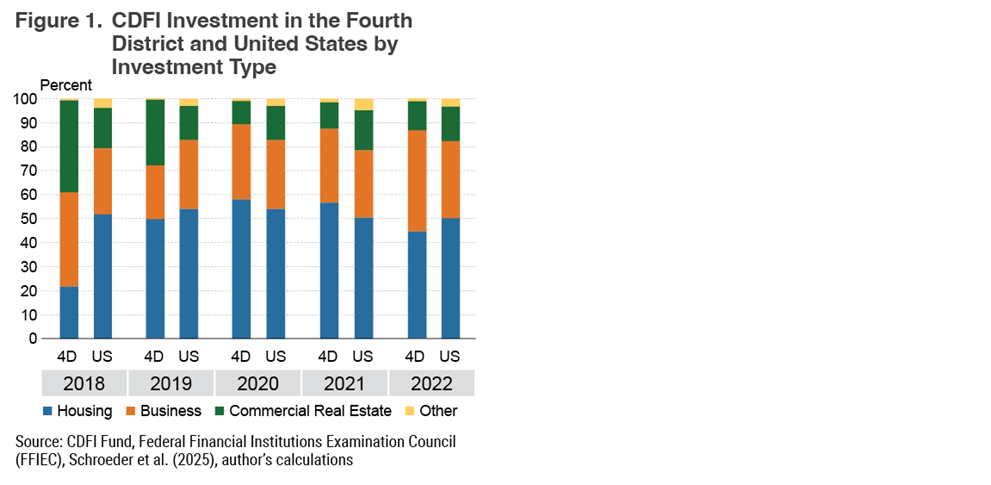
The largest portion of this investment in the Fourth District over the last five years has occurred in two major categories, housing and business (Figure 1), with investments in our District mirroring overall patterns across the nation.
The largest share of CDFI investment in our District in 2022 was in housing (45 percent; $452 million), including loans for home purchase, home improvement, and construction and rehabilitation of single- and multi-family homes. Business investments were the second-largest type of investment in 2022 (42 percent; $425 million). These investments are made to either for-profit or not-for-profit businesses for purposes unrelated to construction or rehabilitation of facilities.
A lot of people . . . sit around and talk about problems, and . . . don't really have vehicles to solve those problems . . . we [CDFIs] have the ability to kind of just move on things, move on projects.
CDFIs’ Broader Community Impact
To complement this report’s data analysis, 13 individuals from 10 CDFI loan funds4 in our District were interviewed to fully illuminate CDFIs’ role in the financial ecosystem. This section discusses how these lenders saw CDFIs’ activities and why they believed these activities support CD and EcD in LMI areas. Because each CDFI has a distinct mission and lending pattern, information from one CDFI is not representative of the overall industry. The CDFIs interviewed for this report ran the gamut from small microbusiness lenders to multimillion-dollar loan funds.
The interviews covered four main topics:5
- CDFIs’ role in the financial ecosystem
- The part they play in financing CD and EcD in LMI communities
- How CDFIs work with commercial banks and CD and EcD professionals
- The challenges and opportunities they see in the CDFI space going forward
These conversations revealed interesting subtleties regarding how CDFIs play a key role in EcD using a vast referral network of banks, EcD actors, and municipalities. Interviewees discussed how their mission-driven lending in LMI neighborhoods can contribute to the community and economic vitality of an area. Additionally, they highlighted the importance of technical assistance and capacity-building to the success of individuals, businesses, and projects. Interviewees also discussed challenges and opportunities in this space.
The missing piece of the puzzle: CDFIs as catalysts
CDFIs grew primarily out of the need to finance CD projects with a focus on combating poverty, building affordable housing, and stabilizing LMI communities (Greer and Gonzales, 2017). With legislation changes in the 1990s that created the CDFI Fund and revisions to the Community Reinvestment Act (CRA),6 CDFIs were able to increase their capitalization and gain traction in the CD and EcD space.
As one interviewee reflected on this history, they noted that, prior to the 1990s, CDFIs were considered the “middleman” when one applied for tax credits. But this interviewee noted that the perceived function of CDFIs changed as the landscape evolved:
“When the CDFI Fund was created . . . people started to see the value of . . . [what] nonprofit lending institutions can do, not just for housing, but for economic development.”
CDFI leaders reinforced the idea of combining EcD and CD to create economically vibrant LMI neighborhoods.
“CDFIs play a huge role in . . . community development, economic development. . . .” They continued, “And so, certainly, we can get into places and spur investment. Where others [traditional lenders] can't go. . . . Those [CDFIs that serve] small business . . . the microlenders . . . play a huge role in community. I think one of the things that we're seeing [is] . . . the merging of community development and economic development. . . .”
Interviewees were asked about how deals flowed between CDFIs, banks, EcD organizations, and real estate developers to gauge those relationships and interactions. Many CDFIs that engaged in larger EcD projects, whether it was real estate or affordable housing, found the process a fluid one that was forged in the relationships that they built.
“They [economic developers] know that they can call us, count on us . . . to help them. If they have a client that needs some financing, or needs another nonprofit to go seek funding from somewhere else . . . we can help with that.”
“I think being able to have a supportive resource [CDFIs] that can fund more economic development or support economic development, especially in neighborhoods . . . I think that that's where a lot of that primary role for CDFIs [has] been.”
Some interviewees discussed how their lending can help solve a community problem, no matter the size and scope.
“We make our loans to the businesspeople, be it a $5,000 loan to somebody with an idea . . . to putting together . . . a $3 million package for a medium-sized manufacturer in our service territory. So, it really runs the gamut for us.”
“Our role is to figure out what money is out there to solve a problem in a place, or for a family, and to take it from wherever that is . . . and make it accessible to a judge, a mayor, a community, a family.”
A lender of last resort
By offering more favorable terms such as lower collateral requirements, longer loan terms, and lower fees, CDFIs can provide capital in ways that the private market cannot. Additionally, CDFIs can “braid” their varied streams of public, private, and philanthropic dollars to assist in making loans where traditional banks do not (Getter, 2023). CDFIs are sometimes categorized as a lender of last resort because many businesses and developers turn to them when they cannot get traditional loans for projects in LMI areas. Their flexible underwriting allows them to take on riskier loans, and they can provide technical assistance to help shepherd applicants through this process.
When asked what deals would not have happened “but for” CDFI investment, many spoke to complicated deals involving a variety of stakeholders including EcD organizations, city officials, and private developers. One interviewee casually commented, “Dang near every project that we do is a but-for project, right?” Many loan-fund CDFIs could easily recount several projects that would not have happened were it not for CDFI investment. These projects included helping a nonprofit daycare purchase their building, transforming vacant buildings into affordable housing, and constructing a mixed-use development that included a much-needed grocery store in an LMI neighborhood.
Many interviewees discussed how CDFIs can make their loan terms more flexible by using a blended funding model of grants and loans. Some CDFIs recognized that this funding model allowed them to take a chance on entrepreneurs or finance deals that banks would not. Some described leveraging grants and foundation monies to achieve this goal.
“We can be a little more flexible . . . our leverage is really, really low, and all the money we have out . . . is either federal grant[s] or really low-interest loans that we've taken on.”
“But then also, it could be that we may need to provide grant sources, because . . . even as much as we want to do the deal, there's just some costs that can't be covered . . . because there's limited equity from the borrower. So, there's a lot of . . . additional support that happens behind the scenes that CDFIs do, particularly as it relates to investments.”
One lender discussed how structuring small-business loans could be difficult, even if they are small-dollar loans, as repayment schedules for these loans could be longer than the owner stays in business. Talking about a hypothetical restaurant deal, one respondent mentioned the following.
“If we're trying to stick to five years [of loan repayment], we can't do 10 years . . . [eight years is] the max that we can go, but you know I'm not getting my money back, right? Restaurants don't last that long, potentially, right?”
These CDFIs understood the balancing act of providing credit as a lender of last resort while upholding their fiduciary responsibility to their own organization.
CDFI interviewees discussed how commercial banks do not see them as competition but rather as complementing their work because these CDFIs are not depository institutions.7 There were conversations related to the referral network between commercial banks and CDFIs and how these banking relationships helped foster a more vibrant financial ecosystem.
“We're . . . a big part of that [financial] ecosystem. . . . We also fill a gap in expertise. I think we're kind of unique in that. Not only do we provide loans and investments, but we do a lot of consulting.”
The role of technical assistance and financial coaching
By far, the most discussed topic among interviewees was the importance of CDFIs in providing technical assistance or financial coaching to their clients, to EcD and CD professionals, and throughout the financial ecosystem. Several interviewees discussed how CDFIs can bring technical assistance to the table to make a deal happen.
CDFIs that directly financed businesses or small developers discussed how they walk their clients through the financing process. One interviewee mentioned how they spend weeks, even months, getting applicants financially ready even before a client submits a loan application; they recognized that these efforts are key to economic mobility.
“The biggest thing that we try to focus in on is getting people more capital ready.” They continued, “Our niche is talking about self-employment to business owners . . . moving into self-employment takes them out of poverty.”
CDFI technical assistance provides value beyond what is offered in traditional banking since, as one interviewee explained, a bank may require that “all of the i's have been dotted, the t's have been crossed, so that it can go directly into underwriting.” This “hand-holding,” they said, is a “differentiating factor for CDFIs” and an important step to facilitate development in LMI areas. Many CDFIs have a deep understanding of the needs of their community; one CDFI pointed out that their staff live in their investment communities and know the properties in their service area.
“We may take on that project and see it through at an earlier stage than perhaps a financial institution may . . . helping to fill out the capital stack, or find other sources to make the project pencil,8 and so, that's part of the TA [technical assistance] service delivery side of the CDFIs. . . .”
“We have been there next to them [small developers] from their very beginnings, when . . . they weren't bankable at all, and we were there to help provide capital to them to get started. And so, we've been with them the whole journey . . . they felt like there was comfort working with us.”
“They [national banks] . . . have some local presence here, but . . . their leadership isn't here, they're not involved in the day-to-day, they don't always know what's going on at City Hall. They don't know what the pulse of the neighborhood is the same way that we do, right? And so, that is an advantage to CDFIs that I think is really important.”
Technical assistance can extend beyond underwriting to enhance community capacity building. This support can be offered to various entities, including nonprofits, municipal governments, EcD organizations, and developers.
“Let's take advantage of that and try to spread our wings a little bit on the neighborhood development technical assistance . . . build capacity in the community development corporations.”
“Developers will come to us with an idea, and they'll say, gosh, if we're so crazy to do this, will it work? So, we'll often do their financial feasibility work for them, their market analysis, and underwriting. And so, we will put [those] full services together. Sometimes a city will come to us and say, do you think you can connect us with developers who might be willing to undertake this project?”
One interviewee discussed how their CDFI was involved in a complicated real estate finance deal that consisted of the CDFI acquiring the property, finding a primary lender, and using their expertise to apply for tax abatements and tax credits, all in order to get the project to the financing stage. This project added affordable apartments in an otherwise vacant and derelict building.
“The project was able to go to a financeable stage, and we converted that risky loan into a . . . less risky loan that bridged the historic tax credits. . . .” They continued, “This was more than just doing a transaction. This is almost . . . serving as [a] development consultant, city hand-holder, and everything else. And there's not another entity who would do that . . . other than a CDFI.”
Challenges and opportunities
Most of the themes that emerged regarding opportunities and challenges in the CDFI space were associated with capacity. Some of this was related directly to staffing capacity, while other comments were directed at the future of funding, capitalization, and CDFI business models.
Beyond this, some CDFIs discussed the precarity of their situation because, depending on the CDFI, their funding model can rely on external grants to make loans. Others said they operate through a social service model under which they provide extensive technical assistance and high-risk loans. Staffing capacity and shortages were also mentioned; these remarks are similar to what the Cleveland Fed has heard from a variety of nonprofits across our District (Klesta, 2025). One interviewee discussed having to explain to an employee that their position may not exist in the next year because of uncertainty around funding. Another participant indicated that because of the braided funding structure, it can be difficult to keep up with the administrative burden of tracking grants and reporting requirements.
Many interviewees discussed capital formation and looking beyond federal and CRA investments to strengthen their balance sheets. In tandem with diversification of capitalization, some interviewees discussed consolidation in the market, with mixed feelings. Many of these CDFI lenders were looking to diversify their product portfolio to best serve their clients and uphold their fiduciary responsibility. Some were looking to create new funds or products based on changing demand and to align with other funding streams.
“The CDFI model is more designed like a banking model than it is a development model.” They continued, “We're pushed to do the type of lending that financial institutions shy away from. But yet, we have to borrow to do it.”
“We have to keep broadening . . . our investor base, thinking about moving beyond CRA banks. . . . We need to just kind of think about how to go exponential with our balance sheet. . . .”
“We need to be thinking a lot differently about consolidation. We need to think a lot differently about where does capital formation come from.”
When a CDFI leader who focuses on microloans to startups was asked who else was lending in this space, they indicated that they could not think of any others. They mentioned that because many of the startups they lent to were in the service sector and served LMI areas, they were typically considered too risky for traditional banking. In this instance, this CDFI was truly a lender of last resort.
When interviewees were asked how current economic conditions were impacting their lending and deal flow, their responses varied depending on the type of financing they engaged in and the geography they served. Some saw an endless number of deals that could happen, but because of limited staffing and funding capacity, they were not able to meet demand. Others saw a slowing market due to uncertainty and increased costs in the industry. One interviewee indicated that many development deals are “upside down,” meaning that the costs of a project exceed its potential revenue or value, as a result of higher costs across the board—from development to construction. Beyond this, many CDFIs said their nonprofit clients had an unclear funding future based on federal and state policy changes, which could impact their ability to obtain loans. All of this makes CDFIs’ role more important in helping to secure funding for projects and in providing gap financing.
Conclusion
CDFIs have emerged as critical connectors in the financial ecosystem, bridging traditional lending and the unique needs of LMI communities. This report demonstrates that CDFIs contribute to CD and EcD not only through direct investments, but also as technical advisors, capacity builders, and catalysts for projects. The interviews with 10 CDFI loan funds reveal how these institutions often serve as lenders of last resort, offering flexible underwriting, long-term capital, and technical assistance that traditional institutions are often not able to provide. Interviewees described combining diverse funding sources, structuring complex deals with multiple stakeholders, and providing intensive support—from assisting microbusinesses in becoming capital-ready to helping develop major real estate projects.
Overall, while CDFIs face challenges related to capacity and uncertain funding, their expertise in securing resources and deep community knowledge make them key to advancing both CD and EcD in LMI neighborhoods.
Endnotes
- I would like to thank Robert Brinkley and Lisa Nelson for helping to organize and for participating in the CDFI interviews. Return to 1
- The Fourth District covers Ohio and parts of Pennsylvania, Kentucky, and West Virginia. Return to 2
- This report discusses only investments from certified CDFIs based on data from the CDFI Fund. It does not examine allocations from the New Markets Tax Credit Program, which is a federal tax credit program that is designed to encourage private investment in LMI communities. Return to 3
- Only loan funds were interviewed for this research because these actors are involved primarily in CD and EcD transactions that focus on business, real estate, and housing. Return to 4
- The interview protocol was structured around the four main themes listed. Semi-structured interviews were conducted virtually, recorded, and transcribed. These transcripts were then analyzed using an inductive technique to determine the main themes discussed in this report. Virtual interviews took place from September to December 2025. Return to 5
- The Community Reinvestment Act of 1977 was enacted to encourage banks to meet the credit needs of people in LMI communities in their service area (Board of Governors of the Federal Reserve System, 2025). Return to 6
- The CDFIs that were interviewed are not credit unions. Credit unions can be considered depository institutions. Return to 7
- Many developers and bankers refer to a project’s “penciling,” meaning turning a profit or breaking even. Before a project is started, developers create a pro forma analysis to see if the total costs needed to cover the development (for example, development, construction, and carrying costs) are less than the income that will be generated from the project. For more information on making a housing project “pencil,” see Garcia (2019). Return to 8
Appendix
Table A1. CDFI Investment in the Fourth District and United States by Year (US$ million; expressed in 2025 dollars)
| Low | Moderate | Middle | Upper | ||||||
| 2018 | 4D | $ | 61.1 | $ | 31.4 | $ | 42.9 | $ | 53.1 |
| % | 32.0 | % | 17.0 | % | 23.0 | % | 28.0 | ||
| US | $ | 1,758.8 | $ | 3,240.4 | $ | 4,458.8 | $ | 3,419.3 | |
| % | 14.0 | % | 25.0 | % | 35.0 | % | 27.0 | ||
| 2019 | 4D | $ | 48.3 | $ | 38.6 | $ | 108.2 | $ | 62.1 |
| % | 19.0 | % | 15.0 | % | 42.0 | % | 24.0 | ||
| US | $ | 1,680.2 | $ | 3,820.3 | $ | 5,990.6 | $ | 4,813.5 | |
| % | 10.0 | % | 23.0 | % | 37.0 | % | 30.0 | ||
| 2020 | 4D | $ | 97.5 | $ | 75.8 | $ | 151.5 | $ | 57.9 |
| % | 25.0 | % | 20.0 | % | 40.0 | % | 15.0 | ||
| US | $ | 2,344.6 | $ | 5,923.1 | $ | 10,853.3 | $ | 7,697.1 | |
| % | 9.0 | % | 22.0 | % | 40.0 | % | 29.0 | ||
| 2021 | 4D | $ | 123.8 | $ | 190.9 | $ | 226.5 | $ | 195.3 |
| % | 17.0 | % | 26.0 | % | 31.0 | % | 27.0 | ||
| US | $ | 2,253.9 | $ | 5,270.7 | $ | 9,839.7 | $ | 7,908.1 | |
| % | 9.0 | % | 21.0 | % | 39.0 | % | 31.0 | ||
| 2022 | 4D | $ | 209.1 | $ | 247.9 | $ | 333.8 | $ | 223.5 |
| % | 21.0 | % | 24.0 | % | 33.0 | % | 22.0 | ||
| US | $ | 4,834.9 | $ | 11,805.7 | $ | 19,452.1 | $ | 15,394.0 | |
| % | 9.0 | % | 23.0 | % | 38.0 | % | 30.0 | ||
Source: CDFI Fund, FFIEC, Schroeder et al. (2025), author's calculations
About the Data
There are a variety of ways that CDFI investment and activities can be counted as occurring in a target market. Target markets include areas with high unemployment, high poverty rates, LMI status, and locations within Empowerment Zones (CDFI Fund, 2025). Beyond this, CDFI investments and activities can also qualify if they create jobs in non-LMI tracts that benefit LMI people or if they create and retain businesses owned by LMI individuals, among others (for a full description of qualifying activities, see the Riegle Community Development and Regulatory Improvement Act of 1994). All of this may contribute to a higher percentage of investment being allocated to moderate- and upper-income tracts in this report.
The CDFI Fund provides data on transaction-level CDFI investments. Transactions are recorded as a loan, an equity investment, a line of credit, debt with equity, a loan guarantee, loan loss reserves, or capital reserves. However, it does not indicate if the transaction is funded by all or a portion of CDFI monies but instead only what is reported on the CDFI balance sheet. Data from the CDFI Fund are derived from the Transaction Level Report (TLR), which collects compliance data from award recipients. Thus, there is selection bias that occurs with the data because only CDFIs that are receiving grant funds from the CDFI Fund are included; the data do not include the universe of CDFI lending.
These investments and allocations are recorded in a variety of forms but can be categorized as investments in businesses, home purchases and improvement, housing development, and commercial real estate. This report does not include consumer loans made to individuals for health, education, emergency, credit repair, debt consolidation, or other purposes. However, if a consumer obtains a personal loan for a business, this would be categorized as a “business” purpose, similar to how taking out a loan to purchase or rehabilitate a property would be considered a “housing” purpose. Moreover, if an investment is recorded for the Fourth District, it is counted in that geography, no matter where the CDFI is headquartered.
For this report, data were aggregated by census tract and merged with data from the Federal Financial Institutions Examination Council (FFIEC), which provides income thresholds to identify LMI census tracts. Tracts qualify as low-income if the median family income (MFI) is less than 50 percent of the area MFI; moderate-income if the MFI is at least 50 percent but less than 80 percent of the area MFI; middle-income if the MFI is at least 80 percent but less than 120 percent of the area MFI; and upper-income if the MFI is at least 120 percent of the area MFI. The FFIEC data also contain information related to the percentage of minority residents in the tract. Data were harmonized to 2020 census tracts. The five-year 2018–2022 American Community Survey population data were used to calculate per capita investments for each tract; tracts with populations of less than 12 were removed to exclude outliers (Schroeder et al., 2025).
The initial sample included any census tract that received investment from 2018 to 2022, consisting of 79,066 census tracts nationwide and 4,205 in the Fourth District. Because of limited data availability, not all census tracts have income-level designations. Thus, the final sample used 56,912 census tracts nationally and 3,410 in the Fourth District.
References
- Benjamin, L., Rubin, J. S., and Zielenbach, S. 2004. Community Development Financial Institutions: Current Issues and Future Prospects. Journal of Urban Affairs 26 (2): 177–195. https://doi.org/10.1111/j.0735-2166.2004.00196.x.
- Berry, M., K. Moy, R. Newberger, and G. A. Ratliff. 2007. "The Evolving Roles of Mission-Focused Financial Intermediaries and Mainstream Financial Institutions in Community Development Finance." ProfitWise News and Views. Federal Reserve Bank of Chicago. https://www.chicagofed.org/publications/profitwise-news-and-views/2007/pnv-august2007.
- Board of Governors of the Federal Reserve System. 2025. " History of the CRA and Regulatory Actions." https://www.federalreserve.gov/consumerscommunities/cra_history.htm.
- Boyd, A. A., and C. Van Dijk. 2022. "An Overview of Community Development Financial Institutions." Consumer Compliance Outlook. Federal Reserve Banks. https://www.consumercomplianceoutlook.org/2022/first-issue/overview-of-community-development-financial-institutions/.
- CDFI Fund. 2021a. "2018 CDFI Program Awardee Data Release, Documentation and Instructions." US Department of the Treasury. Retrieved April 1, 2025. https://www.cdfifund.gov/documents/data-releases.
- CDFI Fund. 2021b. "2019 CDFI Program Awardee Data Release, Documentation and Instructions." US Department of the Treasury. Retrieved April 1, 2025. https://www.cdfifund.gov/documents/data-releases.
- CDFI Fund. 2022. "2020 CDFI Program Awardee Data Release, Documentation and Instructions." US Department of the Treasury. Retrieved April 1, 2025. https://www.cdfifund.gov/documents/data-releases.
- CDFI Fund. 2023. "2021 CDFI Program Awardee Data Release, Documentation and Instructions." US Department of the Treasury. Retrieved April 1, 2025. https://www.cdfifund.gov/documents/data-releases.
- CDFI Fund. 2024a. "2022 CDFI/NACA/CDFI RRP Program Award Recipient Data Release, Documentation, and Instructions." US Department of the Treasury. Retrieved April 1, 2025. https://www.cdfifund.gov/documents/data-releases.
- CDFI Fund. 2024b. "List of Certified CDFIs." US Department of the Treasury. Retrieved May 23, 2025. https://www.cdfifund.gov/sites/cdfi/files/2024-01/CDFI_Cert_List_01_10_2024_Final.xlsx.
- CDFI Fund. 2025. "Target Market: CDFI Certification Webinar." US Department of the Treasury. https://www.cdfifund.gov/system/files/2025-08/Target_Market_Webinar_Slides.pdf.
- Deller, S. 2021. "Are We in the 4th Wave of Economic Development?" The Review of Regional Studies 51(3): 233–46. https://doi.org/10.52324/001c.30813.
- Federal Financial Institutions Examination Council. 2024. "Census and Demographic Data." https://www.ffiec.gov/censusproducts.htm.
- Garcia, D. 2019. “Making It Pencil: The Math Behind Housing Development.” Turner Center for Housing Innovation. UC Berkeley. https://ternercenter.berkeley.edu/wp-content/uploads/pdfs/Making_It_Pencil_The_Math_Behind_Housing_Development.pdf.
- Getter, D. E. 2023. “Community Development Financial Institutions (CDFIs): Overview and Selected Issues.” Congressional Research Service Report No. R47217. https://www.congress.gov/crs-product/R47217.
- Greer, James L., and Oscar Gonzales. 2017. Community Economic Development in the United States: The CDFI Industry and America’s Distressed Communities. Palgrave Macmillan US. https://doi.org/10.1057/978-1-349-69810-3.
- Harger, K. R., A. Ross, and H. M. Stephens. 2019. "What Matters the Most for Economic Development? Evidence from the Community Development Financial Institutions Fund." Papers in Regional Science 98 (2): 883–905. https://doi.org/10.1111/pirs.12396.
- Hill, E. (Ned). 2023. "What Is Economic Development? And What Is the Job of an Economic Development Professional?" Economic Development Quarterly 37 (1): 34–48. https://doi.org/10.1177/08912424221147013.
- “H.R.3474 - 103rd Congress (1993-1994): Riegle Community Development and Regulatory Improvement Act of 1994.” Congress.gov. September 23, 1994. https://www.congress.gov/bill/103rd-congress/house-bill/3474/text.
- Klesta, M. 2025. "Community Issues and Insights 2025: Inflation Continues to Strain Households' Budgets." Federal Reserve Bank of Cleveland. https://doi.org/10.26509/frbc-cd-20250605.
- Malizia, E., and Y. Chen. 2019. "The Economic Growth and Development Outcomes Related to Vibrancy: An Empirical Analysis of Major Employment Centers in Large US Cities." Economic Development Quarterly 33 (4): 255–66. https://doi.org/10.1177/0891242419872803.
- Malizia, E., E. Feser, H. Renski, and J. Drucker. 2021. Understanding Local Economic Development. London: Routledge.
- Marquez, R. 2002. "Competition, Adverse Selection and Information Dispersion in the Banking Industry." Review of Financial Studies 15 (3): 901–26. https://doi.org/10.1093/rfs/15.3.901.
- Piazza, M., and M. Schweitzer. 2026. "The Growing Role of Community Development Finance in Economic Development." Economic Development Quarterly 40(1): 41-55. https://doi.org/10.1177/08912424251362127.
- Schroeder, J., D. Van Riper, S. Manson, K. Knowles, T. Kugler, F. Roberts, and S. Ruggles. 2025. “IPUMS National Historical Geographic Information System: Version 20.0 [dataset].” Minneapolis, MN: IPUMS. http://doi.org/10.18128/D050.V20.0.
- Scott, J., M. C. Recto, and J. Kivell. 2023. “Sizing the CDFI Market: Understanding Industry Growth.” Federal Reserve Bank of New York. https://www.newyorkfed.org/outreach-and-education/household-financial-stability/sizing-the-cdfi-market-understanding-industry-growth.
- Smith Loyas, C., and Impact Seven, Inc. n.d. "A Qualitative Model for the Evaluation of Community Development Financial Institutions." Community Development Innovation Review. Federal Reserve Bank of San Francisco.
- Theodos, B., McDaniel, N., and Hangen, E. 2025. “Credit Trajectories of Business Owners Who Receive Loans from Community Development Financial Institutions (CDFIs).” Urban Institute. https://www.urban.org/research/publication/credit-trajectories-business-owners-who-receive-loans-community-development.
Suggested Citation
Piazza, Merissa. 2026. “Beyond Investment: How CDFIs Support Community and Economic Development in Low- and Moderate-Income Areas.” Federal Reserve Bank of Cleveland, Community Development Reports. https://doi.org/10.26509/frbc-cd-20260414
This work by Federal Reserve Bank of Cleveland is licensed under Creative Commons Attribution-NonCommercial 4.0 International


Related resources

Community Development
Supporting low- and moderate-income communities in the Fourth District is a cornerstone of our mission at the Cleveland Fed. Find out how our Community Development team is promoting access to good jobs, housing, and credit for the residents within our district.

About Us
The Federal Reserve Bank of Cleveland (commonly known as the Cleveland Fed) is part of the Federal Reserve System, the central bank of the United States.