

- Share
Cross-Border Payments for Heartland Banks


Introduction
The payments industry generates $2.5 trillion in annual revenue globally, making it the most valuable component of financial services according to industry estimates. Cross-border payments specifically contributed about 4 percent of payment revenue at banks in North America, representing a relatively small but material slice of overall financial service revenues (McKinsey, 2025). End users, meanwhile, regularly transact across the border. For example, Visa found that 30 percent of consumers worldwide make weekly cross-border ecommerce purchases and that 45 percent send remittances monthly (Corporate Visa, 2024). It would follow, then, that a financial institution seeking to offer a comprehensive suite of payment services to a broad base of customers may need to provide a cross-border payment capability. The purpose of this brief is to explore the extent of cross-border payment activity and the options available to US financial institutions to process these payments, including the thousands of domestically focused institutions for which cross-border payments represent a small component of their business.1
Background
Correspondent banking is commonly used for bank-account-based cross-border funds transfers. Domestically focused banks in the United States can process a cross-border payment through a global correspondent bank that maintains a network of account relationships with banks located around the globe. To process an outgoing cross-border payment, the correspondent bank will typically debit the sender account (the originator of the payment or its bank) and credit a receiver account (the beneficiary of the payment, its bank, or an intermediary bank) on the correspondent’s books. In cases in which the beneficiary or its bank does not maintain an account directly with the correspondent bank, the correspondent will credit (or pay through a domestic payments system) an intermediary bank that it believes does maintain such an account for the beneficiary or its bank. This protocol can create a funds transfer that must go through a chain of banks, each potentially located in a different jurisdiction and each responsible for settling its leg of the transfer in compliance with local law before it orders the next party in the chain to do the same. The result can be a slow, expensive, and opaque sequential process wherein fees may be deducted by, delays may be introduced by, and current status may not be visible to each bank in the chain. Figure 1 provides an example of a traditional correspondent banking routing path.
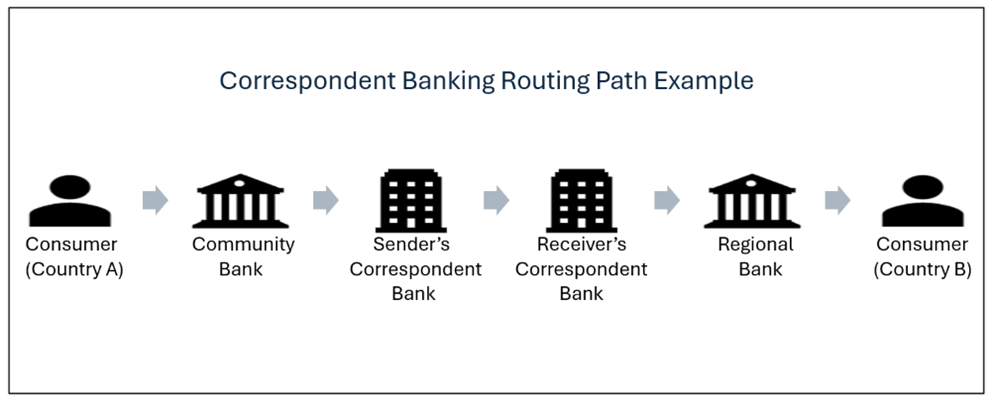
This prevailing model for cross-border funds transfers likely contributes to industry sentiment that cross-border payments are slow, often taking several days to clear and settle. They are expensive, often resulting in fees amounting to 5 percent or 10 percent of the value transferred. They are complex, because of reliance on fragmented correspondent banking chains and disparate international regulations (Payments Intelligence, 2026).
It has been historically difficult for new players to enter as global correspondent banks because of the high cost and compliance risk associated with building a global network of correspondent banking relationships. As a result, there are relatively few global correspondent banks that can provide a cross-border payment service to US-based community banks, regional banks, credit unions, and their customers. This situation has limited the choices available to the thousands of domestically focused financial institutions in the United States that may want to offer a cross-border payment capability (Rice et al, 2020).
In recognition of the challenges facing cross-border payments, G20 leaders endorsed the Roadmap for Enhancing Cross-Border Payments in 2020 and subsequently endorsed a set of quantitative targets related to cost, speed, access, and transparency, the majority of which targets are to be achieved by 2027. To help the industry achieve them, various priority actions were identified and organized into three themes: payments system interoperability and extension; legal, regulatory and supervisory frameworks; and data exchange and message standards. Some of the efforts underway across the globe to address these themes include the migration to the ISO 20022 messaging standard, extension of real-time gross settlement payment system operating hours, and the interlinking of domestic fast payments systems (Financial Stability Board, 2025).
The Federal Reserve is also working to improve its domestic infrastructure that supports international payments by adopting globally compatible message formats such as the ISO 20022 format for the Fedwire® Funds Service, implemented in July 2025. Additionally, the Federal Reserve announced the expansion of the operating days for Fedwire Funds and National Settlement to include Sundays and weekday holidays, with implementation in several years, though no earlier than 2028, to ensure operational and industry readiness (Board of Governors of the Federal Reserve System, 2025). Expanded US payments system hours will increase the overlap with foreign market operating hours, thus expanding the time window to transact between entities operating during these hours.
Heartland Banks
There are numerous experiments, pilots, and proofs of concept underway across the globe to explore new approaches to improve cross-border payments and advance the G20 roadmap. Globally focused banks and institutions are very active in these efforts. Indeed, globally focused institutions represent the majority of participants in a variety of cross-border payments pilots and experiments, and large banks are more actively exploring on-chain technology for various use cases, including cross-border payments, compared to smaller banks and credit unions2 (Gargano, 2026).
We define “global banks” as those that have a presence in multiple countries around the globe directly or via correspondent relationships with local banks. We define “global institutions” to include alternative entities such as central banks, global payments or messaging networks, closed-loop payment companies, and supra-national organizations that participate in the global conversation on improving cross-border payments.
We will refer to the remaining US community banks, credit unions, regional banks, and domestically focused national banks as “heartland banks.” Heartland banks tend not to participate in these global projects and are therefore largely underrepresented in the global conversation on cross-border payments, despite that most of these banks routinely process cross-border payments on behalf of their customers. To better understand the significance of this absence, it is useful to quantify the extent of heartland bank activity in transacting cross-border payments.
While there are limited data about total heartland bank cross-border payment activity, Fedwire provides a useful window into US dollar (USD) funds transfer activity, a portion of which is in support of cross-border payments.3 There are approximately 9,000 Fedwire-eligible institutions in the United States, with about 4,500 banks insured by the FDIC (Federal Deposit Insurance Corporation), plus roughly 4,400 federally insured credit unions. About one-half of these Fedwire-eligible institutions access Fedwire directly, while the remainder access it through a domestic correspondent bank and are therefore captured in the data below only through their domestic correspondent’s Fedwire activity. Using cross-border Fedwire send and receive volume for the month of May 2025, we segmented Fedwire participants into global banks and heartland banks. Global banks for this purpose include US branches and agencies of foreign banks in addition to US banks that have a direct or indirect global presence via a broad international network of correspondent relationships. Heartland banks for this purpose are defined as all other Fedwire participants. Heartland banks encompass the subsegments of community, regional, and national banks, also displayed in Figure 2.4 In May 2025, there were roughly 4,500 heartland banks and 100 global banks participating in Fedwire.
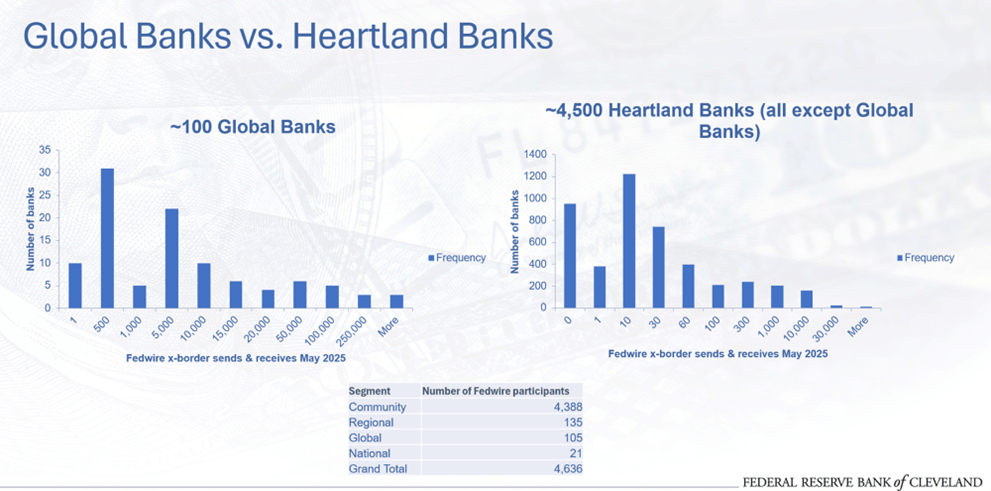
A key distinction between these two groups is that global banks tend to maintain direct correspondent banking relationships with foreign entities. Heartland banks, on the other hand, typically can reach international destinations only indirectly via a Fedwire transfer to or from one of the global banks that act as service providers with cross-border reach through their correspondent bank networks.
Figure 2 illustrates that most Fedwire participants are heartland banks with relatively low but still measurable cross-border funds transfer activity every month. Indeed, roughly two-thirds (about 3,000) of Fedwire participants processed between one and 100 cross-border transfers during the month. These institutions may not have the scale to invest heavily in improving their cross-border payment capability, but it is plausible that they do have an interest in providing more effective cross-border payments services to their customers. The figure also illustrates that there are approximately 1,000 Fedwire participants with no cross-border activity. Some of these banks may be transacting cross-border payments through a mechanism other than their direct participation in Fedwire, but others may be turning away their customers who seek to pay across the border and might introduce a cross-border payments service if there were one that improved on the current model.
Approaches | Solutions for Enabling Cross-Border Payments
There are many cross-border payments solutions in the market today, including both established solutions and newer ones. Correspondent banking is a common, established approach for bank-account-based cross-border transfers, as described previously.
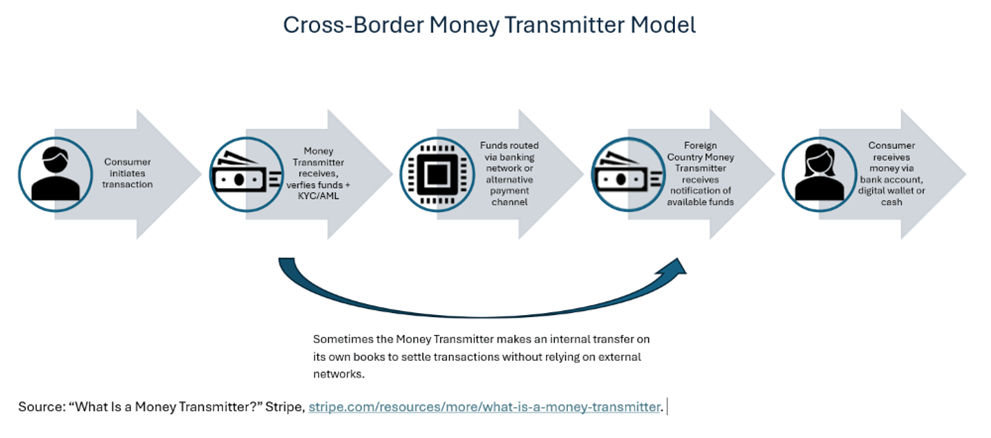
Money transmission is an established nonbank alternative to the global correspondent bank method. Money transmitters provide services to facilitate the transfer of funds from one person or entity to another, both domestically and internationally. Money transmitters such as Western Union, MoneyGram, Wise, and PayPal may specialize in in-person or digitally initiated cross-border payments. The corridors served by each of these services, the fees charged, and the timing required vary by use case and provider. Money transmitters sometimes require users or intermediaries on both sides of the transaction to establish or maintain a relationship with them, allowing for an internal transfer on the money transmitter’s books. Low-cost domestic payments mechanisms on each side of the transaction allow the money to come from or arrive at the end user’s preferred account or wallet. This approach can avoid the cost of using international correspondent banking services, but it introduces an alternative fee taken by the money transmitter. As an alternative to providing cross-border transfers through a global correspondent bank, depository institutions can partner with money transmitters to make it easier for a customer to fund or defund their international money transfers from or to a bank account. Such an approach may be preferable to a heartland bank that is willing to forgo the cross-border payment fee it would otherwise collect in order to reduce the operational and technical work required to work with a global correspondent bank (see Figure 3 for an example of a cross-border money transmitter transaction flow).
The cross-border payments market is quickly evolving, with many emerging solutions aimed at addressing the current pain points of moving money across borders. In some cases, emerging solutions involving digital wallets or mobile applications are more of a product or network extension of a pre-existing service. For example, PayPal has historically enabled person-to-person or person-to-business funds transfers settled via debits and credits to each end user on PayPal’s books. More recently, PayPal has extended its concept by enabling instant cryptocurrency to stablecoin or fiat currency conversions.
Similarly, card networks like Visa and Mastercard are leveraging their traditional networks to enable near-real-time to real-time payments across borders, integrating with other payments systems and rails. In the cross-border payments space, they are leveraging their connections with local bank transfer systems in the countries in which they operate, their ability to maintain substantial global liquidity in the currency they trade, and their ability to provide foreign currency exchange services (PaymentsJournal, 2025). To the extent that heartland banks are already integrated with one of these traditional wallet or card providers, they may be able to more easily implement the new cross-border payments feature offered by that provider.
There are also emerging networks or platforms such as Dandelion Payments, a real-time, cross-border payments network with direct connections to local financial systems and a single flexible API (application programming interface), among other integration methods. Many similar solutions exist. These networks allow banks and payments companies to extend their cross-border networks in a simplified way. Their built-in settlement capability could eliminate the need for their customers to build relationships with receiving banks and, therefore, may be a viable option for heartland banks to explore.
Tokenized forms of money such as tokenized deposits and stablecoins also might transform cross-border payments by enabling faster money movement and programmable payments, potentially at reduced costs compared to those of traditional banking rails. A tokenized deposit is a digital token on a blockchain, backed by deposits held in bank accounts that may be regulated and insured. It can be transferred quickly across borders, enabling instant cross-border payments on a shared ledger. Stablecoins, by contrast, are digital tokens denominated in fiat currency on a blockchain backed by cash or cash-equivalent reserves. They are mostly issued by nonbank companies and are subject to evolving regulations currently being finalized.
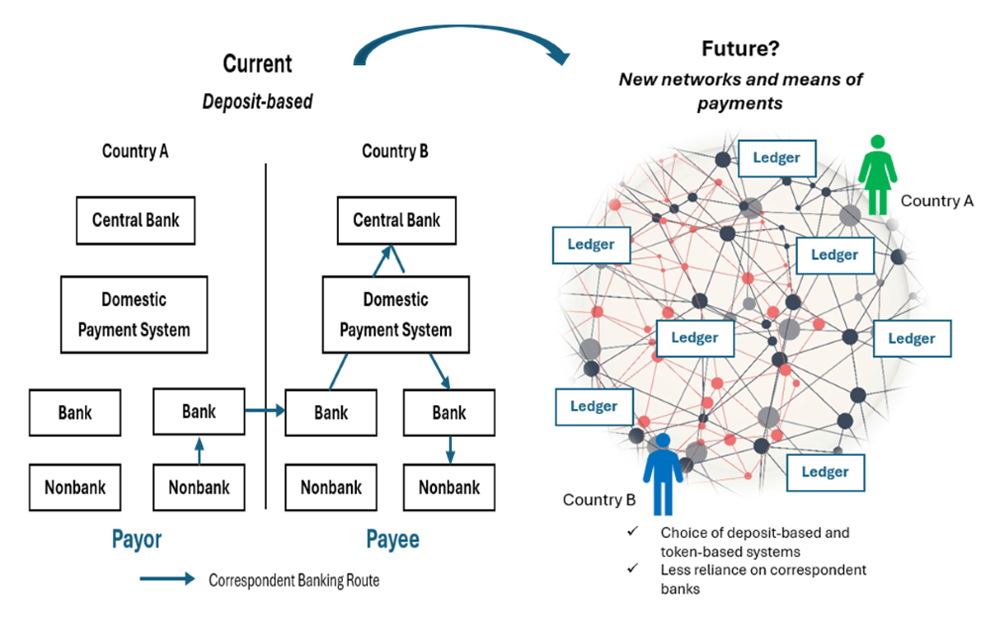
Figure 4 illustrates one way to conceptualize how business architecture could change if the industry migrates from traditional established cross-border payment solutions via a correspondent banking model to newer, more distributed token-based networks (modified from Deshpande, 2025).
There are key elements for heartland banks to consider when exploring the potential benefits of a new cross-border solution, including the type of money used for end-user settlement, the types of money used for settlement between service providers, the nature of the entity that arranges settlement, and the fees and timing model of the solution, as outlined in Figure 5.
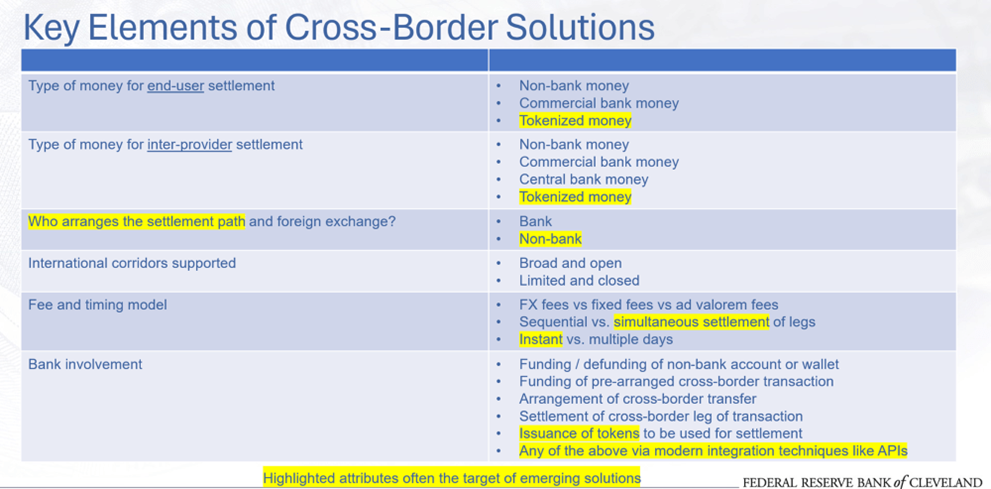
Considerations for Heartland Banks
Given the variety of solutions available in the market today to enable cross-border payments, there are several ways that heartland banks may play a more active role in providing cross-border payments services for their customers (several are mentioned in Figure 5).
Heartland banks could arrange and settle elements of cross-border transactions by establishing a contractual relationship with a correspondent bank or multiple correspondent banks to reach various international corridors. This is the predominant model used today by heartland banks, but it may not address some of the concerns expressed by industry participants about the speed, cost, and complexity of cross-border payments.
As an alternative, a heartland bank could partner with nonbank cross-border payments providers by making it more seamless for customers to fund or defund cross-border payments from the customer’s traditional bank account or physical bank branch location. Several nonbank cross-border payments services have APIs and other programs to make this type of integration more seamless for the bank to implement. The cost and speed of these services, however, vary widely, and their effectiveness is use-case, payment-amount, and payment-corridor specific.
Heartland banks could also consider issuing or accepting tokenized deposits or stablecoins that would be used by customers for settlement of cross-border payments transactions. In this model, the heartland bank could act as the bridge between the traditional banking infrastructure and the evolving blockchain ecosystem (for example, on and off ramping). There are several new companies and initiatives empowering banks of all sizes to be able to issue or accept tokenized instruments.
Fintechs and bank consortiums are also proliferating in this space, several of which are looking to partner with banks to coordinate the settlement of tokenized assets with an offsetting settlement event in traditional bank deposits. Texas Bankers Association, for example, announced that it will offer its member banks the opportunity to join its tokenized deposit pilot program (Texas Bankers Association, 2026). The Cari Network is another tokenized deposit consortium that was announced in March 2026 by five regional banks (Cari Network, 2026). The field is rapidly expanding. Many of these initiatives would likely welcome participation from or partnership with heartland banks.
Are Solutions Meeting the Needs of Heartland Banks?
In order to determine whether existing and emerging cross-border payments solutions are meeting the needs of heartland banks, we solicited information from payments industry stakeholders via a series of informal interviews with select entities in the Federal Reserve’s Fourth District, including community banks, credit unions, regional banks, national banks, and service providers in this space.5
Interviewees revealed that several implementation challenges must be addressed in order to expand their service offerings, and these are related to technology implications of a service change, compliance considerations, and customer experience. Any heartland bank evaluating a new cross-border payment capability would likely need to compare the costs of addressing each of these challenges against the potential benefits of an enhanced cross-border payment capability.
From a technology perspective, interviewees shared that a heartland bank can review its technical resource availability, potential integration complexities, and any operational changes that may be needed.
Regarding compliance, a heartland bank can review anti-money-laundering (AML), Bank Secrecy Act of 1970 (BSA), and Office of Foreign Assets Control (OFAC) screening and know-your-customer (KYC) monitoring implications of any new cross-border payments service offering. The elevated compliance risk of processing cross-border payments is a longstanding pain point in the industry that should be addressed for a new solution.
Considering customer experience, a new solution may be evaluated by the extent to which it meets customer needs for speed, cost, and reachability, among other factors. The results may be specific to each bank’s customer base. A seamless onboarding and end-user experience also may reduce the need for customer training and increase the effectiveness of the solution in customer retention.
Most heartland banks with whom we spoke do not view cross-border payment frictions as a major concern given their relatively low level of cross-border payments activity. While generally satisfied with their current solutions, institutions remain open to improvement, with larger players more actively seeking optimization. The level of sophistication scales with institution size: community banks typically maintain straightforward solutions that meet basic customer needs, while larger banks deploy increasingly complex, multipartner approaches. Heartland banks view partnerships with financial institutions, fintechs, and service providers as critical to help them extend their reach globally.
The economics of cross-border payments create natural market segmentation. High fixed costs associated with establishing and maintaining each cross-border payment corridor, including technology infrastructure, compliance frameworks, and operational requirements, mean scale is essential for profitability. Community banks typically rely on a single partner such as a core banking processor or a single global correspondent bank whose priorities may not always align with community banks’ immediate needs, while larger regional banks add specialized foreign endpoints incrementally based on customer demand for payments into or from that region. Global institutions may maintain connectivity to 200 or more global corridors, reflecting both their customer base and ability to amortize substantial infrastructure investments.
This dynamic distinguishes cross-border payments from domestic payment rails. Unlike domestic ACH, wire transfers, and checks—which are universally supported regardless of institution size—cross-border capabilities are calibrated to each bank's specific footprint and customer needs. The substantial per-endpoint costs for technology, compliance, and ongoing regulatory maintenance make new corridors viable only when institutions achieve sufficient transaction volume, potentially limiting a corridor-specific approach to mid-sized and larger players.
In summary, the interviews revealed that while cross-border payments are not a top priority for many banks, there is still interest in improving processes. Larger banks tend to have more scale and can build out targeted corridors, while smaller banks are more likely to partner with global correspondents, fintechs, or money transmitters. There are many new players seeking to build new networks surrounding new types of money, something which may also be an option for heartland bank participation. Banks could focus on technology, compliance, and customer experience when exploring new options.
Conclusion
Most banks have at least some customers who occasionally make cross-border payments; however, cross-border payments are generally slow, costly, and complex. There are many coordinated efforts around the globe focused on improving cross-border payments, and globally focused institutions are shaping these initiatives. The remaining institutions, the heartland banks, represent the vast majority of banks in the United States, and they have several options, some well-established and others emerging, to facilitate cross-border payments on behalf of their customers. The solution they choose will likely depend on various factors, including but not limited to cost, customer demand, complexity, compliance frameworks, infrastructure investments, and third-party service provider capabilities.
Footnotes
- The views expressed in this paper are solely those of the authors and do not represent the views of the Federal Reserve Bank of Cleveland or the Federal Reserve System. The authors would like to thank Susan Black, Paola Boel and Ed Knotek for their valuable assistance. Return to 1
- Central banks across the globe and other payments industry stakeholders including the BIS Innovation Hub, SWIFT, and others are actively engaged in collaborative projects to enhance the efficiency and effectiveness of cross-border payments. Some examples include Project Agorá, mBridge, Project Nexus, and Project Mandala, among others. Return to 2
- Not all cross-border flows are captured in the Fedwire data reviewed. For example, the Fedwire data do not capture data from private-sector funds transfer provider CHIPS, credit card networks, international ACH, or nonbank solutions. Yet Fedwire is commonly used by a broad range of depository institutions to facilitate cross-border funds transfers and therefore provides a reasonable basis on which to evaluate the broader market. Return to 3
- National banks include those that are not classified as global but have a national footprint (presence in more than one-half of US states) and service providers to other banks such as bankers’ banks. Regional banks are those not classified as global or national but that have more than approximately 1,500 cross-border transfers during the month of May. Community banks comprise the remaining Fedwire depository institution participants. Return to 4
- Interviews were conducted with officers and staff responsible for cross-border payments activities at one community bank, two domestically focused regional banks, one corporate credit union, one globally focused regional bank, and one fintech/non-bank service provider. Return to 5
References
- Board of Governors of the Federal Reserve System. 2025. “Federal Reserve Board Announces Expanded Operating Days of Two Large-Value Payments Services, Fedwire® Funds Service and the National Settlement Service (NSS), to Include Sundays and Weekday Holidays.” Press Release. October 9. https://www.federalreserve.gov/newsevents/pressreleases/other20251009a.htm.
- Cari Network. 2026. “A New Standard for Powering Digital Money.” Accessed March 27, 2026. https://www.cari.com/.
- Corporate Visa. 2024. “Unlocking the Future: Banking on Cross-Border Payment Habits.” November. https://corporate.visa.com/content/dam/VCOM/corporate/visa-perspectives/innovation/documents/Visa-Direct-global-cross-border-consumer-habits-report.pdf.
- Deshpande, Aditya Vilas. 2025. “Enhancing Cross-Border Payment Efficiency with Stablecoins: Reducing Costs and Settlement Delays.” SSRN Scholarly Paper No. 5337435. Social Science Research Network. https://doi.org/10.2139/ssrn.5337435.
- Financial Stability Board. 2025. “G20 Roadmap for Cross-Border Payments: Consolidated Progress Report for 2025.” October 9. https://www.fsb.org/2025/10/g20-roadmap-for-cross-border-payments-consolidated-progress-report-for-2025/.
- Gargano, Frank. 2026. “Big Banks Are Leading the On-Chain and Stablecoin Race.” American Banker, March 24. https://www.americanbanker.com/payments/news/exclusive-research-big-banks-lead-on-chain-stablecoin-race.
- McKinsey. 2025. “The 2025 Global Payments Report: Competing Systems, Contested Outcomes.” September 26. https://www.mckinsey.com/industries/financial-services/our-insights/global-payments-report.
- Payments Intelligence. 2026. “Cross-Border Payments in 2026: Friction and Reform.” The Payments Association, February 16. https://thepaymentsassociation.org/article/cross-border-payments-2026-friction-reform/.
- PaymentsJournal. 2025. “Fear and Friction in Cross-Border Payments: The Alternative to Correspondent Banking.” May 29. https://www.paymentsjournal.com/fear-and-friction-in-cross-border-payments-the-alternative-to-correspondent-banking/.
- Rice, Tara, Goetz von Peter, and Codruta Boar. 2020. “On the Global Retreat of Correspondent Banks.” BIS Quarterly Review 2020 (March). https://www.bis.org/publ/qtrpdf/r_qt2003g.htm.
- Texas Bankers Association. 2026. “TBA to Offer Pilot Access for Tokenized Deposit Capabilities Following Vantage Bank Launch.” February 5. https://www.texasbankers.com/tba-to-offer-pilot-access-for-tokenized-deposit-capabilities-following-vantage-bank-launch/.