

- Share
Do Group Unemployment Rates Send Warning Signs about the Broader Labor Market?
Labor market commentary often discusses unemployment rates for certain groups as potential leading indicators for the overall unemployment rate. I test that idea for several commonly mentioned groups, finding that increases in the unemployment rates for Black workers and workers who did not complete high school do predict higher overall unemployment in subsequent months. Though not commonly discussed in this context, increases in the unemployment rate for workers aged 35–44 also predict higher subsequent overall unemployment.

The views authors express in Economic Commentary are theirs and not necessarily those of the Federal Reserve Bank of Cleveland or the Board of Governors of the Federal Reserve System. The series editor is Tasia Hane. This paper and its data are subject to revision; please visit clevelandfed.org for updates.
Introduction
Policymakers have highlighted increased unemployment rates among more cyclically sensitive groups of workers as a potential sign of a softening labor market (Waller, 2025; Cook, 2026). Several papers document greater cyclicality in employment outcomes for workers who are nonwhite (Hoynes, 2000; Cajner et al., 2017); young, especially teenagers (Hoynes et al., 2012); or less educated (Hoynes, 2000; Jefferson, 2008; Doniger, 2019). Some suggest that this greater cyclicality is present whether the economy is contracting or expanding (see, for example, Aaronson et al., 2019). Commentators have pointed to these increases in unemployment rates as sending warning signs about where the labor market is headed, and while this cyclicality evidence makes it reasonable to suspect that shifts in labor market conditions could show up within these groups before they are clear in more aggregate measures, academic research has not fully addressed that question.
Specification and Main Results
If a group unemployment rate is a leading indicator, that is, one that sends warning signs about the future trajectory of the labor market, then, conditional on recent history, an increase in it likely predicts an increase in the overall unemployment rate over some horizon going forward. How to condition on recent history, which groups, and what horizons is not obvious. To make things concrete, I estimate the regression
for various groups g over horizons k from 1 to 12 months, where ∆ represents the one-month change from the prior period. The coefficient represents the degree to which the overall unemployment rate will be higher k months from now when the unemployment rate for group g rises by one percentage point from last month to this month, controlling for this month’s change in the overall unemployment rate and the last two months of changes in both the overall unemployment rate and the unemployment rate for the group in question.1
I first consider the groups that the research mentioned above suggests experience greater cyclicality in labor market outcomes: Black workers, Hispanic workers, workers ages 16 through 19, and workers who have completed less than a high school education (LTHS). The Bureau of Labor Statistics publishes official seasonally adjusted estimates of the unemployment rates for these groups each month, and I use these estimates to calculate changes in unemployment rates.2 Figure 1 plots the coefficients from the equation above, estimated separately for each group at horizons from one to 12 months.
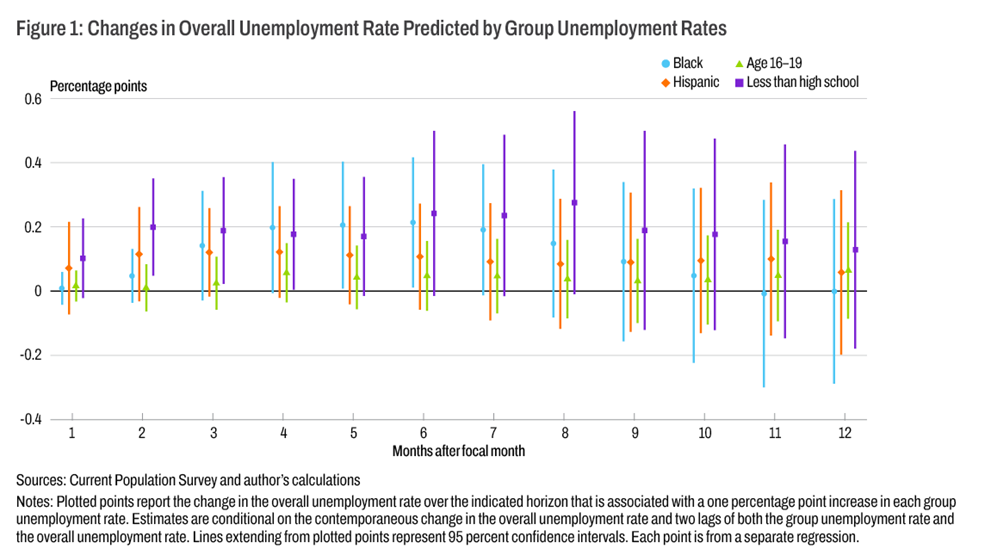
Estimates suggest that the unemployment rates for Black workers and those who did not complete high school do predict higher overall unemployment two to six months later. The LTHS unemployment rate is more immediately predictive, with a 1 percentage point increase in that measure associated with an increase in the overall unemployment rate that reaches about 0.2 percentage points two months later. This effect is statistically significant from two to four months later and fairly consistent in magnitude through 10 months later, after which point it declines modestly.
Changes in the aggregate unemployment rate following increases in the Black unemployment rate take a little bit longer to manifest fully but reach a similar magnitude. The overall unemployment rate tends to be about 0.2 percentage points higher four to seven months later for each percentage point increase in the Black unemployment rate today. This relationship is statistically significant in months five and six. In both the Black and LTHS cases, the estimated subsequent increases in the overall unemployment rate are larger than would be implied mechanically by a persistent increase in unemployment within these groups, given their shares of the labor force.3
Coefficients on increases in the Hispanic unemployment rate are consistently around 0.1 percentage points in months two to 11, but never statistically significant over the horizons considered. Estimates for the unemployment rate for ages 16 to 19 are consistently closer to zero. For all four of these initial groups, results are qualitatively similar, if occasionally less precise, if regressions control for only one prior month of changes in overall and group-specific unemployment rates rather than two. Results are also similar, and even slightly stronger, if the regression is specified in levels of overall and group unemployment rates rather than changes. In this formulation, the predicted increases in the overall unemployment rate associated with increased Black or LTHS unemployment peak at about 0.3 percentage points rather than 0.2 percentage points.4
Results for Other Groups
While the public discussion of leading indicators is often oriented around groups with the most cyclically sensitive unemployment rates, the monthly employment report details conditions for a wide range of groups, including one very much at the heart of the labor market: prime-age workers, those from the ages of 25 through 54. Figure 2 repeats the prediction exercise above for narrower age ranges within this group (25–34, 35–44, and 45–54) and reveals that increased unemployment rates among workers in the middle of their prime working years (35–44) is also statistically significantly associated with future increases in the overall unemployment rate.
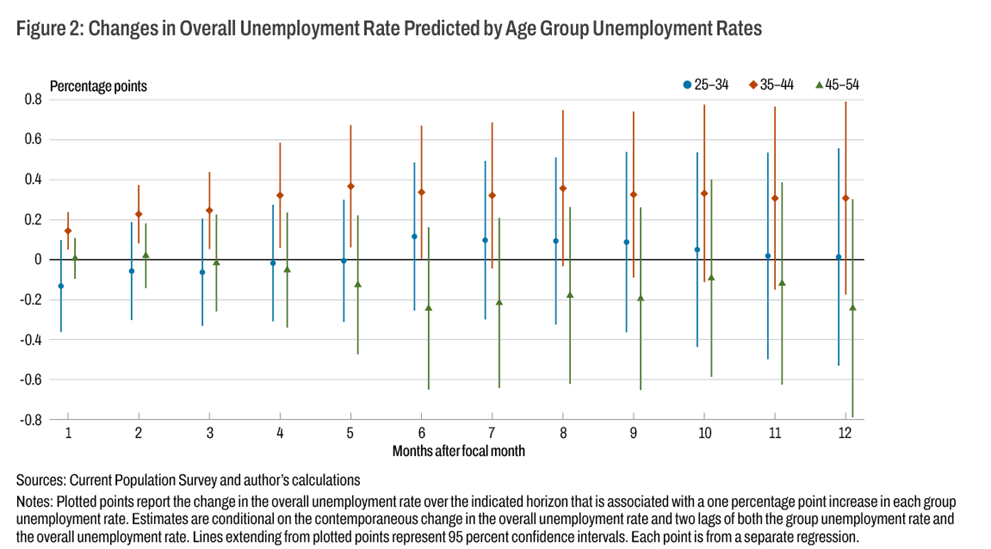
Increases in the unemployment rate for workers aged 35–44 predict a higher overall unemployment rate with statistical significance even one month later, at which point overall unemployment is 0.1 percentage points higher for each 1 percentage point increase within this group. The increase in overall unemployment grows over time before leveling off at a little over 0.3 percentage points four months later and remaining at roughly that level through at least 12 months later.5
Looking to other groups defined by other characteristics does not yield the same success in identifying leading indicators. The unemployment rate for white workers is very highly correlated with the overall unemployment rate. Once changes in the overall unemployment rate are controlled for, there is little predictive power left in the white unemployment rate. Estimates for other education groups are too imprecise to rely on.
Conclusion
The intuition that changes in unemployment rates for more cyclically exposed groups of workers might tell us something about how the overall unemployment rate will change going forward turns out to be partially correct. Increases in the Black and LTHS unemployment rates tend to be followed by higher overall unemployment, on the order of a 0.2 percentage point increase in overall unemployment per 1 percentage point increase in group-specific unemployment. But the predictive power of group unemployment rates is not limited to these more vulnerable groups. The unemployment rate among workers aged 35–44, the age group that typically has the highest employment and participation rates among those officially tabulated, also predicts subsequent changes in the overall unemployment rate, and its relationship to those subsequent changes is, if anything, stronger than the other groups considered.
References
- Aaronson, Stephanie R., Mary C. Daly, William L. Wascher, and David W. Wilcox. 2019. “Okun Revisited: Who Benefits Most from a Strong Economy?” Brookings Papers on Economic Activity 2019 (Spring): 333–404. brookings.edu/articles/okun-revisited-who-benefits-most-from-a-strong-economy/.
- Cajner, Tomaz, Tyler Radler, David Ratner, and Ivan Vidangos. 2017. “Racial Gaps in Labor Market Outcomes in the Last Four Decades and over the Business Cycle.” Finance and Economics Discussion Series No. 2017-071. doi.org/10.17016/feds.2017.071.
- Cook, Lisa D. 2026. “Economic Outlook.” Speech at the Economic Club of Miami, Miami, Florida, February 4. Board of Governors of the Federal Reserve System. federalreserve.gov/newsevents/speech/cook20260204a.htm.
- Doniger, Cynthia L. 2019. “Do Greasy Wheels Curb Inequality?” Finance and Economics Discussion Series No. 2019-021. Board of Governors of the Federal Reserve System. doi.org/10.17016/FEDS.2019.021.
- Duzhak, Evgeniya A. 2021. “How Do Business Cycles Affect Worker Groups Differently?” FRBSF Economic Letter No. 2021-25. Federal Reserve Bank of San Francisco. frbsf.org/research-and-insights/publications/economic-letter/2021/09/how-do-business-cycles-affect-worker-groups-differently/.
- Hoynes, Hilary. 2000. “The Employment and Earnings of Less Skilled Workers over the Business Cycle.” In Finding Jobs: Work and Welfare Reform, edited by Rebecca Blank and David Card. New York: Russell Sage Foundation.
- Hoynes, Hilary, Douglas L. Miller, and Jessamyn Schaller. 2012. “Who Suffers during Recessions?” Journal of Economic Perspectives 26(3): 27–48. doi.org/10.1257/jep.26.3.27.
- Jefferson, Philip N. 2008. “Educational Attainment and the Cyclical Sensitivity of Employment.” Journal of Business & Economic Statistics 26(4): 526–535. doi.org/10.1198/073500108000000060.
- Waller, Christopher J. 2025. “Let’s Get On with It.” Speech at the Economic Club of Miami, Miami, Florida, August 28. Board of Governors of the Federal Reserve System. federalreserve.gov/newsevents/speech/waller20250828a.htm.
Endnotes
- I focus on interpreting on its own, rather than together with and , to align this analysis with public discussion of real-time data releases. Return to 1
- For October 2025, when unemployment data were not collected because of a lapse in appropriations for the Bureau of Labor Statistics, I linearly interpolate between September and November values for each series and use that interpolated value to calculate changes. Return to 2
- Black workers are about 13 percent of the labor force, while LTHS workers are about 6 percent of the age 25+ labor force (education-specific unemployment rates are estimated for workers age 25+). Return to 3
- While this analysis focuses on the implications of the most recent month’s change in group unemployment rates for the future path of overall unemployment, one might also be interested in considering the three months of changes in group unemployment rates together. For the Black unemployment rate, the null hypothesis that the three coefficients on the three months of changes included here are jointly zero cannot be rejected at any of the horizons considered. For the LTHS unemployment rate, that same null hypothesis can be rejected at the 10 percent level or less at horizons of one and two months. The joint null is more frequently rejected when this analysis is specified in levels, consistent with larger point estimates in that setting. Return to 4
- For reference, workers from the ages of 35 through 44 represent about 12 percent of the labor force. An F-test rejects the null hypothesis that the coefficients on the contemporaneous change in the age 35–44 unemployment rate, and its first two lags are jointly zero at the 10 percent level or less at horizons of one to five months. Return to 5
Suggested Citation
Rinz, Kevin. 2026. “Do Group Unemployment Rates Send Warning Signs about the Broader Labor Market?” Federal Reserve Bank of Cleveland, Economic Commentary 2026-10. https://doi.org/10.26509/frbc-ec-202610
This work by Federal Reserve Bank of Cleveland is licensed under Creative Commons Attribution-NonCommercial 4.0 International


Related resources

About Us
The Federal Reserve Bank of Cleveland (commonly known as the Cleveland Fed) is part of the Federal Reserve System, the central bank of the United States.

Economic Commentaries
Economic Commentaries provide analysis of relevant economic issues and are written for an informed but nonspecialist audience.