

- Share
Community Issues and Insights 2026: Housing Affordability and Inflation Remain Top Concerns
The Federal Reserve Bank of Cleveland’s Community Issues Survey (CIS) collects information semiannually from direct service providers to monitor economic conditions and identify issues impacting low- and moderate-income (LMI) households in the Federal Reserve’s Fourth District, a region that includes Ohio, western Pennsylvania, eastern Kentucky, and the northern panhandle of West Virginia. From March 2 through 13, 2026, we surveyed more than 550 organizations that directly serve LMI individuals and communities across our District and received 108 responses (19 percent response rate). The results of this survey are summarized here and provide insights into how organizations and the households they serve are faring in today’s economy.

The views expressed in this report are those of the author(s) and are not necessarily those of the Federal Reserve Bank of Cleveland or the Board of Governors of the Federal Reserve System.
Key Findings
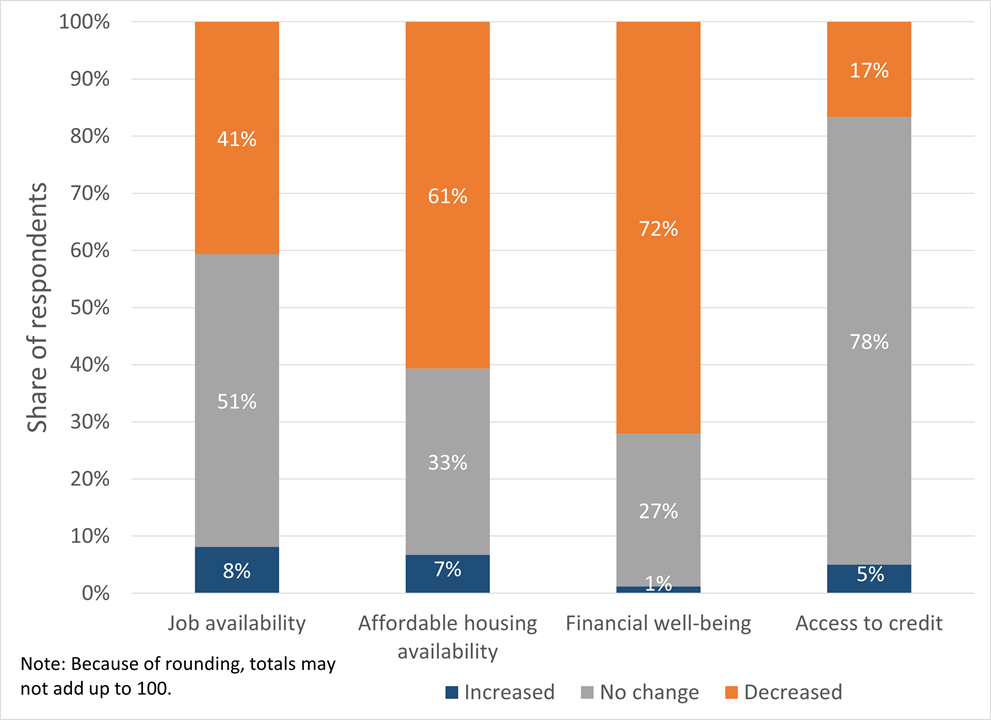
- Job availability: Only 8 percent of respondents said that job availability for LMI workers had increased in the past six months, a sideways move from the September 2025 survey (7 percent). Most respondents (51 percent) said that there had been no change (Figure 1).
- Affordable housing availability: Sixty-one percent of respondents said that the availability of affordable housing had continued to decrease over the past six months (Figure 1). This share has exceeded 50 percent since the March 2022 survey.
- Financial well-being and access to credit: Seventy-two percent of respondents reported that financial well-being for LMI people had decreased over the past six months, while 78 percent said that access to credit had remained unchanged over the past six months (Figure 1).
- Top concerns for LMI households: Respondents’ top concerns were the cost of housing, the continued impact of price increases on households’ budgets, and the shortage of affordable housing.
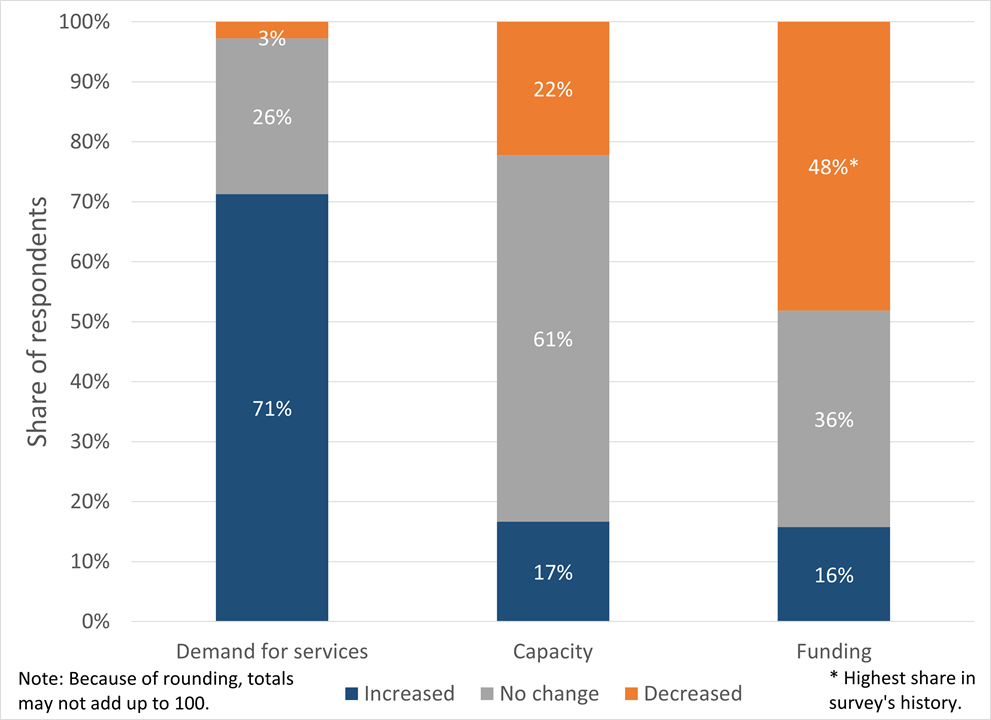
- Trends for nonprofit organizations: A large majority of nonprofit organizations reported that demand for their services had increased over the past six months, consistent with responses to previous surveys, while their capacity, or ability to fulfill the demand, had remained steady. Forty-eight percent of respondents said that funding had decreased over the past six months, the highest share since the survey began in March 2018 (Figure 2). Organizations cited federal funding cuts as their primary concern.
Economic Conditions of LMI Households
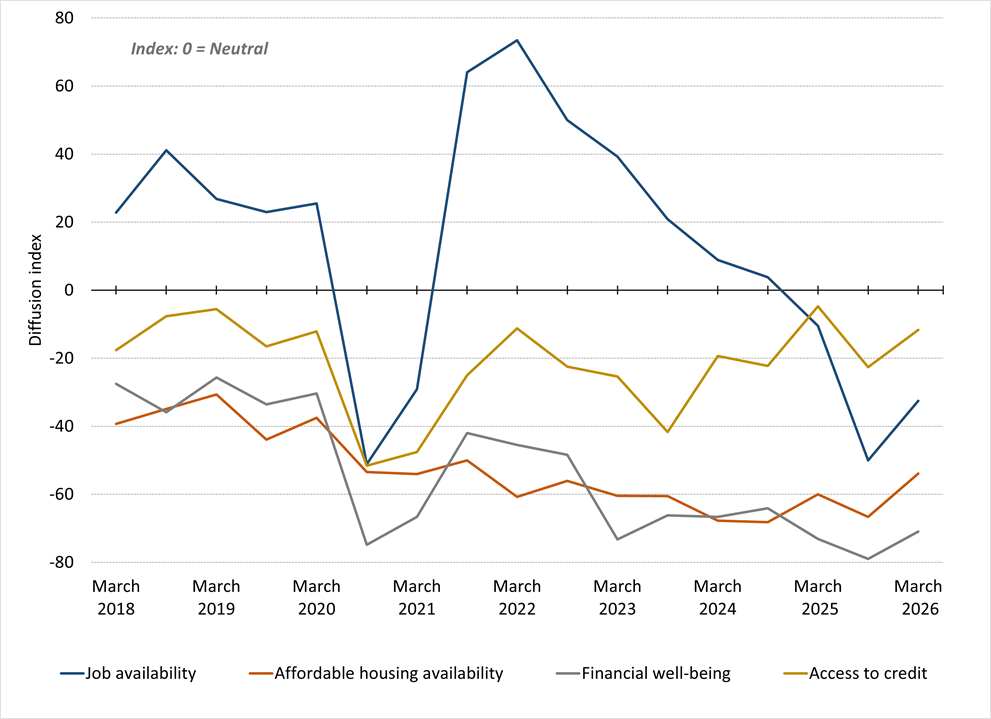
A diffusion index was built for each survey question to observe trends in the responses over time (see the Methodology section for more information on diffusion indexes). According to the March 2026 survey, all indexes rebounded from September 2025 levels, but they all remained below 0, which indicates worsening conditions, though at a slower rate (Figure 3).
Top Issues Impacting LMI Households in the Fourth District
Job availability: Continued to decline
While most respondents said that job availability for LMI households had not changed in the past six months (51 percent), 41 percent indicated that it had decreased, down from 57 percent in the September 2025 survey but above the survey average of 22 percent. Several respondents noticed a decrease or slowing growth in the number of entry-level positions, and one respondent explained that “entry-level and mid-skill hiring has slowed due to uncertainty caused by tariffs on materials.” Compounding this challenge, one respondent noted that companies are expecting several years of experience for entry-level wages and the ability to handle multiple roles under one job title. Other respondents noticed an increase in low-paying manual labor jobs, part-time or temporary jobs, and the use of gig work such as DoorDash or Uber. However, there was concern that “gig work does not provide access to healthcare or provide workers with a reliable income.”
Affordable housing: Availability declined again
For the ninth consecutive survey since March 2022, a majority of respondents (61 percent) said that affordable housing availability had declined over the past six months. Most respondents cited rising rents, increases in other housing-related expenses such as property insurance and taxes, and limited housing supply as the primary reasons. According to one respondent, increased pressure from costs such as property taxes and insurance caused more people to seek foreclosure prevention services, while another respondent had seen a steady rise in days stayed at their shelter because of the decline in affordable housing: “In the past, families would typically stay in the shelter for roughly 30 days, but in 2023 the average stay was 97 days, and in 2025 it was 124 days.” An affordable housing owner and builder wrote, “We continue to see cost pressures for operating rentals and building for-sale homes, and there is no room for absorption into the margin, so they are being passed on to customers to the extent possible.”
Financial well-being: Effects of inflation continued to strain LMI households’ budgets
Nearly three-fourths of respondents (72 percent) said that financial well-being for LMI people had decreased over the past six months, with elevated prices being the primary reason cited. This share was down from the September 2025 survey (80 percent). Most respondents noted that increased food, rent, and utility costs had been impacting the populations they serve. One respondent explained that “in eastern Kentucky, electric rates are among the highest in the country, with most bills almost doubling in the past few months. Some of our residents, especially the elderly, are receiving bills in excess of their monthly income.” Respondents observed more clients using credit to meet monthly needs, increasing their debt burden. As one respondent noted, “residents are increasingly using debt to bridge the gap between their stagnant earnings and the rising cost of living.”
Access to credit: Remained largely unchanged
While most respondents reported that access to credit had remained unchanged over the past six months (78 percent), 17 percent noted a decrease. On the business lending side, one respondent raised concerns about some fintech lenders, noting that “while [traditional] lenders have pulled back, fee-based fintech companies are expanding market share and aiming for small business owners who need cash quickly.” The respondent added that “this is problematic because many business owners don't know how to properly vet credit opportunities or understand the total cost of fintech credit products.” On the household side, several respondents cited evictions and late payments as barriers to credit qualification, while others pointed to high interest rates and tighter lending standards as obstacles to borrowing.
How Organizations That Serve LMI Households Are Faring
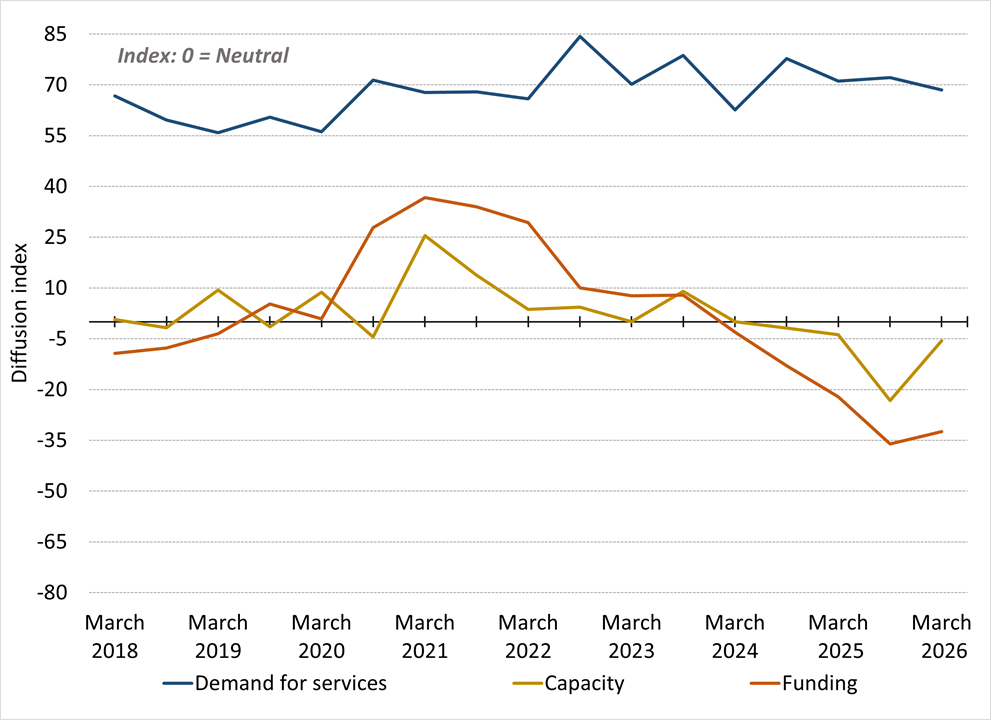
Figure 4 shows diffusion indexes for questions on the state of the organizations that serve LMI households (see the Methodology section for more information on diffusion indexes). In the March 2026 survey, the majority of respondents continued to indicate an increase in demand over the past six months. Organizations’ capacity moved up to nearly neutral, while the funding index leveled off but remained negative.
Top Issues Impacting Organizations That Serve LMI Households
Demand for services: Remained high
Seventy-one percent of respondents said that demand for their services had increased over the past six months (Figure 2), a share which is equal to the survey average going back to March 2018. Housing-related reasons were cited most frequently as drivers of increased demand, but many comments were multidimensional. For example, one respondent explained that “there are more homeless [people] now due to fluctuations in the job market—whether through job loss, decreased hours, or the cost of rental housing.” Other respondents mentioned pressure from reduced benefits or the disruption to Supplemental Nutrition Assistance Program (SNAP) benefits in late 2025. According to one respondent, “we believe the biggest driver [of the organization’s increased demand] was the disruption in SNAP benefits in November [2025], coupled with inflation and other economic pressures that are felt at the household level.” Another respondent noted that the disruption to SNAP benefits “forced families to spend money they didn't have . . . which can throw off finances for months.”
Capacity: Continued staff reductions due to funding cuts
Most respondents said that their capacity had not changed (61 percent), but just over one-fifth (22 percent) noted a decline over the last six months (Figure 2). Many attributed declining capacity to a combination of funding and staffing cuts. According to one respondent, “We have been on a hiring freeze for the last eight months due to further cuts being projected in October of 2026.” Another respondent’s organization was looking toward a technology solution to address the funding reduction: “To meet our budget, staff was reduced and increased technology optimization tools were introduced.” Lastly, one respondent described how stagnant funding levels had limited their capacity to serve families amid rising rental costs: “As rents in the private market increase, our costs per household have risen, reducing the number of families that may be assisted because funding has not kept pace with the rental market changes.”
Funding: Federal funding cuts were the most cited reason for the overall decrease
As shown in Figure 2, nearly half of the respondents said that their funding had decreased over the past six months (48 percent), the highest share since the survey began in March 2018. Federal funding cuts were the most common reason mentioned. For example, one respondent shared that the “federal government decreased the aid to our food distribution program by 14%.” Several respondents mentioned that reduced funding had increased competition for both private and public grant sources, while “many government agencies, lenders, and foundations have shifted their resources” following the government shutdown in late 2025. One respondent said that “philanthropy has pulled back some compared to previous years,” while another noticed that “many funders have said they are holding off on awarding grants until they have a clearer understanding of what the government will do.”
Special questions: Nonprofit organizations’ use of AI
Periodically, the CIS includes special survey questions to dig into a specific topic. This survey included a block of questions focused on the use of artificial intelligence (AI) in nonprofit organizations. A majority of respondents said their organizations were currently using AI for work (57 percent).1 Many respondents felt that their organizations were in the early stages of AI use, and several mentioned the development of office policies around its use. The most commonly reported uses were individual productivity such as notetaking, summarizing, or scheduling (29 percent) and writing or marketing (29 percent). One respondent indicated that their organization had used AI for grant writing. However, another respondent expressed concern over the use of AI for grant writing: “As a funder, we are starting to receive more grant applications that are clearly written by AI with little editing. The value of a written application is diminishing.” Twenty-five percent of respondents said their organizations were not using AI, and 18 percent said their organizations were unsure about whether they plan to start using it in the future. The most common reasons for not using AI were data security and privacy concerns (23 percent), AI not being applicable to their organization (20 percent), and cost (17 percent).
Conclusion
The March 2026 CIS examined the state of LMI households and the organizations that serve them. From the responses, we learned that job availability for LMI households had continued to decrease and that employers were offering fewer entry-level jobs and more part-time or temporary jobs. Additionally, the survey results suggested that the availability of affordable housing had decreased because of rising rents, increases in other housing-related expenses, and low affordable housing supply. The responses also indicated that the effect of inflation had continued to strain LMI households’ budgets and that access to credit had continued to be limited by high interest rates, high debt burden, and tighter lending standards. Regarding organizations that serve LMI households and communities, respondents indicated that demand for these organizations’ services had increased over the past six months. However, the responses also suggested that these organizations’ capacity had continued to be impacted by changes in federal funding and that many had seen a pullback in other funding sources or increased competition.
Survey Methodology
The Federal Reserve Bank of Cleveland developed this survey tool to elicit perspectives from community stakeholders that directly serve LMI individuals and communities on key issues impacting the economic mobility and resiliency of those populations. In March 2026, the online survey was distributed to more than 550 individuals working in direct service organizations in the Fourth District; 108 completed the survey. The following tables show the types of organizations that provided responses to the survey and in which states the organizations were located.
Respondents by Organization Type*
| Organization type | Share (percent) |
| Community service provider** | 43 |
| Government entity | 9 |
| Neighborhood development organization | 8 |
| Workforce development board | 8 |
| Foundation/funder | 7 |
| Community development financial institution (CDFI) | 5 |
| Other | 19 |
| Total | 100 |
*Shares may not sum to 100 because of rounding.
**Community service providers include organizations such as community action agencies and social service organizations.
Respondents by State*
| State | Share of respondents (percent) | Share of 2023 Fourth District population (percent) |
| Ohio | 73 | 69 |
| Kentucky | 9 | 12 |
| Pennsylvania | 13 | 19 |
| West Virginia | 5 | 1 |
*Shares may not sum to 100 because of rounding.
Type of Clients Predominantly Served
| Clients | Share (percent) |
| Urban | 69 |
| Rural | 23 |
| Suburban | 8 |
Survey Methodology: Diffusion Indices
A diffusion index is a useful way of summarizing data to understand if something is improving or worsening over time. In the diffusion indices shown in this report, each response to a survey question is tallied as increased, decreased, or no change. That survey question’s diffusion index is then calculated by subtracting the percentage of decreased responses from the percentage of increased responses. An index value of greater than zero means the average response indicates improving conditions, while a value of less than zero means the average response suggests worsening conditions. The calculation and example that follow are a guide to better understand the information provided in the indices:
- Diffusion Index = (I – D)*100
- I = increase (% of observations)
- D = decrease (% of observations)
- Index > 0 indicates improving conditions
- Index = 0 is neutral
- Index < 0 indicates worsening conditions
Example: A decrease in the index from 40 to 20 could represent a couple of trends. It could indicate that conditions have still improved on net but that more respondents are stating that conditions are worsening. It could also represent a combination of things such as a decline in respondents who say that conditions are improving, an increase in those who say no change, and no increase in those who say that conditions are worsening.
Endnote
- AI refers to technology designed to perform and learn tasks that typically require human intelligence, such as decisionmaking and recognizing speech or images. AI tools can include standalone AI applications or features of software already in use. Return to 1
Suggested Citation
Klesta, Matt. 2026. “Community Issues and Insights 2026: Housing Affordability and Inflation Remain Top Concerns.” Federal Reserve Bank of Cleveland, Community Issues and Insights. https://doi.org/10.26509/frbc-cd-20260519
This work by Federal Reserve Bank of Cleveland is licensed under Creative Commons Attribution-NonCommercial 4.0 International


