

- Share
SORCE Insights: An Update on Firms’ Costs and Prices
The Cleveland Fed’s Survey of Regional Conditions and Expectations (SORCE) fielded from August 6 through August 13, 2026, included a set of special questions focused on firms’ costs and prices. This District Data Brief discusses the top-line results from these questions.


The views authors express in District Data Briefs are theirs and not necessarily those of the Federal Reserve Bank of Cleveland or the Board of Governors of the Federal Reserve System. The series editor is Harrison Markel.
The Cleveland Fed’s Survey of Regional Conditions and Expectations (SORCE) fielded from August 6 through August 13, 2026, included a set of special questions focused on firms’ costs and prices. This District Data Brief discusses the top-line results from these questions. This question set was last fielded during January 2026, and the results were detailed in SORCE Insights: The Relationship between Costs and Prices.
Actual and Expected Changes in Costs and Prices
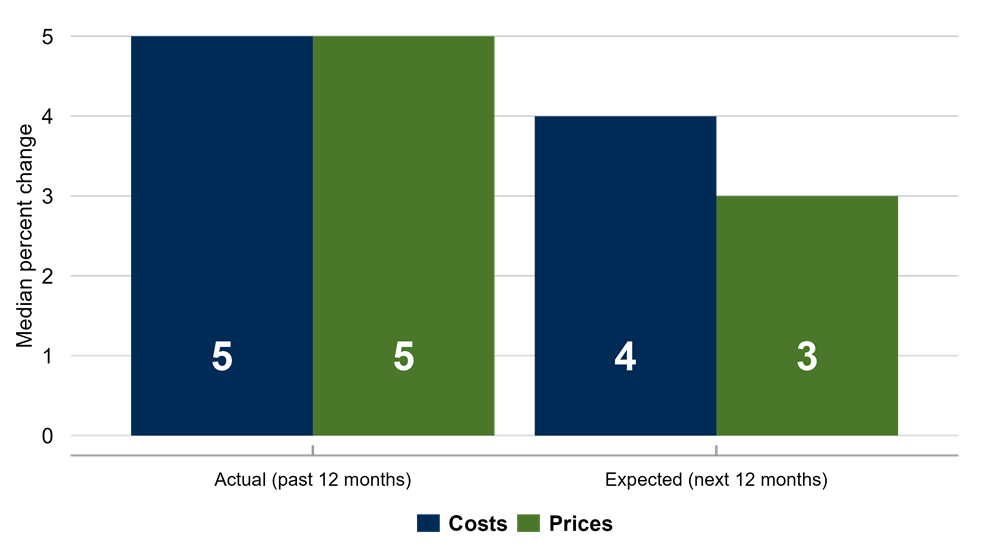
In the August 2026 survey, firms reported that their costs and prices each rose by a median of 5 percent over the previous 12 months. Firms expected their costs to rise by 4 percent and their selling prices by 3 percent over the next 12 months.1, 2
Compared with firms surveyed in January, those surveyed in August seem to have passed on a greater share of their cost increases over the past 12 months. At the median, firms surveyed in August reported that their past-12-month price increases equaled 100 percent of their past-12-month cost increases, up from roughly 80 percent in the January survey.3
Source: Cleveland Fed SORCE
Question 1: Looking back, by about what percent did [your costs] change over the last 12 months?
Question 2: Looking back, by about what percent did you change [your selling prices] over the last 12 months?
Question 3: Looking ahead, by about what percent do you expect that [your costs] will change over the next 12 months?
Question 4: Looking ahead, by about what percent do you expect to change [your selling prices] over the next 12 months?
Note: 152 respondents answered about at least one variable. Excludes financial services.
Average Importance of Various Factors in Setting Prices
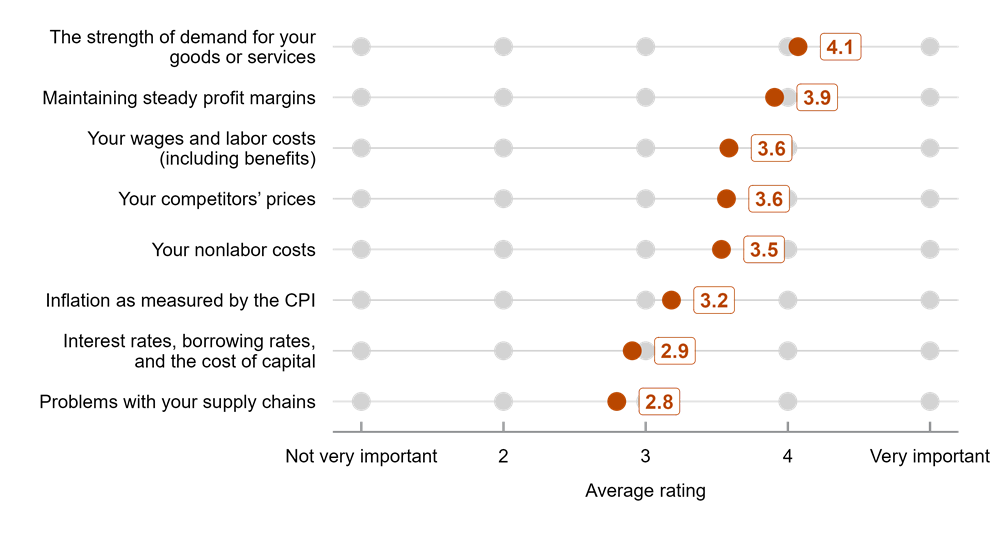
As in January, firms in the August survey were asked about the level of importance they place on different factors when setting prices; a value of 1 indicates low importance, and a value of 5 indicates high importance. Among these factors, the strength of demand continued to be the most important factor, on average (4.1 out of a possible 5). Maintaining steady profit margins (3.9), wages and labor costs (3.6), competitors’ prices (3.6), and nonlabor costs (3.5) were also important considerations.
Source: Cleveland Fed SORCE
Question: “Currently, when you think about setting prices across all your goods or services, how important to you are the following factors in making those decisions?”
Note: Sixteen respondents rated “Other” factors. 183 respondents rated at least one factor.
Pace of Change in Nonlabor Costs
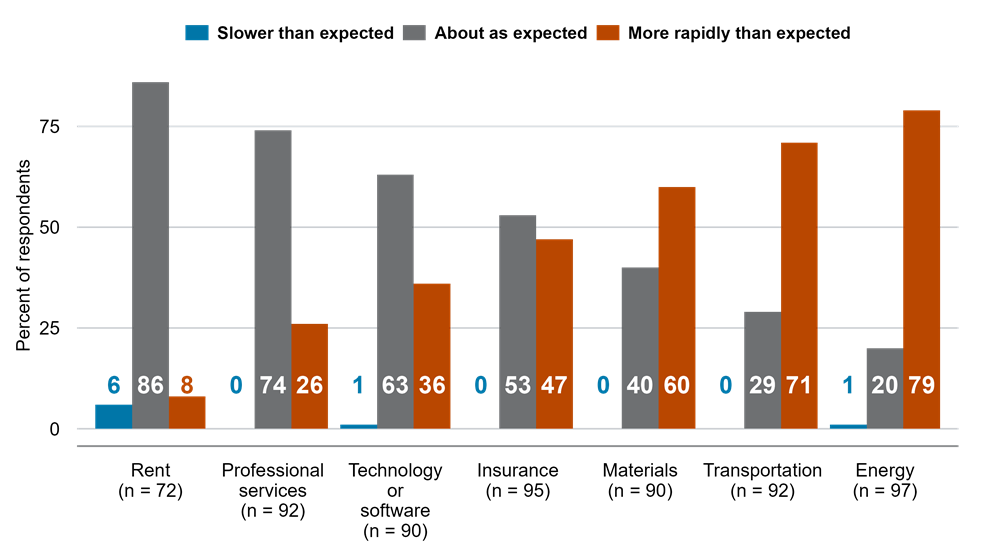
Firms that placed a high level of importance on nonlabor costs in making price-setting decisions were asked to comment on the pace of change in those costs over the past 12 months relative to what they had expected. Majorities of firms reported faster-than-expected increases in energy costs (79 percent), transportation costs (71 percent), and materials costs (60 percent). Most firms said rent costs (86 percent), professional services costs (74 percent), technology costs (63 percent), and insurance costs (53 percent) rose at the pace they expected. Few firms reported slower-than-expected increases.
Source: Cleveland Fed SORCE
Question: “Over the past 12 months, how have the following nonlabor costs changed relative to what you expected?”
Note: Includes only firms that said nonlabor costs were an “important” or “very important” factor in their pricing decisions.
Pace of Change in Labor-Related Costs
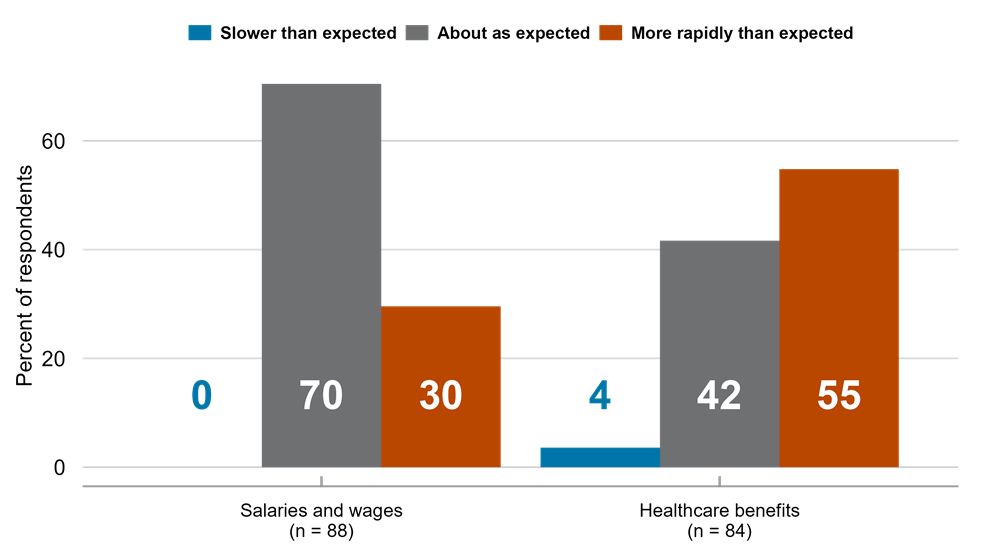
Firms that placed a high level of importance on labor costs in making price-setting decisions were asked how these costs had changed over the past 12 months relative to what they had expected. Most firms said wage and salary increases were in line with their expectations, while most said the cost of healthcare benefits rose more rapidly than they expected.
Source: Cleveland Fed SORCE
Question: “Over the past 12 months, how have the following wages or labor costs changed relative to what you expected?”
Note: Includes only firms that said wages and labor costs (including benefits) were an “important” or “very important” factor in their pricing decisions. Six respondents selected “Other” costs, three of whom said these costs rose more rapidly than they expected.
The Cleveland Fed’s Research Department gathers and analyzes timely economic information from businesses and community contacts to inform our Beige Book contribution and to prepare for Federal Open Market Committee (FOMC) meetings. One way we obtain this information is through the Survey of Regional Conditions and Expectations (SORCE), a business conditions survey sent to firms across the Fourth District, which comprises Ohio, western Pennsylvania, eastern Kentucky, and the northern panhandle of West Virginia. The SORCE is administered eight times per year. In addition to the set of standard questions asked during each round of the survey, the Cleveland Fed routinely asks a set of “special questions” to explore timely issues that may be impacting businesses across the Fourth District. The SORCE Insights District Data Briefs share the results from the “special questions.” For more information on SORCE, visit https://clevelandfed.org/SORCE.
Footnotes
- To minimize the influence of extreme values, cost and price data are winsorized at 95 percent. This means that values greater than the 97.5th percentile or less than the 2.5th percentile have been set equal to those respective limits, leaving the middle 95 percent of the data unadjusted. Return to 1
- To capture general trends in prices and costs, firms were allowed to respond about the “average prices and costs” across all their goods or services or about the prices and costs associated with their “most important goods or services.” These responses are combined, as there were no statistically significant differences between the two groups. Return to 2
- Limiting the sample to firms that responded in both January and August 2026, the average ratio of 12-month price-to-cost increases was 90 percent in August and 65 percent in January. Return to 3
Suggested Citation
Huettner, Brett, and Mitchell Isler. 2026. “SORCE Insights: An Update on Firms’ Costs and Prices.” Federal Reserve Bank of Cleveland, Cleveland Fed District Data Brief. https://doi.org/10.26509/frbc-ddb-20260901
This work by Federal Reserve Bank of Cleveland is licensed under Creative Commons Attribution-NonCommercial 4.0 International


Related resources

Survey of Regional Conditions and Expectations (SORCE)
SORCE indexes are based on our survey of business and community leaders and provide a timely summary of economic activity in our region, which includes all of Ohio and parts of Pennsylvania, Kentucky, and West Virginia. Released twice each quarter.

Regional Data, Analysis, and Engagement
Explore economic trends and the circumstances impacting the economy and diverse communities of the Federal Reserve’s Fourth District, which includes all of Ohio, western Pennsylvania, eastern Kentucky, and the northern panhandle of West Virginia.

About Us
The Federal Reserve Bank of Cleveland (commonly known as the Cleveland Fed) is part of the Federal Reserve System, the central bank of the United States.