

- Share
What Share of Unemployed People in Fourth District States Receive Unemployment Insurance?
Unemployment insurance recipiency rates vary considerably across Fourth District states, namely Ohio, Kentucky, Pennsylvania, and West Virginia. This article examines these recipiency rates and the factors that may influence them.

The views expressed in this report are those of the author(s) and are not necessarily those of the Federal Reserve Bank of Cleveland or the Board of Governors of the Federal Reserve System.
Introduction
As analysts look at weekly unemployment insurance (UI) claims numbers to assess the state of the labor market, it is important to remember that most unemployed workers do not apply for, much less receive, UI.1 According to the Bureau of Labor Statistics, 74 percent of unemployed individuals who had worked in the previous 12 months did not apply for UI in 2022. Of those who did not apply, a little more than half (55 percent) indicated that they did not do so because they (correctly or incorrectly) did not think they were eligible.2 Nationally, roughly one in four unemployed people received UI in 2025, with younger, less educated, and minority populations tending to have lower recipiency rates, as they believe they are ineligible for UI at higher rates than their older, more educated, nonminority counterparts.3, 4
Individuals are primarily eligible for UI if they are unemployed through “no fault of their own” and have a sufficient employment and earnings history.5 However, because UI is administered at the state level, what qualifies as sufficient employment and earnings history varies by state. This, along with a myriad of other details, causes worker eligibility and recipiency rates to differ significantly across states. Research from the Minneapolis Fed shows that the share of unemployed people receiving UI benefits varies across states and has widened in recent years.6
This report takes a closer look at the recipiency rate—or the share of unemployed people that receive UI—in Fourth District states, namely Ohio, Kentucky, Pennsylvania, and West Virginia. In general, Pennsylvania’s recipiency rate is above the national average, West Virginia’s tends to be in line with the average, and Kentucky’s and Ohio’s are below the average.
What the Data Reveal
One can refer to data on the UI recipiency rate to determine the number of unemployed job seekers who receive UI and better understand how state-level policy choices affect program access across states. One of the state-level policy choices for which data are readily available is the maximum number of weeks an individual is eligible to receive UI. In normal times, individuals from most states, including Ohio, Pennsylvania, and West Virginia, are eligible for up to 26 weeks of benefits.7 All else equal, one would expect states with longer eligibility periods to have higher recipiency rates and states with shorter eligibility periods—like Kentucky, which allows up to 16 weeks—to have lower recipiency rates. A closer examination of the data shows that states with longer eligibility periods generally have higher levels of UI access nationwide.8 However, there are marked differences in UI access across Fourth District states, even among those with equal eligibility periods. The data demonstrate that, in addition to the duration of eligibility periods, several other state-level policy choices may impact the level of support received by unemployed individuals searching for work.
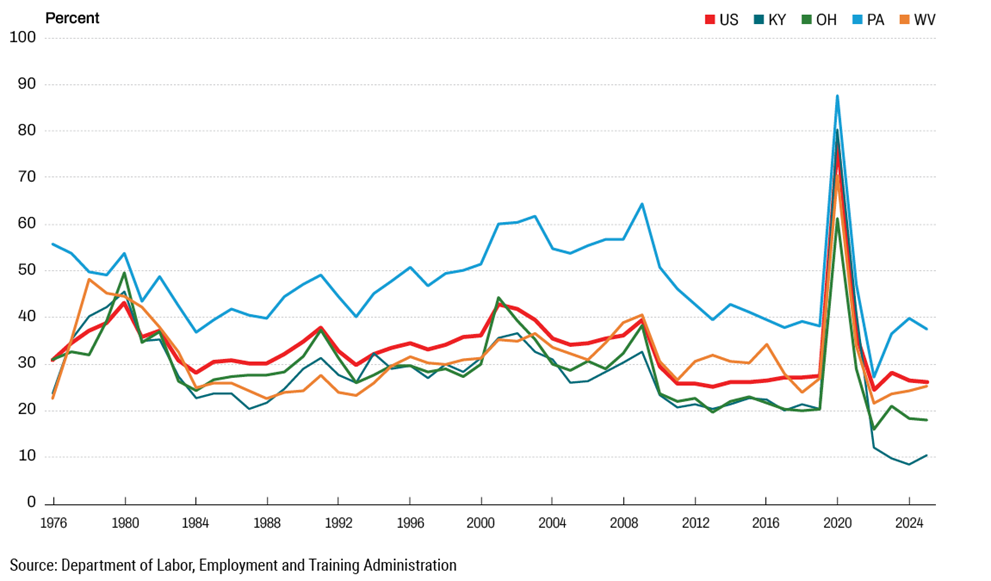
Figure 1 presents annual estimates for the share of unemployed individuals that receive UI benefits in Ohio, Kentucky, Pennsylvania, West Virginia, and nationwide from 1976 through 2025. The national UI recipiency rate remained between 30 and 40 percent of unemployed people from the late 1970s through the 2000s before dropping below 30 percent during the 2010s. This decline aligns with changes in the composition of occupations—which reduced the number of workers eligible for UI—and with policy changes in several states that reduced maximum benefit duration, often from 26 weeks, a standard many states had maintained for decades.9 The national recipiency rate spiked to 77.1 percent in 2020 as emergency programs enacted during the pandemic temporarily expanded eligibility across several dimensions, most notably allowing individuals to receive up to 53 weeks of UI in most states. More recently, the national recipiency rate has stabilized at around 27 percent.
Turning to Fourth District states, Figure 1 shows longstanding differences in UI recipiency rates. In general, Pennsylvania’s recipiency rate is above the national average, West Virginia’s tends to be in line with the average, and Kentucky’s and Ohio’s are below the average. The differences in recipiency rates persist as of 2025, with 37.6 percent of unemployed people in Pennsylvania receiving UI compared to 25.3 percent in West Virginia, 18.1 percent in Ohio, and 10.6 percent in Kentucky.
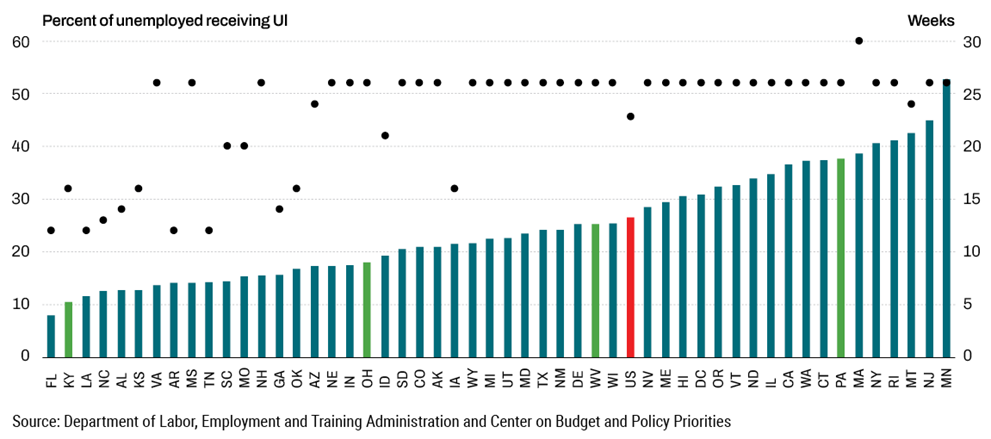
Looking at recipiency rates and maximum weeks of UI eligibility across all 50 states and Washington DC illustrates how state-level policy decisions can impact accessibility. Figure 2 presents the UI recipiency rates along with the maximum number of weeks (black dots, right axis) an individual is eligible for UI in 2025. Note the marked differences in recipiency rates and number of weeks of eligibility across the country. More than 50 percent of unemployed Minnesotans receive UI (the highest rate nationally) compared to 8.1 percent of unemployed Floridians (the lowest). Regarding the duration of UI eligibility, four states—Florida, Louisiana, Arkansas, and Tennessee—limit eligibility to a maximum of 12 weeks (the lowest nationally), while Massachusetts allows for up to 30 weeks (the highest).
The moderate-to-strong correlation (0.61) between the maximum number of weeks of eligibility and recipiency rates supports the notion that increased eligibility promotes increased access. However, the variation in recipiency rates across states with the same maximum number of weeks of eligibility suggests that additional differences in state-level policies may affect whether people receive UI.19 For instance, unemployed individuals in Pennsylvania and Ohio are both eligible for up to 26 weeks, but there was almost a 20 percentage point difference in recipiency rates between the two states in 2025. Given their proximity, one could assume that Ohio and Pennsylvania have similar shares of covered workers and individuals unemployed through “no fault of their own.” However, Ohio has higher employment and earnings requirements than Pennsylvania. An individual is eligible for UI in Ohio after 20 weeks of employment with an average weekly wage of at least $352 compared to 18 weeks with an average weekly wage of at least $116 in Pennsylvania.11 These differences may explain some of the nearly 20 percentage point disparity in UI recipiency between Ohio and Pennsylvania. Another possible reason for the difference in UI recipiency across the two states is that the replacement rate, or the share of previous earnings replaced by UI, tends to be lower in Ohio (43 percent) than Pennsylvania (50 percent).12 However, a more robust analysis would be required to understand how much of that disparity can be accounted for by differences in employment and earnings requirements and by replacement rates across the two states. Similarly, the optimal benefit level or efficacy of specific state-level policies is beyond the scope of this publication.13
Conclusion
This report provides two insights to consider. First, when interpreting weekly UI claims, one must acknowledge that these numbers represent only a fraction of the true unemployment picture. Less than a third of unemployed workers nationally receive UI benefits, with even lower rates in states like Kentucky and Ohio. Second, the disparities between states’ recipiency rates demonstrate how state-level policy choices around eligibility may impact the degree to which unemployed individuals receive support while searching for work. Combining these insights with the notion that younger, less educated, and minority populations tend to believe they are ineligible for UI at higher rates suggests that these populations are less likely to show up in the weekly numbers, potentially further distorting our understanding of labor market conditions. It also points to the idea that changes in state-level policy around eligibility can greatly impact the degree to which these already-disadvantaged populations receive support while searching for work.
Endnotes
- Horwich, Jeff. 2023. Should People with Limited Work History Qualify for Unemployment Insurance?. Federal Reserve Bank of Minneapolis. https://www.minneapolisfed.org/article/2023/should-people-with-limited-work-history-qualify-for-unemployment-insurance.
Michaud, Amanda. 2025. Expanding Unemployment Insurance Coverage. Institute Working Paper No. 67. Opportunity & Inclusive Growth Institute, Federal Reserve Bank of Minneapolis. https://doi.org/10.21034/iwp.67.
Forsythe, Eliza, and Hesong Yang. 2022. Understanding Disparities in Unemployment Insurance Recipiency. Working Paper. Washington Center for Equitable Growth. https://equitablegrowth.org/working-papers/understanding-disparities-in-unemployment-insurance-recipiency/. Return to 1 - US Bureau of Labor Statistics. 2023. “Most Unemployed People in 2022 Did Not Apply for Unemployment Insurance Benefits.” The Economics Daily, April 14, 2023. https://www.bls.gov/opub/ted/2023/most-unemployed-people-in-2022-did-not-apply-for-unemployment-insurance-benefits.htm. Return to 2
- Chiarenza, Gabriella. 2026. “Why Don’t More out-of-Work People Receive Unemployment Insurance?” Fed Communities, February 24. https://fedcommunities.org/why-dont-more-out-work-people-receive-unemployment-insurance/. Return to 3
- Gould-Werth, Alix, and H. Luke Shaefer. 2012. “Unemployment Insurance Participation by Education and by Race and Ethnicity.” Monthly Labor Review, October 2012. https://www.bls.gov/opub/mlr/2012/10/art3full.pdf.
Forsythe, Eliza, and Hesong Yang. 2022. Understanding Disparities in Unemployment Insurance Recipiency. Working Paper. Washington Center for Equitable Growth. https://equitablegrowth.org/working-papers/understanding-disparities-in-unemployment-insurance-recipiency/. Return to 4 - Self-employed, independent contractors and “gig” workers are not eligible to receive UI. For more information about UI programs, see
Employment and Training Administration (ETA). n.d. What Is Unemployment Insurance (UI)? US Department of Labor. https://oui.doleta.gov/unemploy/docs/factsheet/UI_Program_FactSheet.pdf.
Employment and Training Administration (ETA). 2026a. “State Unemployment Insurance Benefits.” US Department of Labor, February 19. https://oui.doleta.gov/unemploy/uifactsheet.asp. Return to 5 - Narayan, Ayushi, and Ryan Nunn. 2025. How Unemployment Insurance Access and Benefits Vary by State. Federal Reserve Bank of Minneapolis. https://www.minneapolisfed.org/article/2025/how-unemployment-insurance-access-and-benefits-vary-by-state. Return to 6
- The maximum number of weeks is typically extended during recessions. Return to 7
- Data used in this analysis retrieved from https://oui.doleta.gov/unemploy/chartbook.asp and
https://www.cbpp.org/research/economy/how-many-weeks-of-unemployment-compensation-are-available. Return to 8 - O’Leary, Christopher, Kenneth Kline, Thomas Stengle, and Stephen Wandner. 2023. Why Are Unemployment Insurance Claims So Low? Working Paper No. 23-383. W.E. Upjohn Institute for Employment Research. https://doi.org/10.17848/wp23-383.
National Employment Law Project (NELP). 2023. Benefit Duration. Policy Advocacy Brief. https://www.nelp.org/insights-research/benefit-duration/. Return to 9 - Narayan, Ayushi. 2025. Administrative Processes Shape Unemployment Insurance Access. Federal Reserve Bank of Minneapolis. https://www.minneapolisfed.org/article/2025/administrative-processes-shape-unemployment-insurance-access.
Hogan, Mary, and Amalea Jubara. 2025. How Low-Income Women Experience the Unemployment Insurance System. Federal Reserve Bank of Minneapolis. https://www.minneapolisfed.org/article/2025/how-low-income-women-experience-the-unemployment-insurance-system. Return to 10 - Ohio Department of Job and Family Services. 2026. Worker’s Guide to Unemployment Insurance: A Guide to Unemployment Benefits in Ohio. https://www.odjfs.state.oh.us/forms/num/JFS55213/pdf/.
Commonwealth of Pennsylvania Department of Labor and Industry. n.d. “Eligibility Information.” Accessed April 17, 2026. https://www.pa.gov/agencies/dli/resources/for-claimants-workers/benefits-information/benefit-guide/eligibility-information. Return to 11 - Employment and Training Administration (ETA). 2026b. “UI Replacement Rates Report.” US Department of Labor, February 19. https://oui.doleta.gov/unemploy/ui_replacement_rates.asp. Return to 12
- A recent working paper from the Federal Reserve Bank of St. Louis considers the optimal UI policy.
Birinci, Serdar, and Kurt See. 2026. The Implications of Labor Market Heterogeneity for Unemployment Insurance Design. Working Paper No. 2024-026F. https://doi.org/10.20955/wp.2024.026. Return to 13
Appendix
Table A1: Unemployment Insurance Recipiency Rates and Maximum Weeks of Eligibility, 2025 (Underlying Data for Figure 2)
| State | Recipiency rate | Maximum weeks of eligibility |
| AK | 21.0% | 26 |
| AL | 12.7% | 14 |
| AR | 14.1% | 12 |
| AZ | 17.3% | 24 |
| CA | 36.6% | 26 |
| CO | 21.0% | 26 |
| CT | 37.4% | 26 |
| DC | 30.9% | 26 |
| DE | 25.2% | 26 |
| FL | 8.0% | 12 |
| GA | 15.6% | 14 |
| HI | 30.6% | 26 |
| IA | 21.5% | 16 |
| ID | 19.3% | 21 |
| IL | 34.7% | 26 |
| IN | 17.5% | 26 |
| KS | 12.8% | 16 |
| KY | 10.6% | 16 |
| LA | 11.7% | 12 |
| MA | 38.6% | 30 |
| MD | 23.5% | 26 |
| ME | 29.4% | 26 |
| MI | 22.5% | 26 |
| MN | 52.7% | 26 |
| MO | 15.4% | 20 |
| MS | 14.1% | 26 |
| MT | 42.5% | 24 |
| NC | 12.6% | 13 |
| ND | 33.9% | 26 |
| NE | 17.3% | 26 |
| NH | 15.6% | 26 |
| NJ | 45.0% | 26 |
| NM | 24.2% | 26 |
| NV | 28.5% | 26 |
| NY | 40.6% | 26 |
| OH | 18.1% | 26 |
| OK | 16.8% | 16 |
| OR | 32.4% | 26 |
| PA | 37.6% | 26 |
| RI | 41.1% | 26 |
| SC | 14.4% | 20 |
| SD | 20.6% | 26 |
| TN | 14.3% | 12 |
| TX | 24.1% | 26 |
| UT | 22.7% | 26 |
| VA | 13.8% | 26 |
| VT | 32.6% | 26 |
| WA | 37.3% | 26 |
| WI | 25.4% | 26 |
| WV | 25.3% | 26 |
| WY | 21.7% | 26 |
| US | 26.5% | 22.8 |
Source: Department of Labor, Employment and Training Administration and Center on Budget and Policy Priorities
References
- Birinci, Serdar, and Kurt See. 2026. The Implications of Labor Market Heterogeneity for Unemployment Insurance Design. Working Paper No. 2024-026F. https://doi.org/10.20955/wp.2024.026.
- Center on Budget and Policy Priorities. 2026. How Many Weeks of Unemployment Compensation Are Available? https://www.cbpp.org/research/economy/how-many-weeks-of-unemployment-compensation-are-available.
- Chiarenza, Gabriella. 2026. “Why Don’t More out-of-Work People Receive Unemployment Insurance?” Fed Communities, February 24. https://fedcommunities.org/why-dont-more-out-work-people-receive-unemployment-insurance/.
- Commonwealth of Pennsylvania Department of Labor and Industry. n.d. “Eligibility Information.” Accessed April 17, 2026. https://www.pa.gov/agencies/dli/resources/for-claimants-workers/benefits-information/benefit-guide/eligibility-information.
- Employment and Training Administration (ETA). 2026a. “State Unemployment Insurance Benefits.” US Department of Labor, February 19. https://oui.doleta.gov/unemploy/uifactsheet.asp.
- Employment and Training Administration (ETA). 2026b. “UI Replacement Rates Report.” US Department of Labor, February 19. https://oui.doleta.gov/unemploy/ui_replacement_rates.asp.
- Employment and Training Administration (ETA). 2026c. “Unemployment Insurance Chartbook.” US Department of Labor, February 19. https://oui.doleta.gov/unemploy/chartbook.asp.
- Employment and Training Administration (ETA). n.d. What Is Unemployment Insurance (UI)? US Department of Labor. https://oui.doleta.gov/unemploy/docs/factsheet/UI_Program_FactSheet.pdf.
- Forsythe, Eliza, and Hesong Yang. 2022. Understanding Disparities in Unemployment Insurance Recipiency. Working Paper. Washington Center for Equitable Growth. https://equitablegrowth.org/working-papers/understanding-disparities-in-unemployment-insurance-recipiency/.
- Gould-Werth, Alix, and H. Luke Shaefer. 2012. “Unemployment Insurance Participation by Education and by Race and Ethnicity.” Monthly Labor Review, October 2012. https://www.bls.gov/opub/mlr/2012/10/art3full.pdf.
- Hogan, Mary, and Amalea Jubara. 2025. How Low-Income Women Experience the Unemployment Insurance System. Federal Reserve Bank of Minneapolis. https://www.minneapolisfed.org/article/2025/how-low-income-women-experience-the-unemployment-insurance-system.
- Horwich, Jeff. 2023. Should People with Limited Work History Qualify for Unemployment Insurance?. Federal Reserve Bank of Minneapolis. https://www.minneapolisfed.org/article/2023/should-people-with-limited-work-history-qualify-for-unemployment-insurance.
- Michaud, Amanda. 2025. Expanding Unemployment Insurance Coverage. Institute Working Paper No. 67. Opportunity & Inclusive Growth Institute, Federal Reserve Bank of Minneapolis. https://doi.org/10.21034/iwp.67.
- Narayan, Ayushi. 2025. Administrative Processes Shape Unemployment Insurance Access. Federal Reserve Bank of Minneapolis. https://www.minneapolisfed.org/article/2025/administrative-processes-shape-unemployment-insurance-access.
- Narayan, Ayushi, and Ryan Nunn. 2025. How Unemployment Insurance Access and Benefits Vary by State. Federal Reserve Bank of Minneapolis. https://www.minneapolisfed.org/article/2025/how-unemployment-insurance-access-and-benefits-vary-by-state.
- National Employment Law Project (NELP). 2023. Benefit Duration. Policy Advocacy Brief. https://www.nelp.org/insights-research/benefit-duration/.
- Ohio Department of Job and Family Services. 2026. Worker’s Guide to Unemployment Insurance: A Guide to Unemployment Benefits in Ohio. https://www.odjfs.state.oh.us/forms/num/JFS55213/pdf/.
- O’Leary, Christopher, Kenneth Kline, Thomas Stengle, and Stephen Wandner. 2023. Why Are Unemployment Insurance Claims So Low? Working Paper No. 23-383. W.E. Upjohn Institute for Employment Research. https://doi.org/10.17848/wp23-383.
- US Bureau of Labor Statistics. 2023. “Most Unemployed People in 2022 Did Not Apply for Unemployment Insurance Benefits.” The Economics Daily, April 14, 2023. https://www.bls.gov/opub/ted/2023/most-unemployed-people-in-2022-did-not-apply-for-unemployment-insurance-benefits.htm.
Suggested Citation
Fee, Kyle D. 2026. “What Share of Unemployed People in Fourth District States Receive Unemployment Insurance?” Federal Reserve Bank of Cleveland, Community Development Reports. https://doi.org/10.26509/frbc-cd-20260701
Related resources

Community Development
Supporting low- and moderate-income communities in the Fourth District is a cornerstone of our mission at the Cleveland Fed. Find out how our Community Development team is promoting access to good jobs, housing, and credit for the residents within our district.

About Us
The Federal Reserve Bank of Cleveland (commonly known as the Cleveland Fed) is part of the Federal Reserve System, the central bank of the United States.