

- Share
Dollars and Cents: Real Hourly Wage Growth across the Lower Half of the Wage Distribution
This report analyzes real dollar differences across the lower half of the US wage distribution to shed light on the financial health of low- and moderate-income people and their households.

The views expressed in this report are those of the author(s) and are not necessarily those of the Federal Reserve Bank of Cleveland or the Board of Governors of the Federal Reserve System.
Introduction
Strong nominal wage growth among lower-wage workers was one of the defining characteristics of the US labor market coming out of the COVID-19 pandemic.1 The Federal Reserve Bank of Atlanta’s Wage Growth Tracker shows that nominal year-over-year growth for the lower half of the wage distribution was north of 7.0 percent in late 2022 and early 2023. However, elevated inflation rates eroded these nominal wage gains, such that the financial well-being of low- and moderate-income (LMI) people continues to decline, according to a regular survey of Fourth District community-based organizations.2 Despite this dour sentiment, recent Cleveland Fed research shows that even after accounting for elevated inflation rates, the purchasing power for the bottom 40 percent of workers increased by about 4.5 percent from 2019 to 2024.3 But what does an additional 4.5 percent of purchasing power mean in the context of household budgets that are based on dollars and cents? And is this better or worse than would be expected based on real wage trends prior to the pandemic?
This report analyzes real dollar differences across the lower half of the national wage distribution from 2015:Q1 through 2025:Q3 to better illustrate the financial health of LMI people and their households. Focusing on real wage growth in terms of actual dollars and cents shows that even though nominal wage gains can appear substantial, they may not translate into meaningful financial gains when accompanied by rising price levels. This analysis also incorporates a counterfactual based on trends in real wage gains prior to the pandemic (2015:Q1 through 2019:Q4) to determine if current real wage levels are above or below what would be expected.
Key Findings
- Real wages among workers in the bottom half of the wage distribution did not increase throughout the entire period analyzed. On net, real hourly wages rose by $1.34, $1.49, and $1.75 at the 10th, 25th, and 50th percentiles, respectively, from 2020:Q1 through 2025:Q3.
- The current levels of real hourly wages for workers in the bottom half of the wage distribution are below what would be expected based on prepandemic trends. Real hourly wage gains from 2015 to 2020 were $0.37, $0.41, and $0.66 larger than gains from 2020 through 2025:Q3 at the 10th, 25th, and 50th percentiles of the wage distribution.
- From 2020:Q1 through 2025:Q3, workers at the 10th percentile saw real wages grow more than twice as fast as workers at the 90th percentile in terms of percentage changes (9.7 percent versus 4.5 percent). However, workers at the 90th percentile saw real hourly wages grow more than twice as much as workers at the 10th percentile in terms of dollars and cents ($3.09 versus $1.34).
Data
The data in this analysis for the 10th, 25th, and 50th wage percentiles are from the Usual Weekly Earnings of Wage and Salary Workers series, which is based on the Current Population Survey (CPS). This series, produced quarterly by the Bureau of Labor Statistics, represents the perspectives of individuals or workers, as earnings information is self-reported.4 The weekly data are converted to an hourly rate by dividing weekly values by 40 hours, then converted to 2024 dollars using the Federal Open Market Committee’s preferred measure of inflation, the Personal Consumption Expenditures: Chain-type Price Index. The data are then smoothed using a four-quarter moving average.
One benefit of using this data series is that the dollar values are observable. Figure 1 presents real hourly wages at the 10th, 25th, and 50th percentiles from 2001 through 2025:Q3. There are a few things to point out about the data before jumping into the analysis. Note that the bottom half of the wage distribution includes all workers making less than $30 an hour in 2025. Next, notice that real wages in the bottom half of the wage distribution were relatively flat from 2001 to the mid-2010s. As such, this analysis concentrates on the most recent 10 years of available data to allow prepandemic trends in wages and inflation to be part of the discussion. The prepandemic trends are estimated for each percentile using data from 2015:Q1 through 2019:Q4 to establish a linear trend line that can be carried forward and used as a counterfactual. Lastly, real wage growth peaked in 2021:Q1; note that this occurred after relatively low rates of inflation in 2019 and 2020 and prior to the elevated inflation and nominal wage growth observed during the pandemic.
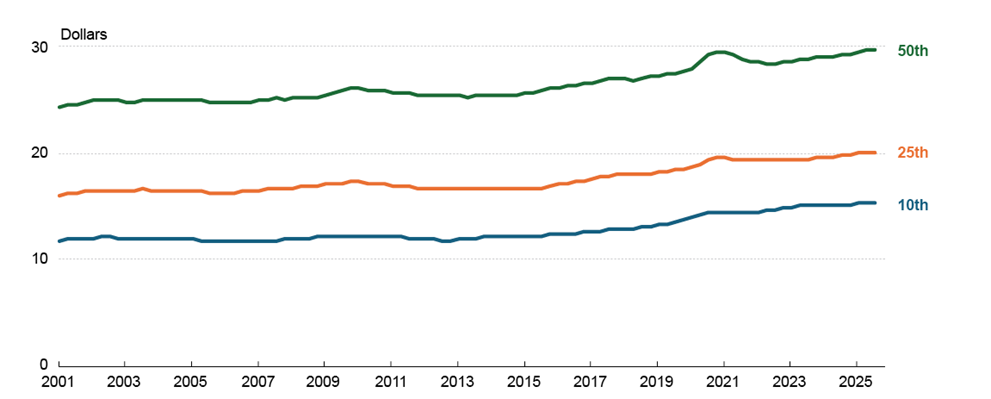
Sources: Bureau of Labor Statistics, Bureau of Economic Analysis, and author’s calculations
Findings
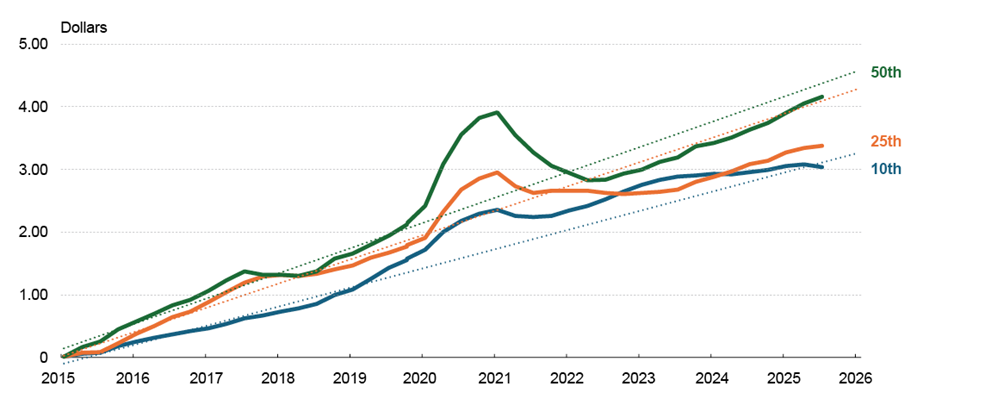
A cumulative measure of real hourly wage changes helps to better illustrate the collective impact of wage increases over time. Figure 2 presents the cumulative real hourly wage changes across the lower half of the wage distribution from 2015:Q1 through 2025:Q3. Real wages among workers in the bottom half of the wage distribution did not increase throughout the entire period analyzed. Qualitatively, the data follow a pattern of consistent prepandemic wage gains, followed by an acceleration of those gains in 2019 and 2020 before a peak in 2021:Q1. There is some variability in what happens next, but generally, the magnitude of real wage declines is larger—and the length of time needed to return to peak levels is longer—at higher wage rates. An additional takeaway is that, at current levels, real wage gains are below what would be expected based on prepandemic trajectories for workers in the bottom half of the wage distribution, as the combination of moderate nominal wage growth and relatively low inflation rates experienced in the late 2010s supported real wage growth during that period.
- Starting with workers at the 10th percentile of the wage distribution, gradual increases in real wages during the latter half of the 2010s resulted in cumulative real hourly wage growth of $1.71 by 2020. Cumulative real hourly wage gains continued until they peaked at $2.35 in 2021:Q1, after which they declined briefly before returning to that same level in 2022:Q1. Following gradual increases throughout 2022 and 2023, cumulative real hourly wage gains at the 10th percentile have been stable at around $3.00 (plus or minus 10 cents) since 2023:Q4. Most recently, from 2025:Q2 to 2025:Q3, real hourly wages declined by $0.04, causing cumulative real hourly wage gains to fall to $3.05. This is notable in that it marks the first decline in real wages at the 10th percentile outside of the pandemic since 2014:Q4. It also brings cumulative real wage gains for this percentile below what would be expected based on prepandemic trends after years of their being ahead of trend.
- Moving on to the 25th percentile, a somewhat different pattern emerges for cumulative real wage changes. Workers at this percentile experienced stronger prepandemic real hourly wage gains than workers at the 10th percentile, with the gains totaling $1.90 by 2020. These gains accelerated in 2020 until they peaked at $2.96 in 2021:Q1. Real hourly wages then declined by $0.35 before consistently growing again in 2023, with cumulative real hourly wage gains eventually returning to $2.96 in mid-2024. Despite continued growth through 2025:Q3, these gains remain more than $0.60 below what would be expected based on prepandemic trends.
- For workers at the 50th percentile, or those earning the median wage, cumulative real wage growth follows a pattern similar to that for workers at the 25th percentile. Real hourly wage gains for the median worker were strong in the late 2010s and accelerated in 2020. After peaking in 2021:Q1, real hourly wages declined markedly, falling by more than $1.00 before returning to growth in 2022. Consistent real wage gains followed in 2023 and 2024, but real wages for workers at the 50th percentile would not return to local peak levels until 2025:Q2. Recent strong wage gains have narrowed the gap between actual real wage levels and what one would expect if prepandemic trends had continued. However, cumulative real wage gains for the median worker as of 2025:Q3 remain below what would be expected.
Sources: Bureau of Labor Statistics, Bureau of Economic Analysis, and author’s calculations
Note: Dotted lines represent the 2015:Q1–2019:Q4 trends for each percentile if they were carried forward into the future.
A closer look at the cumulative real wage gains from the pre- and post-2020 periods confirms that dollars-and-cents real wage gains were larger in the prepandemic period. Table 1 presents the real wage gains in terms of (1) dollars-and-cents increases and (2) percentage growth for the pre- and post-2020 periods across the full wage distribution. Real hourly wage gains from 2015 to 2020 were $0.37, $0.41, and $0.66 larger than gains in the post-2020 period at the 10th, 25th, and 50th percentiles. While not the focus of this analysis, higher-wage workers also benefited more in the prepandemic period. Note that the dollars-and-cents real wage increase seen by wage earners at the 90th percentile during the pre-2020 period alone was larger than that seen by the bottom 75 percent of wage earners during the pre- and post-2020 periods combined.
Based on the data shown in Table 1, the real wage growth seen during the pandemic period may not have provided financial gains as meaningful as those suggested by relatively higher percentage changes. For example, from 2020 through 2025:Q3, the median worker gained an additional $14 over an eight-hour shift compared to only $10.72 for workers at the 10th percentile, despite both seeing real wages grow more than 6 percent. Looking at the data for the top half of the wage distribution also illustrates that, although percentage gains can appear substantial from relatively low starting values, the absolute dollar value of these increases can tell a fundamentally different story. Focusing on the pandemic period, workers at the 10th percentile saw real wages grow more than twice as fast (9.7 percent versus 4.5 percent) as workers at the 90th percentile in terms of percentage changes. However, workers at the 90th percentile saw real wages grow more than twice as much ($3.09 versus $1.34) as workers at the 10th percentile in terms of dollars and cents.5
Table 1. Real Wage Gains Pre- and Post-2020 by Percentile (2024$)
| 10th | 25th | 50th | 75th | 90th | ||
| 2015 to 2020 | $ | 1.71 | 1.90 | 2.41 | 3.92 | 7.46 |
| % | 14.0 | 11.4 | 9.5 | 9.7 | 12.2 | |
| 2020 through 2025:Q3 | $ | 1.34 | 1.49 | 1.75 | 2.51 | 3.09 |
| % | 9.7 | 8.0 | 6.3 | 5.7 | 4.5 |
Sources: Bureau of Labor Statistics, Bureau of Economic Analysis, and author’s calculations
Conclusion
This report presents a dollars-and-cents perspective on real wage growth that helps to reconcile high nominal wage growth rates experienced during the pandemic among lower-wage workers with the continued financial struggles of LMI people and households. The analysis also highlights that the late 2010s outperformed the pandemic period in terms of dollars-and-cents real wage gains among lower-wage workers while underscoring the importance of looking beyond percentage-based metrics when evaluating economic progress.
Endnotes
- Autor, Dube, and McGrew (2023); Carroll and Walker (2025); deCourcy and Gould (2024); Venkatu (2024). Return to 1
- The Financial Well-being diffusion index from the Community Issues and Insights survey continues to show that over 70 percent of respondents indicated a decrease in the financial well-being of LMI people they serve. https://www.clevelandfed.org/publications/community-issues-and-insights. Return to 2
- Luduvice, Truss-Williams, and Walker (2025) find that the cumulated growth in purchasing power for the bottom 40 percent of workers was 4.5 percentage points from 2019 to 2024, which translates to roughly a 4.5 percent increase in purchasing power. Return to 3
- Data measure usual hourly and weekly earnings of wage and salary workers. All self-employed persons are excluded, regardless of whether their businesses are incorporated. Data represent earnings before taxes and other deductions and include any overtime pay, commissions, or tips usually received. Wage and salary workers are workers who receive wages, salaries, commissions, tips, payment in kind, or piece rates. Learn more about CPS earnings concepts and definitions. Return to 4
- Despite using different data and metrics, these numbers are qualitatively similar to those found in Luduvice, Truss-Williams, and Walker (2025). The percentage-change estimates in this analysis are larger in magnitude because a common deflator (PCE) was used for all percentiles, whereas Luduvice, Truss-Williams, and Walker (2025) incorporated a BLS version of the CPI designed to measure the inflation experienced by households across the income distribution, the R-CPI-I. Estimates included in this report would likely be smaller if the R-CPI-I were used, as that index shows that the bottom 40 percent of households experienced higher inflation rates than average from 2022 to 2024. Return to 5
References
- Autor, David, Arindrajit Dube, and Annie McGrew. 2023. “The Unexpected Compression: Competition at Work in the Low Wage Labor Market.” No. 31010. National Bureau of Economic Research. https://doi.org/10.3386/w31010.
- Carroll, Daniel R., and Christopher J. Walker. 2025. “Compression in the Wage Distribution During the Post-Covid-19 Labor Market.” Economic Commentary, no. 2025-06 (April). https://doi.org/10.26509/frbc-ec-202506.
- “Community Issues and Insights.” 2025. Accessed January 23, 2026. https://www.clevelandfed.org/publications/community-issues-and-insights.
- Gould, Elise, and Katherine deCourcy. 2024. “Fastest Wage Growth over the Last Four Years among Historically Disadvantaged Groups: Low-Wage Workers’ Wages Surged after Decades of Slow Growth.” Economic Policy Institute. https://www.epi.org/publication/swa-wages-2023/.
- Luduvice, André Victor D., Anaya Truss-Williams, and Christopher J. Walker. 2025. “Did Inflation Affect Households Differently? A Look at the Postpandemic Inflation and Wage Growth Dynamics.” Economic Commentary, no. 2025-11 (October). https://doi.org/10.26509/frbc-ec-202511.
- US Bureau of Labor Statistics. 2025. “Concepts and Definitions (CPS).” https://www.bls.gov/cps/definitions.htm.
- Venkatu, Guhan. 2024. “Lower-Wage Workers in Ohio Have Seen Strong Wage Gains Since 2019.” Cleveland Fed District Data Brief. Federal Reserve Bank of Cleveland. https://doi.org/10.26509/frbc-ddb-20240903.
Suggested Citation
Fee, Kyle D. 2026. “Dollars and Cents: Real Hourly Wage Growth across the Lower Half of the Wage Distribution.” Federal Reserve Bank of Cleveland, Community Development Reports. https://doi.org/10.26509/frbc-cd-20260218
This work by Federal Reserve Bank of Cleveland is licensed under Creative Commons Attribution-NonCommercial 4.0 International


Related resources

Community Development
Supporting low- and moderate-income communities in the Fourth District is a cornerstone of our mission at the Cleveland Fed. Find out how our Community Development team is promoting access to good jobs, housing, and credit for the residents within our district.

About Us
The Federal Reserve Bank of Cleveland (commonly known as the Cleveland Fed) is part of the Federal Reserve System, the central bank of the United States.