
- Share

How is Inflation Measured?
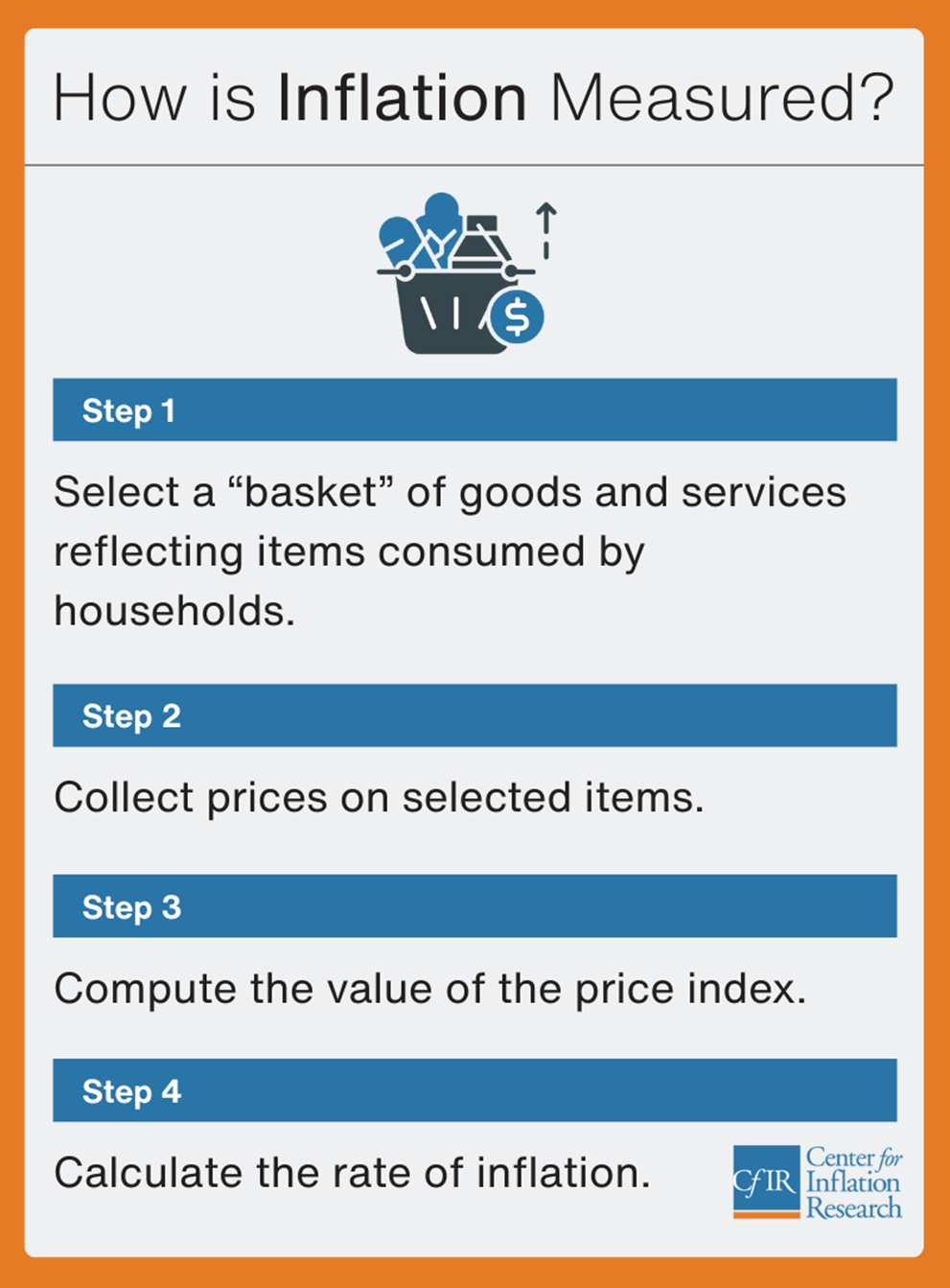
Measuring inflation begins with collecting the prices of a large number of goods and services. In the case of households, government statistical agencies create a “basket” of goods and services that reflects the items consumed by households. The basket does not contain every good or service but is meant to be a good representation of both the types of items and the quantities of items that households typically consume.
Agencies use the basket to construct a price index. First, they determine the current value of the basket by calculating how much the basket would cost at today’s prices (multiplying each item’s quantity by its price today and summing up). Next, they determine the value of the basket by calculating how much the basket would cost in a reference (or base) period (multiplying each item’s quantity by its base-period price). The price index is then calculated as the ratio of the value of the basket at today’s prices to the value at the base-period prices.
There is an equivalent but sometimes more convenient formulation to construct a price index that assigns relative weights to the prices of items in the basket. In the case of a price index for consumers, statistical agencies derive the relative weights from consumers’ expenditure patterns using information from consumer surveys and business surveys.
We provide more details on how a price index is constructed and discuss the two primary measures of consumer prices—the consumer price index (CPI) and the personal consumption expenditures (PCE) price index—on our consumer price data page. Or check out our infographic on the difference between these two key measures of inflation.
A price index does not provide a measure of inflation, but instead provides a measure of the general “price level” compared with that of a base year. The price level is the overall or average cost of goods and services in the economy at a particular time. In other words, the price level measures the general cost of living, while inflation refers to the growth rate (percentage change) of a price index. Watch this video to learn more about the difference between price level and inflation.
To calculate the rate of inflation, the statistical agencies compare the value of the index over some period in time to the value of the index at another comparable period of time, such as month to month, which gives a monthly rate of inflation; quarter to quarter, which gives a quarterly rate; or year to year, which gives an annual rate. It is closely monitored by the Federal Reserve as part of its dual mandate.
In the United States, the statistical agencies that measure inflation include the Bureau of Economic Analysis (BEA) and the Bureau of Labor Statistics (BLS).
Why are there so many price indexes and measures of inflation?
Price indexes track different products and services and weight them differently. These indexes provide information about the price changes experienced by different groups or sectors in an economy.
For example, households are particularly interested in the prices of items they regularly consume, such as food, utilities, and gasoline, while commercial companies are more concerned with the prices of inputs used in production, like the costs of raw materials (coal and crude oil), intermediate products (flour and steel), and machinery.
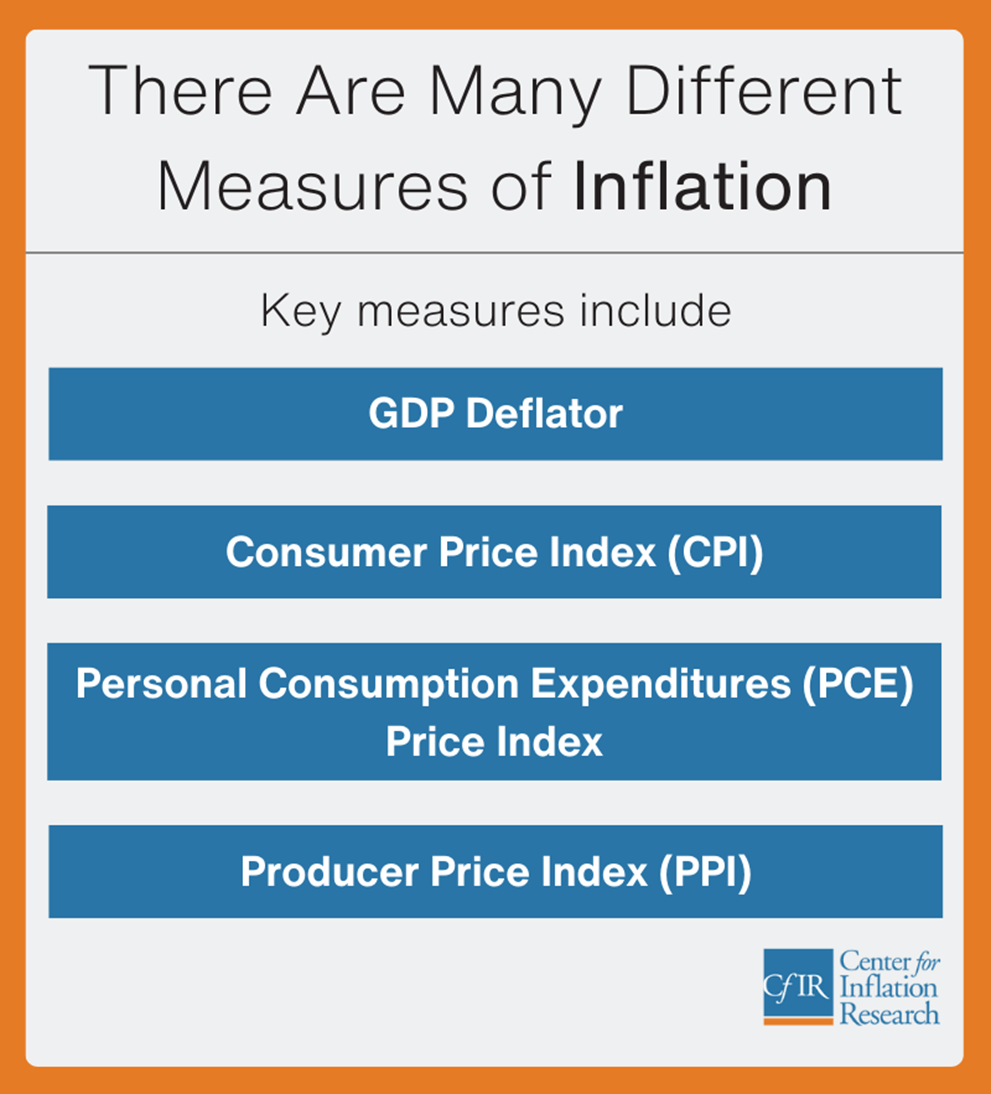
The most broad-based price index is the GDP deflator, which tracks the level of prices related to spending on domestically produced goods and services in an economy in a given quarter. The CPI and the PCE price index focus on baskets of goods and services consumed by households. The producer price index (PPI) focuses on selling prices received by domestic producers of goods and services; it includes many prices of items that firms buy from other firms for use in the production process. Read more detailed descriptions of these price indexes. There are also price indexes for specific items such as food, housing, and energy.
What is "underlying" inflation?
“Underlying inflation” refers to the part of inflation that would prevail if the short-lived effects, sometimes called “noise,” could be removed from the price data.
Some price indexes are designed to provide a general overview of price developments in a broad segment of the economy or at different stages of the production process. Because of their comprehensive coverage, these aggregate (also called “total,” “overall,” or “headline”) price indexes are of considerable interest to policymakers, households, and firms. However, these measures by themselves do not always give the clearest picture of what the more sustained upward movement in the overall level of prices, or underlying inflation, happens to be. This lack of clarity occurs because aggregate measures can reflect events that are exerting only a temporary effect on prices. For example, if a hurricane damages the Florida orange crop, orange prices will be higher for some time. But that higher price will produce only a temporary increase in an aggregate price index and measured inflation. Such limited or temporary effects are sometimes referred to as “noise” in the price data because they can obscure the underlying inflation rate, that is, the price changes that are expected to persist over medium-run horizons of several years.
From the perspective of a monetary policymaker, it is easy to understand the importance of distinguishing between temporary and more persistent (longer-lasting) movements in inflation. If a monetary policymaker viewed a rise in inflation as temporary, then they may decide there is no need to change interest rates, but if they viewed a rise in inflation as persistent, then their recommendation might be to raise interest rates to slow the rate of inflation. Consumers and businesses can also benefit from differentiating between temporary and more persistent movements in inflation. For these reasons, a number of alternative measures have been developed to measure underlying inflation.
How is underlying inflation measured?
One approach to removing noise in price data has been to exclude components that are viewed as the source of noise in aggregate price indexes such as the CPI or PCE price index. Some of these measures of underlying inflation assume the noise is related to the size of price changes (smallest and largest), while others associate the noise with particular items (the most common example is food and energy). The median CPI is an example of the former in that all price changes are excluded from the index except the one in the middle, while core CPI and core PCE are examples of the latter in that both exclude food and energy prices. The consumer price data page talks about underlying inflation measures in more detail. For a quick summary of why policymakers filter out things like food and energy to find underlying inflation, take a look at our infographic.
There are other measures of underlying inflation whose design does not require excluding components. Despite their varied nature, these measures share a common purpose: to provide an estimate of the persistent component of inflation.
What is the connection between the Phillips curve and inflation?
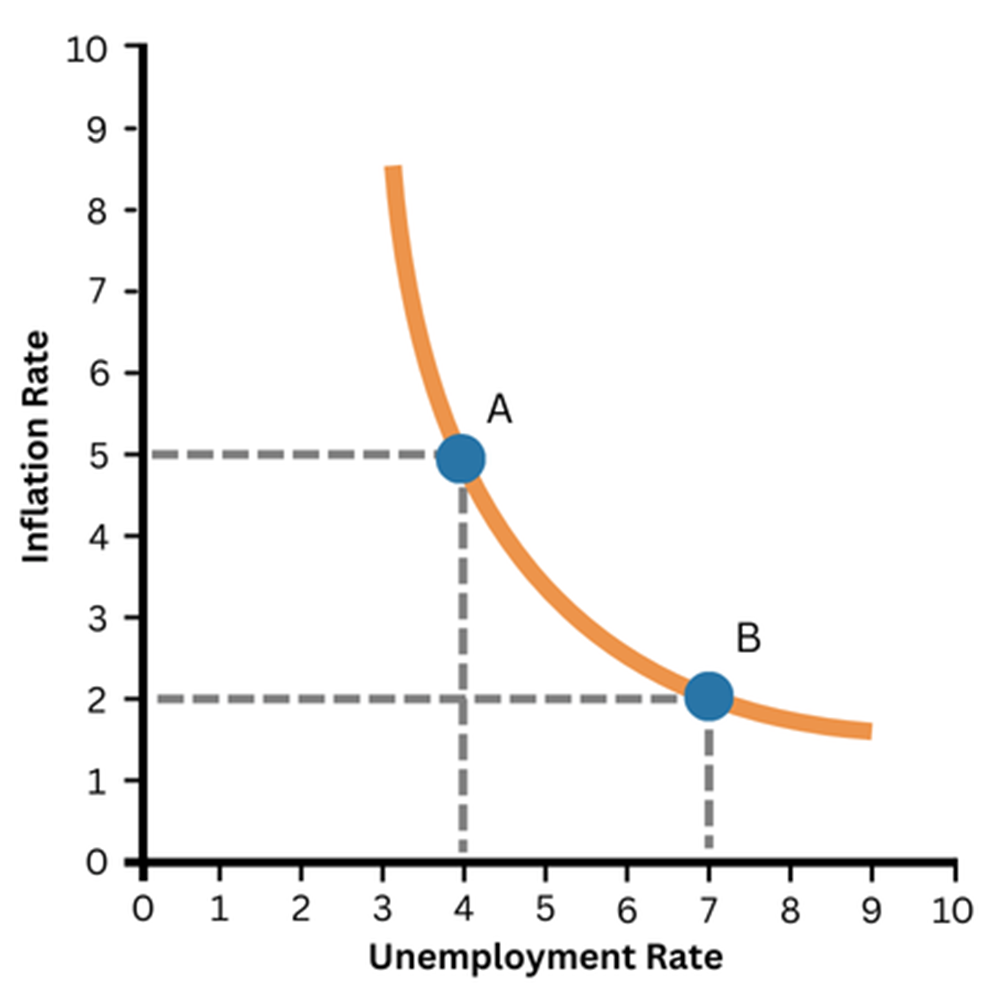
The Phillips curve is named after economist A. W. Phillips, who initially identified the relationship between unemployment and wage inflation in the United Kingdom, and subsequent work extended the idea to inflation as measured by prices as well. The Phillips curve describes the negative relationship between the inflation rate and the unemployment rate. In general, the Phillips curve suggests that inflation is relatively high when the economy is strong and the unemployment rate is low, and inflation is relatively low when the economy is weak and the unemployment rate is high. For example, when the unemployment rate rises, say from 4 percent to 7 percent (moving from point A to point B on the image), inflation tends to fall, in this case from 5 percent to 2 percent.
However, economic conditions are only one of the factors that determine inflation. Some of the other drivers of inflation include changes in energy prices, fluctuations in exchange rates, the productivity of the workforce, and people’s expectations over where inflation is going in the future, among others. For these reasons, inflation may not always be tightly connected to economic conditions and the ups and downs of the business cycle.
What is hyperinflation? What’s the difference between deflation and disinflation? What about stagflation?
If you’ve been hearing different inflation-related terms mentioned on social media or in the news and want to learn more, watch our stop-motion video series. It explains different types of ’flation with everyday items, like potato chips.
What is hyperinflation?
When inflation is extremely high and typically accelerating (prices are rising rapidly and generally at an increasing pace), an economy experiences hyperinflation. This type of episode is usually associated with or can cause social upheaval and civil unrest. The best known example of hyperinflation occurred in Germany between World War I and World War II. More recent examples include Venezuela starting in 2017, Zimbabwe in the 2000s, and Yugoslavia in the 1990s. One common definition of hyperinflation is when the inflation rate is more than 50 percent per month. In some extreme cases, hyperinflation can be so intense that prices double within a matter of days.
What is deflation?
While inflation imposes costs on a society, the opposite scenario, deflation—when the overall price level falls for a sustained period of time—can be costly, too. Deflation can change people’s behavior in ways that hurt the economy. If people think prices will go down in the future, they have less incentive to spend their income now. When prices fall, and people buy less, businesses might need to lower their employees’ wages or even lay off workers. These actions could then set in motion a “deflationary spiral” in which reluctance to spend leads to lower economic activity and a faster decline in prices, with the process then repeating itself.
What is disinflation?
Disinflation refers to a slowdown in the inflation rate, as would be the case if inflation moves from 6 percent to 4 percent. The overall price level is still rising, but at a slower pace than before. That’s different from deflation, which occurs when the overall price level falls for a sustained period of time.
What is stagflation?
While the Phillips curve posits that high inflation tends to occur alongside a strong economy and low unemployment, stagflation refers to the combination of relatively high inflation and a very weak economy with relatively high unemployment. The US experienced two bouts of stagflation during the 1973–1975 and 1980 recessions, when inflation (as measured by the year-over-year change in the CPI) was above 10 percent even as the unemployment rate was rapidly rising. Go to our infographic on stagflation for more information.