

- Share
Reciprocal Deposits: An Update
Reciprocal deposits are deposits exchanged between banks to increase deposit insurance coverage for a depositor. The recently-passed 21st Century ROAD to Housing Act significantly increased the quantity of reciprocal deposits that are not counted as brokered deposits. This Economic Commentary describes the change, how this change increases the deposit insurance limit in practice, and which banks are likely to increase their use of reciprocal deposits as a consequence.


The views authors express in Economic Commentary are theirs and not necessarily those of the Federal Reserve Bank of Cleveland or the Board of Governors of the Federal Reserve System. The series editor is Tasia Hane. This paper and its data are subject to revision; please visit clevelandfed.org for updates.
Introduction
On July 11, 2026, the 21st Century ROAD to Housing Act became law.1 As the title suggests, the law primarily concerns housing. However, it also contains two sections on banking, one of which will have a considerable impact on deposit insurance limits in practice. Specifically, Section 902 of the act significantly increases the quantity of reciprocal deposits that are not treated as brokered deposits. In practice, this change increases deposit insurance coverage for depositors at community and regional banks. This increase should reduce the risk of a run and allow community and regional banks to better compete for large depositors with the largest banks, which are sometimes perceived as being too big to fail.2 However, as with any increase in deposit insurance, the change also reduces market discipline and increases the moral hazard that comes with deposit insurance.3 This Economic Commentary describes this change, identifies which banks are the most affected, and discusses potential implications for reciprocal deposit use.
Reciprocal Deposits and Brokered Deposits
In the United States, the deposit insurance limit is $250,000 per person (or business or other legal entity) at a bank. Since federal deposit insurance was created in the United States in 1934, it has been possible for a person to increase their insurance level by holding deposits at multiple banks, but doing so complicates cash management and is inconvenient. Today, there is an easier way to increase one’s coverage. If a bank participates in a reciprocal deposit network and one agrees to use the service, the bank can exchange one’s deposits over the insurance limit with those of another bank in the network. For example, if a deposit account had a balance of $550,000, only $250,000 of that would be insurable at one’s own bank; however, that bank could exchange another $250,000 with that of another bank and then the remaining $50,000 with yet another bank so that all of the original $550,000 would be insured. From a deposit insurance perspective, it is as if one had three accounts at three different banks, with each deposit under the insurance limit. From the customer’s perspective, the customer deals with only the original bank.
Reciprocal deposits are operated by companies that charge fees to banks that participate in their network. Reciprocal deposits were first introduced by Promontory (now IntraFi) in 2003 for certificates of deposit (CD) (Shaffer, 2012). With developments in technology, these networks are now easier to run and operate than in the past, and today even deposits in transaction accounts can be exchanged. According to the Call Report, 51 percent of US commercial banks held a positive quantity of reciprocal deposits at the end of 2025.
The appeal of reciprocal deposits to a bank lies in that they are an easy way to retain large deposits, particularly for banks that are not large enough to be perceived as too big to fail. There are two costs, though. First, the network provider charges a fee. Doherty and Saretto (2025) report that these fees are on the order of 12 to 15 basis points. Second, reciprocal deposits, subject to an important exception that we will discuss shortly, are treated as brokered deposits.
Brokered deposits are deposits that are placed at banks by some third party (the broker). Often, these deposits are large and are more rate sensitive than traditional deposits. Brokered deposits are considered “hot” money in that they can leave a bank more quickly than a standard deposit. In the 1980s, many bank and thrift failures were connected to brokered deposit use. For this reason, US banking law, regulation, and supervisory practices have made it costly for a bank to rely heavily on brokered deposits.4 These costs include increased deposit insurance assessments, restrictions on a bank’s ability to accept brokered deposits if the bank drops below the designation of “well capitalized,” and heightened supervision.
When reciprocal deposits were first introduced in 2003, the Federal Deposit Insurance Corporation (FDIC) treated all reciprocal deposits as brokered. They were little used initially, but this started to change when the Economic Growth, Regulatory Relief, and Consumer Protection Act of 2018 created an exception for some reciprocal deposits from being counted as brokered deposits. This law exempted a bank’s insured reciprocal deposits up to the lesser of $5 billion or 20 percent of its total liabilities.5 This change led to a small increase in the use of reciprocal deposits by banks, particularly by those with $100 million to $100 billion in assets. However, in 2023 during the banking turmoil associated with the failure of Silicon Valley Bank, the prospect of bank runs increased the demand for insured deposits, and as a result, banks significantly increased their use of them. Figure 1 shows reciprocal deposit use over time by bank size class.
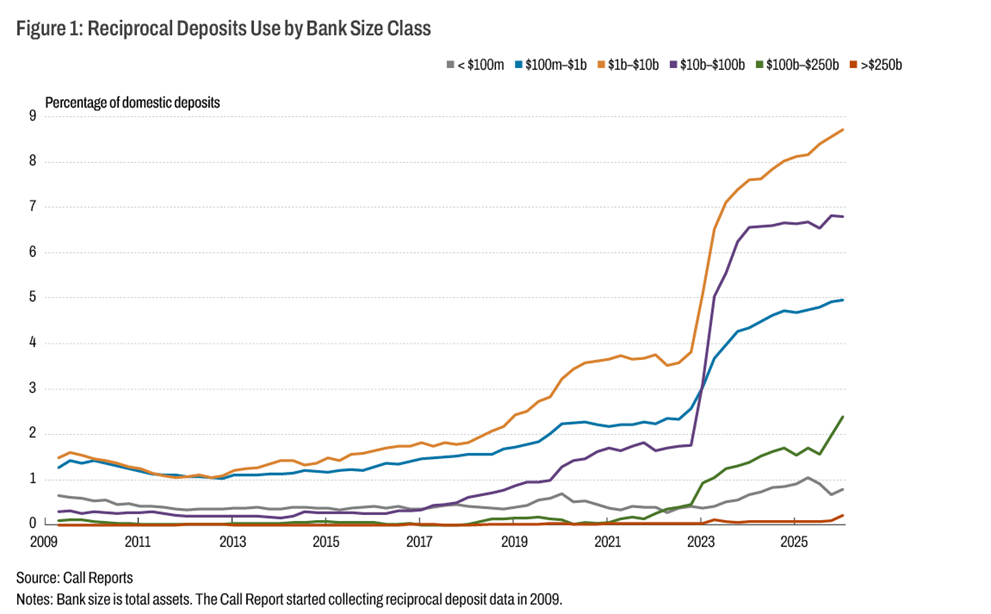
Although the spike in reciprocal deposits in the spring of 2023 was a reaction to banking turmoil, use of this product did not decline after the turmoil passed. Since 2023, reciprocal deposits have increased or leveled off for banks across the size distribution. As a share of total domestic deposits, reciprocal deposits accounted for 2.5 percent as of 2026:Q1, up from 2.1 percent at the end of 2023. The largest use is by banks in the $1 billion to $100 billion range. As we discussed in Prescott and Rosenberger (2024), the largest banks do not use them much because the exception is so small relative to their liabilities and because the market perceives these banks as too big to fail. The smallest banks do not use them much because most of their deposits are already insured.
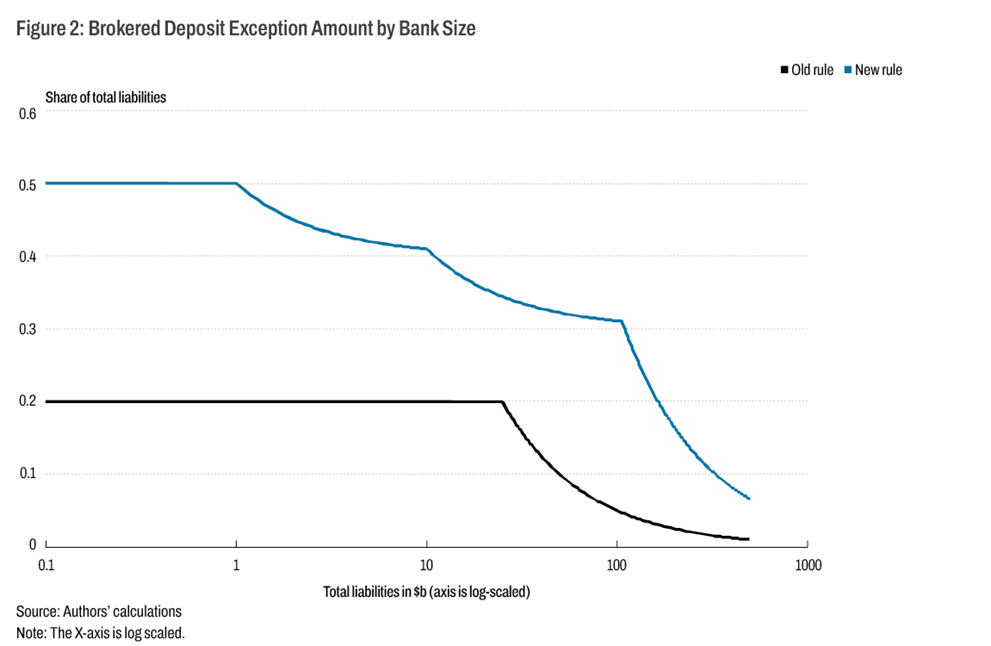
The 21st Century ROAD to Housing Act continues what the 2018 act began by further raising the brokered deposit exception for reciprocal deposits. It changes the exception to the sum of the following three components:
(A) An amount equal to 50 percent of the portion of the total liabilities of the agent institution that is less than or equal to $1,000,000,000.
(B) An amount equal to 40 percent of the portion, if any, of the total liabilities of the agent institution that is greater than $1,000,000,000, but less than or equal to $10,000,000,000.
(C) An amount equal to 30 percent of the portion, if any, of the total liabilities of the agent institution that is greater than $10,000,000,000, but less than or equal to $96,333,333,333.6
The result is a tiered exception structure, with a declining marginal rate in each tier and a cap of about $30 billion. Figure 2 plots the old exception alongside the new one, where both are expressed as a share of total liabilities. Compared with the 2018 law, the new exception is much larger. For example, previously, a $10 billion bank could have no more than $2 billion of its reciprocal deposits be exempt. Under the new law, it can have up to $4.1 billion of these deposits exempt.
Another change in the law is to the definition of an “agent institution.” To be eligible for the brokered reciprocal deposit exception, a bank must qualify as an agent institution. Under the old rule, any insured depository institution was an agent institution if it “is found to have a composite condition of outstanding or good and is well capitalized, or if its total reciprocal deposits do not exceed the average level in the four calendar quarters before the quarter in which it was determined to not have a composite condition of outstanding or good or became less than well capitalized.”7 The composite condition of a bank is another term for a bank’s overall CAMELS rating, which is a supervisory rating that measures the quality of a bank, and “outstanding or good” corresponds to an overall CAMELS rating of 1 or 2, respectively (Federal Register, 2008). The purpose of the old rule was to apply the restrictions of the brokered deposit rules—weak banks are limited on interest rates they can pay on brokered deposits and limited on their ability to rollover and raise new brokered deposits—to a weak bank that used reciprocal deposits. The new rule lowers the composite condition requirement from “a composite condition of outstanding or good” to “a CAMELS rating of 1, 2, or 3.” This change will now allow banks that remain well capitalized but fall to a CAMELS rating of 3 to continue growing reciprocal deposits while taking advantage of the brokered deposit exception.
Which Banks Will Benefit?
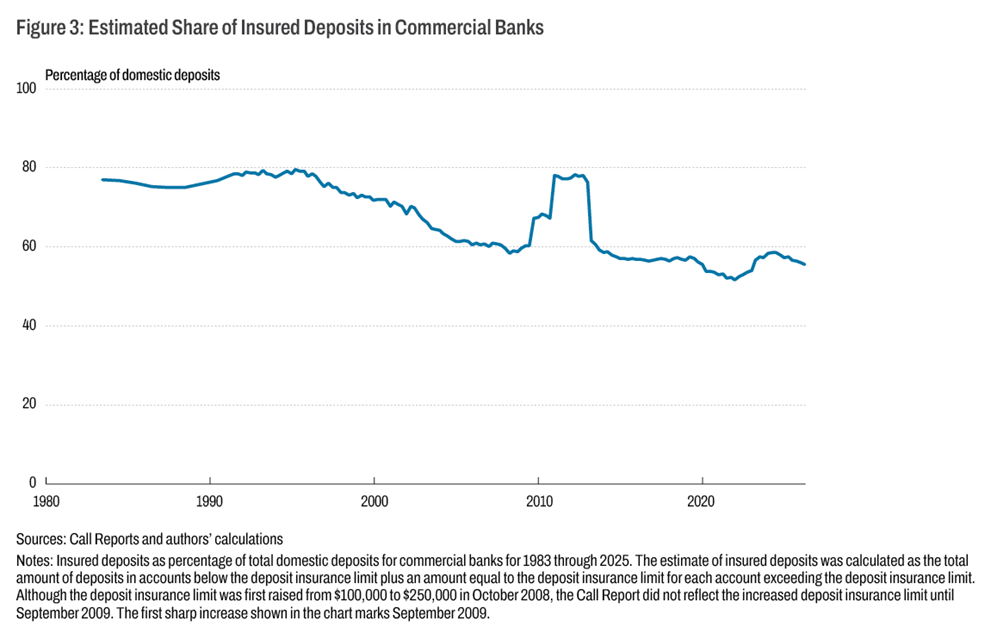
Figure 3 reports the percentage of insured deposits in the commercial banking system from 1983 to 2025.8 The fraction of deposits was close to 80 percent in the mid-1990s and then declined to around 60 percent in the mid-2000s. The sharp increase around 2008 is due to the FDIC’s emergency guarantee of deposits in the fall of 2008 followed by a permanent increase of the deposit insurance limit from $100,000 to $250,000 in 2010.9 The dip starting around 2020 is due to the large increase in deposits from the COVID-19 stimulus. The insured share of deposits increased from 51.9 percent to 54.5 percent in 2023:Q1, coinciding with the banking turmoil of that spring. The share peaked at 56.9 percent in mid-2024 but has dropped back down to 54.0 percent as of 2026:Q1.
The relationship between uninsured deposits and bank size sheds light on the potential impact of the change to the brokered deposit exception. For several asset size classes, Figure 4 reports the average share of deposits that are currently insured or collateralized and what this share would be if uninsured, noncollateralized deposits were converted to reciprocal deposits in an amount up to the bank’s old and new brokered deposit exception. We include collateralized deposits with insured deposits because these deposits are collateralized by securities pledged by a bank, so these deposits are already protected in a bank failure. In the figure, we refer to the sum of insured and collateralized deposits as “protected deposits.”10
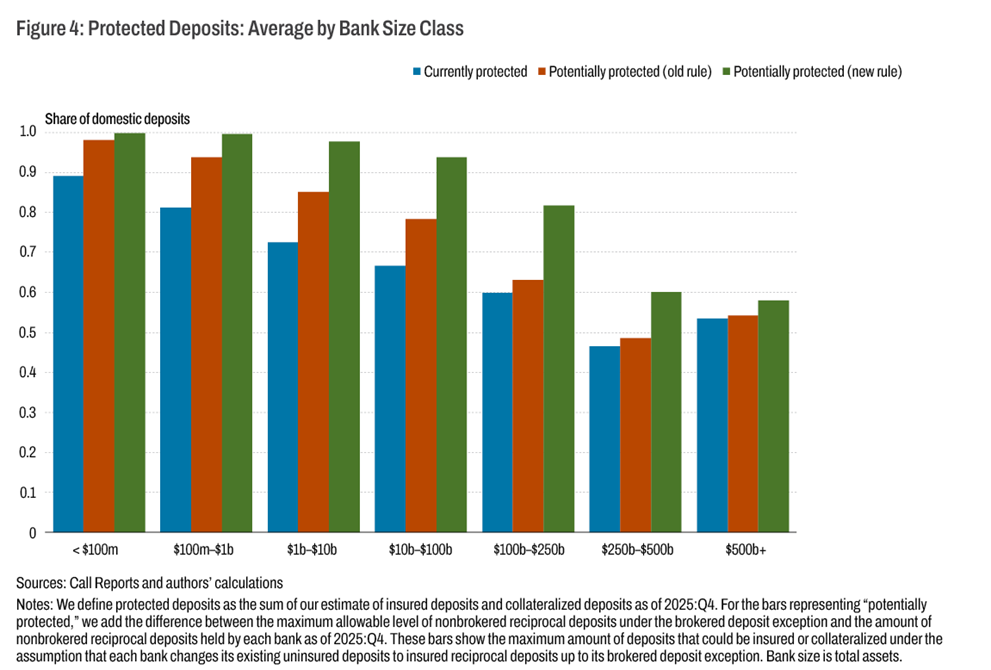
Figure 4 suggests that the legal change would have a limited effect on banks smaller than $1 billion because they could already protect upward of 90 percent of their deposits under the old rule. In contrast, banks in the size classes covering the $1 billion to $250 billion ranges will see large increases in their ability to reduce uninsured deposits by using reciprocal deposits and even banks in the $250 billion to $500 billion size class will see a significant increase. Over $500 billion, the $30 billion exception cap is a proportionally small share of total liabilities, so for these banks the new exception has little effect.
On average, banks did not use nonbrokered reciprocal deposits to the full extent allowed under the old rule. This average reflects the fact that reciprocal deposit use is skewed. Nearly half of banks reported zero reciprocal deposits in 2025:Q4, while the top 10 percent of users reported levels in excess of 15 percent of total deposits. Most of the banks in this top tier of use are not new to reciprocal deposits. Even before the banking turmoil of 2023, reciprocal deposits accounted for 11 percent of total deposits for these banks on average. As of 2025:Q4, the average reciprocal deposit concentration for this group was 23 percent of total deposits, with most near their brokered deposit exception limit. It is possible that in reaction to the increase in the brokered deposit exception these banks will increase their reciprocal deposit use further.
Table 1 reports the average reciprocal deposits concentration and the fraction of banks for which the old exception level on reciprocal deposits was binding, by bank size class.11 Reciprocal deposit reliance is concentrated among banks in the $1 billion to $10 billion and $10 billion to $100 billion groups. In the $100 billion to $250 billion size class, three of the 12 banks are near or above their old caps, which is why the old cap is binding for a quarter of them. However, given that their old cap was $5 billion, the average use of reciprocal deposits is small for this size class.
Table 1: Fraction of Banks for which Reciprocal Deposits Were near or above Their Brokered Reciprocal Deposit Exception as of 2025:Q4
| Size class (in assets) |
Average RD share of deposits | Percentage of banks bound by brokered exception |
| < $100m | 0.6% | 0.4% |
| $100m to < $1b |
3.9% | 5.2% |
| $1b to <$10b |
8.5% | 11.8% |
| $10b to <$100b |
6.7% | 12.6% |
| $100b to <$250b |
1.7% | 25.0% |
| > $250b |
0.2% | 0.0% |
Source: Call Reports
Notes: Reports the average reciprocal deposit share of total deposits and the share of banks with reciprocal deposits of at least 90 percent of the lesser of $5 billion or 20 percent of their liabilities. This reflects the limit on reciprocal deposits that was superseded by Sec. 902 of the 21st Century ROAD to Housing Act. No adjustment is made for banks subject to the special cap (see endnote 11).
In the near future, the increase in the cap will likely affect heavy users the most. With their existing funding strategy already tied to reciprocal deposits, presumably it would be easy for them to increase reciprocal deposits if they choose to do so. For the rest of the banks, given that they are well below their old brokered deposit exception, this suggests that at least in the near future the new exception limit will not affect them. Of course, the increase in the brokered deposit exception might change some banks’ behavior over time. For example, it is plausible that some banks that previously did not use reciprocal deposits that much, particularly if they viewed the old exception as too restrictive, will significantly increase their use of reciprocal deposits in order to attract large depositors. Furthermore, as we observed during the banking turmoil of spring 2023, reciprocal deposit use grew significantly when there was a general concern by depositors about the viability of some banks. Total reciprocal deposits more than doubled in the first half of 2023, with several banks increasing reciprocal deposits to levels that were well above their brokered deposit exception. If another such episode should occur, then we expect use to spike upward again, as we saw in 2023 (Prescott and Rosenberger, 2023).
Conclusion
The 21st Century ROAD to Housing Act increased the quantity of reciprocal deposits that qualify for the brokered deposit exception. In practice, this change represents a significant increase in the deposit insurance coverage for depositors at all but the smallest and very largest banks. While most banks will not be immediately affected by the change, the subset of banks formerly constrained by the brokered deposit exception can now significantly increase reciprocal deposits without bearing the regulatory and supervisory costs associated with brokered deposits. The change may also alter the calculus for banks that have thus far avoided or limited their use of reciprocal deposits. The resulting increase in the effective deposit insurance level for depositors at community and regional banks should reduce run risk and allow these banks to better compete for large depositors with the largest banks. However, as with any increase in deposit insurance, it might also reduce market discipline and increase moral hazard by reducing the incentive large depositors have to monitor their banks.
References
- Barth, James R., Wenling Lu, and Yanfei Sun. 2020. “Regulatory Restrictions on US Bank Funding Sources: A Review of the Treatment of Brokered Deposits.” Journal of Risk and Financial Management 13(6): 130. doi.org/10.3390/jrfm13060130.
- Doherty, Christine, and Alessio Saretto. 2025. “How do Reciprocal Deposits Interact with Deposit Insurance?” Federal Reserve Bank of Dallas, Dallas Fed Economics (August 5). dallasfed.org/research/economics/2025/0805.
- Federal Deposit Insurance Corporation. 2011. “Study on Core Deposits and Brokered Deposits.” Submitted to Congress Pursuant to the Dodd–Frank Wall Street Reform and Consumer Protection Act, July 8, 2011. archive.fdic.gov/view/fdic/6706.
- Federal Register. 2018. Vol. 83, no. 248 (December 28, 2018). fdic.gov/news/board-matters/2018/2018-08-22-notational-fr-c.pdf.
- Kareken, John H. 1983. “Deposit Insurance Reform or Deregulation Is the Cart, Not the Horse.” Federal Reserve Bank of Minneapolis Quarterly Review Spring: 1–9. doi.org/10.21034/qr.721.
- Kim, Edward T., Shohini Kundu, and Amiyatosh Purnanandam. 2024. “The Economics of Network-Based Deposit Insurance” (May 1). Available at SSRN. dx.doi.org/10.2139/ssrn.4813996.
- Nurisso, George C., and Edward Simpson Prescott. 2020. “Origins of Too-Big-to-Fail Policy in the United States.” Financial History Review 27(1): 1–15. doi.org/10.1017/S0968565020000013.
- Prescott, Edward S., and Grant Rosenberger. 2024 “Reciprocal Deposits and the Banking Turmoil of 2023.” Federal Reserve Bank of Cleveland, Economic Commentary, 2024-14. doi.org/10.26509/frbc-ec-202414.
- Shaffer, Sherrill. 2012. “Reciprocal Brokered Deposits and Bank Risk.” Economics Letters 117(2): 383–385. doi.org/10.1016/j.econlet.2012.05.041.
- Stern, Gary, and Ron Feldman. 2009. Too Big to Fail: The Hazards of Bank Bailouts. Washington DC: Brookings Institution Press.
Endnotes
- The text of the law is in 21st Century ROAD to Housing Act, Pub. L. No. 119-101, July 11, 2026. Return to 1
- For more on too big to fail in banking, see Stern and Feldman (2009). For an early history of it, see Nurisso and Prescott (2020). Return to 2
- Articles on the moral hazard of deposit insurance are numerous. Kareken (1983) is an early and accessible one. Return to 3
- For more details on the legal, regulatory, and supervisory treatment of brokered deposits and a discussion of the riskiness of brokered deposits, see Federal Deposit Insurance Corporation (2011); Barth, Lu, and Sun (2020); and our earlier Economic Commentary on reciprocal deposits (Prescott and Rosenberger, 2024). Return to 4
- It is possible that reciprocal deposits could include uninsured deposits, for example, two accounts in two different banks exchange an amount over the $250,000 limit, though we are hard pressed to think of a reason for doing this. Return to 5
- 21st Century ROAD to Housing Act, Pub. L. No. 119-101, § 902 (2026). Return to 6
- 12 U.S.C. § 1831f(i)(2)(A) (2024). Return to 7
- All analysis in this paper is of commercial banks only. This excludes savings banks, savings and loans, credit unions, industrial loan corporations, and branches of foreign banks that have FDIC deposit insurance. Furthermore, some large commercial banks also have significant foreign deposits; these are ineligible for deposit insurance and are excluded from our deposit calculations. Return to 8
- The Call Report did not start using the new $250,000 threshold until September 2009, so the increase shows up in Figure 3 on that date. Additionally, our estimate also leaves out insurance provided by the FDIC’s Temporary Account Guarantee (TAG) program from October 2008 through December 31, 2010. The TAG program provided deposit insurance to all deposits in non-interest-bearing transaction accounts. Bank participation was voluntary, and banks had to pay a fee to participate. The Dodd–Frank Wall Street Reform and Consumer Protection Act of 2010 replaced TAG with an explicit program that covered the same deposits through December 31, 2012. Return to 9
- Under US banking law, with a few minor exceptions, only deposits of public entities such as state and local governments or the federal government can be backed by collateral. While we treat collateralization as a substitute for a reciprocal deposit, it is not a perfect substitute. Collateralizing deposits ties up collateral and requires managing pools of securities to reflect inflows and outflows of payments. Reciprocal deposits save on these costs though at the cost of paying fees to the network provider. Kim, Kundu, and Purnanandam (2024) discuss some of these tradeoffs. Return to 10
- We treat the exception as binding if a bank’s total reciprocal deposits were at least 90 percent of its brokered deposit exception. There is also a special cap on total reciprocal deposits that also applies to banks that are either not well rated or not well capitalized. Roughly, this special cap is the average amount of reciprocal deposits held in the four quarters before the bank stopped being well rated or well capitalized. Banks that exceed the special cap must report all reciprocal deposits as brokered reciprocal deposits. Our calculations in Table 1 make no adjustment for banks subject to the special cap. For details, see FDIC regulations CFR Section 337.6 on brokered deposits. Return to 11
Suggested Citation
Prescott, Edward S., and Grant Rosenberger. 2026. “Reciprocal Deposits: An Update.” Federal Reserve Bank of Cleveland, Economic Commentary 2026-25. https://doi.org/10.26509/frbc-ec-202625
This work by Federal Reserve Bank of Cleveland is licensed under Creative Commons Attribution-NonCommercial 4.0 International


Related resources

About Us
The Federal Reserve Bank of Cleveland (commonly known as the Cleveland Fed) is part of the Federal Reserve System, the central bank of the United States.

Economic Commentaries
Economic Commentaries provide analysis of relevant economic issues and are written for an informed but nonspecialist audience.