

- Share
Examining the Beliefs of Professional Forecasters
This Economic Commentary studies how professional forecasters update their forecasts in response to macroeconomic news. We find that the two most important news releases for how professionals update their short-term forecasts are the unemployment rate and the three-month Treasury bill rate. News about the unemployment rate is particularly important when updating forecasts about real GDP growth or unemployment, whereas news about the short-term Treasury bill rate tends to be more informative for revisions of inflation and three-month Treasury bill rate forecasts.


The views authors express in Economic Commentary are theirs and not necessarily those of the Federal Reserve Bank of Cleveland or the Board of Governors of the Federal Reserve System. The series editor is Tasia Hane. This paper and its data are subject to revision; please visit clevelandfed.org for updates.
Introduction
Economic theory suggests that agents in the economy update their views about the economy as new information, such as data releases about key macroeconomic variables, arrives. This continual stream of economic indicators creates a dynamic environment wherein forecasters must determine the relative importance of various pieces of news when updating previously held forecasts. Understanding how professionals update their belief systems can reveal potential biases in their forecasting processes, highlight which economic indicators are viewed as most informative by professionals, and ultimately improve our understanding of how their expectations are formed. This Economic Commentary explores the extent to which professional forecasters react to news about specific macroeconomic variables and examines the patterns that emerge in forecasters’ revision processes. We rely on data from the Survey of Professional Forecasters in the United States to construct news and forecast revisions about key macroeconomic variables: the inflation rate, the unemployment rate, real GDP growth, and the three-month Treasury bill (TBill) rate. Our analysis highlights two main findings.
First, professionals revise their forecasts most strongly in response to news about the current unemployment rate and short-term TBill rate, whereas news about inflation or real GDP growth has little to no effect on professionals’ forecast updates. Second, news about the unemployment rate is especially informative for updating forecasts about real GDP growth or unemployment itself such that an unanticipated increase in the unemployment rate is associated with a downward forecast revision in the real GDP growth rate and an upward forecast revision in the unemployment rate. On the other hand, news about the three-month TBill rate is particularly important for how professionals update their inflation or TBill rate forecasts. Specifically, an unanticipated increase in the TBill rate is associated with an upward forecast revision of the inflation rate and short-term TBill rate. We use professionals’ forecasts for the three-month TBill rate as a proxy of their federal funds rate forecast. The positive association between news about the TBill rate and inflation forecast revisions would then reflect the information effect, as documented in Nakamura and Steinsson (2018): changes in the TBill rate contain pertinent information about other economic variables, with increases in the TBill rate leading forecasters to believe that the outlook is stronger. Consistent with this view, we find that professional forecasters revise their unemployment outlook downward following an unexpected rise in the TBill rate.
Data
Our analysis focuses on data from the Survey of Professional Forecasters (SPF), a quarterly survey that collects macroeconomic forecasts from a panel of professional economists in the United States, making it one of the oldest continual surveys of macroeconomic expectations in the country. Each quarter, professional economists submit projections for various time horizons for macroeconomic variables, typically including forecasts for the past quarter; current quarter; the next one, two, three, and four quarters ahead; and annual forecasts for the current year, next year, and several years into the future.1 The rich temporal structure allows us to examine how these professional forecasters’ expectations at different horizons respond to new information. We focus on data beginning in the third quarter of 1981 through the third quarter of 2024.2
Each period, we compute the mean h-quarters ahead forecast about inflation, real GDP growth, the unemployment rate, and the three-month TBill rate, where . While professional forecasters in the SPF report forecasts about several measures of inflation, we compute their inflation forecasts implied by their expectations of the GDP price deflator.3 Moreover, we note that the three-month TBill rate is highly correlated with the federal funds rate, set by the Federal Open Market Committee. Since the SPF does not collect forecasts of the federal funds rate, we think of forecasts of the three-month TBill rate as its proxy. The notation for the average h-quarter-ahead forecast about variable x, formed in period t, is given by . News about variable x in period t equals the difference between period t’s realization of x and professionals’ forecast of xt that is reported in the middle of period t, that is, .4 Quarter-ahead forecast revisions at different horizons are computed as the change in the average forecast for a variable at a specific time, that is, . Finally, we construct the average forecast revision over the next year as follows: . Having constructed our news series and forecast revisions at different horizons for each one of our four macroeconomic variables of interest, we next turn to our empirical analysis and results.
Empirical Analysis and Results
We are interested in understanding how news about one variable affects forecasts of other variables. To do so, we employ a two-step analysis. First, we compute raw correlations between quarter-ahead forecast revisions about any variable y and news about any variable x:
(1)
where is the error term and α is a constant term. Our coefficient of interest β represents the change in the current quarter-ahead forecast for variable y in response to current news about variable x. Table 1 reports the OLS estimates of β.
Table 1: Relationship between Forecast Revisions and News
| Revision | ||||
|---|---|---|---|---|
| Real GDP growth | Unemployment | Inflation | Three-month TBill | |
| News | ||||
| Real GDP growth | 0.22*** (0.03) |
-0.16*** (0.03) |
0.02 (0.02) |
0.06*** (0.01) |
| Unemployment | -1.20*** (0.23) |
2.62*** (0.10) |
-0.20* (0.11) |
-0.54*** (0.09) |
| Inflation | 0.02 (0.05) |
-0.14*** (0.05) |
0.09*** (0.02) |
0.05*** (0.02) |
| Three-month TBill | 0.71*** (0.13) |
-0.76*** (0.11) |
0.20*** (0.06) |
0.67*** (0.02) |
Note: The table reports the OLS estimates of β in equation (1).
We find that professionals’ quarter-ahead forecasts are particularly sensitive to news about the unemployment rate and the short-term TBill rate. When the unemployment rate is higher than expected, forecasters revise downward their quarter-ahead expectations for real GDP growth, inflation, and interest rates, but they revise upward their quarter-ahead expectations for the unemployment rate. This result is consistent with professional forecasters’ having a demand-side view of the economy, as documented in Candia, Coibion, and Gorodnichenko (2023).5 If the three-month TBill rate is higher than expected, forecasters revise upward their expectations for real GDP growth, inflation, and future interest rates, and revise downward their expectations for the unemployment rate.6 On the other hand, we find that news about inflation or real GDP growth has a relatively small effect on professionals’ quarter-ahead forecast updates.
We then consider a richer setting: we regress the average forecast revisions of variable y on news about any of the four variables, that is, real GDP growth, the unemployment rate, inflation, and three-month TBill rate:
(2)
Our coefficients of interest , , , and capture the associations between forecast revisions of variable y and news about real GDP growth, unemployment rate, inflation, and the three-month TBill rate, respectively; α is a constant term, and is an error term. Because news about different variables is likely correlated with one another, we estimate equation (2) using the least absolute shrinkage and selection operator (LASSO) technique.7 This prevents the model from being too sensitive to the data (overfitting), and it sets the weight of irrelevant news to 0.
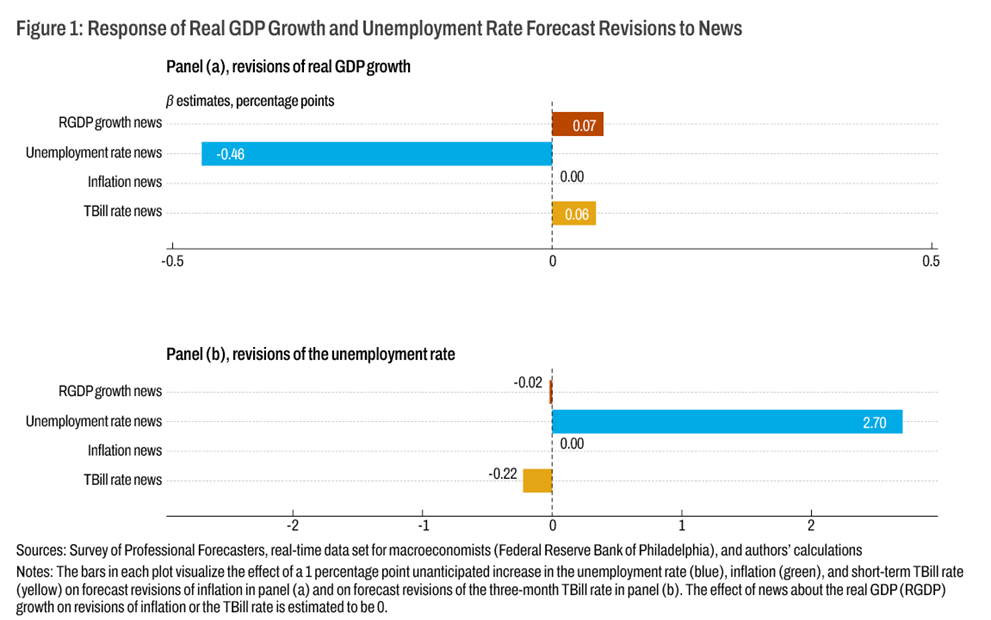
We summarize our findings in Figures 1 and 2. Each subplot reports the optimal β estimates resulting from the LASSO technique applied to equation (2). Figure 1 reports the β estimates pertaining to forecast revisions in real GDP growth and unemployment, whereas Figure 2 plots the estimates related to forecast revisions in the inflation and three-month TBill rates.8 The figures highlight two key findings. First, news about the unemployment rate or the short-term TBill rate is the relatively more important news in terms of professionals’ updating their forecasts, while news about inflation or the real GDP growth has little to no effect on professionals’ forecast updates.
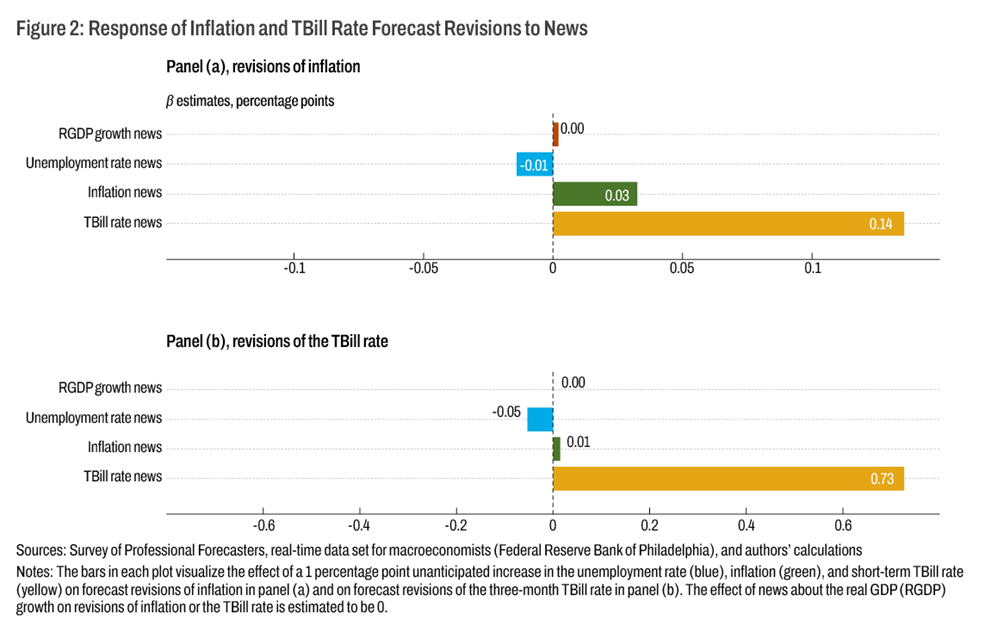
Second, news about the unemployment rate carries a particularly important weight when professionals update their annual forecasts about real GDP growth or unemployment itself, whereas news about the three-month TBill rate is important for how professionals update their inflation or TBill rate forecasts. A 10-basis-point increase in the unemployment rate is associated with 4.6-basis-point decrease in the forecast for year-ahead annual real GDP growth and with a 27-basis-point increase in the average forecast for the unemployment rate in the next year. The latter effect is relatively big, and it could reflect the fact that, historically, once unemployment has started to increase, the sustained rise has been generally steep. On the other hand, news about the short-term TBill rate carries a relatively higher importance for updates of inflation or TBill rate forecasts. Specifically, a 1 percentage point unanticipated increase in the TBill rate is associated with a 14-basis-point increase in the forecast for the year-ahead annual inflation rate and with a 73-basis-point increase in the average forecast for the TBill rate during the next year. As we argued earlier, the effects of news about the short-term TBill rate are likely a reflection of the information effect discussed in Nakamura and Steinsson (2018). Namely, if professionals associate a positive surprise in the TBill rate with an unexpected increase in the federal funds rate, they might interpret that to mean that policymakers anticipate a stronger economy featuring stronger real GDP growth, a lower unemployment rate, or higher inflation. This interpretation can prompt professionals to revise their own forecasts and report higher real GDP forecasts and lower unemployment rate forecasts. Consistent with this view, Figure 1 shows that an unexpected rise in the TBill rate is associated with a slight downward revision of the unemployment forecast but an upward revision of the real GDP growth outlook.9
Finally, our results indicate that inflation news has little effect on professionals' outlook for real activity, and unemployment news has little bearing on their inflation outlook. This contrasts with some existing findings in the literature that look at the correlation between inflation and real GDP growth forecasts for consumers and firms in the United States. For instance, Kamdar (2019) finds that US consumers associate higher future inflation with lower real GDP growth, whereas Candia et al. (2026) document a negative correlation between firms’ inflation and real GDP growth outlooks in the United States.10 Consistent with the results of this Economic Commentary, Candia et al. (2023) document a weak link between inflation and the real GDP growth outlook of professional forecasters in the Livingston survey.
Conclusion
Our analysis reveals patterns in how professional forecasters update their forecasts in response to macroeconomic news. The evidence demonstrates that forecasters are particularly responsive to surprises in unemployment and the three-month TBill rate, with these variables serving as powerful signals that trigger substantial revisions across multiple forecast dimensions. When the rate of unemployment is higher than expected, forecasters revise downward their outlook for real GDP growth and upward their unemployment outlook. On the other hand, and what is likely a reflection of the information effect, we find that unexpected increases in the three-month TBill rate lead professionals to anticipate higher future inflation and TBill rates but lower future unemployment. While the literature has documented a strong, negative link between firms’ or consumers’ outlooks for inflation and real GDP growth, we find a weak relationship between professionals’ outlook for inflation and real GDP growth.
This Economic Commentary sheds new light on modeling expectations formation processes that, as economic theory shows, affect macroeconomic fluctuations and the transmission of monetary policy. Professionals tend to compartmentalize their forecast updates by economic domain: they use news about the real side of the economy to update forecasts about real variables, while they rely on news about nominal variables to update forecasts about nominal variables.
References
- Andre, Peter, Carlo Pizzinelli, Christopher Roth, and Johannes Wohlfart. 2022. “Subjective Models of the Macroeconomy: Evidence from Experts and Representative Samples.” Review of Economic Studies 89(6): 2958–2991. doi.org/10.1093/restud/rdac008.
- Candia, Bernardo, Olivier Coibion, and Yuriy Gorodnichenko. 2023. “The Macroeconomic Expectations of Firms,” Handbook of Economic Expectations. 321–353. doi.org/10.1016/b978-0-12-822927-9.00018-5.
- Candia, Bernardo, Pollyanna De Lima, Ina Hajdini, Damjan Pfajfar, and Paul Smith. 2026. “Inflation Expectations, Business Outlook, And Firm Decisions: Evidence from US Firms,” forthcoming.
- Candia, Bernardo, James Mitchell, and Damjan Pfajfar. 2026. “The Causal Effects of Tariff Uncertainty on Consumers' Macroeconomic Expectations and Spending Plans.” Federal Reserve Bank of Cleveland, Working Paper No. 26-05. doi.org/10.26509/frbc-wp-202605.
- Kamdar, Rupal. 2019. “The Inattentive Consumer: Sentiment and Expectations,” 2019 Meeting Papers 647, Society for Economic Dynamics.
- Janson, Wesley, and Chengcheng Jia. 2020. “The Information Effect of Monetary Policy: Self-Defeating or Optimal?” Federal Reserve Bank of Cleveland, Economic Commentary 2020-15. doi.org/10.26509/frbc-ec-202015.
- Pfajfar, Damjan, and Fabian Winkler. 2025. “Households’ Preferences over Inflation and Monetary Policy Tradeoffs.” Federal Reserve Bank of Cleveland, Working Paper No. 25-12. doi.org/10.26509/frbc-wp-202512.
- Gautier, Erwan, Frédérique Savignac, and Olivier Coibion. 2026. “Firms’ Inflation and Wage Expectations during the Inflation Surge,” NBER Working Paper 33799. doi.org/10.3386/w33799.
- Hajdini, Ina, Edward S. Knotek II, John Leer, Mathieu Pedemonte, Robert W. Rich, and Raphael S. Schoenle. 2023. “Low Passthrough from Inflation Expectations to Income Growth Expectations: Why People Dislike Inflation.” Federal Reserve Bank of Cleveland, Working Paper No. 22-21R. doi.org/10.26509/frbc-wp-202221r.
- Nakamura, Emi, and Jón Steinsson. 2018. “High-Frequency Identification of Monetary Non-Neutrality: The Information Effect.” Quarterly Journal of Economics 133(3): 1283–1330. doi.org/10.1093/qje/qjy004.
Endnotes
- Professional forecasters also submit “forecasts” for the past quarter, which we do not make use of in this Economic Commentary. Return to 1
- We exclude the second, third, and fourth quarter of 2020 from our analysis because of big swings in forecast errors in light of the COVID-19 pandemic. Return to 2
- Our main results are qualitatively robust when we use the growth rate of the consumer price index (CPI) instead of the GDP deflator as a measure of inflation. Return to 3
- Each quarter, the SPF questionnaire is sent out at the end of the first month, the responses are due during the second or third week of the middle month, and the data is published during the second half of the second month. For instance, at the time of reporting, professionals could have observed the unemployment rate of only the first month of the quarter and the daily TBill rates up to the date of reporting. We refer the reader to the SPF documentation for more details. Finally, we note that for the realized value of the variables, we use the real-time data set for macroeconomists from the Federal Reserve Bank of Philadelphia. Return to 4
- Other papers have measured the relationships between different forecasts of macroeconomic variables, with a particular focus on consumers or firms. See, for instance, Andre et al. (2022), Hajdini et al. (2023), Candia et al. (2026), Gautier et al. (2026), among many others. Return to 5
- As we explain later in detail, this finding is consistent with the information effect documented in Nakamura and Steinsson (2018). Return to 6
- LASSO is a regression analysis method that performs variable selection and regularization to enhance the prediction accuracy and interpretability of our statistical model in equation (2). Return to 7
- Specifically, we compute the prediction accuracy implied by the LASSO regression for different values of the regularization parameter λ and pick the value of λ that maximizes the prediction accuracy. Return to 8
- Using forecast data from Blue Chip Economic Indicators, Janson and Jia (2020) similarly find that short-term output growth forecasts increase in response to an unanticipated increase in the federal funds rate. Return to 9
- On the other hand, Pfajfar and Winkler (2025) find that US households believe that a 1 percentage point reduction in inflation must be accompanied by less than a 0.6 percentage point rise in the unemployment rate. Return to 10
Suggested Citation
Hajdini, Ina, and Dylan C. Jacobs. 2026. “Examining the Beliefs of Professional Forecasters.” Federal Reserve Bank of Cleveland, Economic Commentary 2026-24. https://doi.org/10.26509/frbc-ec-202624
This work by Federal Reserve Bank of Cleveland is licensed under Creative Commons Attribution-NonCommercial 4.0 International


Related resources

About Us
The Federal Reserve Bank of Cleveland (commonly known as the Cleveland Fed) is part of the Federal Reserve System, the central bank of the United States.

Economic Commentaries
Economic Commentaries provide analysis of relevant economic issues and are written for an informed but nonspecialist audience.