

- Share
Will US Firms Adopt Stablecoins? Survey Says They’re Not Enthusiastic
We surveyed 148 firms active in the Fourth District about whether they had plans to use stablecoins. Responses were overwhelmingly negative, with only eight of our contacts expressing any such plans. Asked why they did not plan to use stablecoins, respondents cited satisfaction with existing payment methods, unfamiliarity with the new technology, and a lack of demand from clients and suppliers to pay using stablecoins.



The views authors express in Economic Commentary are theirs and not necessarily those of the Federal Reserve Bank of Cleveland or the Board of Governors of the Federal Reserve System. The series editor is Tasia Hane. This paper and its data are subject to revision; please visit clevelandfed.org for updates.
Introduction
The GENIUS Act of July 2025 establishes a regulatory framework for stablecoins in the United States (US Congress, Senate, 2025). Some commentators have argued that the act could lead to a surge in stablecoin use (see, for example, JP Morgan Global Research, 2025). But while the act is designed to ease supply constraints on stablecoin issuance, it is not obvious that the act would have an immediate impact on demand. Therefore, we would expect the passage of the act to directly precipitate rapid growth in stablecoin use only if there is a large amount of pent-up or latent demand for stablecoins that had not been previously met because of regulatory constraints. In this Economic Commentary, we explore the evidence for such latent demand among US firms.
Firms might choose to adopt stablecoins if they are regarded as better—for example, faster, cheaper, or more secure—than existing forms of money such as bank accounts. But stablecoins issued under the GENIUS Act have two disadvantages relative to bank accounts: they cannot directly pay deposit-like interest to holders, and they are not eligible for deposit insurance (see Wells, 2025). Still, deposit insurance limits mean that this second disadvantage may be less of an issue for firms than it is for households. At the time of writing, depositors are insured for up to $250,000 per account in the event of a bank or credit union failure.1 As the failure of Silicon Valley Bank showed, this may be insufficient for many firms (Perotti, 2023). Thus, firms could take advantage of the GENIUS Act and hedge their uninsured counterparty risk by diversifying their monetary holdings away from bank accounts and toward stablecoins.
To learn more, we asked firms directly about their plans to use stablecoins as part of a survey conducted in September 2025. Those survey responses suggest that most firms do not have any such plans, given satisfaction with existing payment methods and uncertainty about whether stablecoins would be better. We complement those survey findings with searches of news stories and public disclosures. We find little evidence that firms are holding stablecoins on their balance sheets, consistent with the lack of enthusiasm from our survey respondents. In our conclusion, we discuss how firms’ views might change as this market matures.
Survey Methodology
We inserted five special questions about stablecoins into the September 2025 round of the Cleveland Fed’s regular Survey of Regional Conditions and Expectations (SORCE). The SORCE is administered eight times a year in preparation for Federal Open Market Committee (FOMC) meetings. Responses were collected from September 18 through 25, 2025. While the SORCE generally focuses on regional economic conditions, on occasion the Cleveland Fed adds additional questions to support research.2
We inquired whether and how the respondent’s firm uses or plans to use stablecoins and what factors influence the decision. We also allowed respondents to provide open-ended comments on their firm’s decision to use stablecoins.3 The multiple-choice questions all had response rates of at least 85 percent, greater than the response rates for special questions on other topics within the September survey. This suggests a high level of interest in the topic.
In total, we received responses from 148 contacts. These contacts were all based in the Fourth Federal Reserve District, which comprises 17 million people in Ohio, western Pennsylvania, eastern Kentucky, and the northern panhandle of West Virginia.4 Six of our respondents represented firms headquartered outside of the Fourth District but that have a large footprint within it.5
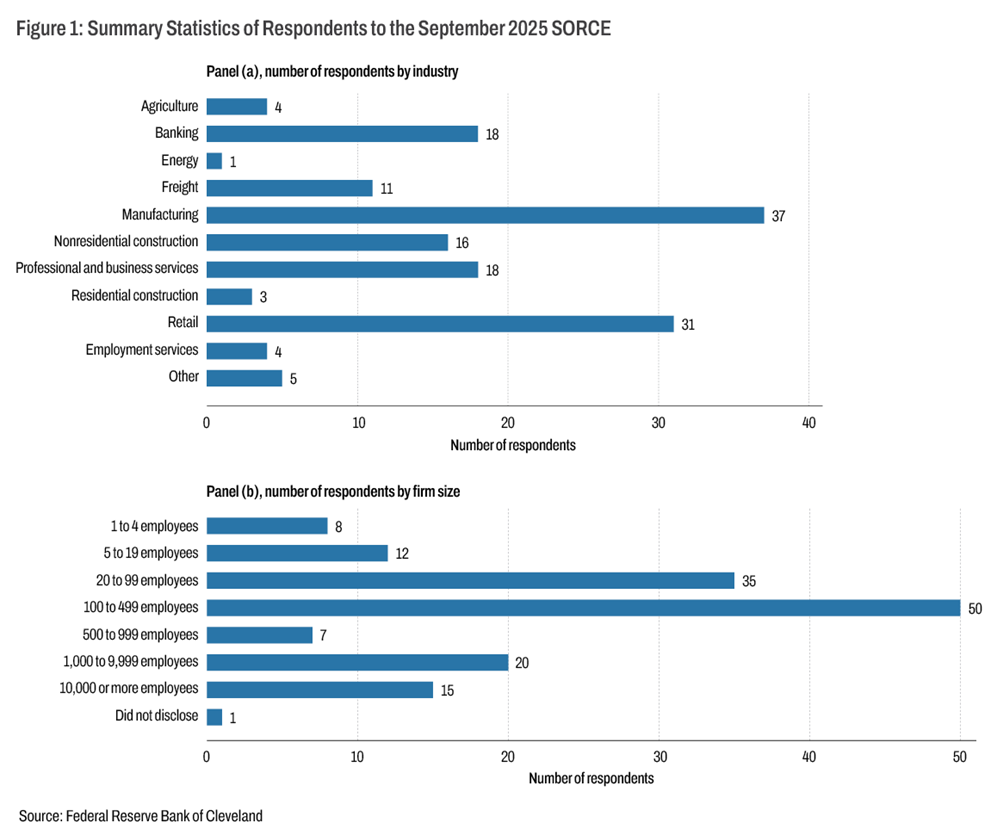
Our survey included firms from a range of industries. As Figure 1 shows, the most common were manufacturing, retail, banking, and professional and business services (see panel a). Most of our contacts represented smaller local firms, with the median firm having from 100 to 499 employees (see panel b). However, 11 of our contacts represented firms listed in the S&P 500, so our survey includes some major national and international companies.
Survey Results
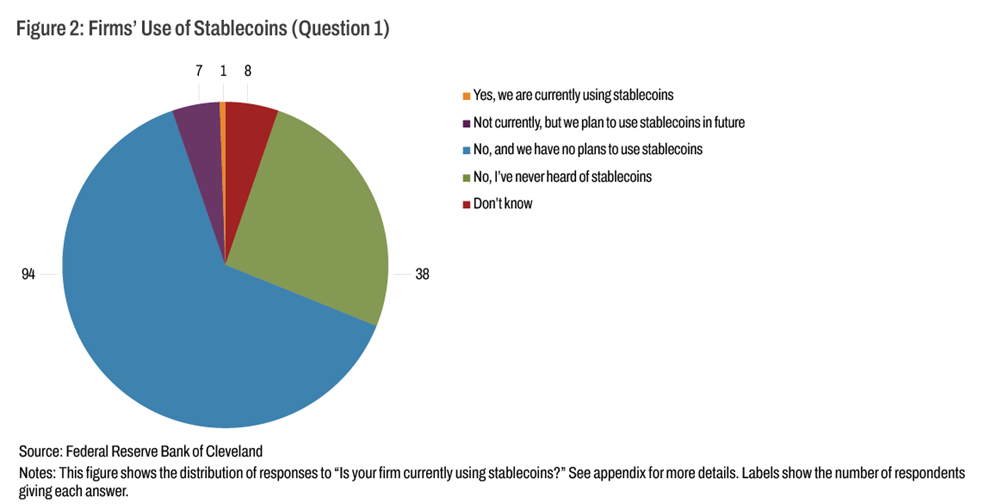
Figure 2 shows the responses to question 1, which asked each contact whether their firm is currently using stablecoins. Only one of our 148 respondents answered affirmatively. Among those who said they are not currently using stablecoins, only seven said that they plan to use them in the future, while the remaining 140 had no plans, had never heard of stablecoins, or said they didn't know. We found no relationship between interest in stablecoins and a firm’s size or sector.
We asked the seven respondents who said that they plan to use stablecoins in the future about when they expect to do so (question 2). Responses were mixed: one respondent answered they planned to use stablecoins within the next six months, two within 12 months, one more within two years, and the remaining three were unsure.
Next, we asked respondents which factors affected their firms' decision to use stablecoins or not (question 3).6 All participants were asked this question unless they either didn’t know about their firms' plans or had never heard of stablecoins. Table 1 shows the results. We expected that, if there were latent demand for stablecoins among US firms, then the availability of stablecoins would be an important factor influencing their decision to use them. Although 21 respondents did cite availability as a factor, it was the least popular option selected. Instead, respondents were more likely to cite factors related to demand (either from customers or suppliers) or to a lack of information about the benefits and costs of using stablecoins.
Table 1: Factors Influencing Stablecoin Usage (Question 3)
| Availability of stablecoins from my existing financial services provider | 21 |
| Demand from customers for us to accept stablecoins for payment | 50 |
| Requests from suppliers for us to make payments in stablecoins | 30 |
| Greater clarity around accounting or tax treatment | 32 |
| More evidence that stablecoins are cheaper or more efficient than other forms of payment | 42 |
| More time to observe market trends and adoption | 49 |
| Other, please specify | 9 |
Source: Federal Reserve Bank of Cleveland
Notes: This table shows the distribution of responses to “Which, if any, of these factors influenced your firm’s decision to use stablecoins/would increase your firm’s interest in using stablecoins? Select all that apply.” Each respondent could select multiple answers. Those who responded, “No, I’ve never heard of stablecoins” or “Don’t know” to Q1 were not asked this question. See appendix for more details. In total, 102 respondents were asked this question.
Whichever answer they gave to question 3, respondents could provide more context in an open-response text box. Eight chose to do so. Of these, one mentioned the importance of education about stablecoins, four mentioned the need for government guarantees or regulations around their use, and the remaining three said that existing methods served their payment needs.
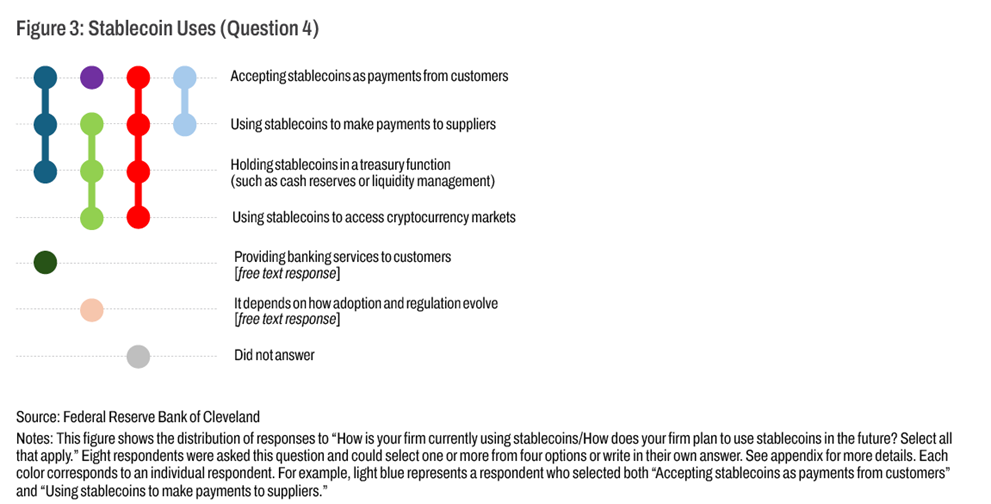
Question 4 asked how firms are either currently using or plan to use stablecoins. This question was asked only of the eight respondents who said their firms use or plan to use stablecoins. Figure 3 shows the results. Four respondents said that they would use stablecoins to accept payments from customers, and four said that they would use them to make payments to suppliers.7 All three respondents who said that they would hold stablecoins in a treasury function—for example, using them to manage cash or liquidity—said they would also use stablecoins to make or receive payments. Two respondents said they would use stablecoins to access cryptocurrency markets; both said they would also hold stablecoins in their internal treasury and use them to pay suppliers.
Two respondents chose to further explain their answers. One of these said that their firm is currently providing cryptocurrency-related banking services to customers. The other said the way that their firm uses stablecoins would depend on how markets and regulations evolve.
Finally, we offered each of our respondents the opportunity to comment on their firm’s decision to use or not use stablecoins in their business (question 5). Of our 148 respondents, 27 chose to write something. Figure 4 summarizes the sentiments expressed.
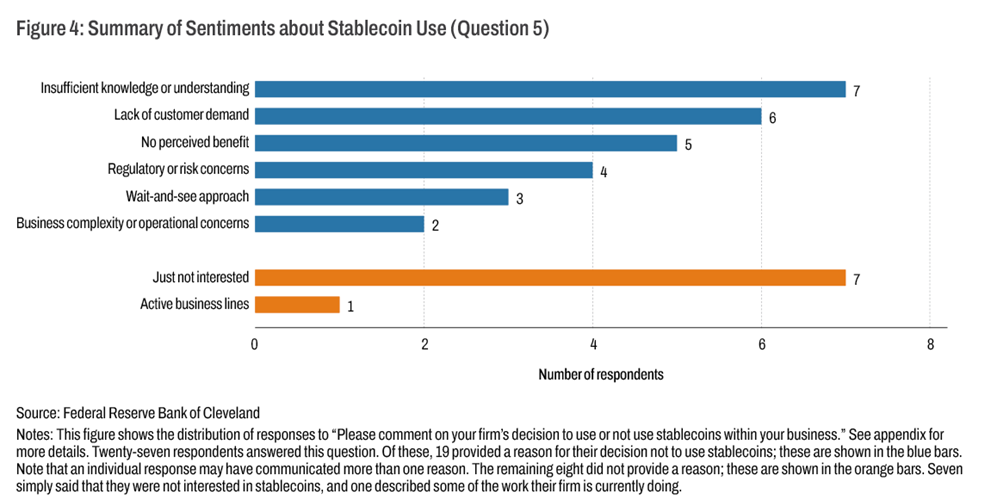
Of the 27 written responses to question 5, only one was entirely positive in tone, and it came from the sole respondent whose firm was already using stablecoins, although it did not address the reasons behind adoption. The other 26 responses were all negative to some degree.
Seven of the responses discussed how a lack of understanding about stablecoins provided a barrier to adoption. Some were concerned about knowledge among their staff, with one saying, “It is hard to imagine what might cause us to buy or sell in stablecoin given the knowledge ramp it would take for my team to successfully implement those strategies.” Others discussed education more generally, with one saying, “The concept of stablecoins may be a major plus to businesses in the future, but at this time I think a thorough education in stablecoin would be needed to change current payment methods.” Six respondents said that they do not see any demand for stablecoin payments from their customers, and five said that they do not see stablecoins as adding any value to their business. One respondent wrote, “There is no strategic need for our Bank to use stablecoin; we are strictly a US business.”
Four respondents mentioned regulatory or risk concerns, sometimes vociferously. “This market is a disaster waiting to happen,” said one respondent; “I do not believe the regulatory structure is there to create a stable (intended pun) market. I hope there is no inclination to do anything from the government when this market implodes.”
Three suggested that their firms were following a more conservative approach, waiting to see how things develop. Two were worried about operational risks, with one noting, “We have enough complexity in our business and probably don't need to add this.”8
Finally, seven respondents said that they were simply not interested, without going into any detail as to their reasons. One simply declared, “Just pay me in US dollars.”
Evidence of Firms’ Interest in Stablecoins from Public Records
One potential critique of our survey findings is that they are not representative of the broader population of US firms, either because the results are specific to the firms in our sample or to the period in which the survey took place. To address these concerns, we undertook two additional analyses:
- We searched for news stories or public statements from named nonfinancial, noncrypto firms in the United States expressing interest in holding stablecoins on their balance sheets. Our searches did not produce examples of firms expressing such interest.
- We looked for public filings over the past 12 months by any nonfinancial, noncrypto firm that holds stablecoins on its balance sheet. These searches did not find examples of such firms disclosing that they hold more than a trivial proportion of their assets as stablecoins (we use a cutoff of 2 percent).
We exclude crypto and financial firms because they may hold stablecoins by virtue of other activities, such as custody, issuance, payments processing, or speculation, rather than for making payments to counterparties. In other words, we are interested in finding firms that have discovered that stablecoins are a better way of making payments for their existing business or that hold them because of limitations on deposit insurance or for other reasons, rather than those whose business model is to provide the infrastructure for stablecoins.
We focus on firms that hold stablecoins on their balance sheets because, if a firm uses a particular form of money to make a significant proportion of its transactions, we might expect it to hold some of that type of money in reserve.9 While we did find several firms that accept stablecoins as payment from customers or counterparties, in these cases firms convert the stablecoins to dollars, facilitated by external payments processors such as Stripe, BitPay, or BVNK. In these cases, stablecoins are used as a medium of exchange but do not seem to be trusted as a store of value.10 Given the extent to which stablecoins have been in the news, we expected to find at least one firm that holds or plans to hold a nontrivial amount of stablecoins on its balance sheet; however, we found none.
Below, we explain further how we carried out these analyses.
News stories
We searched Bing News, Google News, and news stories on a Bloomberg terminal for articles published from June 1, 2025, through July 24, 2026. We used the following search terms: “stablecoin,” “stable coin,” “USDT,” “USDC,” “crypto” plus “Tether,” and “crypto” plus “Circle” and retrieved all articles that contained at least one of these terms.11
We then further filtered the results to include at least one of the following terms: “payment,” “balance sheet,” “usage,” “firms using,” “companies using,” and “holdings.”
We manually looked through the resulting articles and excluded those that were about crypto or finance firms. Of those articles that remained, we could find none in which it was clear that the firm intended to hold stablecoins on its balance sheet.
Public filings
We looked at all filings in the EDGAR database at sec.gov/search-filings from December 4, 2024, through December 4, 2025. The Securities and Exchange Commission requires public companies to file financial disclosures periodically and when major events occur. Among other things, these filings should contain information about material risks to investors (see Securities and Exchange Commission, 2011). Thus, if a firm holds large quantities of stablecoins, we would expect it to be disclosed in these filings.12
We searched EDGAR for the terms “stablecoin,” “stablecoins,” and “USDT.”13 We built a database from these results by extracting the “Form & file,” “Filed,” “Reporting for,” and “Filing entity/person” fields. This database contains 2,986 filings from 761 distinct companies. We manually looked through the companies and dropped those that specialize in cryptocurrencies or financial services. This left 583 filings from 171 distinct companies.
We manually reviewed these 583 filings to see whether they explicitly mention stablecoin holdings. We found only 26 filings from nine companies that did. Of these, only three filings from three companies mention a specific dollar amount of stablecoin holdings. And none of these held more than 1.5 percent of their total assets in stablecoins.
Conclusion
Many observers expected that by clarifying the regulatory treatment of stablecoins, the passage of the GENIUS Act would ease supply constraints around stablecoins and allow latent demand to be fulfilled. However, our survey results revealed little sign of demand for stablecoins from US firms as of September 2025. The vast majority of our respondents had no plans to adopt stablecoins. The main reasons given were a lack of understanding of these instruments, insufficient demand from clients, doubts about the value of adoption, and misgivings about risks and regulatory treatment. While our survey size is small and geographically concentrated, our findings are backed up by public statements and regulatory disclosures, in which our searches yielded little evidence that nonfinancial, noncrypto firms were holding substantive amounts of stablecoins on their balance sheets.14
Stablecoins are still a relatively new and untested technology, so corporate adoption could rise in the future if firms see a benefit from using them and feel comfortable with the risks involved.15 The high response rate to our questions—even among contacts whose firms were not using stablecoins at the time of the survey—indicates an interest in the topic and a desire to engage. And many of our respondents exhibited what we interpret as a cautious stance toward stablecoin use rather than outright hostility. Our survey findings reveal some areas where there is interest, such as using stablecoins to make and receive payments, as well as some barriers, such as a lack of familiarity relative to existing forms of payment.
References
- Bates, Thomas W., Kathleen M. Kahle, and René M. Stulz. 2009. “Why Do US Firms Hold So Much More Cash than They Used To?” Journal of Finance 64(5): 1985–2021. doi.org/10.1111/j.1540-6261.2009.01492.x.
- Batra, Inderpreet, Max Zevin, Ankit Mathur, Cláudio Quitete, Carlos Bravo, and Dawson Li. 2026. “Stablecoin Payments: The Truth Behind the Numbers.” Boston Consulting Group. bcg.com/assets/2026/white-paper-stablecoin-payments-truth-behind-numbers.pdf.
- Elvery, Joel A. 2024. “Introduction to the Cleveland Fed Survey of Regional Conditions and Expectations. SORCE indexes.” Federal Reserve Bank of Cleveland, District Data Brief, 2024-1125. doi.org/10.26509/frbc-ddb-20241125.
- Federal Deposit Insurance Corporation. 2023. Options for Deposit Insurance Reform. Report. fdic.gov/analysis/options-deposit-insurance-reform.
- Financial Accounting Standards Board. 2026. Cash Equivalents—Disclosure Enhancement and Classification of Certain Digital Assets. July 8. fasb.org/projects/current-projects/cash-equivalents%E2%80%94disclosure-enhancement-and-classification-of-certain-digital-assets-423255.
- JP Morgan Global Research. 2025. “What to Know about Stablecoins.” (September 4). jpmorgan.com/insights/global-research/currencies/stablecoins.
- Kher, Prashant, Kevin Bailey, Scott Mickey. 2025. “Stablecoins: Adoption, Optimism and Regulatory Clarity.” EY-Parthenon (September 15). ey.com/en_us/insights/financial-services/cost-savings-and-speed-drive-stablecoin-adoption.
- Levitin, Adam. 2025. “Will Corporate Treasuries Have Any Interest in Using Stablecoins?” In Credit Slips: A Discussion on Credit, Finance, and Bankruptcy (July 21). creditslips.org/2025/07/21/will-corporate-treasuries-have-any-interest-in-using-stablecoins/.
- Luck, Stephan. 2025. “A Historical Perspective on Stablecoins.” Liberty Street Economics (October 1). doi.org/10.59576/lse.20251001.
- NAICS Association. 2025. “Counts by Annual Sales.” Updated December 3, 2024. naics.com/business-lists/counts-by-company-size/.
- Noll, Franklin. 2026. “What Are Stablecoins Used for Today? Estimating the Distribution of Stablecoins.” Federal Reserve Bank of Kansas City, Payments System Research Briefing (April 10). kansascityfed.org/research/payments-system-research-briefings/what-are-stablecoins-used-for-today-estimating-the-distribution-of-stablecoins/.
- O’Trakoun, John. 2024. “Which Fed Districts Look Most Like the US?” Federal Reserve Bank of Richmond, Macro Minute (April 16). richmondfed.org/research/national_economy/macro_minute/2024/which_fed_districts_look_like_us_20240416.
- Perotti, Enrico. 2023. “Learning from Silicon Valley Bank’s Uninsured Deposit Run.” VoxEU (May 5). cepr.org/voxeu/columns/learning-silicon-valley-banks-uninsured-deposit-run.
- Securities and Exchange Commission. 2011. “Investor Bulletin: How to Read a 10-K.” Office of Investor Education and Advocacy (September). sec.gov/files/reada10k.pdf.
- Shehdula, Elton, Carlos Cortes, and Barkin Tuncer. 2026. Stablecoins: The Emergence of a New Payment Rail. Allium. allium.so/reports/stablecoin-payments-q1-2026.
- Tether. 2026. “Global Industrial Conglomerate Hyundai Completes Enterprise Treasury Pilot on Tether USD₮, Moving Corporate Funds across Global Borders.” July 13. tether.io/news/global-industrial-conglomerate-hyundai-completes-enterprise-treasury-pilot-on-tether-usdt-moving-corporate-funds-across-global-borders/.
- US Congress, Senate. 2025. “GENIUS Act.” S. 1582, 119 Cong. 12 USC § 5901. congress.gov/bill/119th-congress/senate-bill/1582/text.
- Wells, Matthew. 2025. “Stablecoins and Financial Stability.” Federal Reserve Bank of Richmond, Econ Focus (Fourth Quarter). richmondfed.org/publications/research/econ_focus/2025/q4_federal_reserve.
- Yim, Anthony, Andrew van Aken, Nic Carter, Wyatt Khosrowshahi, Rob Hadick and Omar Kanji. 2025. “Stablecoin Payments from the Ground Up.” stablecoin.fyi/.
Endnotes
- Federal Deposit Insurance Corporation (2023) discusses options for reform of deposit insurance, including raising the limit. Return to 1
- See Elvery (2024) for more background on the SORCE. Return to 2
- See the appendix for a list of the questions we asked. Return to 3
- According to O’Trakoun (2024), out of the 12 Federal Reserve Districts, the economy of the Fourth District is among the most similar to that of the entire United States. Return to 4
- For confidentiality reasons, we cannot reveal the identities of our respondents or the firms they represent. Return to 5
- As explained in the appendix, we phrased question 3 slightly differently depending on the respondent’s answer to question 1. If a respondent said their firm is currently using stablecoins, we asked them which factors influenced this decision. For the 101 respondents who have heard of stablecoins but said that their firm is not currently using them, we asked which factors would increase their firm’s interest in using them. Among these respondents, the response rate was 87 percent, suggesting a high level of interest in this topic. Respondents could select multiple answers from a list of six and could also write their own response. Return to 6
- As Figure 4 shows, there is significant overlap here because three respondents said they would use stablecoins to both make and accept payments. Return to 7
- For more on operational risks from corporate stablecoin adoption, see Levitin (2025). Return to 8
- For an explanation of why firms hold money on their balance sheets, see Bates, Kahle, and Stulz (2009). Return to 9
- For example, in July 2026 Hyundai Motor America reported that it had completed a pilot using USDT to transfer dollars to its Mexican affiliate. The dollars were converted into USDT, sent to Mexico, and then converted back to dollars (a “stablecoin sandwich”). See Tether (2026). Return to 10
- Because “Tether” and “Circle” are common English words that have meanings outside of stablecoins, we excluded articles that mention these terms without the term “crypto.” Return to 11
- In July, the Financial Accounting Standards Board (2026) proposed that a firm should disclose amounts of “significant classes” of cash equivalents, including stablecoins, in its accounts. If this is implemented, we might expect more disclosures of stablecoin holdings in the future. Return to 12
- Because EDGAR’s search feature returns a maximum of 1,000 results, we split the time range into four subperiods to perform the searches. We did not include the term “USDC” because a very large number of filings use it as an acronym for “United States District Court.” To exclude false positives, we dropped this term. Return to 13
- Kher and Kaempfer (2025) find that corporate interest in and use of stablecoins may be higher than our study suggests. In June 2025, they surveyed 350 executives, mostly located in the United States. They find that 96 percent of respondents expect interest in stablecoins at their firm to increase in the next six to 12 months, while 8 percent of respondents at nonfinancial corporations are currently using stablecoins. However, their sample comprises much larger firms than is typical in the United States (every firm in the sample has an annual revenue of at least $100 million, revenue which would put each of them in the top 2 percent of US firms according to NAICS Association, 2025). Other studies, such as Batra et al. (2026), Noll (2026), Shehdula et al. (2026), and Yim et al. (2025), do not use a survey-based methodology. Instead, they collect data from blockchains or payment-service providers. These papers suggest that, globally, corporate use of stablecoins is low but increasing, but the papers do not focus on corporations in the United States as we do. Return to 14
- Alternatively, future growth in stablecoin demand may come from outside of the US corporate sector; see, for example, Luck (2025). Return to 15
Suggested Citation
Dirtzu, Brooke, Geena Panzitta, and Peter Zimmerman. 2026. “Will US Firms Adopt Stablecoins? Survey Says They’re Not Enthusiastic.” Federal Reserve Bank of Cleveland, Economic Commentary 2026-22. https://doi.org/10.26509/frbc-ec-202622
This work by Federal Reserve Bank of Cleveland is licensed under Creative Commons Attribution-NonCommercial 4.0 International


Related resources

About Us
The Federal Reserve Bank of Cleveland (commonly known as the Cleveland Fed) is part of the Federal Reserve System, the central bank of the United States.

Economic Commentaries
Economic Commentaries provide analysis of relevant economic issues and are written for an informed but nonspecialist audience.