

- Share
Understanding the Motivations for Business Participation in Voluntary Web-Based Business Surveys
As survey response rates decline nationwide, Federal Reserve Banks face challenges to engaging business survey panelists to collect some of the economic data that helps inform monetary policy. This Economic Commentary examines what motivates businesses to participate in some of the survey panels run by the regional groups at the Federal Reserve Banks of Cleveland and Richmond. Based on 312 survey responses, our results show that while helping the Fed is the primary motivation across all segments, participation drivers vary by firm size, recruitment method, and panel tenure. These findings have led the regional teams at both the Cleveland Fed and the Richmond Fed to implement targeted engagement strategies that build ongoing relationships with our survey respondents and demonstrate how survey data informs monetary policy decisions.


The views authors express in Economic Commentary are theirs and not necessarily those of the Federal Reserve Bank of Cleveland or the Board of Governors of the Federal Reserve System. The series editor is Tasia Hane. This paper and its data are subject to revision; please visit clevelandfed.org for updates.
Introduction
The Federal Reserve System comprises 12 regional Federal Reserve Banks whose research teams gather data on business conditions in their Districts. This regional structure ensures local perspectives are integrated into monetary policy decisions. While data from each District are collected in a variety of ways, voluntary web-based business surveys are important inputs to regional Beige Book summaries and Federal Open Market Committee (FOMC) meeting discussions. Over the past few decades, survey response rates have been declining. Even though the Cleveland Fed and Richmond Fed business surveys have not suffered from declining response rates, panel attrition is a perennial problem, increasing the need to recruit new survey participants in order to maintain comprehensive data needed for robust analysis. This Economic Commentary presents the research findings of work done by regional teams at the Cleveland and Richmond Feds regarding business-survey participation motivations, with the aims to improve participants’ survey experience, encourage continued participation, and increase overall participation.
Overview of the Cleveland and Richmond Fed Business Surveys
The regional teams at the Cleveland and the Richmond Feds collect regional economic data through voluntary web-based business surveys in their respective Federal Reserve Districts. The Cleveland Fed’s Survey of Regional Conditions and Expectations (SORCE) covers the Fourth District (Ohio, western Pennsylvania, eastern Kentucky, and the northern panhandle of West Virginia), while Richmond Fed’s Regional Surveys of Business Activity covers the Fifth District (District of Columbia, Maryland, Virginia, North Carolina, South Carolina, and the remainder of West Virginia not covered by the Cleveland Fed). Both maintain survey panels of businesses within their Federal Reserve Districts. These panels provide local insights, ensure data consistency, and track economic trends over time.
Building Relationships for Better Economic Measurements
Statistical agencies devote considerable resources to accurately producing high-quality measures of the economy. One challenge they face is declining survey response rates among businesses. For example, the US Bureau of Labor Statistics’ Job Openings and Labor Turnover Survey (JOLTS) response rate dropped from 68 percent in May 2015 to 35.2 percent by March 2025 (US Bureau of Labor Statistics, 2025). When certain groups systemically do not respond, the resulting data may quickly become biased (Dillman, Smyth, and Christian, 2014), and even rigorous weighting techniques cannot correct for this because the excluded respondents are not represented (Bailey, 2023).
Despite the Federal Reserve Banks’ recruitment and retention efforts for their business surveys, panel attrition remains a perennial issue. This prompted researchers in the regional teams at several Federal Reserve Banks to investigate what motivates businesses to participate in their surveys, with the aim to develop more effective engagement strategies and better demonstrate the Fed's appreciation for businesses' contributions. By understanding these motivations, the regional teams at the Federal Reserve Banks can build stronger relationships with survey participants, ensuring the continued collection of high-quality regional data essential for helping to inform monetary policy decisions made by the FOMC.
To maintain consistent and high-quality data, the regional teams at both the Cleveland Fed and the Richmond Fed have established survey panels, which are dedicated groups of business respondents who participate in a survey over time. Unlike one-time surveys, these panels consist of participants who commit to responding over multiple reporting periods, with some remaining engaged for years. Survey panels are also efficient as they eliminate constant recruitment and enable tracking of responses across reporting periods. For instance, the Richmond Fed's survey asks businesses to report both their actual and expected annual price growth. By tracking the same businesses over time, researchers at the Richmond Fed can understand how accurately they forecast prices one year ahead. This insight into future price trends would not be possible with one-time surveys.
Teams at both the Cleveland Fed and the Richmond Fed work to retain existing business panelists. The Richmond Fed offers its panelists a newsletter of results, invitations to webinars with policymakers, and notifications of when a business’s information was used in a publication. The Cleveland Fed has historically focused on relationship-building efforts such as inviting panelists to join advisory councils and making calls to individual panelists.
Research Methodology
The primary frameworks for survey participation theories, gleaned from areas such as social exchange theory (Dillman, Smyth, and Christian, 2014), benefit–cost theory (Singer, 2011), and leverage salience (Groves, Singer, and Corning, 2000), derive from household survey participation studies, creating a knowledge gap in understanding business participation motives. Each theoretical approach has different practical applications regarding how to motivate survey participation and maintain a consistent survey panel.
This investigation used an inductive methodology rather than imposing existing theories on businesses. The approach analyzed businesses' self-reported motivations, allowing motivational categories to emerge organically from the data (Creswell and Poth, 2018). This approach captured the multidimensional nature of business-response behaviors, revealing both unique participation drivers and some overlap with theories based on household surveys. This understanding also provides actionable insights into tailored recruitment and retention strategies specifically for business survey panels.
While this Economic Commentary focuses on the outcomes of the Cleveland Fed and the Richmond Fed surveys, several other Federal Reserve Banks implemented the same survey about why businesses participate in Fed survey panels. Participating Federal Reserve Banks added an open-ended question for respondents to address the following statement: “Please tell us the reasons why you participate in this survey.” The fielding dates for the Cleveland Fed survey were September 30 to October 7, 2024 (eight days). The fielding dates for the Richmond Fed survey were slightly earlier and had a longer response window, August 29 to September 18, 2024 (21 days). The question garnered 312 total responses, 108 from Cleveland Fed’s respondents and 204 from Richmond Fed’s respondents.
We coded the responses using a codebook generated to bucket similar responses. Table 1 illustrates how the emergent themes were categorized according to business motivations and how those themes aligned with established theories on survey participation drivers.
Table 1: Grouped Coding
| Grouped theme (established theories) | Categories: reasons to participate |
| I want to help (altruism) |
|
| Receipt of a benefit (cost–benefit) |
|
| I want to be heard (influence) |
|
| Heuristics (reasoned action) |
|
| Survey sponsor (authority) |
|
| Who I am (cognitive dissonance) |
|
| Topic salience (leverage-salience) |
|
Key Findings
Overall Results from Cleveland Fed and Richmond Fed Surveys
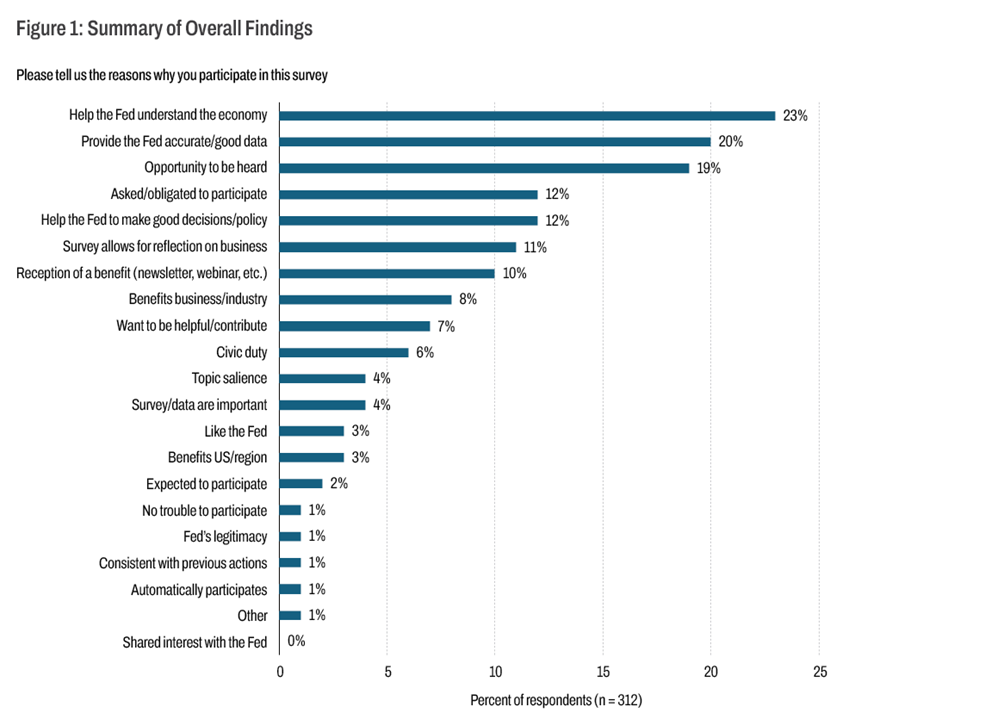
The three most cited reasons for participation in the surveys were helping the Fed understand the economy (23 percent), providing the Fed with accurate data (20 percent), and having the opportunity to be heard (19 percent).
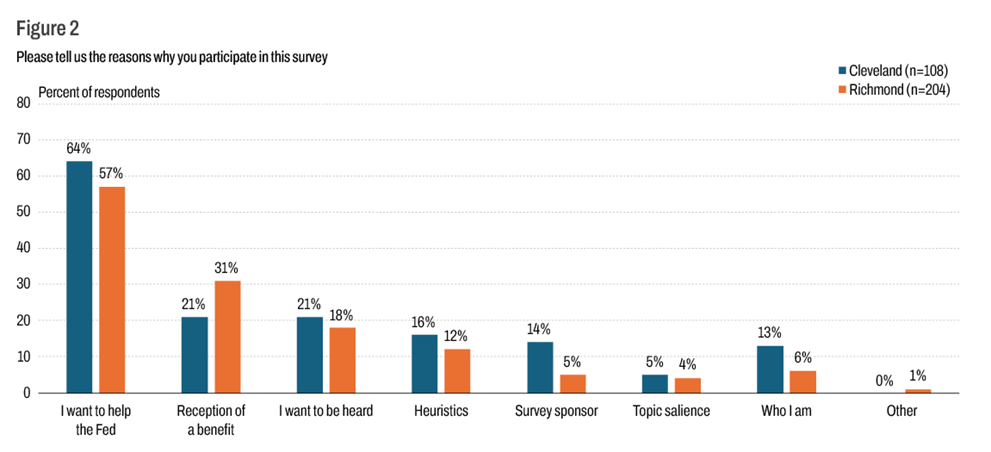
When assessing the grouped reasons for participation, wanting to help the Fed was by far the most important reason for participation overall, followed by receiving a benefit (Figure 2). However, participation patterns varied between institutions, highlighting the distinct contextual factors influencing respondents to the Cleveland Fed and the Richmond Fed surveys. Differences in respondent motivations align with the different engagement strategies employed by each Bank, with the Richmond Fed's benefits-focused strategy and Cleveland Fed's relationship-building strategy each appearing to shape participant perceptions in distinctive ways. Studying the responses from the two Banks provides a more complete picture of the range of participant motivations.
Cleveland Fed-Specific Analysis
Cleveland Fed survey participants primarily reported wanting to help the Federal Reserve understand the economy and provide accurate data. Business-survey participants, especially from small to midsized firms, wanted to have a voice in monetary policy discussions. Recruitment methods also influenced motivations, highlighting relationships as a key element of the Cleveland Fed’s survey panel engagement.
Results by Firm Size
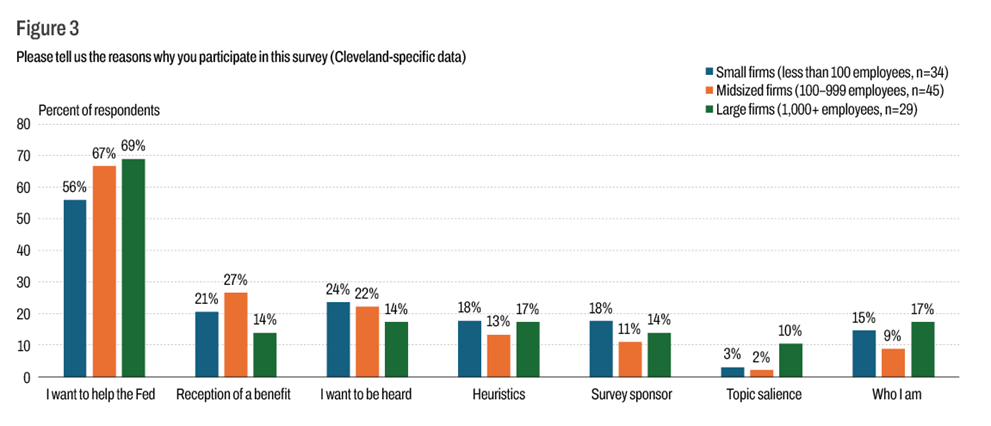
Firm size revealed different participation drivers. Midsized and large firms more frequently reported wanting to help the Fed (understand the economy, have accurate data, and so on) than small firms. Small and midsized firms, in comparison to large firms, more frequently cited receiving benefits as motivation, including more mentions of using the survey to reflect on their own firm’s performance. Small and midsized firms also more frequently reported being motivated by having their voices heard in monetary policy discussions than did large firms.
Results by Mode of Recruitment
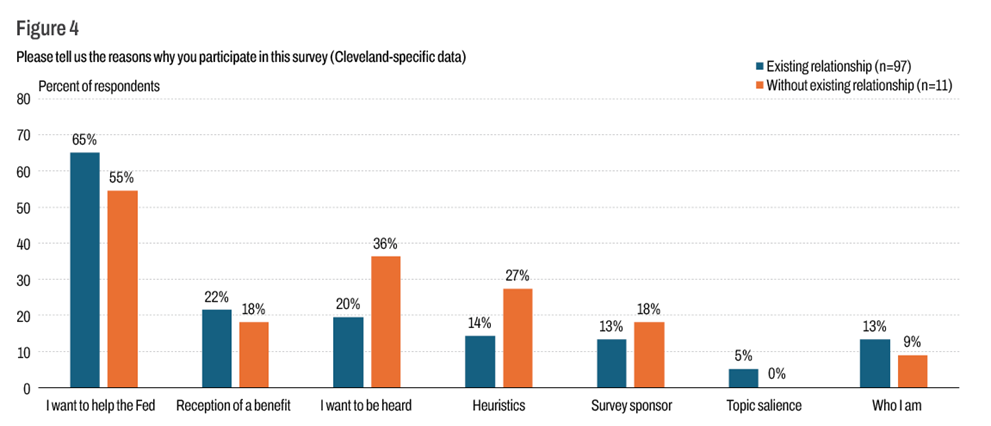
Panelists in the Cleveland Fed’s survey are recruited through regional executives’ individual outreach meetings and cold letter campaigns. Panelists with existing relationships—those who were recruited by regional executives—more frequently cited wanting to help the Fed than did those without an existing relationship (Figure 4). Those recruited by cold letters more frequently expressed wanting to be heard and desired transparency about how the results are used.
Richmond Fed-Specific Analysis
Researchers at the Richmond Fed conducted a detailed segmentation analysis to understand how survey participation motivations vary based on two key factors: the method through which businesses were initially recruited and their duration as panel members. This analysis aimed to optimize communication strategies and enhance long-term engagement within different segments of their business panel.
Results by Mode of Recruitment
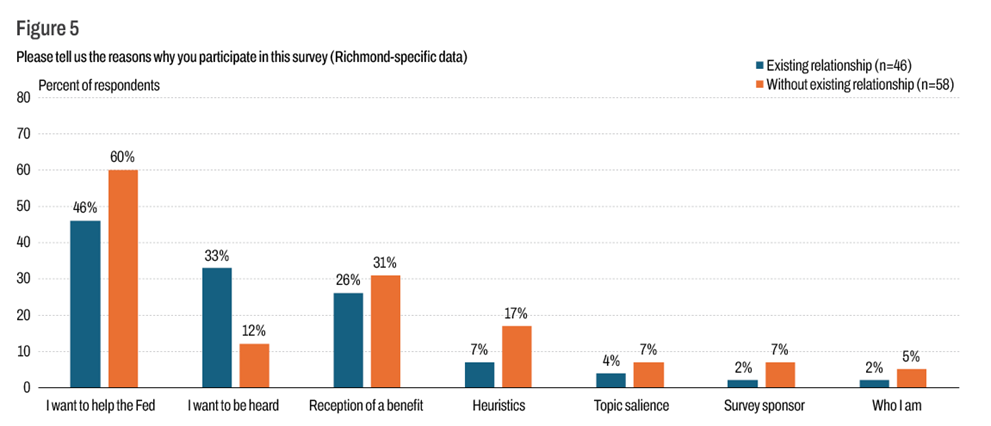
Across all recruitment methods, the desire to help the Federal Reserve was the most frequently cited motivation (Figure 5). Businesses without an existing relationship with the Richmond Fed more frequently cited the desire to help the Federal Reserve as their primary motivation than those with existing relationships. Additionally, businesses without an existing relationship more frequently valued the benefits offered to panel members and felt a sense of obligation to participate. In contrast, businesses with an existing relationship were more motivated by ensuring their voices were heard, while placing somewhat less emphasis on benefits.
Results by Panel Duration
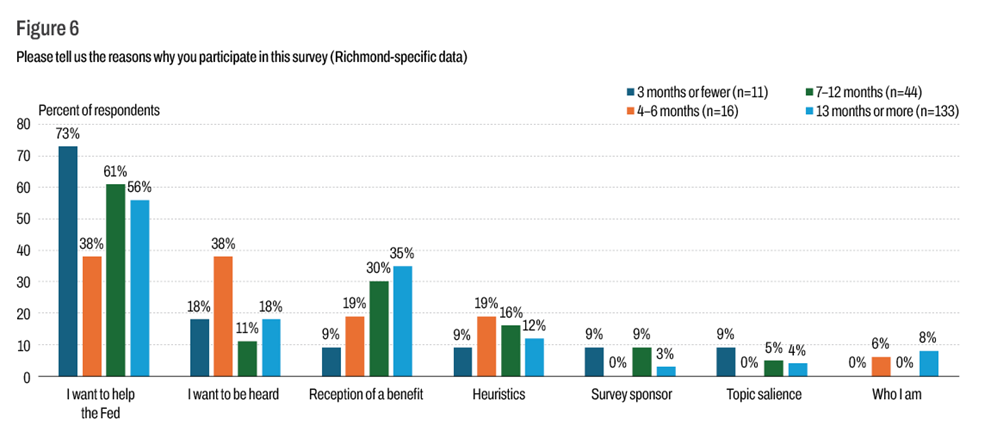
The results were also split based on the panelists’ duration in the panel. The desire to help the Federal Reserve was a consistent motivation across all participants, regardless of how long they had been panelists. However, as shown in Figure 6, this motivation is particularly strong among the newest members of the panel (a tenure of three months or fewer). Longer-term panel members (seven months or more) more frequently reported valuing the benefits they receive, such as webinars and newsletters, having had more time to experience the survey panel benefits. Panel members with a tenure of four to six months most frequently valued the opportunity to be heard.
Adjustments Informed by Findings
Cleveland Fed Adjustments
Based on findings from the Cleveland Fed’s survey, the regional team at the Bank expanded its engagement strategies beyond the previous recruitment focus. Access to business survey results or other benefits was an important motivator for many firms to participate across all respondents. This insight motivated the regional team to release SORCE indexes derived from the survey data, host a webinar to introduce the indexes, and to increase the publication frequency of District Data Brief, a series of short articles analyzing survey results and other trends in the region. In an effort to increase transparency of how data are used, the group conducting the survey participated in developing a multimedia story about data-collection processes and data use leading up to FOMC meetings.
The Cleveland Fed’s regional team is developing additional strategies to reach respondents and the public with survey results. Asking businesses about their motivations is an initial step to help balance panelists’ efforts with the appropriate benefits while enabling evidence-based retention strategies rather than relying on trial-and-error approaches. This feedback strengthens institutional relationships, enhances transparency, and ensures sustained collection of high-quality data essential for helping inform monetary policy.
Richmond Fed Adjustments
Based on findings from the Richmond Fed’s survey, the regional team implemented a communication strategy tailored to the duration of businesses' membership on its panel. New businesses began receiving an email after their first month on the panel that explains how their information is used, emphasizes the Bank's respect and appreciation for their participation, and provides details on how their responses contribute to monetary policy discussions. Longer-term panel members, those with seven months or more on the panel, also receive periodic reminders about accessing information and additional analyses from the survey to maintain their engagement and inform them of the ongoing value of their participation.
The Richmond Fed also updated its recruitment materials to reflect the different ways it connects with businesses, whether through an existing relationship or forging a new one. With the new understanding that businesses with existing relationships want the opportunity to be heard, all recruitment materials were updated to highlight this motivation. In outreach to businesses without existing relationships, recruitment materials highlight how their participation is an opportunity to tell policymakers what is happening with business conditions at the local level and in real time, which may not always be visible in national data or only are available with a delay.
Multiple businesses cited receiving a benefit as a significant motivator behind their participation. Many businesses value the information provided because it allows them to benchmark their performance against that of other businesses in the region. This benefit is particularly important for longer-serving panelists. This information has motivated the Richmond Fed’s regional team to develop new data products that businesses may find valuable, with the aim of encouraging continued participation.
Building Sustainable Survey Relationships
This analysis demonstrates that businesses' motives to participate in Federal Reserve Bank surveys largely align with social exchange theory frameworks that focus on individuals. Respondents' participation appears driven by a rational assessment of benefits and costs, where the value derived from engagement—whether through a newsletter, meetings, or contribution to policy—exceeded the time and effort required. These findings reaffirm that balanced relationships are fundamental to sustained engagement in the Fed's survey panels. Hearing directly from businesses about these motivations helps researchers at both the Cleveland Fed and the Richmond Fed design strategies to foster long-term participation.
This research suggests that the engagement approach, rather than the communication content, influences participation by building on three facets:
- Shared interests: Businesses and the Fed both want a healthy economy. As one participant noted, "It is important that the Fed has good data to make good decisions so they can improve business conditions."
- Credibility: Businesses value the opportunity to share insights with the Fed, which can use the results to inform monetary policy. As another respondent noted, "My participation gives a voice to small businesses in policymaking conversations."
- Respect: Business panelists need to know if their survey responses are taken seriously and used transparently. When Reserve Banks are transparent in how they use information that they gather, respondents see that their efforts are valued.
We hope that this foundational research will help develop strategies to build and maintain relationships with businesses in the Cleveland Fed and Richmond Fed Districts and beyond, encouraging sustained survey participation.
References
- Bailey, Michael A. 2023. “A New Paradigm for Polling.” Harvard Data Science Review 5(3). doi.org/10.1162/99608f92.9898eede.
- Creswell, John W., and Cheryl N. Poth. 2018. Qualitative Inquiry & Research Design: Choosing among Five Approaches. Fourth edition. Sage.
- Dillman, Don A., Jolene D. Smyth, and Leah Melani Christian. 2014. Internet, Phone, Mail, and Mixed-Mode Surveys: The Tailored Design Method. Fourth edition. Wiley.
- Groves, Robert M., Eleanor Singer, and Amy Corning. 2000. “Leverage-Saliency Theory of Survey Participation: Description and an Illustration.” Public Opinion Quarterly 64(3): 299–308. doi.org/10.1086/317990.
- Lavrakas, Paul J., and Sebastian Kocar. 2023. “A Low-Cost Method to Try to Improve Panel Survey Representation.” Survey Practice 16(1). doi.org/10.29115/SP-2023-0014.
- Singer, Eleanor. 2011. “Toward a Benefit-Cost Theory of Survey Participation: Evidence, Further Tests, and Implications.” Journal of Official Statistics 27(2): 379–392.
- US Bureau of Labor Statistics. 2025. “Household and Establishment Survey Response Rates.” Bureau of Labor Statistics. bls.gov/osmr/response-rates/.
Suggested Citation
Dirtzu, Brooke, and Jason Kosakow. 2026. “Understanding the Motivations for Business Participation in Voluntary Web-Based Business Surveys.” Federal Reserve Bank of Cleveland, Economic Commentary 2026-18. https://doi.org/10.26509/frbc-ec-202618
This work by Federal Reserve Bank of Cleveland is licensed under Creative Commons Attribution-NonCommercial 4.0 International


Related resources

About Us
The Federal Reserve Bank of Cleveland (commonly known as the Cleveland Fed) is part of the Federal Reserve System, the central bank of the United States.

Economic Commentaries
Economic Commentaries provide analysis of relevant economic issues and are written for an informed but nonspecialist audience.