

- Share
Earnings Gaps in the Aftermath of COVID-19
This Economic Commentary examines differences between the earnings of white men and those of Black and Hispanic men before and after the COVID-19 pandemic. Following larger initial employment losses for Black and Hispanic men, after the pandemic this group experienced a narrower earnings gap relative to white men, bringing the median log hourly earnings gap to its lowest level of the twenty-first century. The analysis shows that this narrowing extends across both the earnings distribution and occupation groups and is not driven by changes in workforce age or education composition. The evidence indicates that the post-pandemic narrowing reflects broad-based relative changes in earnings rather than effects confined to lower-earning workers or to economy-wide earnings compression alone.

The views authors express in Economic Commentary are theirs and not necessarily those of the Federal Reserve Bank of Cleveland or the Board of Governors of the Federal Reserve System. The series editor is Tasia Hane. This paper and its data are subject to revision; please visit clevelandfed.org for updates.
Introduction
The COVID-19 pandemic had significant effects on the labor market in the United States. In particular, its onset led to a net loss of 14.6 million jobs (US Bureau of Labor Statistics, 2021). These effects were not uniform across groups of workers. This Economic Commentary focuses on differences between labor market trends in earnings of non-Hispanic white men and those of non-Hispanic Black and Hispanic men.1 Non-Hispanic Black and Hispanic men are pooled into a single group for the purposes of this analysis because their labor market outcomes exhibit similar trends throughout the sample period.
In the early phase of the pandemic, employment losses were larger for Black and Hispanic men than for white men, reflecting the former groups’ greater concentration in occupations requiring physical presence or interpersonal interaction (Couch et al., 2023). As the labor market recovered beginning in the second half of 2020, employment among Black and Hispanic men rebounded more rapidly than among white men,2 while differences in median log hourly earnings narrowed steadily. By the post-pandemic period, the gap in median hourly earnings had reached its lowest level of the twenty-first century.
Several mechanisms could account for this post-pandemic convergence in earnings.
- First, it may reflect overall compression in the earnings distribution during a period of historically high labor market tightness. Previous research shows that such high-pressure labor markets are often associated with faster earnings growth at the lower end of the distribution than at the higher end (Autor et al., 2024). Because Black and Hispanic men are disproportionately represented in lower-earnings percentiles, distribution-wide compression could by itself narrow aggregate earnings gaps.
- Second, the gap may have narrowed through movements of Black and Hispanic men within the earnings distribution. Convergence could arise from relative gains for Black and Hispanic men at multiple points of the distribution or from increased representation in higher-paying segments of the pooled earnings distribution.
- Third, developments across occupations may have contributed to convergence. Black and Hispanic men may have experienced stronger earnings growth within occupations, or shifts in occupational employment patterns could have altered their representation across higher- and lower-paying occupation groups.
- Finally, shifts in age and educational composition could affect observed earnings differences. For example, increases in educational attainment or changes in the age profile of Black and Hispanic men relative to white men could reduce earnings gaps even if pay differentials within age and education groups remained unchanged.
This Economic Commentary evaluates these alternative explanations for the post-pandemic convergence in earnings. The analysis draws on monthly data from the Current Population Survey and traces employment and earnings patterns from January 2002 through June 2025. To compare the prepandemic and post-pandemic periods, it narrows the focus to the periods from January 2017 through December 2019 and from January 2021 through December 2023.
The results indicate that several of these mechanisms contributed to the post-pandemic convergence in earnings. Consistent with a period of high labor market tightness, the recovery coincided with earnings compression, as earnings growth was strongest at the lower end of the distribution. However, convergence is not solely attributable to distribution-wide compression. Black and Hispanic men increased their representation in higher-paying segments of the earnings distribution, and the earnings gap narrowed at multiple points of the distribution, indicating relative gains beyond changes in distributional location alone.
Across major occupation groups, Black and Hispanic men experienced larger earnings increases than white men. The reduction in the earnings gap therefore cannot be attributed to differences in occupational concentration between the groups or to shifts toward occupations with stronger earnings growth. Finally, changes in educational attainment and age composition were modest and did not materially affect earnings gaps between the demographic groups.
Key Trends in Employment and Earnings
This section introduces national trends in employment rates and median log hourly earnings for white men and for Black and Hispanic men. The figures place recent developments in historical context by showing patterns from January 2002, following the 2001 recession, through June 2025.
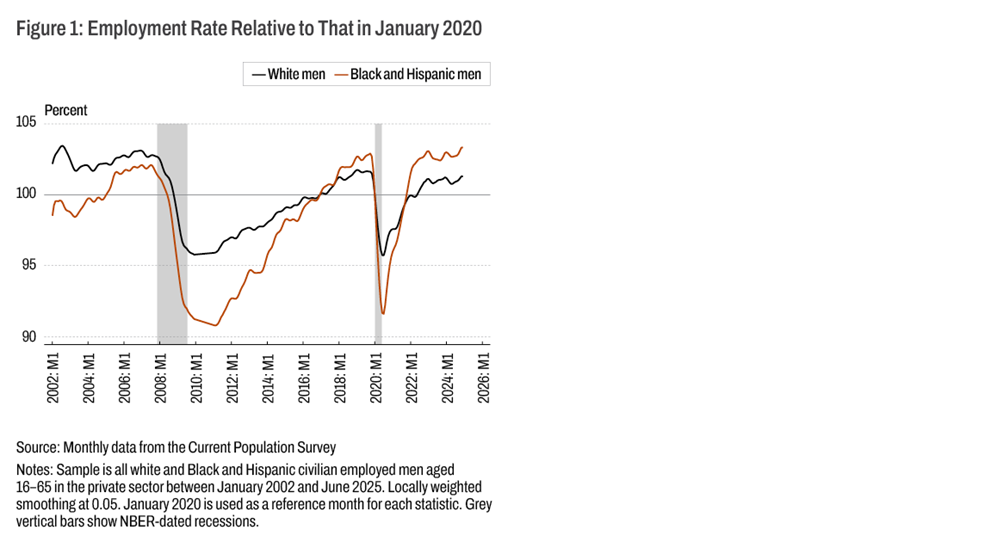
Figure 1 plots the employment rates of white men and of Black and Hispanic men, indexed to 100 in January 2020. Prior to the pandemic, the series moved closely together, with somewhat larger cyclical fluctuations for Black and Hispanic men, including a deeper decline during the Great Recession. Employment rates for both groups fell sharply at the onset of the COVID-19 recession, with a noticeably larger drop for Black and Hispanic men. In the recovery that followed, however, employment rates for Black and Hispanic men returned to and surpassed their January 2020 level.
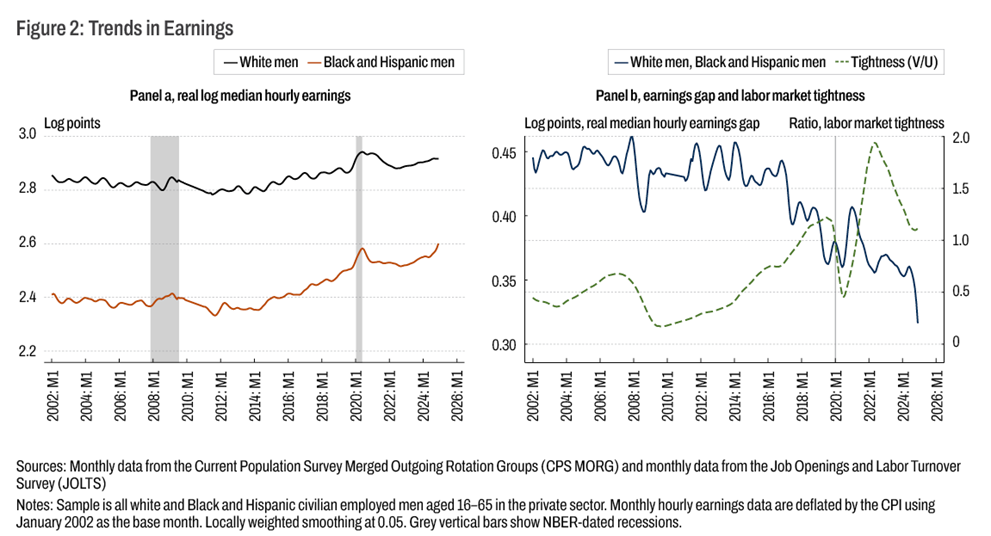
Figure 2 shows real log median hourly earnings.3 The left panel traces the evolution of real log median hourly earnings for white men and for Black and Hispanic men from January 2002 through June 2025. The right panel reports the real median hourly earnings gap (in log points) between white men and Black and Hispanic men, defined as the median log earnings of white men less the median log earnings of Black and Hispanic men, over the same period. Lower values indicate a narrower gap. The figure also includes a measure of labor market tightness, defined as the ratio of job vacancies to unemployment (V/U), so as to highlight the relationship between tightness and the earnings gap.4
Real median log hourly earnings for white men and for Black and Hispanic men evolved similarly during the 2000s and much of the 2010s, with the earnings gap fluctuating within a relatively narrow range. During the pandemic recession, the gap exhibited pronounced movements, reflecting volatility in measured earnings associated with shifts in employment composition.5 Following the initial recovery, however, the earnings gap declined further and remained below its prepandemic level through much of the post-pandemic period, reaching its lowest values since 2002.
During the prepandemic period, labor markets were already tight by historical standards but considerably less so than during the post-pandemic surge; beginning in early 2021, the V/U ratio increased sharply and remained elevated through much of 2023. The overlap in timing between the sustained post-pandemic decline in the earnings gap and the rise in tightness suggests that broader macroeconomic conditions may have contributed to changes in relative earnings outcomes.
Motivated by this evolution in labor market conditions, the analysis that follows comparing pre- and post-pandemic earnings differences focuses on the period from January 2021 through December 20236 and compares these differences with a symmetric three-year window spanning from January 2017 through December 2019. It excludes the year 2020 to avoid distortions associated with the pandemic shock and temporary reallocation of employment.
Taken together, Figures 1 and 2 indicate that during the post-pandemic period employment and median earnings rose more among Black and Hispanic men than among white men. Because these patterns occurred simultaneously, the narrowing of earnings differences in this period is unlikely to reflect just selection into employment. In particular, if the apparent earnings gains were driven by labor market exit of low-earnings workers, who are more concentrated among Black and Hispanic men than among white men, we would expect employment for this group to decline or grow more slowly relative to that of white men. Instead, employment increased alongside median earnings, suggesting that the convergence in earnings reflects genuine improvements rather than purely compositional changes in the employed workforce.
The remainder of the Economic Commentary begins by documenting an overall compression of the earnings distribution and goes on to demonstrate that the reduction in earnings gaps spans the earnings distribution and broadly-defined occupation groups and is not driven by changes in workforce characteristics.
Compression of the Overall Earnings Distribution
The results of a recent study by Autor et al. (2024) may provide a plausible explanation for the narrowing of the earnings gap between white men and Black and Hispanic men between the pre- and post-pandemic periods. In their paper on earnings dynamics following COVID-19, they document earnings compression across the labor market, with earnings rising more at the lower end of the distribution than at the top. Because Black and Hispanic men are overrepresented in the lower part of the earnings distribution relative to white men, these trends could help account for the observed reduction in the earnings gap. However, the analysis that follows shows that while this factor contributed, the observed reductions in the earnings gap are not fully attributable to the concentration of Black and Hispanic men at the bottom of the distribution.
Earnings Compression across the Earnings Distribution
The two panels in Figure 3 summarize changes in earnings and employment across the earnings distribution between the prepandemic period (2017 through 2019) and the post-pandemic period (2021 through 2023). All values represent differences between the two periods and are expressed in percentage points.
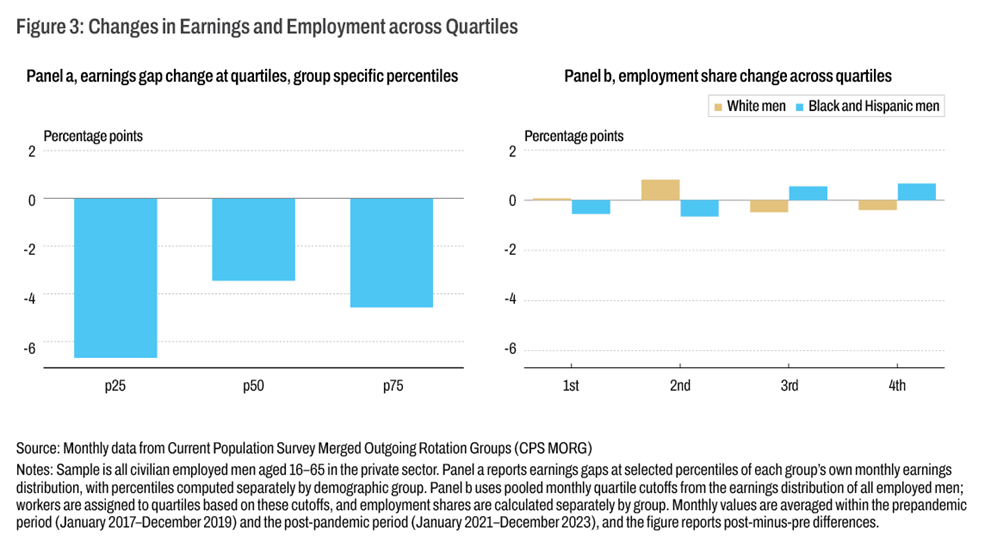
Figure 3, panel (a) reports how the gap in hourly earnings between white men and Black and Hispanic men changed at the 25th percentile, the 50th percentile, and the 75th percentile of each group’s own earnings distribution. By calculating percentiles separately within each group, the analysis allows for comparisons among lower-, middle-, or higher-earning workers of the two groups.7 The panel shows that the earnings gap declined at all three percentiles, indicating that convergence was not confined to the bottom of the distribution but occurred across multiple points of the earnings distribution within groups.
Figure 3, panel (b) divides the overall male earnings distribution into four quartile bins based on hourly earnings levels, and it reports how workers in each group shifted across these lower- and higher-earning quartiles of the overall distribution. It shows that in the post-pandemic period, Black and Hispanic men became more represented in the upper quartiles, while the distribution for white men shifted toward the lower quartiles. This reallocation toward higher-paying segments contributes to the observed convergence by changing where workers are positioned in the overall earnings distribution.
Overall, Figure 3 indicates that the narrowing reflects both a reduction in earnings differences within multiple points of the earnings distribution and a reallocation of Black and Hispanic men toward higher-paying segments, rather than simply stronger earnings growth at the bottom of the distribution.
Earnings Changes across Occupation Groups
Another way to assess how broad-based the changes are is to examine developments across occupation groups. Convergence could reflect stronger earnings growth for Black and Hispanic men within occupations or shifts of Black and Hispanic men into occupations with higher earnings levels. Figure 4 examines changes in median log real hourly earnings across broad occupation groups. Occupations are categorized into six groups following Autor and Dorn (2013): professionals, clerical and sales, low-skill services, skilled trades, machine operators, and industrial trades.8
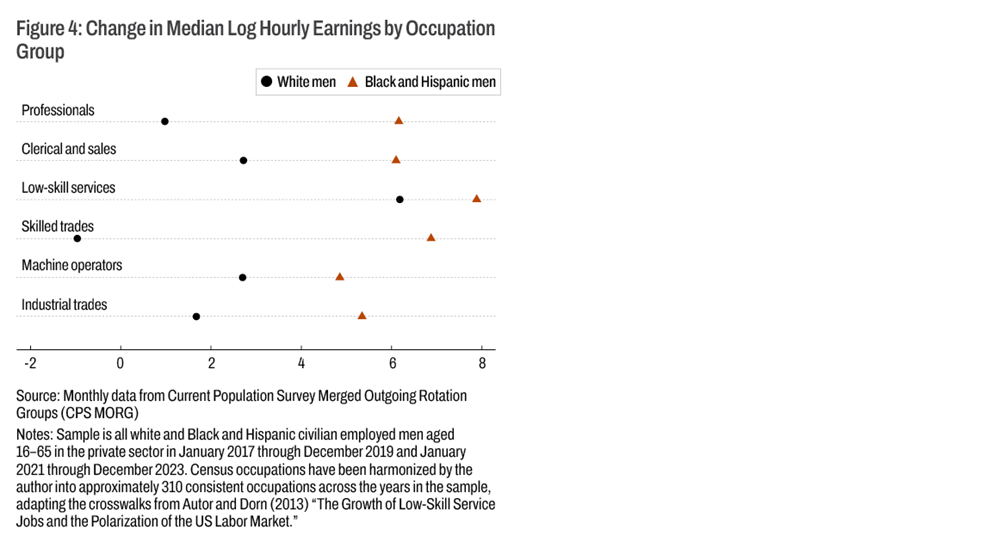
Figure 4 shows that the narrowing of the earnings gap is pervasive across occupations. Earnings growth for Black and Hispanic men exceeds that of white men for all occupations. Thus, the evidence indicates that convergence reflects changes occurring within all occupational groups rather than developments confined to jobs traditionally associated with lower earnings or overrepresentation of a specific demographic group.
To further evaluate these channels, the analysis also considers changes in occupational employment shares and movements within the pooled earnings distribution across occupation groups (detailed results are omitted for brevity). Occupational employment shares shifted only modestly over the period, and movements across occupation groups were broadly similar in direction across demographic groups. However, their implications for the earnings gap differ. For white men, changes in representation across earnings quartiles largely reflect developments occurring within occupations, consistent with earnings compression inside occupational categories. For Black and Hispanic men, by contrast, small increases in representation in higher-paying occupation groups and reduced concentration in lower-paying services are associated with improvements in their relative position in the pooled earnings distribution. Convergence, therefore, reflects both earnings gains within occupations and modest occupational mobility, with the latter playing a comparatively larger role for Black and Hispanic men than for white men.
Changes in Composition of Age and Education of the Workforce
The previous sections show that earnings convergence between white men and Black and Hispanic men emerges across the earnings distribution and across occupations, suggesting that neither economy-wide earnings compression nor occupational shifts alone can account for the observed changes. This result raises the question of whether demographic reallocation within employment, particularly by age or education, contributed to the evolution of earnings. Figure 5 evaluates whether changes in workforce composition along these dimensions help explain the post-pandemic narrowing of earnings gaps. The two panels compare the composition of employment in the pre- and post-pandemic periods used throughout this Economic Commentary.
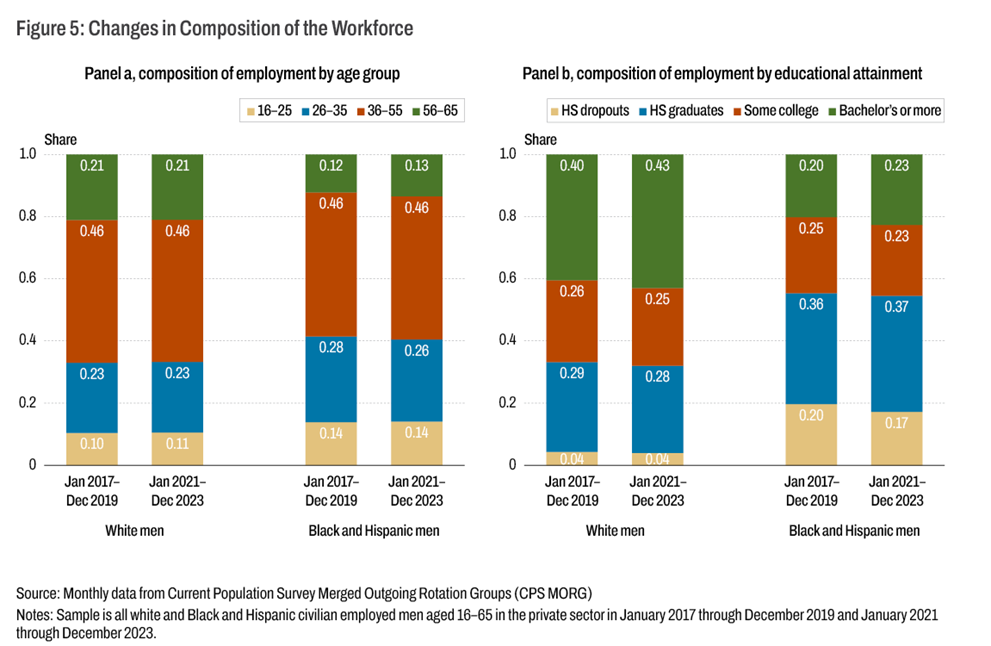
The first panel presents the age distribution of employed workers. For both white men and Black and Hispanic men, changes in age composition across the two periods are modest, indicating that changes in the age distribution of employment did not contribute significantly to the decline in the earnings gap.
The second panel reports the distribution of employment by educational attainment. For white men, educational composition changes only marginally, with a small increase in the share holding a bachelor’s degree or more and little movement across the remaining categories. Among Black and Hispanic men, there is a small shift toward higher educational attainment: the share of these workers without a high school diploma declines, while the shares of those with a high school diploma and with at least a bachelor’s degree rise slightly. This pattern points to modest educational upgrading, but the magnitude of the changes relative to that for white men is small.
Conclusion
The evidence presented documents a narrowing of earnings gaps between white men and Black and Hispanic men between the period before and the period after the COVID-19 recession. Although the pandemic initially generated larger employment losses for Black and Hispanic men, they experienced a stronger employment recovery alongside a narrowing of earnings gaps relative to white men in the post-pandemic period. By 2022, the median log hourly earnings gap had fallen to its lowest level of the past 25 years.
Evidence across earnings quartiles and occupations shows that convergence is broad-based rather than limited to low-paying jobs or occupation groups, and the narrowing of the gap cannot be explained by shifts in education or age composition of the workforce. Overall, the post-pandemic period is characterized by a broad rise in relative earnings for Black and Hispanic men. The long-term persistence of these gains remains an open question.
References
- Autor, David H., and David Dorn. 2013. “The Growth of Low-Skill Service Jobs and the Polarization of the US Labor Market.” American Economic Review 103(5): 1553–1597. doi.org/10.1257/aer.103.5.1553.
- Autor, David H., Arindrajit Dube, and Annie McGrew. 2024. “The Unexpected Compression: Competition at Work in the Low Wage Labor Market.” Working Paper No. 31010. National Bureau of Economic Research. doi.org/10.3386/w31010.
- Couch, Kenneth A., Robert W. Fairlie, and Huanan Xu. 2023. “Racial Disparities in Unemployment during the COVID‐19 Pandemic and Recovery: The ‘Stubborn,’ the ‘Hiccup,’ and the ‘Stall.’” Economic Inquiry 61(3): 480–495. doi.org/10.1111/ecin.13133.
- Flood, Sarah, Miriam King, Renae Rodgers, Steven Ruggles, J. Robert Warren, Daniel Backman, Annie Chen, Grace Cooper, Stephanie Richards, Megan Schouweiler, and Michael Westberry. 2023. “IPUMS, Current Population Survey: Version 11.0.” Dataset. Minneapolis, MN: IPUMS. doi.org/10.18128/D030.V11.0.
- National Bureau of Economic Research. 2023. “US Business Cycle Expansions and Contractions.” Dataset. National Bureau of Economic Research. nber.org/research/data/us-business-cycle-expansions-and-contractions.
- Tüzemen, Didem, and Deepak Venkatasubramanian. 2023. “A Strong Labor Market Has Narrowed Gaps in Participation and Employment between Black and White Non-College Men.” Economic Review 109(1). doi.org/10.18651/ER/v109n1TuzemenVenkatasubramanian.
- US Bureau of Labor Statistics. 2021. “14.6 Million Private Sector Jobs Lost during Second Quarter 2020.” Economics Daily. US Department of Labor. bls.gov/opub/ted/2021/14-6-million-private-sector-jobs-lost-during-second-quarter-2020.htm.
- US Bureau of Labor Statistics. “Unemployed Persons per Job Opening Ratio, Seasonally Adjusted: Total Nonfarm.” Series JTS000000000000000UOR. Job Openings and Labor Turnover Survey (JOLTS). Accessed March 30, 2026. download.bls.gov/pub/time.series/jt/jt.data.8.UnemployedPerJobOpeningRatio.
Endnotes
- Throughout this Economic Commentary, “Black” indicates non-Hispanic Black, and “white” indicates non-Hispanic white. Return to 1
- As also reported by Tüzemen and Venkatasubramanian (2023). Return to 2
- Throughout this Economic Commentary, hourly earnings are measured using CPS Outgoing Rotation Group pay information. For hourly paid workers, the reported hourly wage rate is used directly; for other workers, usual weekly earnings before deductions are converted to an hourly measure using usual weekly hours worked so that all pay measures are expressed in hourly terms. Top coded values are multiplied by 1.5. I exclude observations that include hourly wages below the minimum wages set for tipped workers, thus below $2.13 throughout this period (Congressional Research Service Report, 2015). Return to 3
- The measure is constructed as the inverse of the official series “Total Nonfarm Unemployed per Job Opening Ratio” of the US Bureau of Labor Statistics, constructed from the Current Population Survey (CPS) and Job Openings and Labor Turnover Survey (JOLTS). Higher values indicate a tighter labor market—more vacancies relative to job seekers—while lower values indicate greater slack. See download.bls.gov/pub/time.series/jt/jt.data.8.UnemployedPerJobOpeningRatio. Return to 4
- Temporary increases in median earnings during downturns can arise mechanically when lower-paid workers disproportionately exit employment, a situation which helps explain the sharp movement observed during the pandemic period; a similar trend occurred during the Great Recession. Return to 5
- While the United States did not declare the pandemic officially over from an administrative standpoint until May 2023, for purposes of this Economic Commentary, I define the post-COVID-19 period as 2021–2023 to capture the sustained episode of historically elevated labor market tightness following the pandemic shock, whereas 2024 reflects a clear normalization of vacancies, unemployment, and earnings growth that marks a transition to a distinct labor-market regime. Nevertheless, all results are robust to extending the post period to 2021–2024 and using a correspondingly matched pre-COVID-19 window, and the substantive conclusions remain unchanged. Return to 6
- Because Black, Hispanic, and white men are not evenly distributed across the earnings distribution, this approach compares workers at similar positions within each group. Return to 7
- “Professionals” indicates management, technical, financial sales, and public security occupations; “clerical and sales” indicates administrative support and retail sales occupations; “skilled trades” indicates precision production and craft occupations; “machine operators” also includes assemblers and inspectors; “industrial trades” indicates transportation, constructions, mechanics, and mining occupations. Return to 8
Suggested Citation
Dicandia, Vittoria. 2026. “Earnings Gaps in the Aftermath of COVID-19.” Federal Reserve Bank of Cleveland, Economic Commentary 2026-15. https://doi.org/10.26509/frbc-ec-202615
This work by Federal Reserve Bank of Cleveland is licensed under Creative Commons Attribution-NonCommercial 4.0 International


Related resources

About Us
The Federal Reserve Bank of Cleveland (commonly known as the Cleveland Fed) is part of the Federal Reserve System, the central bank of the United States.

Economic Commentaries
Economic Commentaries provide analysis of relevant economic issues and are written for an informed but nonspecialist audience.