

- Share
Changes in Wage Gaps over Forty Years in the United States
This Economic Commentary explores the evolution of wage gaps between white and Black and white and Hispanic workers in the United States from 1980 to 2022. It analyzes wage gaps at various percentiles of the wage distribution and decomposes them to identify the factors driving changes over time. The findings reveal that while the gap between wages for white individuals and for Black men has narrowed at the 20th and 50th percentiles, it has expanded elsewhere, with the most significant widening occurring at the 80th percentile, particularly for Hispanic workers. Differences in educational attainment and occupations are the key factors that explain the observed wage gap trends.

The views authors express in Economic Commentary are theirs and not necessarily those of the Federal Reserve Bank of Cleveland or the Board of Governors of the Federal Reserve System. The series editor is Tasia Hane. This paper and its data are subject to revision; please visit clevelandfed.org for updates.
Introduction
Wage gaps remain a persistent feature in the United States despite efforts to reduce differences across demographic groups. This Economic Commentary explores the evolution of the inflation-adjusted (real) hourly wage gap over time between white and Black workers and between white and Hispanic workers in the United States from 1980 to 2022.1 By tracing how the wage gap changes when accounting for factors such as age, marital status, geographic location, education, occupation, industry, and hours worked, this analysis provides a broader window into the forces that shape wage dynamics in the United States. As is common in studies of wage dispersion, examining wage differences across the wage distribution provides a more complete understanding of how gaps vary among workers at different levels. In fact, economic research shows that focusing only on average wages can mask important variations, and research emphasizes the importance of analyzing multiple points on the distribution to better understand the full scope of heterogeneities (Bayer and Charles, 2018; Dicandia, 2026). In this Economic Commentary, I measure the wage gap as the difference between logarithmic real hourly wages of white men (or women) and those of Black or Hispanic men (or women) at the 20th, 50th, and 80th percentiles.
There are three key findings. First, from 1980 to 2022, only Black men at the 20th and 50th percentiles of the wage distribution saw a narrowing of the difference between their wages and the wages of white men in the same percentiles. For all other groups at each percentile, the wage gap had widened by 2022. Secondly, this widening was most pronounced for all groups at the 80th percentile, where gaps grew more significantly than at other points in the wage distribution. Lastly, the levels of the observed wage gaps were primarily driven by composition effects, most often differences in education and occupation.
Data and methodology
I source data from the Current Population Survey Annual Social and Economic Supplement (CPS ASEC) dataset, which is collected annually in March and provides detailed information on individuals' employment, wages, and demographic characteristics in the previous calendar year. The data period, which spans from 1980 to 2022, is analyzed at five-year intervals and is averaged over three consecutive years for each interval considered. Thus, 1980 refers to 1979–1981, 1985 refers to 1984–1986, and so on. However, for the final three periods, I adjust the intervals to account for specific economic events.2 The final data sample comprises white, Black, and Hispanic male and female workers aged 20 through 64 with hourly wage records above the minimum wages for tipped workers.3 I adjust for inflation by deflating nominal hourly wages using the consumer price index (CPI), with 1999 as the base year.4
I decompose observed wage gaps into two components following the approach of Firpo, Fortin, and Lemieux (2018). The “composition effect” captures the portion of the gap attributable to differences in observable worker characteristics across groups, such as education or occupation, evaluated using the wage profile of a reference group for comparison. The “returns effect” reflects how differences in pay for the same characteristics contribute to the gap by applying one group’s wage pattern to the other group’s characteristics while also capturing any remaining unexplained differences through a constant term.5 Put simply, the returns effect shows whether workers who share the same observable characteristics, such as holding a college degree or having a similar occupation, receive different wages because the labor market values these characteristics differently across groups.
The characteristics included in this analysis are nine age-group intervals, each spanning five years; a binary indicator for marital status; indicators for the four broad regions of the United States; a binary indicator identifying whether the worker resides in an urban or rural area; five education levels; 17 occupational categories; 12 industry categories; and six categories based on working-hours intervals.6, 7
Evolution of the wage gap over time
Figure 1 shows the evolution of the wage gap over time for white and Black male workers, white and Hispanic male workers, white and Black female workers, and white and Hispanic female workers. For all figures in this paper, a positive value indicates that white workers (male or female) have higher wages than the corresponding groups.
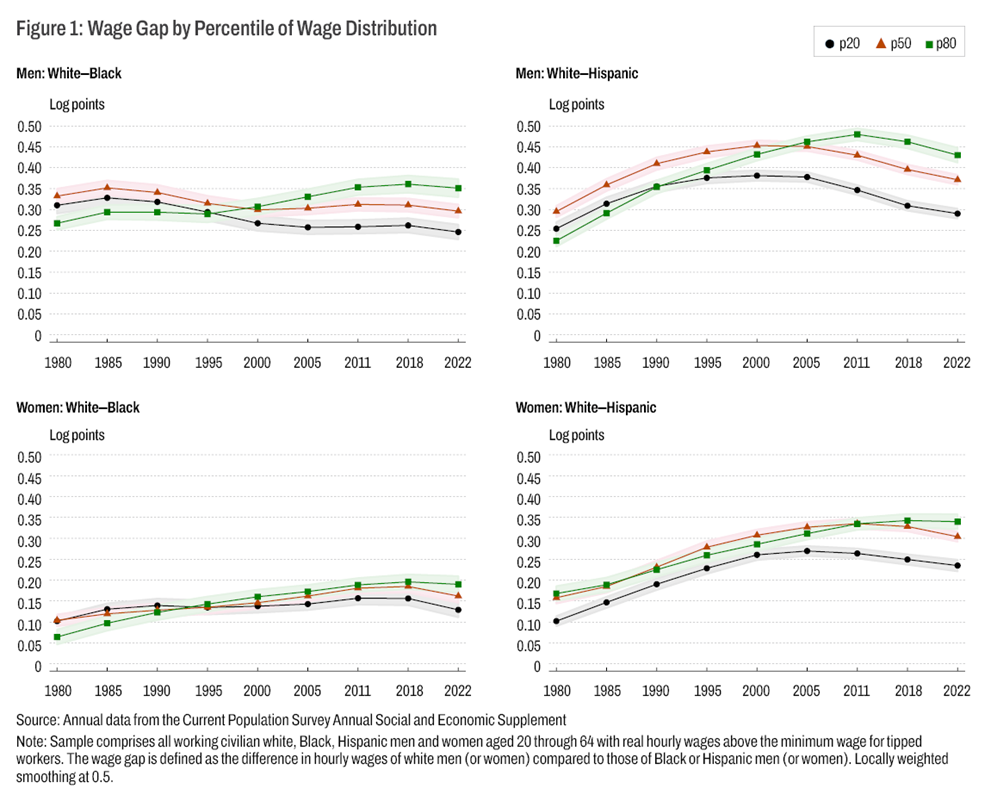
Several important patterns emerge from the wage gaps in Figure 1. First, trends over time in wage gaps vary notably across demographic groups, even at the 50th percentile. Comparing 1980 and 2022, most groups experienced widening differences from the start to the end of the sample, with the exception of Black men at the 20th and 50th percentiles. Second, wage gaps relating to gender are consistently smaller for women than for men across all points in the wage distribution, a pattern that is particularly pronounced for Black women. Third, the timing of changes in wage gaps differs by race and ethnicity. The White-Black gap exhibits more heterogeneous trends for much of the period, with trajectories varying across gender and percentile, although the gap narrows at all three percentiles for both men and women between 2018 and 2022. The White-Hispanic gap follows a more similar trend across groups, generally widening in the earlier part of the sample and then declining after the mid-2000s or early 2010s for most gender-percentile groups, except for women at the 80th percentile. By 2022, the wage gaps between white and Hispanic workers were wider than that for white and Black workers of both genders. Finally, differentials at the top of the wage distribution have become increasingly pronounced, especially for men. Among men, wage gaps at the 80th percentile expanded the most, particularly for Hispanic men. Women exhibit similar patterns, though differences across percentiles are narrower, reflecting less variation throughout the distribution.
Wage gap decomposition
Next, I analyze the drivers of these trends in wage gaps. Figure 2 presents the decomposition of the wage gaps in a simplified form. It shows the extent to which they are explained by the characteristics of the workforce versus the differences in their returns. The decomposition reveals that the composition effect, which accounts for differences in observable characteristics such as occupation and education, explains a greater share of the overall gap than the returns effect, which captures differences in the wage payoff that the same characteristics provide across groups in almost all years. This pattern is consistent across all groups for the entire wage distribution.
Nonetheless, the returns effect is a significant factor for all groups considered, and, in some instances, it drives the changes over time in the overall wage differences between groups. For example, in the case of Black men at the 20th and 50th percentiles, it is the decline in the returns effect that contributes to the narrowing of the overall wage gap.
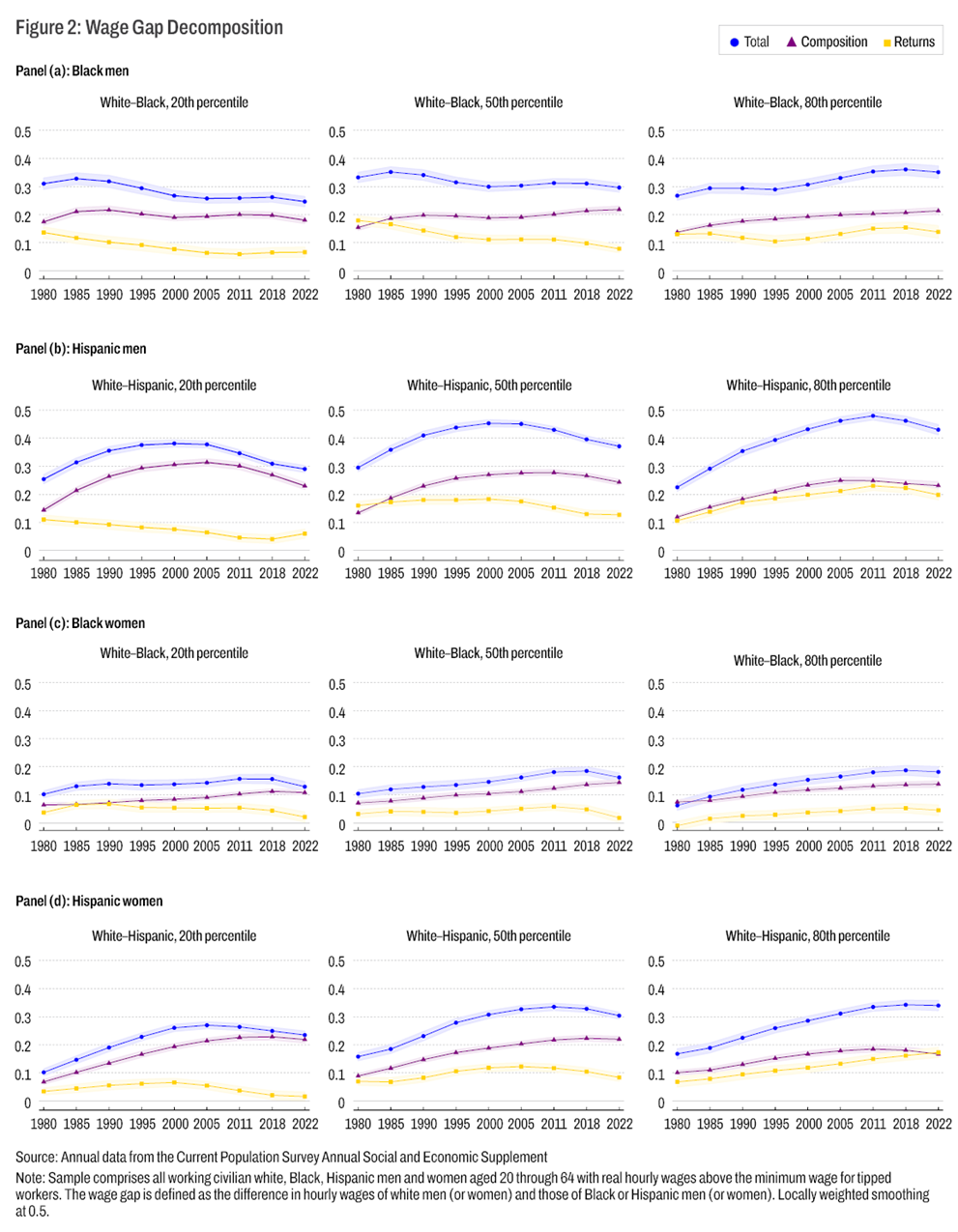
The difference between the composition effect and the returns effect is telling. With the exception of Black women, the higher the percentile, the lower the level of the gap explained by the composition effect and the higher the level of the gap explained by the returns effect.
The composition effect
Across the wage distribution, composition effects are shaped primarily by differences in occupation and education, though their relative importance varies sharply by demographic group and percentile. These factors not only contribute unevenly to the level of wage gaps, but also to how these gaps evolve over time. In the interest of space, I discuss the patterns of the decomposition factors without accompanying graphical illustration.
For Black men, occupational sorting is the central driver of the composition-related wage gap. At the lower end of the distribution, occupational differences diminish over time, and the narrowing wage gap at the 20th percentile is largely explained by declining wages in service and farming, forestry, and fishing occupations, two sectors in which Black men have historically been overrepresented. Higher up the distribution, however, occupational differences widen. At the 50th percentiles, growing gaps are driven by Black men’s continued overrepresentation in transportation and persistent underrepresentation in fast-growing, high-paying occupations such as upper management and lawyers, lower management, and engineers and computer specialists. At the 80th percentile, this underrepresentation in some of the highest-paying jobs in the labor market accounts for both the size of the wage gap in 2022 and its expansion since 1980.
Educational attainment also contributes to wage gaps for Black men, but less so than occupation. Its role declines at the 20th percentile as the share of Black men without a high school diploma falls substantially throughout the time period under examination. By contrast, education becomes more consequential at the top of the distribution, where the continued underrepresentation of Black men among four-year degree holders combines with rising returns to a four-year college degree to amplify education’s contribution to the gap at the 80th percentile.
The pattern for Black women differs from that of Black men in important ways. As was true for Black men, occupational sorting explains a sizable share of the wage gap early in the period, but its contribution remains relatively stable over time across percentiles. Educational attainment, by contrast, grows steadily in importance and emerges as the dominant source of the composition effect by the end of the period.
For Hispanic men and women, educational differences are the primary force shaping composition-related wage gaps. During the first half of the period, differences in education drive widening gaps across the entire wage distribution. After roughly 2005, these education-related gaps level off for women and even narrow slightly for men. Occupational sorting plays a secondary but increasingly important role over time, with the exception of Hispanic men at the 20th percentile.
The returns effect
The returns effect can be summarized briefly. Within the returns component, the contribution associated with the constant term—that is, the term reflecting baseline differences between groups after controlling for compositional differences, and capturing residual differences not attributable to observed covariates —is the largest determinant for men and contributes significantly to widening the wage gap, surpassing the other components of the returns effect. For Black men, this component contributes to the wage gap especially at the 20th and 50th percentiles, although its relative importance compared to other return-effect factors decreases over time. In contrast, for Hispanic men, the wage gap linked to the constant grows significantly over the period, becoming the dominant factor of the returns effect in the latter half of the observed period.
Conclusion
This Economic Commentary analyzes the evolution of real wages from 1980 to 2022 for six demographic groups and examines real wage gaps. For Black men, the wage gap with white men narrowed at the lower and median points of the wage distribution but widened at the higher end. In contrast, wage gaps grew across all points of the distribution for all other groups, with the largest increases occurring at the 80th percentile. Hispanic workers, both male and female, exhibited a more pronounced widening of the wage gap compared to Black workers.
A decomposition of the wage gaps shows that the composition effect, which captures differences in workers' characteristics, consistently plays a larger role than the returns effect, which highlights differences in the returns to said characteristics, in explaining both the levels and trends in wage gaps. The composition effect across all demographic groups is mostly attributable to differences in educational attainment and occupation category, though their relative significance varies across groups. For Black men, occupational sorting plays the most prominent role in widening the wage gap. For Black women, educational attainment has become the most significant contributor to widening the wage gap over time. Lastly, for both Hispanic men and women, differences in educational attainment are the primary driver of wage gaps with their white counterparts. Overall, this Economic Commentary highlights the dynamics of wage gaps across demographic groups, with educational attainment and occupational sorting emerging as key factors in shaping wage heterogeneity over time.
References
- Bayer, Patrick, and Kerwin Kofi Charles. 2018. “Divergent Paths: A New Perspective on Earnings Differences between Black and White Men since 1940.” Quarterly Journal of Economics 133(3): 1459–1501. doi.org/10.1093/qje/qjy003.
- Bick, Alexander, Adam Blandin, and Richard Rogerson. 2022. “Hours and Wages.” Quarterly Journal of Economics 137(3): 1901–1962. doi.org/10.1093/qje/qjac005.
- Bradley, David H. 2015. “The Tip Credit Provisions of the Fair Labor Standards Act (FLSA): In Brief.” Report No. R43445. Congressional Research Service. congress.gov/crs-product/R43445.
- Dicandia, Vittoria. 2026. “Technological Change and Racial Wage Gaps.” Federal Reserve Bank of Cleveland, Working Paper No. 26-09. https://doi.org/10.26509/frbc-wp-202609.
- Firpo, Sergio P., Nicole M. Fortin, and Thomas Lemieux. 2018. “Decomposing Wage Distributions Using Recentered Influence Function Regressions.” Econometrics 6(2): 28. doi.org/10.3390/econometrics6020028.
- Flood, Sarah, Miriam King, Renae Rodgers, Steven Ruggles, J. Robert Warren, Daniel Backman, Annie Chen, Grace Cooper, Stephanie Richards, Megan Schouweiler, and Michael Westberry. 2024. “IPUMS Current Population Survey: Version 12.0 [dataset].” Minneapolis, MN: IPUMS. doi.org/10.18128/D030.V12.0.
- Luduvice, André Victor D., Anaya Truss-Williams, and Christopher J. Walker. 2025. “Did Inflation Affect Households Differently? A Look at the Postpandemic Inflation and Wage Growth Dynamics.” Economic Commentary, no. 2025-11 (October). doi.org/10.26509/frbc-ec-202511.
Endnotes
- The starting point is based on data availability. Return to 1
- For 2010, I use the year 2011 (covering 2010–2012) to avoid the impact of the Great Recession’s most severe datapoint. Also, I select 2018 (covering 2017–2019) and 2022 (covering 2021–2023) to define the pre- and post-pandemic-recession periods and deliberately exclude 2020 to minimize the confounding effects of COVID-19. Return to 2
- Hourly wages are computed as the annual wages divided by the usual number of hours worked and the usual number of weeks worked in a year. Hourly wages below the minimum wages set for tipped workers are $1.60 in 1980, $1.86 in 1981, $2.01 from 1982 through 1990, $2.09 in 1991, and $2.13 from 1992 onward (Bradley, 2015). I also adjust hourly wages for the consumer price index with base year 1999. Return to 3
- This analysis assumes a common inflation rate across workers and therefore deflates nominal wages using the same CPI measure for all groups. This abstracts from potential heterogeneity in inflation experiences, which Luduvice, Truss-Williams, and Walker (2025) document across income groups in the postpandemic period. Return to 4
- For more on the composition effect and the returns effect and the Oaxaca-RIF decomposition method, see Firpo, Fortin, and Lemieux (2018). Return to 5
- There is a large body of economics literature documenting the relationship between weekly hours and hourly wages. For an example, see Bick, Blandin, and Rogerson (2022). Return to 6
- Age-group intervals can also act as an imperfect proxy for work experience. US regions are northeast, middle west, south, and west. Education levels are below high school, high school diploma, some college, four-year degree, and more-than-a-four-year degree. Occupational categories are as follows: upper management and lawyers; lower management; engineers and computer specialists; scientists; health-related occupations; education and social support; artists and nonspecified professionals; technicians; sales occupations; clerical occupations; service occupations; farming, forestry, fishing; production and repairing; construction and extraction; precision production; operators; and transportation. The 12 industry categories are agriculture and mining, construction, low-tech manufacturing, hi-tech manufacturing, public utilities (including transportation and communications), wholesale trade, retail trade, financial activities, business and repair services, personal and entertainment services, professional services (including health and education), and public administration. Working-hour intervals are ≤20 hours, 21–30 hours, 31–39 hours, 40 hours (standard “full time”), 41–50 hours, and >50 hours. The implementation of this methodology requires the selection of base categories for each variable: once again following Firpo, Fortin, and Lemieux (2018), the base level in this Economic Commentary is a worker aged 40 to 44 who is married, living in a rural area in the northeast, with a high school diploma, working in the construction and extraction occupation category in the construction industry, and has a standard workweek of 40 hours. Return to 7
Suggested Citation
Dicandia, Vittoria. 2026. “Changes in Wage Gaps over Forty Years in the United States.” Federal Reserve Bank of Cleveland, Economic Commentary 2026-14. https://doi.org/10.26509/frbc-ec-202614
This work by Federal Reserve Bank of Cleveland is licensed under Creative Commons Attribution-NonCommercial 4.0 International


Related resources

About Us
The Federal Reserve Bank of Cleveland (commonly known as the Cleveland Fed) is part of the Federal Reserve System, the central bank of the United States.

Economic Commentaries
Economic Commentaries provide analysis of relevant economic issues and are written for an informed but nonspecialist audience.