

- Share
How Much Nonbank Business Lending Is Indirectly Funded by Banks? Some Evidence from a New Data Set
Bank lending to the nonfinancial business sector in the United States has declined in recent decades, accompanied by an increase in credit provision by nonbank financial institutions (NBFIs). At the same time, banks are important providers of funding to the NBFI sector, raising concerns over their exposure to the risk in loans made by NBFIs. This Economic Commentary uses the Federal Reserve’s novel issuer-to-holder data, part of the enhanced financial accounts of the United States, to provide a conservative estimate of the share of lending by NBFIs to nonfinancial businesses that is indirectly financed by the banking sector. Using this method, I find that the additional indirect exposure of banks to business loans through this specific channel has been stable at about 5 percent to 6 percent of all business sector loans over the past 20 years. This share is small when compared to the share of business lending that banks provide directly and does not fully compensate for the decline since 1980 in the share of business lending that banks do directly.

The views authors express in Economic Commentary are theirs and not necessarily those of the Federal Reserve Bank of Cleveland or the Board of Governors of the Federal Reserve System. The series editor is Tasia Hane. This paper and its data are subject to revision; please visit clevelandfed.org for updates.
Introduction
The decline of business lending by banks has been a major observable trend in the US financial system in recent decades, with an increasing share of financial intermediation across the economy occurring outside of banks’ balance sheets (Buchak et al, 2024). Alongside this reduction in the importance of banks for credit provision, nonbank financial institutions (NBFIs) such as pension funds, hedge funds, and mutual funds have become an increasingly important provider of credit to the economy (Financial Stability Board, 2024). However, NBFIs often use banks to finance their own activities. By 2024, the largest US banks had total credit commitments to the NBFI sector of $2.3 trillion, up from $1.3 trillion in 2018 (Board of Governors of the Federal Reserve System, 2025). Through their interconnections with the NBFI sector, banks may be increasingly indirectly exposed to the credit risk taken by NBFIs in the business sector, and this increased exposure may entail heightened risk if loans made by NBFIs are riskier than those made by banks themselves (Acharya, Cetorelli, and Tuckman, 2024; Boyarchenko, Choi, and Elias, 2025; Cetorelli, Landoni, and Lu, 2023).
This Economic Commentary uses the recently assembled issuer-to-holder “From Whom to Whom” dataset,1 first published by the Federal Reserve as part of the enhanced financial accounts in 2023, to estimate the indirect exposure of banks to the NBFI sector in the US nonfinancial business loan market. The analysis finds that banks’ indirect credit exposure to business loans through balance sheet lending to NBFIs has been stable at about 5 percent to 6 percent of all business sector loans over the past 20 years. This amount is small when viewed as a share of total business lending and does not compensate fully for the decline in direct bank balance sheet lending to the business sector in recent decades. This result helps to inform the discussion of how exposed banks are to loans made by NBFIs because of the credit they provide to NBFIs.
The Shift in US Business Lending from Banks to NBFIs
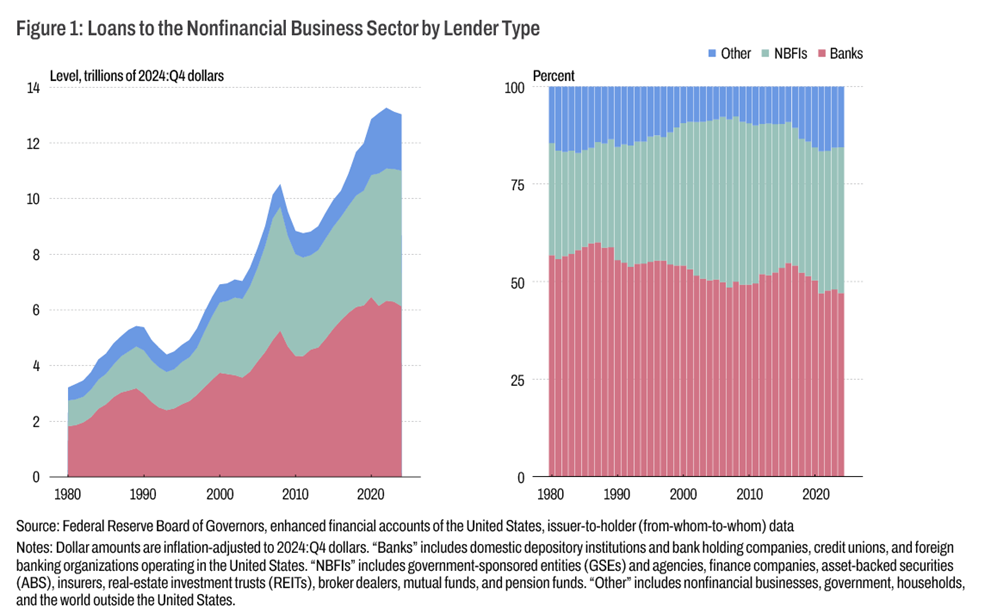
Banks are the traditional providers of credit to businesses, but their importance in that function has decreased over the past few decades, as illustrated in Figure 1. The chart below is based on data from the issuer-to-holder report first published by the Federal Reserve in 2023. This data set builds on existing flow of funds data and maps out a network of relationships between issuers and holders of financial instruments across the US economy. Going back to the 1950s, it offers detailed information on how much in various debt and equity instruments the different sectors of the economy have issued and who owns them. It thereby provides detailed data on the links between different financial and nonfinancial sectors in the US economy at the level of financial instruments. The data set offers a unique view of connections among different sectors and how shocks to one sector might spill over to another; however, it does have some related shortcomings. For example, data at the sector level might hide concentrated exposures between individual institutions, something which could transmit shocks even with limited exposures at the sector level. Furthermore, the data include connections created only through balance sheet relationships, wherein one sector’s liabilities are another sector’s assets. This limitation necessarily precludes the inclusion of other connections between sectors, for example, supplier–customer relationships. Having said that, this data source provides a comprehensive picture of lending by banks and NBFIs to the real economy and to each other, a fact which is key to analyzing indirect-lending relationships.
Figure 1 focuses on lending through loan instruments, which represent the core of the traditional bank business model.2 Loans to businesses are one of the areas in which nonbank providers have become increasingly important, including, for example, through leveraged loans and private credit (International Monetary Fund, 2024, chapter 2). The left panel of Figure 1 illustrates this point by showing the annual, inflation-adjusted dollar amounts of loans to the corporate and noncorporate business sector, grouped by lender type, from 1980 to 2024. The chart splits banks and NBFIs and aggregates all other lender types, such as households, nonfinancial businesses, the government, and overseas lenders, into a residual category. The right panel of Figure 1 uses the same data and converts them to relative shares to show what percentage of business lending was provided by the different sectors. As seen in the left panel, there has been strong growth in total business lending over the full sample period from 1980 to 2024, excluding a notable drop at the time of the Great Recession of 2007–2009 and a smaller dip during the credit crunch of the early 1990s. While the growth in dollar terms extends to banks and nonbanks alike, banks lost market share, as seen in the right panel. The share of business loans held by banks decreased overall from 56.7 percent of all business loans in 1980 to 47.1 percent in 2024. This decline is mirrored by an increase in the market share of nonbank lenders, whose share rose from 28.8 percent in 1980 to 37.4 percent in 2024.
How Exposed Are Banks to Business Loans through Their Funding of NBFIs?
Despite the shift of a large share of business loans from banks to the nonbank sector, banks might still be exposed to the loans made by NBFIs if they provide significant funding to them. Such financing might expose banks indirectly to the credit risk taken by NBFIs, something which is especially important if loans made by NBFIs are riskier than those made by banks (Acharya et al., 2024). For example, if enough businesses were to default on the loans made by NBFIs, then NBFIs might default, as well, and banks with exposures to NBFIs might bear losses. This concern relates to theories of contagion among banks based on interbank lending, theories which received strong attention following the Global Financial Crisis of 2007–2009 (Allen and Gale, 2000; Eisenberg and Noe, 2001; Elliott, Golub, and Jackson, 2014; Acemoglu, Ozdaglar, and Tahbaz-Salehi, 2015).3
Moving from theory into practice, how important might these concerns be? While several contributions have discussed the decline in bank lending and the rise of NBFI lending (Buchak et al., 2024; Financial Stability Board, 2024), along with the increasing interconnection between banks and NBFIs (Acharya, Cetorelli, and Tuckman, 2024; Cetorelli, Landoni, and Lu, 2023), there has been less attention paid to measuring these two issues jointly. Boyarchenko, Choi, and Elias (2025) map out the network of financial interconnections across all lender sectors and show how adjusting for these connections can change the picture of who ultimately funds the real sector. They find that adjusted lending to the real sector is significantly lower than direct lending for government-sponsored entities (GSEs), while it is higher for pension funds and the foreign sector. This Economic Commentary focuses on corporate lending and the connection between banks and NBFIs, to address the specific concerns raised in the literature regarding that exposure,4 and provides an estimate for the potential for such indirect exposure of banks to NBFIs by computing “indirectly bank-funded” loans as the share of business loans made by NBFIs that is equal to the share of funding that NBFIs receive from banks.
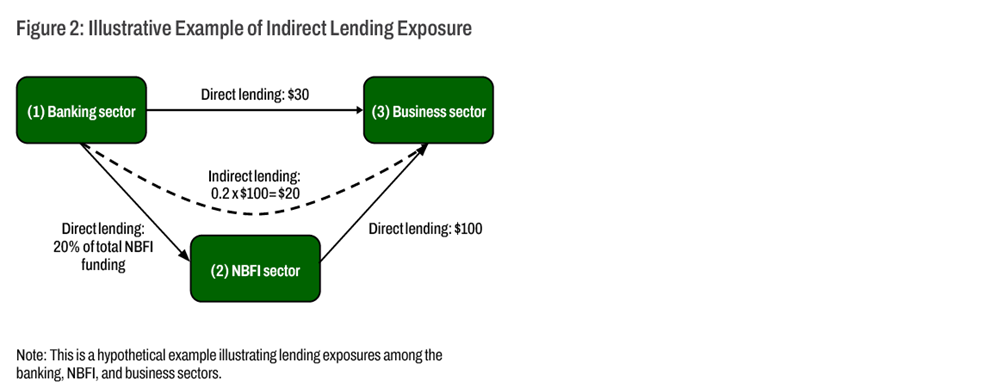
Figure 2 illustrates how I estimate such indirect lending, by means of a simple example. There are three boxes representing three sectors of the economy relevant for this exercise: (1) the banking sector, (2) the NBFI sector, and (3) the business sector. The solid arrows represent direct lending between sectors. In this example, the NBFI sector provides $100 in loans to the business sector. At the same time, the banking sector provides 20 percent of the NBFI sector’s total funding. The total of indirectly bank-funded loans to the business sector would then be calculated as 20 percent of $100, or $20. This is shown by the dashed arrow in Figure 2.
It is worth noting that the assumption that bank exposure to NBFI lending is proportional to the funding NBFIs receive from banks presents an approximation. The actual exposure may be higher or lower, depending on the priority of the financing instruments that banks extend to NBFIs, among other factors. For example, equity instruments are junior to debt instruments, meaning that they take losses before debt instruments do. If banks provide most of their financing to NBFIs in the form of equity, such financing will be more at risk than financing in the form of debt. Having said that, within a financial instrument, liability for losses on that instrument is proportional to ownership. In the simplest terms, if an investor owns half of the equity in a company and that company incurs $100 in losses, then the investor takes a hit of $50, or half, on their holdings of that equity.
We take our estimation approach to real-world data using the Federal Reserve’s issuer-to-holder data set and looking at data for the period from 1980 to 2024. The first step in the estimation procedure calculates the share of NBFI funding accounted for by banks. Here, I adopt a conservative approach, by using the share of NBFI debt funding that is provided by banks. This approach is likely to provide an upper bound of the risk exposure of banks to NBFIs for two reasons. First, as noted previously, debt is senior to equity instruments. Second, banks tend to be overrepresented in debt instruments relative to all NBFI funding. For example, in 2024 the banking sector provided about 5 percent of NBFI funding across all instruments, including debt and equity. In the same year, the share of NBFI debt funding provided by banks was significantly larger and amounted to about 22 percent.5 This general pattern applies to all years in our sample.
For the second step in the estimation procedure, we multiply the share of NBFI funding provided by banks with the overall share of business lending that the NBFI sector provides. Using the 22 percent share of all NBFI debt funding, indirectly bank-funded business loans would amount to 8 percent of all business loans in 2024 (note that 37.4 percent of all business loans are made by NBFIs, of which about 22 percent are estimated to be funded by banks).
Of course, the above estimates of bank funding and NBFI business loans are imprecise simply because they measure the relationship among banks, NBFIs, and businesses at the sector level, lumping together many subsectors of NBFIs while only some of them may be active in the business-lending market. Fortunately, the issuer-to-holder data, being more granular, allows separation of multiple subsectors of NBFIs, such as hedge funds or mutual funds. The dollar amount of indirectly bank-funded lending can thus be computed for each NBFI subsector separately based on that subsector’s lending to nonfinancial businesses and receipt of bank financing. For example, the data measure the share of funding that banks provide for the broker-dealer NBFI subsector and how much business lending that subsector accounts for. The total bank exposure can then be computed by adding up across all NBFI subsectors. Since different NBFI subsectors vary both in the amount of business lending they extend and the share of bank funding they receive, this approach provides a more precise estimate of the indirect bank funding of NBFI business lending.
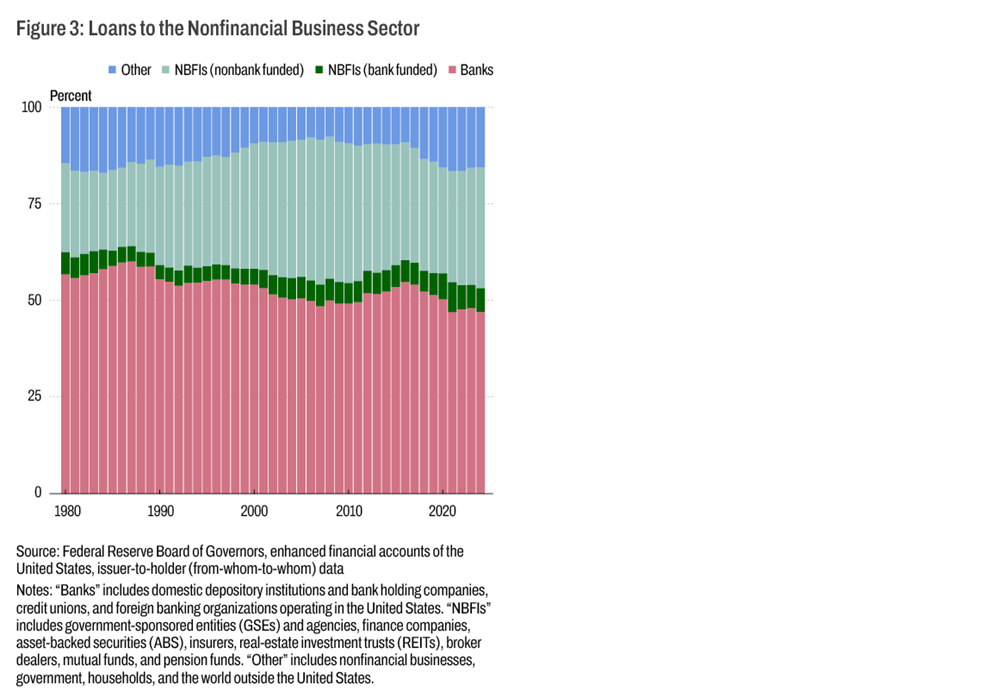
Figure 3 shows the result of this more granular analysis. Using a similar breakdown of total lending to the nonfinancial business sector as in the right panel of Figure 1, Figure 3 splits up NBFI business lending to show how much of it is indirectly bank funded (dark green) and funded from all other sources (light green). The estimated share of total business lending that is funded indirectly by banks has been about 5 percent to 6 percent over the past 20 years. Before that, in the 1990s, this share was around 3 percent to 4 percent. This increase suggests that while there has been a roughly 2 percentage point increase in indirect bank-funded NBFI lending, this increase reflects only a fraction of the overall shift from bank to nonbank credit observed over the same period.
This point is underlined by the fact that the estimate in Figure 3 calculates indirectly bank-funded NBFI lending by using the share of debt funding (excluding equity) that is provided by banks to NBFIs. As noted before, this approach provides a likely upper bound both because it ignores the equity slice that would be first to take any losses and because the bank funding provided to NBFI as a share of total funding is lower.
There are certain limitations to the above analysis. First, the data used present a periodic snapshot of the balance sheets, that is, the financial assets and liabilities, of various sectors of the US economy. As such, it does not capture the role of banks in the origination of loans or through off-balance-sheet instruments. For example, in the syndicated loan market, the originating banks tend to keep only a fraction of the overall loan, and recent research shows that many sell off the loans entirely (Blickle et al., 2024). The importance of banks in that market exceeds the share of funding that banks keep as assets on their balance sheets. In addition, the balance sheet data do not capture unused capacity in credit lines, which are becoming an increasingly important vehicle for bank credit provision to NBFIs (Acharya et al., 2025).
Second, the calculations assume that the exposure of banks through their funding of NBFIs within a given sector is proportional to the share of total debt that banks account for in that sector. This assumption does not capture the differences in the concentration of NBFI funding across banks and of business lending across different NBFI firms in the same subsector. Either of these issues could lead to individual bank exposures that are higher or lower than estimated for the total banking sector.
Finally, the analysis above focuses on the business-loan sector. NBFIs also engage in private equity and corporate bond markets, both of which are outside the scope of this exercise. Furthermore, by focusing on lending to nonfinancial businesses, the analysis does not cover the household sector, in which NBFIs have similarly increased their market share in recent decades. For example, in the residential mortgage market, most mortgages today are held by nonbank lenders, including government-sponsored entities such as Fannie Mae and Freddie Mac (Haughwout et al., 2025).
Despite such limitations, having an estimate of the total exposure of US banks through their NBFI lending is important to inform the debate about the risk that these exposures might pose to the banking sector and to financial stability more broadly.
Conclusion
Direct bank lending to the nonfinancial business sector has been declining since the 1980s and is increasingly being replaced by rapidly growing credit provided by NBFIs. At the same time, the NBFI sector is increasingly making use of funding provided by the banking sector, creating interconnections between both types of lenders. One concern arising from these interconnections is that banks that lend to NBFIs might potentially incur losses if NBFIs default on loans. This Economic Commentary provides a high-level estimate of the total amount of lending that might be considered “indirectly bank funded” under the assumption that it is proportional to the share of total NBFI debt that is funded by banks. This assumption is conservative in the sense that if an NBFI incurred losses, the equity holders of that NBFI would absorb the losses first, before any debt holders. At 5 percent to 6 percent of total business lending, the estimated amount of NBFI lending that is indirectly bank funded is small relative to both the share of direct bank lending to the nonfinancial business sector and the drop that this share has exhibited since the 1990s.
References
- Acemoglu, Daron, Asuman Ozdaglar, and Alireza Tahbaz-Salehi. 2015. “Systemic Risk and Stability in Financial Networks.” American Economic Review 105(2): 564–608. doi.org/10.1257/aer.20130456.
- Acharya, Viral, Nicola Cetorelli, and Bruce Tuckman. 2024. “Where Do Banks End and NBFIs Begin?” Working Paper No. 32316. National Bureau of Economic Research. doi.org/10.3386/w32316.
- Acharya, Viral, Manasa Gopal, Maximilian Jager, and Sascha Steffen. 2025. “Shadow Always Touches the Feet: Implications of Bank Credit Lines to Non-Bank Financial Intermediaries.” Working Paper No. 33590. National Bureau of Economic Research. doi.org/10.3386/w33590.
- Allen, Franklin, and Douglas Gale. 2000. “Financial Contagion.” Journal of Political Economy 108(1): 1–33. doi.org/10.1086/262109.
- Batty, Michael M., Elizabeth Holmquist, and Robert J. Kurtzman. 2023. “From-Whom-to-Whom Relationships in the Financial Accounts of the United States: A New Methodology and Some Early Results.” FEDS Notes. Board of Governors of the Federal Reserve System. doi.org/10.17016/2380-7172.3273.
- Blickle, Kristian S., Quirin Fleckenstein, Sebastian Hillenbrand, and Anthony Saunders. 2022. “The Myth of the Lead Arranger’s Share.” Staff Report No. 922. Federal Reserve Bank of New York. newyorkfed.org/research/staff_reports/sr922.html.
- Board of Governors of the Federal Reserve System. 2025. “Financial Stability Report.” federalreserve.gov/publications/files/financial-stability-report-20250425.pdf.
- Board of Governors of the Federal Reserve System. “Issuer-to-Holder (From-Whom-to-Whom) Data.” Accessed September 15, 2025. federalreserve.gov/releases/efa/fwtw.htm.
- Boyarchenko, Nina, Hyuntae Choi, and Leonardo Elias. 2025. “Who Finances Real Sector Lenders?” Liberty Street Economics, May 12. Federal Reserve Bank of New York. libertystreeteconomics.newyorkfed.org/2025/05/who-finances-real-sector-lenders/.
- Buchak, Greg, Gregor Matvos, Tomasz Piskorski, and Amit Seru. 2024. “The Secular Decline of Bank Balance Sheet Lending.” Working Paper No. 32176. National Bureau of Economic Research. doi.org/10.3386/w32176.
- Cetorelli, Nicola, Mattia Landoni, and Lina Lu. 2023. “Non-Bank Financial Institutions and Banks’ Fire-Sale Vulnerabilities.” Supervisory Research and Analysis Working Paper No. 23-1. Federal Reserve Bank of Boston. bostonfed.org/publications/risk-and-policy-analysis/2023/non-bank-financial-institutions-and-banks-fire-sale-vulnerabilities.aspx.
- Eisenberg, Larry, and Thomas H. Noe. 2001. “Systemic Risk in Financial Systems.” Management Science 47(2): 236–249. doi.org/10.1287/mnsc.47.2.236.9835.
- Elliott, Matthew, Benjamin Golub, and Matthew O. Jackson. 2014. “Financial Networks and Contagion.” American Economic Review 104(10): 3115–3153. doi.org/10.1257/aer.104.10.3115.
- Financial Stability Board. 2024. “Global Monitoring Report on Non-Bank Financial Intermediation.” fsb.org/2024/12/global-monitoring-report-on-non-bank-financial-intermediation-2024/.
- Haughwout, Andrew F., Donghoon Lee, Jonathan Lee, Joelle Scally, and Wilbert van der Klaauw. 2025. “A Check In on the Mortgage Market.” Liberty Street Economics, August 5. Federal Reserve Bank of New York. libertystreeteconomics.newyorkfed.org/2025/08/a-check-in-on-the-mortgage-market/.
- International Monetary Fund. 2024. “The Last Mile: Financial Vulnerabilities and Risks.” Global Financial Stability Report. doi.org/10.5089/9798400257704.082.
- Irani, Rustom M., Rajkamal Iyer, Ralf R. Meisenzahl, and José-Luis Peydró. 2021. “The Rise of Shadow Banking: Evidence from Capital Regulation.” Review of Financial Studies 34(5): 2181–2235. doi.org/10.1093/rfs/hhaa106.
Endnotes
- The data are available at federalreserve.gov/releases/efa/fwtw.htm, Board of Governors of the Federal Reserve. For further background on this dataset and how it was constructed, see Batty, Holmquist, and Kurtzman (2023). Return to 1
- Loan instruments reported in the data include loans, mortgages, consumer credit, and other loans and advances. Return to 2
- There are other potential mechanisms for contagion from the NBFI sector to the banking sector, for example, through common asset holdings that can transmit losses through fire-sales (Cetorelli, Landoni, and Lu, 2023). These remain outside the scope of this Economic Commentary. Return to 3
- See, for example, Acharya, Cetorelli, and Tuckman (2024). Return to 4
- The debt instruments in the Federal Reserve Flow of Funds data include open market paper, US Treasury securities, agency- and GSE-backed securities, municipal securities, and corporate and foreign bonds. We add loan instruments including mortgages, consumer credit, depository institution loans not elsewhere classified, and other loans and advances. Return to 5
Suggested Citation
Siedlarek, Jan-Peter. 2026. “How Much Nonbank Business Lending Is Indirectly Funded by Banks? Some Evidence from a New Data Set.” Federal Reserve Bank of Cleveland, Economic Commentary 2026-13. https://doi.org/10.26509/frbc-ec-202613
This work by Federal Reserve Bank of Cleveland is licensed under Creative Commons Attribution-NonCommercial 4.0 International


Related resources

About Us
The Federal Reserve Bank of Cleveland (commonly known as the Cleveland Fed) is part of the Federal Reserve System, the central bank of the United States.

Economic Commentaries
Economic Commentaries provide analysis of relevant economic issues and are written for an informed but nonspecialist audience.