

- Share
Covered Savings Associations: A New Type of Depository Institution
The Economic Growth, Regulatory Relief, and Consumer Protection Act of 2018 allowed most federally chartered savings associations to elect to operate with the powers of a national bank, expanding their ability to engage in commercial banking activities and no longer requiring them to concentrate their activities in residential mortgage lending. This Economic Commentary describes which associations have made the election, their reasons for doing so, and how the election has changed their asset mix. Both mutual and stock savings associations have made this election, and among mutuals, large institutions are especially likely to have done so. Institutions that have made this election have altered their asset mix away from residential lending and toward that of similarly sized national banks.


The views authors express in Economic Commentary are theirs and not necessarily those of the Federal Reserve Bank of Cleveland or the Board of Governors of the Federal Reserve System. The series editor is Tasia Hane. This paper and its data are subject to revision; please visit clevelandfed.org for updates.
Introduction
The Economic Growth, Regulatory Relief, and Consumer Protection Act of 2018 (EGRRCPA) created a new type of depository institution, the covered savings association (CSA). This law allowed a federal savings association (FSA)—a savings bank or savings and loan with a federal charter—with under $20 billion in assets as of December 31, 2017, to elect to be a CSA, and the institution could remain a CSA even if it grows above $20 billion in assets. In terms of rules, a CSA is treated almost the same as a national bank. The most important change to an FSA that makes the CSA election is that it is no longer subject to the qualified thrift lender (QTL) test and other lending restrictions that require FSAs to concentrate their business in residential mortgage lending. Yet, unlike a national bank, a CSA retains a few traditional FSA powers, most notably, regarding governance. For FSAs looking to diversify their loan portfolio, the CSA election may be an attractive option.
For historical reasons, the majority of FSAs are mutuals, that is, they are owned by their depositors, but national banks have to be organized as stock corporations. The CSA election means that for the first time since the National Bank Acts of 1863 and 1864 created national banks, there can be, for almost all practical purposes, mutual national banks. While the election allows mutual FSAs to retain their mutual structure, stock FSAs have no such benefit. Nevertheless, a significant number of them have made the election, choosing that over converting to a national bank charter. As of 2025:Q2, there were 233 FSAs with $538 billion in assets; of these, 40 mutual and stock FSAs with $78 billion in combined assets had made the CSA election.
This Economic Commentary provides a short history of federally chartered savings associations—or “thrifts”—the laws that require them to concentrate in residential lending, and information regarding how the CSA election relaxes these laws to allow them to concentrate in other forms of lending. It also describes other costs and benefits of making the CSA election for both mutual and stock FSAs. Among mutual FSAs, mainly larger ones have made the election, while among stock FSAs, there is no size pattern. We find that the asset mix of FSAs that make the election becomes closer to that of similarly sized national banks. Interestingly, the change starts before most FSAs make the election, suggesting that the election is used by institutions that have already started to move away from a business model focused on residential lending.
FSAs have long been allowed to convert to a national bank charter, and many have done so. Before becoming a national bank, however, a mutual FSA must convert to a stock form of organization. No such step is necessary under the CSA election. The election allows mutual FSAs to operate with many of the same powers as commercial banks, mirroring some state savings banks, particularly in the northeast, which operate like commercial banks but are mutually owned. However, we find that about half of the institutions that made the election are stock owned. This fact suggests that some stock FSAs view the CSA election as a less costly alternative to converting to a national bank.
FSA Powers and Restrictions and the CSA Election
The creation of the CSA election is part of a long trend of convergence between the powers of thrifts and commercial banks. Historically in the United States, residential mortgage loans were made primarily by thrifts—savings and loans, savings banks, and cooperative banks—while commercial loans and payments services were provided primarily by commercial banks. These differences go back to the 19th century but were cemented into federal law when, following the collapse of the banking and residential mortgage system during the early 1930s, Congress passed the Federal Home Loan Bank Act of 1932, the Home Owners’ Loan Act of 1933 (HOLA), and the National Housing Act of 1934. These acts created federally chartered savings and loans, provided deposit insurance to federal savings and loans and state-chartered savings and loans that chose it, and created the Federal Home Loan Bank (FHLB) system to provide liquidity to thrifts by providing advances against residential mortgages. Furthermore, HOLA required federally chartered thrifts to concentrate their asset holdings in residential mortgages. Broadly, these acts and subsequent federal policy were designed to support residential mortgage lending and did so, at least through the 1970s, by promoting specialization in residential mortgage lending by the thrift industry.
The distinctions between thrifts and commercial banks have faded over time, particularly when, in response to the inflation of the 1970s and the subsequent savings and loan crisis of the 1970s and 1980s, thrift powers were relaxed in an attempt to keep them viable.1 For example, prior to the 1980s, FSAs were largely limited to making loans on the security of first liens on residential property or on deposit accounts, and they could not accept demand deposits. Then in the early 1980s, thrift powers were expanded to allow some commercial lending and nonresidential property lending. In the other direction, in 1989 commercial banks were allowed to become members of the FHLB system if they held 10 percent of their assets as residential mortgages.2 Further convergence of powers occurred with the Gramm–Leach–Bliley Act of 1999, which prohibited new acquisitions of savings associations by commercial companies.3 Then in 2010, the Dodd–Frank Wall Street Reform and Consumer Protection Act eliminated the Office of Thrift Supervision (OTS), which had been the primary regulator of all FSAs, shifting the responsibility for FSA regulation to the Office of the Comptroller of the Currency (OCC), which is the primary regulator for national banks. Furthermore, Dodd–Frank aligned federal preemption powers between FSAs and national banks (Bailey, 2014). Previously, FSAs had enjoyed a greater ability to preempt state laws.
Despite these changes, some differences in powers have remained. The most important distinction between FSAs and commercial banks that continues to exist is the asset restrictions on FSAs.4 The modern form of this difference is the qualified thrift lender (QTL) designation, which was created by the Financial Institutions Reform, Recovery, and Enforcement Act of 1989. All FSAs were required to satisfy the QTL test, which continued to tether FSAs to their traditional role as home lenders by requiring them to concentrate in certain qualified investments, including residential mortgages.5 Additionally, FSAs are restricted in the amount of certain nonqualified investments they can hold, such as commercial loans, construction and land development loans, and commercial real estate loans. Over time, there were some changes to the QTL requirements, but they always favored residential mortgage lending and put constraints on the amount of nonqualified lending an FSA could do.
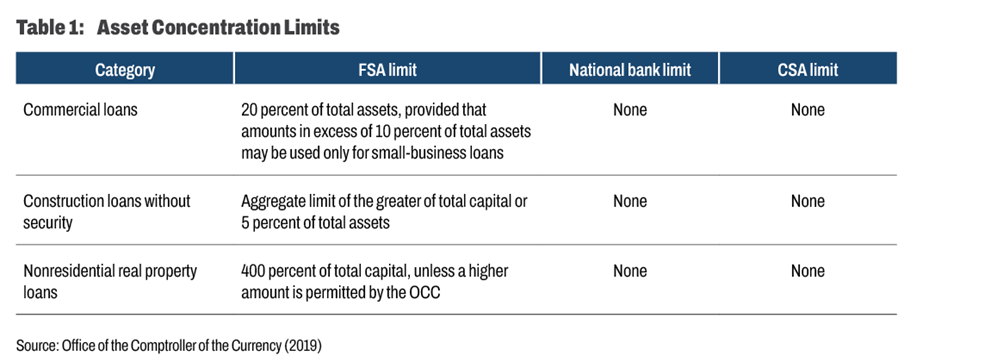
The CSA election eliminates these asset restrictions. Any FSA that makes the CSA election is no longer subject to the QTL requirements or the restrictions on holding of nonqualified investments. Instead, they are subject to the much more limited investment and lending restrictions of national banks. For example, there are no concentration limits in commercial and nonresidential real estate lending for national banks (OCC, 2019). Table 1 lists these limits for a few categories of loans. The CSA election also removes some powers granted only to FSAs. For example, an FSA is permitted to invest up to 3 percent of its total assets in the capital stock, obligations, and other securities of service corporations.6 These service corporations can engage in a range of activities, including real estate development.7 However, CSAs are subject to national bank rules that prohibit investment in service corporations (OCC, 2019). FSAs that make the CSA election also lose the ability to pledge assets to secure private deposits (OCC, 2019).
A CSA election also affects the powers and limitations that apply to an electing thrift’s holding company. The Federal Reserve, which is responsible for holding-company regulation, has interpreted the EGRRCPA such that holding companies that hold a CSA are treated like holding companies that hold a national bank (Board of Governors of the Federal Reserve System, 2021), meaning that the holding company of a CSA is treated like a bank holding company (BHC). In contrast, the holding company of an FSA that does not make a CSA election is treated as a savings and loan holding company (SLHC) unless for some other reasons, such as the holding company’s owning a commercial bank, it is treated as a BHC. SLHCs are permitted to engage in some activities such as real estate development, property management, and general insurance agency activities that are prohibited for BHCs (Greenlee, 2021).8 The holding companies of electing CSAs lose these powers. Additionally, CSAs, like national banks and unlike other FSAs, are required to become members of the Federal Reserve System (Board of Governors of the Federal Reserve System, 2021).
While the CSA election is part of the convergence of commercial bank and FSA powers, FSAs do retain some FSA powers if they make the election, mainly relating to corporate governance, although some powers related to dividend payments, capital distributions, and subordinated debt issuance also remain.9 Retention of corporate governance powers is notable because FSAs may be organized under a mutual ownership structure (that is, owned by their depositors), while national banks cannot organize in this way, instead having shareholders.
There are several reasons that a thrift might want to stay a mutual. Even today, mutual thrifts tend to be small, community-orientated institutions. Their governance and immunity from activist shareholders give them different incentives than their stock counterparts.10 They tend to take less risk and grow more slowly.11 The election allows FSAs that wish to transition away from residential real estate investments, or toward otherwise-capped asset categories, to do so while retaining their mutual ownership structure.
Data Analysis
The number of FSAs has dropped dramatically over the years. In 1980, there were 2,000, and even in 2010 there were still 670. But as of 2025:Q2, there were only 233; of these, 127 are mutuals, and 106 are stock FSAs. Among stock FSAs, a small number are owned by large financial institutions, and a few are still owned by commercial companies that were grandfathered in under the unitary thrift exemption.12
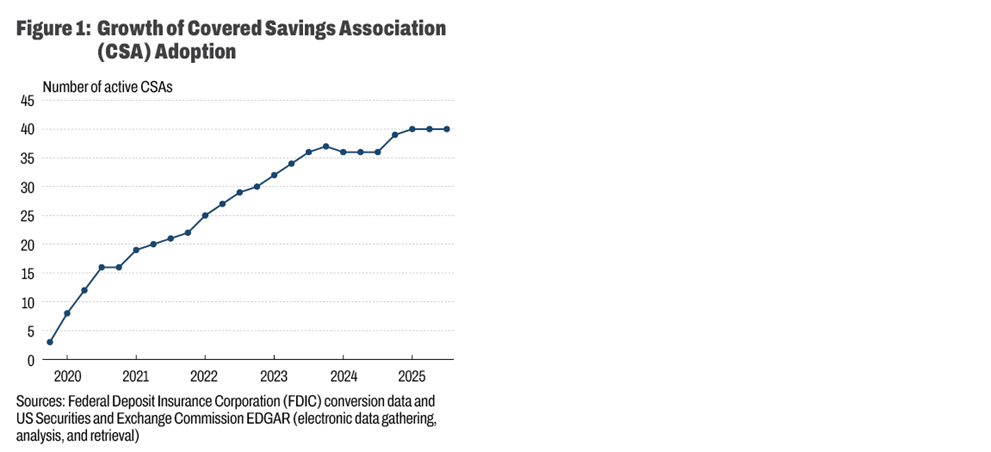
As of 2025:Q2, 40 of the FSAs have made the CSA election; of mutuals, 21 of the 127 have made the election, while 19 of 106 stock FSAs have. The first CSA election occurred in August 2019, soon after regulations were written to implement the EGRRCPA, and the number of CSAs grew at a steady pace until tapering off in late 2023. Figure 1 shows the total number of active CSAs in each quarter since the first election. As of 2025:Q2, there were two institutions that previously made the CSA election but no longer operated as CSAs. One of these converted to a national bank, and the other was acquired by a bank.
What financial institutions elect to be a CSA, and what do CSAs do?
To analyze which institutions make the CSA election and to see how doing so affects asset allocations, we use publicly available Call Report data to compare CSAs with FSAs that do not make the election and with national banks with less than $20 billion in assets as of 2017:Q4.13 We exclude two FSAs that are ineligible to become CSAs because they had more than $20 billion in assets as of 2017:Q4.14 Some banks and savings associations operate predominantly by providing fiduciary or credit card services. These institutions make no loans, hold few deposits, and are significantly different than other depository institutions. We exclude these institutions from the summary statistics and calculations reported below;15 five CSAs fall into this group.16 Table 2 reports summary statistics for CSAs, noncovered FSAs, and similarly sized national banks for several balance sheet variables as of 2025:Q2.17
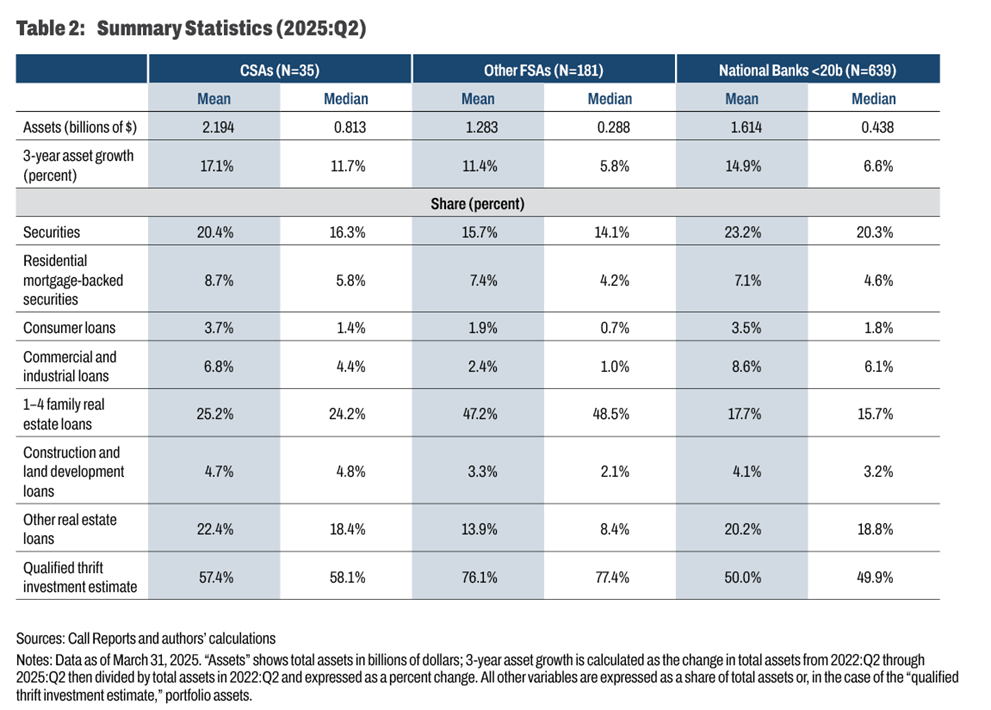
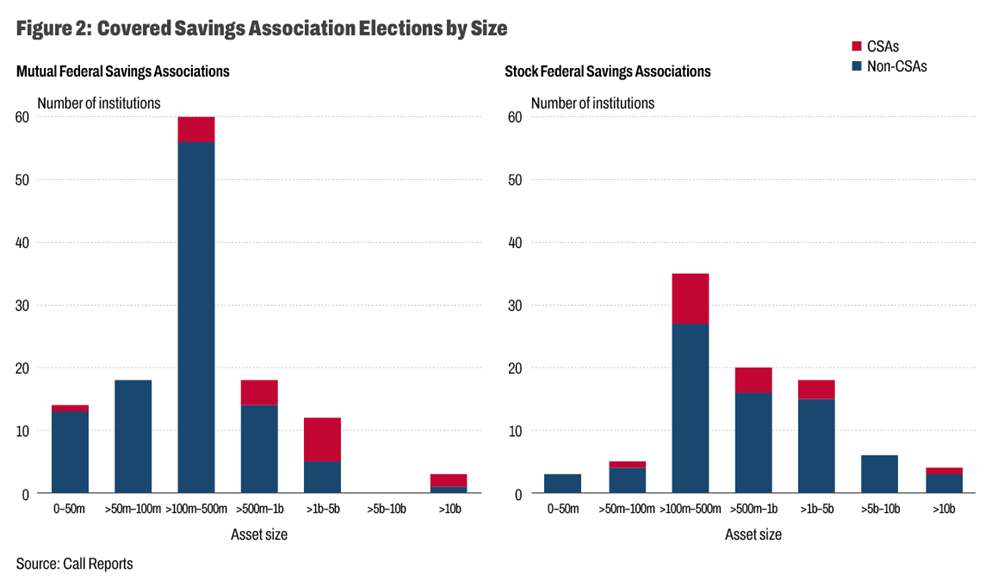
CSAs are generally community bank-sized institutions, although a couple exceed the commonly used $10 billion asset threshold for identifying community banks. The median CSA is larger than both the median FSA and the median from our national bank sample. This difference is driven by mutual CSAs, which are much larger than a typical mutual. The median size of a mutual noncovered FSA is $197 million, while the median size for a mutual CSA is $1.05 billion. Of the 20 largest mutual FSAs, 11 have elected to become a CSA, including four of the largest five mutual FSAs.
In contrast, there is no such size difference for stock thrifts. The median stock CSA holds $445 million in assets, while the median stock, noncovered FSA holds $535 million. Figure 2 reports the number of CSAs and other FSAs for mutuals and stocks broken down by asset size. For mutuals, the CSA election is more likely to be chosen by the largest of them, while for stocks there is no such pattern.
The behavior of CSAs is different from other FSAs and national banks. From 2022:Q2 through 2025:Q2, the asset growth rate for CSAs was higher than it was for other FSAs and national banks (Table 2).18 In terms of balance sheet composition, CSAs are between other FSAs and national banks. They hold more commercial loans and nonresidential real estate loans as a percentage of assets than other FSAs, but less than national banks in our sample. They also tend to have higher levels of core deposits than other FSAs but lower levels than national banks. Most strikingly, they hold substantially less residential real estate loans than other FSAs, but still more than national banks. Table 2 shows that in place of residential real estate lending, CSAs are more concentrated than other FSAs in several smaller asset categories. This distribution of assets is consistent with the idea that institutions elect to operate as CSAs to reduce their concentration in residential real estate lending and increase other types of lending and investment.
Changes in CSA asset concentrations before and after election support this hypothesis. Figure 3 plots the average concentration in residential real estate lending and FSA-capped lending categories for CSAs before and after the quarter in which they elected to operate as CSAs. On average, these institutions were reducing their residential real estate lending and increasing these capped loan categories for two years before electing to operate as CSAs and continued to do so afterward. Interestingly, Figure 3 shows that most of the shift in asset concentrations occurred before CSA election, though this could be due to the shorter postelection horizon in our sample. Still, on average CSAs do not accelerate the shift from residential lending to previously capped lending after they elect. This suggests that the CSA election is an intermediate step in a longer-term balance sheet shift rather than the beginning of one.
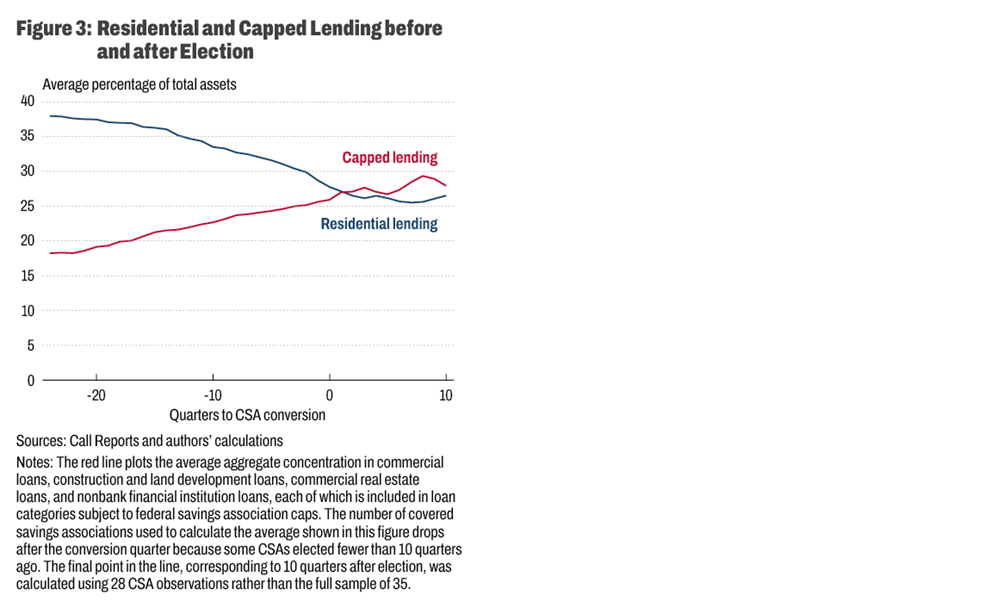
It is not clear from Figure 3 whether the reduction in residential real estate lending was characteristic of CSAs, in particular, or if it was part of a general trend among FSAs. Most CSA elections were made in the 2020–2021 period, when deposit liabilities and cash holdings swelled. So the declining average residential real estate concentration before and after CSA election could reflect the broad reduction in residential real estate lending concentrations across the banking industry in 2020–2021 as a result of the large increase in deposits. Additionally, since residential real estate lending is just one component of QTL qualified investments, an institution could maintain compliance with QTL requirements by increasing concentration in other qualified investments to compensate for a reduction in residential real estate lending.
To account for these possibilities, we compare over time CSAs, FSAs that did not make the CSA election, and national banks with less than $20 billion in assets. The first panel of Figure 4 plots residential real estate lending concentration separately for each group. The second panel plots the average concentration in FSA-capped lending categories separately for CSAs, FSAs, and national banks. The last panel plots our estimate of QTL qualified investments for each group.19 In this figure, all institutions that eventually elected to operate as CSAs are included in the CSA group, and all other FSAs that did not make the election are included in the FSA group.
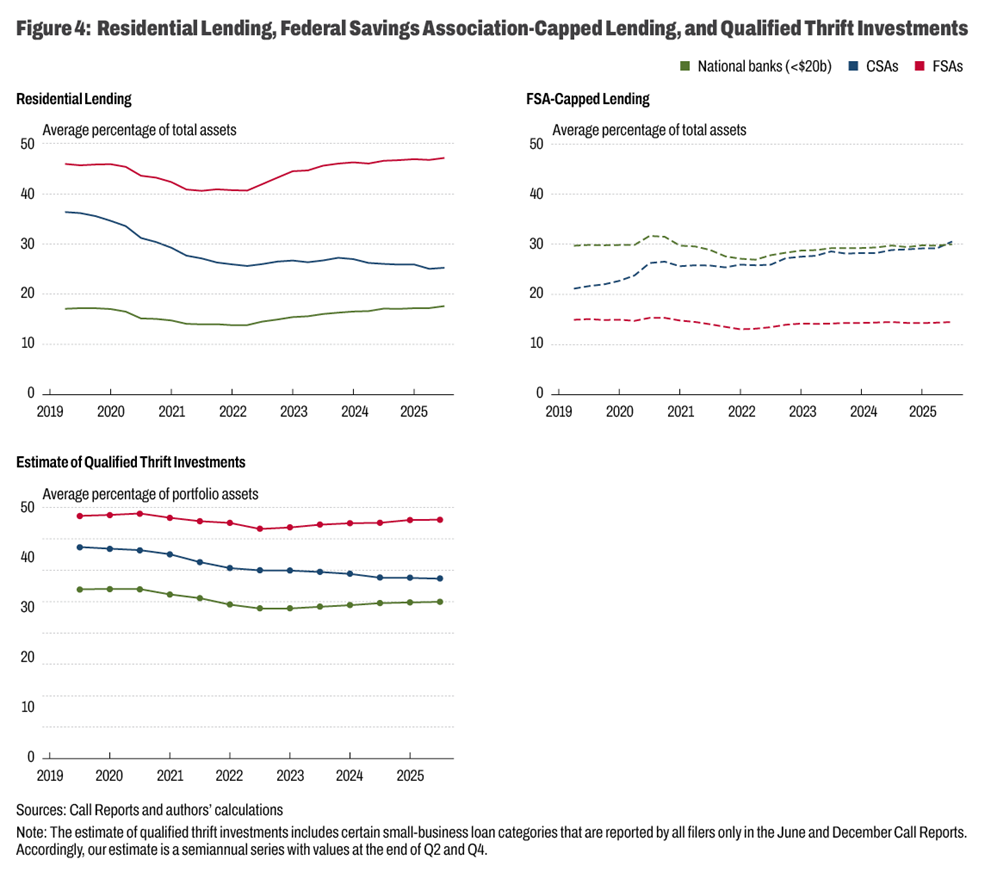
Even before any had become CSAs, the average concentrations for the CSA group are different from the averages for other FSAs and national banks. This pattern is consistent with our finding that CSAs had been moving away from residential real estate lending and toward capped lending categories for years before converting. The CSA group reduced its average qualified thrift investments concentration by about 10 percent of total assets from 2019:Q2 to 2025:Q2 and did so primarily by reducing residential real estate lending. Although they dipped in 2020–2022, in contrast, average qualified thrift investments and residential real estate lending concentrations rebounded for national banks and FSAs by the end of 2024. Furthermore, the CSA group increased concentration in capped loan categories by nearly 10 percent of total assets over this period, while other FSAs and national banks held it steady. Over this period, the CSA group increasingly diverged from other FSAs and moved toward national banks.
As the aggregate statistics indicate, many of the CSAs had been decreasing residential real estate lending concentrations before they elected, and many continued to decrease these concentrations afterward. At the individual-institution level, this decline was frequently accompanied by an increase in asset categories that were previously subject to caps, such as commercial and industrial loans and commercial real estate loans. Some CSAs, however, maintained high enough levels of qualified thrift investments to pass the QTL test, suggesting that their CSA election was not motivated by a desire to immediately remove the QTL requirements. Of these, some increased concentration in previously capped asset classes, indicating that the removal of FSA asset caps was a motivating factor. Still others remained capable of both passing the QTL test and abiding by FSA asset caps after becoming CSAs.
Why not just become a national bank?
The rationale for a mutual FSA electing to operate as a CSA seems straightforward: it can gain national bank powers while retaining its mutual ownership structure. The rationale for a stock FSA is less clear because it could presumably convert to a national bank, thereby gaining the same powers. One potential explanation is that it is easier to elect to become a CSA than it is to convert to a national bank. To operate as a CSA, an FSA need only submit a notice to the OCC.20 To convert to a national bank, an FSA must submit an application and wait for the OCC to process and act on it.21 Similarly, a CSA can terminate its election by notifying the OCC and return to being treated as an FSA, whereas a national bank is required to submit an application to convert to an FSA. For stock FSAs, the CSA election may simply serve as a quick, low-cost way to essentially convert to a national bank while retaining the option of quickly switching back to a standard FSA and regaining those powers.22
Conclusion
Since 2019, about 20 percent of FSAs have elected to operate as CSAs. These CSAs have taken advantage of their new powers to shift away from assets backed by residential real estate and toward commercial banking activities. However, it appears that they started this shift around two years before making the election. The CSA election is especially attractive for large mutual FSAs, while for stock FSAs the election is made across the size distribution.
References
- Bailey, Dori K. 2014. “A Defense of the Doctrine of Preemption: Revealing the Fallacy That Federal Preemption Contributed to the Financial Crisis.” University of Pennsylvania Journal of Constitutional Law 16(4): 1041–1108.
- Balla, Eliana, Edward S. Prescott, and Grant Rosenberger. 2025. “Organizational Form and Thrift Risk During the US Housing Boom and Bust.” Working Paper No. 25-18. Federal Reserve Bank of Cleveland. doi.org/10.26509/frbc-wp-202518.
- Board of Governors of the Federal Reserve System. 2021. “Frequently Asked Questions about Covered Savings Associations Pursuant to Section 5A of the Home Owners’ Loan Act.” federalreserve.gov/supervisionreg/legalinterpretations/covered-savings-associations-frequently-asked-questions.htm.
- Greenlee, Mark. 2021. “Is It Time to Unify the Regulation of Depository Institution Holding Companies? Historical Review of Differentiation and Convergence in the Regulation and Supervision of Depository Institutions, Bank Holding Companies, and Savings and Loan Holding Companies.” North Carolina Banking Institute 25(1): 1. scholarship.law.unc.edu/ncbi/vol25/iss1/5.
- Kane, Edward J. 1989. The S&L Insurance Mess: How Did It Happen? The Urban Institute Press.
- Office of the Comptroller of the Currency. 2019. “Key Differences Among National Bank, Federal Savings Association, and Covered Savings Association Requirements.” occ.treas.gov/publications-and-resources/publications/banker-education/files/pub-key-diff-among-nat-bank-fsa-covered-sav-assoc-req.pdf.
- White, Lawrence J. 1991. The S&L Debacle: Public Policy Lessons for Bank and Thrift Regulation. Oxford University Press.
Endnotes
- For histories of the savings and loan crisis, see Kane (1989) or White (1991). Return to 1
- Financial Institutions Reform, Recovery, and Enforcement Act of 1989, Pub. L. No. 101-73, § 704, 103 Stat. 183, 416 (1989). Later, the Gramm–Leach–Bliley Act of 1999 allowed insured depository institutions below a certain asset threshold to become FHLB members without having 10 percent of total assets in residential mortgages. This asset threshold is subject to change but was $1.5 billion as of January 2025 (90 FR 3865). Return to 2
- Previously, commercial companies, such as retailers, were allowed to own a single savings association, the so called “unitary thrift exception.” Commercial companies that acquired a savings association before Gramm–Leach–Bliley were allowed to continue to operate with this grandfathered power. Return to 3
- A federal savings association that fails to remain a qualified thrift lender is subject to restrictions on its activities consistent with the restrictions applicable to national banks. Return to 4
- The QTL test requires that institutions hold at least 65 percent of their assets in qualified thrift investments. State chartered savings associations are required to meet the QTL test, although state savings banks and cooperative banks are not. In lieu of the QTL test, a qualified thrift lender can opt to qualify as a domestic building and loan association (DBLA), which involves meeting a similar asset test requiring concentration in certain asset categories, including residential lending. Return to 5
- 12 C.F.R. § 5.59(g) (2025). Return to 6
- 12 C.F.R. § 5.59(f) (2025). Return to 7
- Some SHLCs retain grandfathered powers to engage in commercial activities. Both SLHCs and BHCs that qualify as a financial holding company (FHC) can engage in additional financial and related activities. For a discussion about the history of holding company powers and restrictions, see Greenlee (2021). Return to 8
- For a full list of activities for which CSAs are subject to the provisions that apply to FSAs, see 12 C.F.R § 101.4(a)(2) (2025). Return to 9
- For a comparison of risk taking and failure rates of mutual and stock thrifts over the 2001–2013 period, see Balla, Prescott, and Rosenberger (2025). Return to 10
- A significant disadvantage they have, however, is a limited ability to raise external capital. Return to 11
- Examples of the latter include Macy’s, Deere and Company, and Hy-Vee, Inc. Return to 12
- Institutions are excluded if they did not file a Call Report in 2017:Q4 and 2025:Q2. Return to 13
- These are Synchrony Bank and USAA Federal Savings Bank. Both had around $80 billion in assets as of 2017:Q4. Return to 14
- Specifically, we exclude institutions that hold less than 5 percent of their total assets in loans. Return to 15
- These are ClearPoint Federal Bank & Trust, Country Trust Bank, Everence Trust Company, FDS Bank, and Northwestern Mutual Wealth Management Company. Return to 16
- There were 639 national banks with less than $20 billion in assets as of December 31, 2017. Return to 17
- The variable 3-year asset growth shown in Table 2 represents the change in total assets from 2022:Q2 through 2025:Q2, divided by total assets in 2022:Q2, expressed as a percent change. Return to 18
- Our estimate of QTL qualified investments is based on the definition for “qualified thrift investments,” which is used in the QTL test of assets. Our estimate includes loans secured by residential real estate, small business loans, residential mortgage-backed securities, residential real estate owned, and credit card loans. This value is likely an underestimate because it excludes some qualified asset categories that cannot be isolated using Call Report data. See the appendix for a description of how we made this estimate. Return to 19
- 12 C.F.R. § 101.3 (2025). Return to 20
- 12 C.F.R. § 5.24 (2025). Return to 21
- As of 2025:Q2, no CSA has un-elected and returned to operating as a standard FSA. Return to 22
Suggested Citation
Prescott, Edward S., and Grant Rosenberger. 2026. “Covered Savings Associations: A New Type of Depository Institution.” Federal Reserve Bank of Cleveland, Economic Commentary 2026-08. https://doi.org/10.26509/frbc-ec-202608
This work by Federal Reserve Bank of Cleveland is licensed under Creative Commons Attribution-NonCommercial 4.0 International


Related resources

About Us
The Federal Reserve Bank of Cleveland (commonly known as the Cleveland Fed) is part of the Federal Reserve System, the central bank of the United States.

Economic Commentaries
Economic Commentaries provide analysis of relevant economic issues and are written for an informed but nonspecialist audience.