

- Share
The Effect of Size Thresholds on Large Banks under the 2019 Tailoring Framework
Federal bank regulators finalized a tailoring framework for large-bank regulation in 2019. Among other provisions, the 2019 tailoring framework replaced a single category of large banks above $50 billion in total assets with four new categories for prudential regulation separated by size thresholds. Compared to the 2010 Dodd–Frank Act, the 2019 tailoring framework phased in large-bank regulations incrementally, adding a smaller set of changes at each threshold instead of all at once at $50 billion. This Economic Commentary analyzes the effect of this change in banking regulation during the 2016 through 2023 period. It finds that the new framework reduced bunching of banks just below the $50 billion in total assets threshold, which was removed from the regulation. At the same time, there is evidence of banks’ bunching just below $100 billion and $250 billion in total assets, two of the newly introduced thresholds under the new framework. Such bunching suggests that the 2019 tailoring framework imposed some regulatory costs on banks at each threshold as regulations became incrementally stricter, as intended by the framework. It does not, however, appear to have prevented bank growth outright. Indeed, the data show that multiple banks grew beyond their applicable size threshold after the new framework was implemented.


The views authors express in Economic Commentary are theirs and not necessarily those of the Federal Reserve Bank of Cleveland or the Board of Governors of the Federal Reserve System. The series editor is Tasia Hane. This paper and its data are subject to revision; please visit clevelandfed.org for updates.
Introduction
A key objective of banking regulation is to protect the safety and soundness of the banking system, ensuring that it can continue lending as the economy goes through the ups and downs of the business cycle. Regulators pay particular attention to the largest or otherwise systemically important banks because of their larger impact on the banking system and the economy should they fail.1 Therefore, frameworks for banking regulation tend to apply different regimes to different categories of banks, with the strictest rules applying to the largest and most systemically important ones.
To put this approach into practice, regulators group banks into different categories based on size, designating discrete size thresholds at which a bank jumps from one regime to another, often with significant changes to its regulatory requirements. For example, under the rules of the Dodd–Frank Wall Street Reform and Consumer Protection Act of 2010, large banks in the United States with total assets above $50 billion were subject to enhanced prudential standards that included greater capital requirements, liquidity requirements, and regular supervisory stress tests. A bank with just below $50 billion in total assets would not have had to meet these additional requirements and therefore would have avoided incurring the costs involved.2
Significant changes in regulatory requirements at these size thresholds create incentives for banks to avoid growing beyond regulatory size thresholds and incurring additional costs from having to meet stricter rules (Bouwman, Hu, and Johnson, 2018). If a significant number of banks hold back their growth as they approach specific regulatory size thresholds, as a result of not wanting to incur the increased regulatory burden, this would create a bunching effect in which disproportionately more banks are found just below a given threshold than just above it. Alvero, Ando, and Xiao (2023) find evidence of such bunching at the Dodd–Frank regulatory thresholds of $10 billion and $50 billion. Using an econometric model of the bank size distribution, they then use the bunching in the size distribution to estimate the costs associated with meeting the regulatory requirements. Their estimates suggest that the cost of meeting the Dodd–Frank requirements for a bank just above $50 billion in size totaled about $4 million per year, of which about $1 million derives from the additional requirements imposed at the $50 billion threshold, with the remainder a result of the regulations that apply to all banks above $10 billion.
In 2019, US federal banking regulators refined the regulatory framework for large banks by finalizing a new tailoring rule that reduced regulatory requirements for all but the very largest banks and tailored requirements more specifically to different categories of large banks.3 Specifically, this 2019 tailoring framework, in force from 2020 onward, replaced the $50 billion-and-above size band for large banks under Dodd–Frank with four categories for large banks, with size bands of $100 billion or more but less than $250 billion, $250 billion or more but less than $700 billion, and $700 billion or more, plus a separate category for US banks recognized as global systemically important banks (G-SIBs).4
Using bank size data extracted from publicly available regulatory filings for the period 2016 through 2023, this Economic Commentary seeks to answer the question of whether and to what extent the four categories introduced by the 2019 tailoring framework created incentives for banks to manage their growth when close to the corresponding size thresholds.5 To this end, we look for evidence of bunching just below the new regulatory size thresholds implemented under the framework. We find evidence of bunching in the size distribution at $100 billion in total assets, the new entry threshold for large-bank regulation for category IV banks, and at the threshold for category III banks at $250 billion, although bunching at the latter is less pronounced than at $100 billion. Our evidence of bunching at the newly introduced $100 billion and $250 billion thresholds is consistent with the goals of the 2019 tailoring framework. Bunching is to be expected under regulations with discrete categories and intentionally stricter guidelines for larger banks than for smaller banks. We also show that several banks have crossed these two size thresholds since 2020, when the 2019 tailoring framework came into effect, suggesting that the new regulatory thresholds do not outright prevent bank growth.
Size Thresholds under the 2019 Tailoring Framework
The 2019 tailoring framework replaced the framework for large banks under Dodd–Frank, which was introduced after the financial crisis of 2007 and 2008. One of the drivers for the reform of large-bank regulation was the desire to replace the one-size-fits-all approach for large banks under Dodd–Frank (for which significantly stricter prudential regulations and the associated costs were imposed on all banks with more than $50 billion in total assets) with one that was more finely tuned and accounted for the differences between banks of, for example, $50 billion and $800 billion in size. Instead of one size threshold at $50 billion, the 2019 tailoring framework introduced four categories separated by three size thresholds, with incremental increases in regulatory requirements occurring at $100 billion, $250 billion, and $700 billion. The categories are separated not only by total-asset thresholds, but also by consideration of other risk characteristics such as the degree of short-term wholesale funding, off-balance-sheet assets, and international activity. Nonetheless, the most important criterion for most banks is total asset size.
All categories are subject to risk-based-capital and leverage-capital requirements and to single-counterparty credit limits; however, they differ in a variety of other requirements, notably regarding stress testing, the frequency of liquidity reporting, and the treatment of accumulated other comprehensive income (AOCI) in regulatory capital, the last of which captures market value gains and losses on available-for-sale securities. Table 1 provides an overview of some of these key differences at the various thresholds under the 2019 tailoring framework. Starting from the top, the $100 billion threshold separates category IV banks from “other firms” below $100 billion. Adding to the capital requirements applicable to all other firms, category IV banks are subject to supervisory stress testing on a two-year cycle and to various liquidity requirements that do not apply to a smaller bank of less than $100 billion in size. Crossing the next threshold at $250 billion in total assets, category III banks are subject to more frequent annual supervisory stress tests, company-run stress testing every other year, a supplementary leverage ratio, the countercyclical capital buffer (CCyB), and tighter liquidity-management requirements. Category II banks greater than $700 billion are subject to supervisory and company-run stress testing on an annual basis and stricter liquidity requirements and importantly do not have access to the AOCI opt-out that is available to smaller banks. Finally, category I includes the US G-SIBs that are additionally subject to a G-SIB surcharge on capital requirements, the enhanced supplementary leverage ratio, and requirements regarding total loss-absorbing capacity (TLAC).
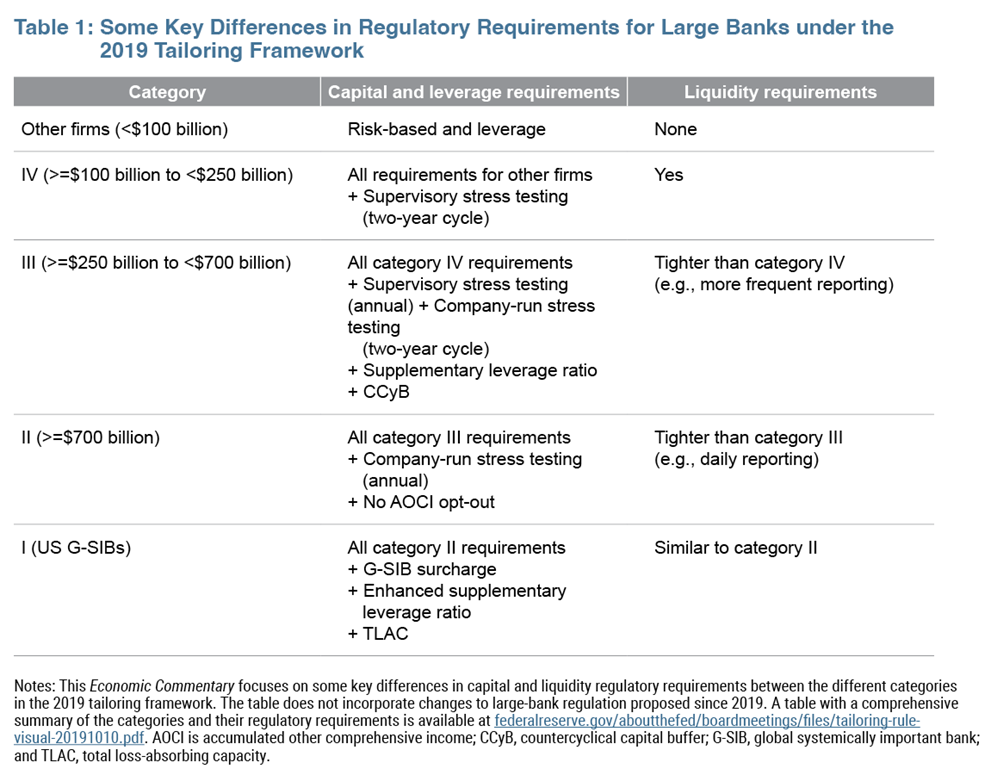
The expectation was that this regulatory framework with four categories instead of one for large banks would better tailor supervision and regulation to the size of individual banks. Consequently, crossing each individual size threshold would trigger a smaller set of incremental regulatory changes than before, with lower costs for banks crossing from below to above the size threshold. The question then arises of whether and to what extent the new size thresholds created incentives for banks to limit their growth. To answer this question, the analysis below discusses two pieces of evidence: bunching of banks below the thresholds and the extent to which individual banks grow across various size thresholds.
Evidence for Bunching at Size Thresholds under the 2019 Tailoring Framework
One way to assess the extent to which banks take steps to avoid crossing size thresholds found in the 2019 tailoring framework is to look for evidence of bunching of banks just below regulatory thresholds. We perform an analysis similar to that in Alvero, Ando, and Xiao (2023), who study the effect of size thresholds at $10 billion and $50 billion under the Dodd–Frank regulatory framework. We update parts of their analysis and add the new thresholds at $100 billion and $250 billion that apply to category IV and category III banks, respectively, under tailoring. We also use new data that have become available since the framework was implemented in 2020.6 Figure 1 shows the cumulative distribution function (CDF) of quarterly bank size observations in a range around the two new thresholds of $100 billion and $250 billion in total assets, using total assets data from bank regulatory filings, as well as the old $50 billion threshold.7 The CDF measures the percentage of banks in the range with at most a certain level of total assets. For example, if the value of the CDF at $100 billion on the x-axis is 50 percent on the y-axis, then half the bank-quarter observations in the sample range are less than or equal to $100 billion. The slope of the graph indicates the spread of bank sizes. If banks were evenly spread along the size dimension, the graph would be a straight 45-degree line. Steep curvature above the 45-degree line indicates a larger number of banks at that level than at other levels, indicative of bunching.
Figure 1(a) displays the CDF of banks with assets in a range from $40 billion to $60 billion, including the $50 billion threshold in place under Dodd–Frank. The dark-blue line captures the CDF before tailoring, with the $50 billion threshold in force; the orange line captures the CDF after tailoring, when the $50 billion threshold was no longer in place. Consistent with the findings in Alvero, Ando, and Xiao (2023), the CDF is steeper below $50 billion before tailoring, crossing the vertical bar at $50 billion at a value of around 75 percent. This evidence of notable bunching before tailoring is consistent with increased regulatory requirements from crossing that threshold during that time. After tailoring, the CDF is shallower below $50 billion, crossing the vertical bar below the dark-blue line, consistent with less bunching and with the threshold no longer being in place for regulatory purposes.
Moving on to the thresholds newly introduced by the 2019 tailoring framework, Figure 1(b) suggests that before the new framework the distribution of banks between $80 billion to $120 billion was relatively evenly spread, without noticeable bunching around the $100 billion threshold. In contrast, after the new regulation was implemented, we see a significant deviation from an even size distribution, with a sharp increase in the number of banks around $90 billion, reflected by the orange line curving steeply up and then staying above the dark-blue line until after the $100 billion threshold. This pattern implies that a larger share of banks had total assets just below $100 billion after tailoring was implemented. In other words, there is evidence of bunching of banks just below the $100 billion threshold. Turning to Figure 1(c), at the $250 billion level, the differences before and after are not as prominent but are still noticeable, as seen in the gap between the orange and the dark-blue lines. After the 2019 tailoring framework, bunching is more pronounced, as indicated by the orange line that shows a steeper slope than the dark-blue line at less than $250 billion, before returning to the dark-blue line for sizes above $250 billion.8
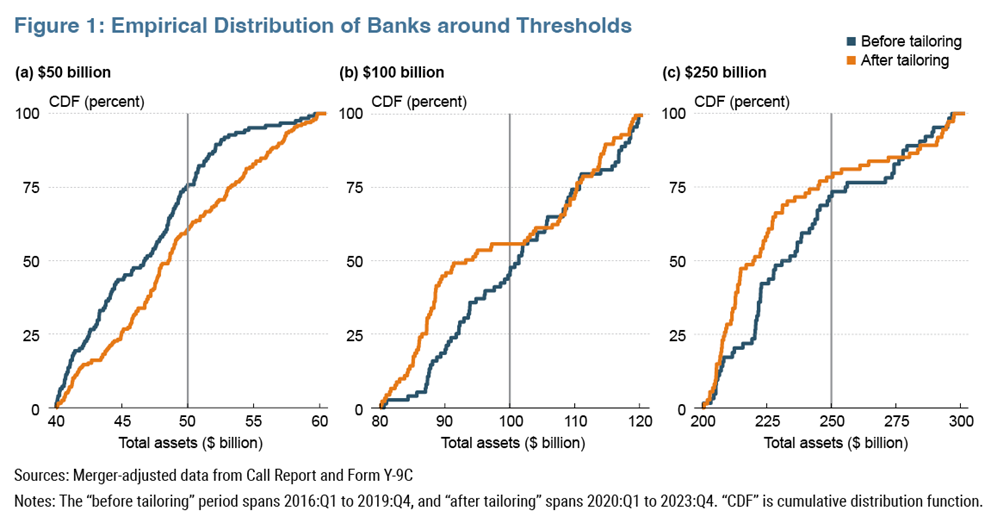
Overall, Figure 1 suggests more bunching just below both the $100 billion and the $250 billion total asset-size thresholds after the 2019 tailoring framework was put in place, with the effect being visibly stronger at $100 billion, and less bunching just below the old $50 billion threshold. As noted above, the presence of bunching is to be expected under tailored regulations with discrete categories and stricter guidelines for larger banks than for smaller banks. Moreover, the difference in bunching between $100 billion and $250 billion is consistent with the way the 2019 tailoring framework introduced and strengthened requirements incrementally for progressively larger banks: category IV banks above $100 billion are required to meet two new categories of regulations, specifically supervisory stress testing and liquidity requirements, that banks below $100 billion do not have to meet. In contrast, entering category III status tends to tighten the existing requirements for category IV banks between $100 billion and $250 billion rather than adding entirely new ones. Among other changes, this tightening includes a higher frequency for stress testing and liquidity monitoring. The CCyB, which is new for category III banks, has thus far not been activated in the United States and at present imposes limited costs to banks above $250 billion in size. Therefore, a case can be made that, at least thus far, the $100 billion threshold to become a category IV bank comes with a more substantial and thus costly increase in regulatory requirements than a move from category IV to category III at $250 billion, something which could create the patterns observed in Figure 1.
Evidence for Banks’ Crossing the 2019 Tailoring Thresholds
While we see evidence that banks are bunching below the thresholds at $100 billion and $250 billion, this evidence does not imply that the regulations are making bank growth across these thresholds impossible. To illustrate this point, Figure 2 presents data on the frequency at which US banks have crossed the regulatory thresholds during the period covered by our sample. In each case, the blue bar shows transitions before the 2019 tailoring framework was introduced, and the orange bar shows transitions that took place after introduction, both normalized by the number of banks with greater than $10 billion in total assets. Positive bars represent banks that increased their total assets from below to above the threshold, while negative bars represent banks that shrank in size from above the threshold to below it.
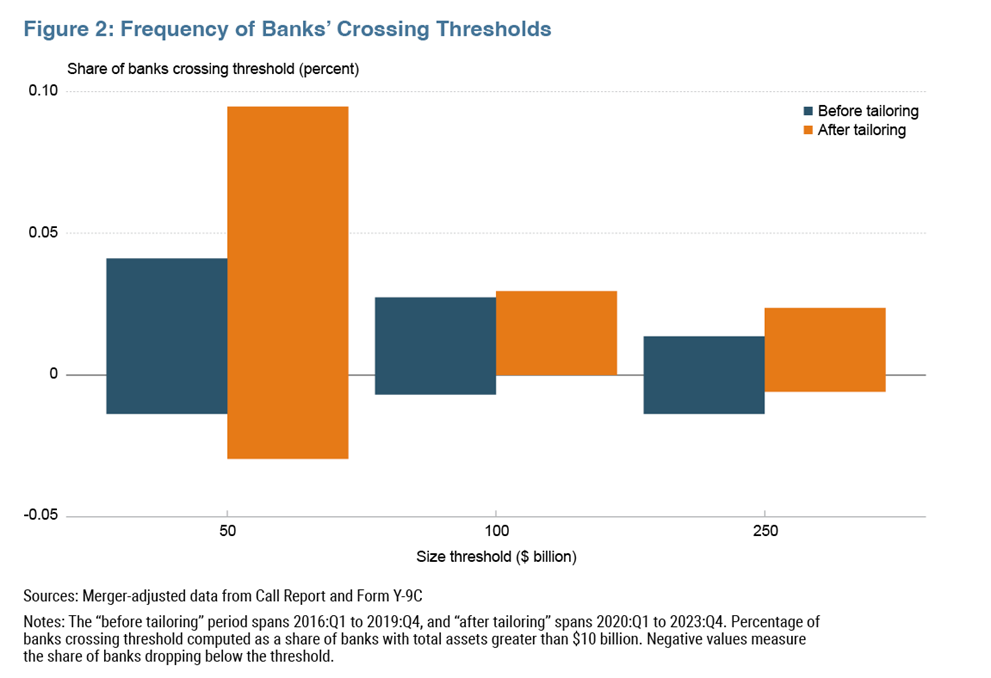
We specifically examine these movements around the $50 billion, $100 billion, and $250 billion thresholds. At $50 billion, the large-bank threshold in place under Dodd–Frank, we notice a significant increase in the share of banks that cross the threshold and grow to a size beyond $50 billion. This change can be attributed to the 2019 tailoring framework’s removing the requirements at $50 billion that had previously been implemented under Dodd–Frank. Banks that might have been cautious about crossing above $50 billion before were free to expand, leading to roughly a doubling in upward transitions under tailoring.
At the $100 billion and $250 billion thresholds, while we see some differences before and after the 2019 tailoring framework went into effect, it is hard to draw firm conclusions given the small number of banks involved. For example, only four banks crossed above the $100 billion threshold before the 2019 tailoring framework went into effect, while five banks did so after. At the $250 billion threshold, two banks crossed from below before tailoring, while four did so after tailoring was put into place. The small increases may be due to noise or the overall growth of the banking sector during that time, rather than reflecting the impact of regulations. At least two factors contributed to bank-size growth in the period from 2020 to 2024. First, banks saw inflows of deposits as a result of large fiscal transfers from the government to households and businesses that were part of the economic relief programs in response to the COVID-19 pandemic (Castro, Cavallo, and Zarutskie, 2022). Second, a surge in inflation starting in 2021 raised the overall price level, thereby increasing the nominal size of the US economy and, by extension, nominal measures of total bank assets. Overall, the data show that any regulatory costs involved with moving into category IV or category III did not outright prevent bank growth since several banks in our sample did, indeed, cross the size thresholds from below and since the overall frequency of such crossing has not changed notably since the introduction of the 2019 tailoring framework. By contrast, many more banks crossed the $50 billion threshold after the threshold was removed with the implementation of the 2019 tailoring framework.
Conclusion
This Economic Commentary provides evidence for bunching in the size distribution of banks following the implementation of the 2019 tailoring framework of large-bank regulation. This bunching just below the thresholds of $100 billion and $250 billion for category IV and category III banks, respectively, is consistent with a regime with discrete increases in regulation as banks get larger and more important, and it suggests that banks have found it costly to cross the new size thresholds. Our analysis also shows that these costs are not sufficiently large enough to entirely prevent bank growth since several banks crossed into larger size categories and since the frequency at which they did so did not materially change after the 2019 tailoring framework was in force. In contrast, we observe roughly a doubling in the frequency at which banks grew from below $50 billion to above, consistent with the elimination of that Dodd–Frank era size threshold under the 2019 tailoring framework. Overall, the data suggest that the new framework was successful at encouraging bank growth for banks near the previous $50 billion size threshold while at the same time introducing new regulations around the size thresholds of $100 billion and $250 billion.
References
- Alvero, Adrien, Sakai Ando, and Kairong Xiao. 2023. “Watch What They Do, Not What They Say: Estimating Regulatory Costs from Revealed Preferences.” Review of Financial Studies 36(6): 2224–2273. doi.org/10.1093/rfs/hhac089.
- Bouwman, Christa H.S., Shuting (Sophia) Hu, and Shane A. Johnson. 2018. “Differential Bank Behaviors around the Dodd–Frank Act Size Thresholds.” Journal of Financial Intermediation 34(April): 47–57. doi.org/10.1016/j.jfi.2018.01.005.
- Castro, Andrew, Michele Cavallo, and Rebecca Zarutskie. 2022. “Understanding Bank Deposit Growth during the COVID-19 Pandemic.” FEDS Notes. Washington: Board of Governors of the Federal Reserve System. June 06, 2022. doi.org/10.17016/2380-7172.3133.
Endnotes
- At the same time, regulation can create costs that need to be weighed against the benefits it provides. For example, supervisory stress testing imposes significant fixed costs for both banks and supervisors, and the benefits of applying this tool to small banks might be more limited. Return to 1
- Bouwman, Hu, and Johnson (2018) present evidence for an increase in the net regulatory costs at the thresholds introduced by the Dodd–Frank Act and for banks near the threshold altering their behavior to avoid incurring these costs. Return to 2
- See federalreserve.gov/newsevents/pressreleases/bcreg20191010a.htm. Return to 3
- The new framework was a consequence of and designed to be consistent with the Economic Growth, Regulatory Relief, and Consumer Protection Act (EGRRCPA), passed in 2018. The 2019 tailoring framework kept in place the $10 billion threshold while changing some regulatory requirements around that threshold. Return to 4
- This Economic Commentary analyzes the 2019 tailoring framework using a historical sample from 2016 through 2023. The analysis does not incorporate any changes to large-bank regulation that have been proposed since then, including changes that would affect the enhanced supplementary leverage ratio and total loss absorbing capital (federalreserve.gov/newsevents/pressreleases/bcreg20250627a.htm) and the wider regulatory capital framework (federalreserve.gov/newsevents/pressreleases/bcreg20260319a.htm). Return to 5
- The 2019 tailoring framework introduced a further threshold for category II banks above $700 billion in total assets, but too few observations are available for meaningful analysis of that threshold. For example, between 2020:Q1 and 2023:Q4, there were only six banks with total assets in the $600 billion to $800 billion range for which the $700 billion threshold would reasonably be considered relevant. Thus, we focus our attention here on the $100 billion and $250 billion thresholds. Return to 6
- We combine data from Regulatory Form Y-9C for holding companies with Call Reports for banks that are not part of a holding company. Most large banks with assets above $40 billion during our sample period have holding companies and therefore file Form Y-9C. However, the large-bank 2019 tailoring framework also applies to large banking organizations that may not be required to fill out this form. We therefore add Call Report data for banks that do not have a holding company and thus do not file Form Y-9C. Return to 7
- In the chart around the $250 billion threshold, almost three-fourths of bank-quarter observations fall below $250 billion even before tailoring, resulting in a concave CDF. This pattern might arise from the fact that these observations are significantly further into the tail of the size distribution, where there are fewer and fewer banks within a given size band, thereby creating the concavity observed in the chart. Return to 8
Suggested Citation
Siedlarek, Jan-Peter, and Isabella Wang. 2026. “The Effect of Size Thresholds on Large Banks under the 2019 Tailoring Framework.” Federal Reserve Bank of Cleveland, Economic Commentary 2026-07. https://doi.org/10.26509/frbc-ec-202607
This work by Federal Reserve Bank of Cleveland is licensed under Creative Commons Attribution-NonCommercial 4.0 International


Related resources

About Us
The Federal Reserve Bank of Cleveland (commonly known as the Cleveland Fed) is part of the Federal Reserve System, the central bank of the United States.

Economic Commentaries
Economic Commentaries provide analysis of relevant economic issues and are written for an informed but nonspecialist audience.