

- Share
Reconciling Recent Strong Output Growth with Rising Unemployment
Over the last three years, robust GDP growth alongside comparatively weak labor market data on jobs and unemployment has presented a puzzle to policymakers and analysts. This disconnect shows up as elevated labor productivity growth and an unemployment rate that has risen despite robust GDP growth, violating the usual inverse relationship known as Okun’s law. We show that these data may be less puzzling than they appear. Historical revision patterns provide no evidence that recent productivity gains will be revised away. And once we account for lagged effects, the comovements of recent GDP and unemployment rate data are consistent with historical patterns.


The views authors express in Economic Commentary are theirs and not necessarily those of the Federal Reserve Bank of Cleveland or the Board of Governors of the Federal Reserve System. The series editor is Tasia Hane. This paper and its data are subject to revision; please visit clevelandfed.org for updates.
Introduction
Over the last three years, robust GDP growth alongside comparatively weak labor market data has presented a puzzle to policymakers and analysts. One concern, as Federal Reserve Governor Christopher Waller put it, is that “something’s gotta give—either economic growth softens to match a soft labor market, or the labor market rebounds to match stronger economic growth” (Waller, 2025). This disconnect between GDP and labor market data manifests in two distinct ways. First, output growth has been strong while employment growth has been comparatively weak—a gap explained by elevated labor productivity growth. But one concern is that this elevated productivity growth could be revised away. Second, the unemployment rate has risen slowly despite robust GDP growth, violating the typical inverse relationship known as Okun's law. The mixed signals from GDP and labor market data have made it challenging for policymakers to distinguish cyclical weakness from structural changes, complicating monetary policy decisions (FOMC, 2025a, 2025b).
Our analysis suggests that the tension between GDP and labor market data may be less severe than it appears. We present two findings. First, historical revision patterns suggest that smoothed labor productivity growth is unlikely to be revised down substantially—and could even be revised up slightly—meaning that GDP data accurately reflect the economy’s current overall strength. Second, the disconnect between GDP growth and unemployment rate changes is not as unusual as it may appear. Specifically, once we account for how past GDP growth affects current unemployment rate changes, recent data fall well within historical patterns. In short, recent GDP and labor market data are not necessarily in sharp conflict.
The Output-Employment Puzzle
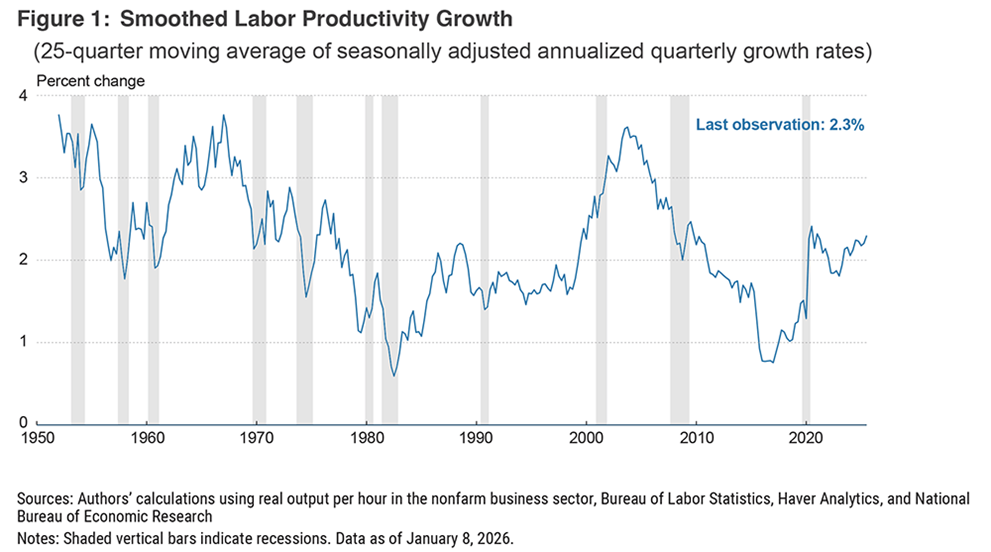
Labor productivity growth has averaged about 2.3 percent recently, based on a 25-quarter moving average of annualized quarterly growth rates through 2025:Q3, what we will call “smoothed productivity growth.”1, 2 This growth rate is well above that in the mid- to late 2010s but close to the long-term average of 2.2 percent, as shown in Figure 1.
One way to resolve the recent tension between robust GDP growth and comparatively weak employment growth would be through downward revisions to labor productivity growth. But we find that historical revision patterns to the 25-quarter moving average of labor productivity growth provide no evidence that recent productivity gains will be revised away. This finding implies that the recent boost to GDP from labor productivity gains is also unlikely to be revised away, meaning that the overall economy is as strong as current GDP data indicate.
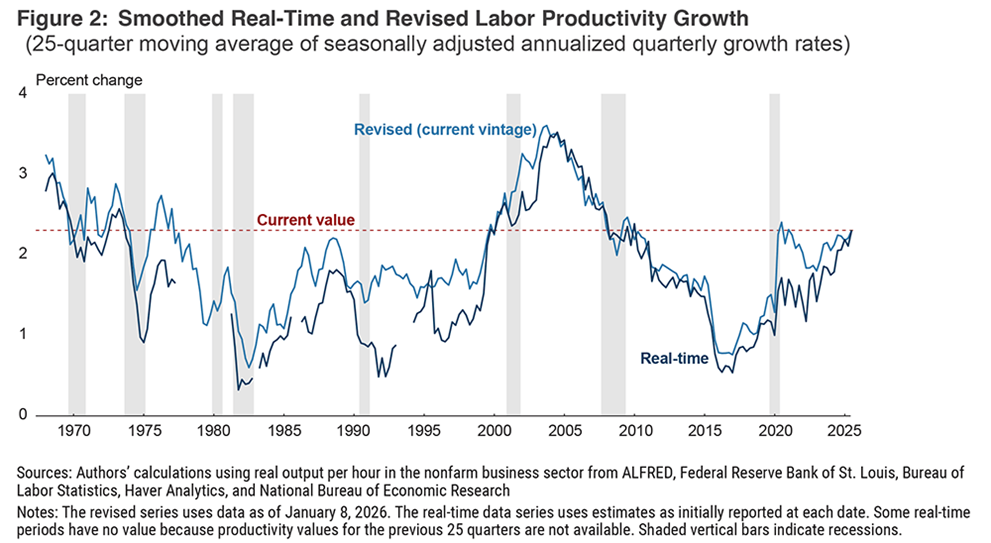
Historical revisions to smoothed labor productivity growth are almost always positive. Figure 2 compares initial productivity estimates (dark blue) with currently available estimates (light blue) that have been subject to revisions, both measured as the 25-quarter moving average of annualized quarterly growth rates.3 The pattern is striking: smoothed productivity growth has rarely been revised down, and, when it has, the revisions have been small. The median revision across all smoothed observations has been +0.26 percentage points, as shown in Table 1, column 1. Only about 10 percent of initial estimates have been revised down, and even at the 5th percentile, the revision has been just -0.13 percentage points.
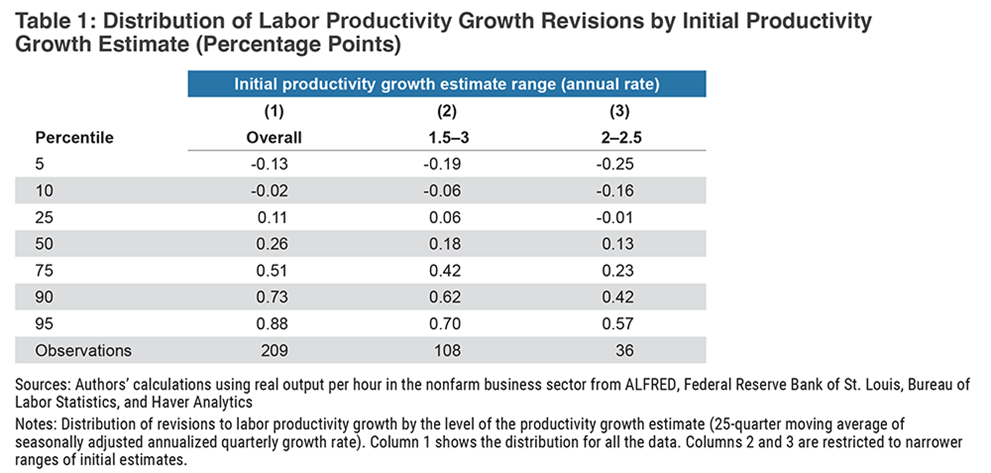
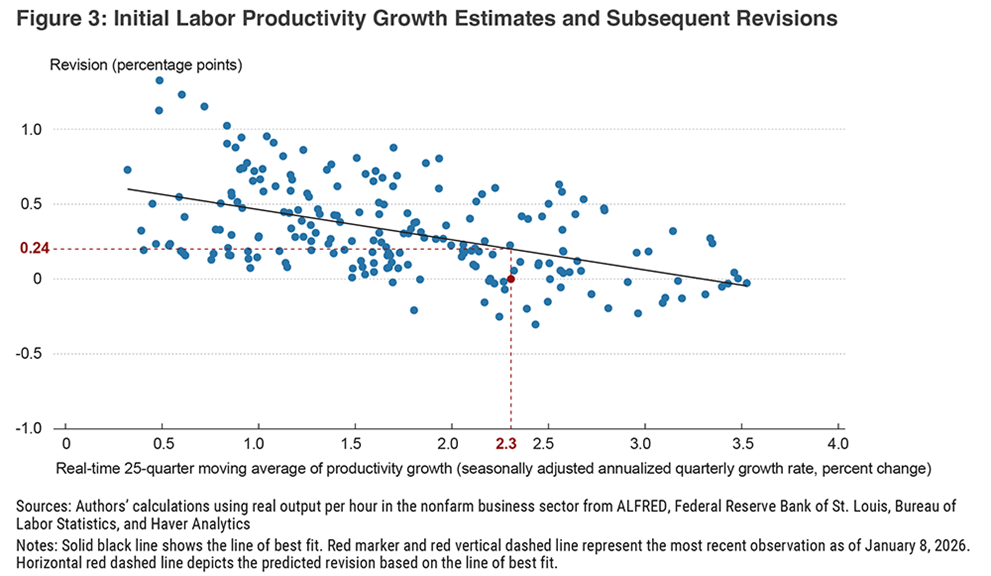
This historical pattern suggests recent readings of smoothed productivity growth will likely be revised up, not down. Figure 3 plots initial smoothed productivity growth estimates against subsequent revisions. The line of best fit predicts an upward revision of 0.24 percentage points for the current reading (shown by the horizontal red dashed line). Even in a worst-case scenario, smoothed productivity growth has never been revised down by more than 0.3 percentage points; if this holds true for the most recent reading, productivity growth would remain at 2 percent. Table 1, column 2, confirms this pattern: when initial estimates of smoothed productivity growth fall between 1.5 percent and 3 percent (like the current 2.3 percent), the median revision is +0.18 percentage points, and the 5th percentile is only -0.19 percentage points.4
The GDP-Unemployment Puzzle
The recent comovements of GDP and unemployment appear unusual—with robust GDP growth alongside a rising unemployment rate—but are actually consistent with historical patterns. The key is accounting for how GDP growth in previous quarters affects unemployment rate changes today. That they are consistent with historical patterns suggests that the disconnect between robust growth and a rising unemployment rate is less puzzling than it may first appear and that a rising unemployment rate does not necessarily signal weakness that is not captured by GDP data.
Okun’s law describes the typical inverse relationship between GDP growth and changes in the unemployment rate: robust GDP growth usually coincides with falling unemployment rates (Okun, 1962). Figure 4 confirms this pattern using data from 1948:Q2 through 2022:Q2 (blue dots). The blue line of best fit for this period implies that each percentage point increase in GDP growth (at an annualized quarterly growth rate) is associated with a 0.067 percentage point decline in the unemployment rate. This estimated coefficient on real GDP growth is known as Okun’s coefficient.
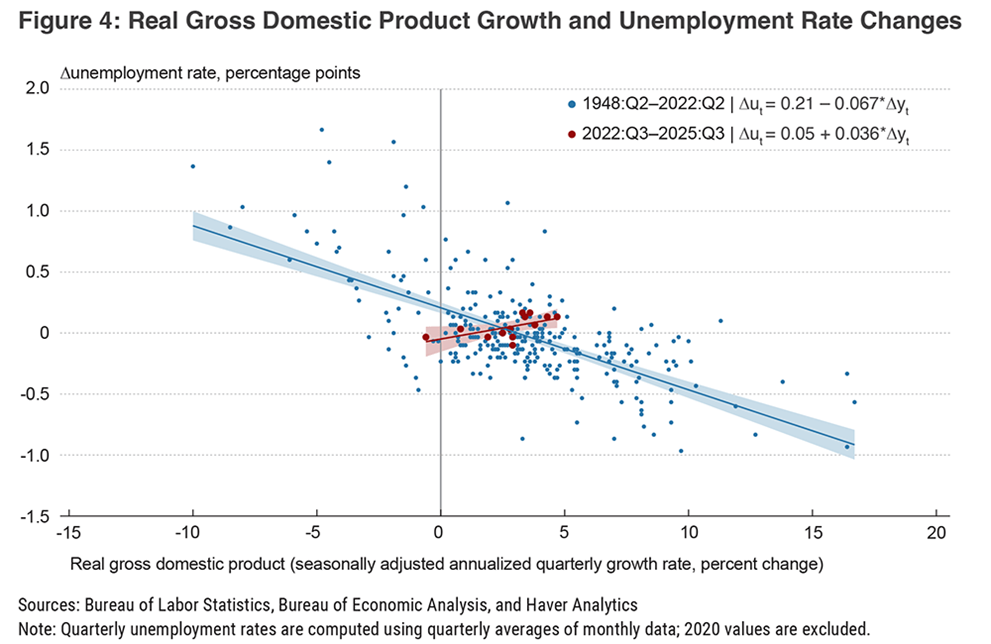
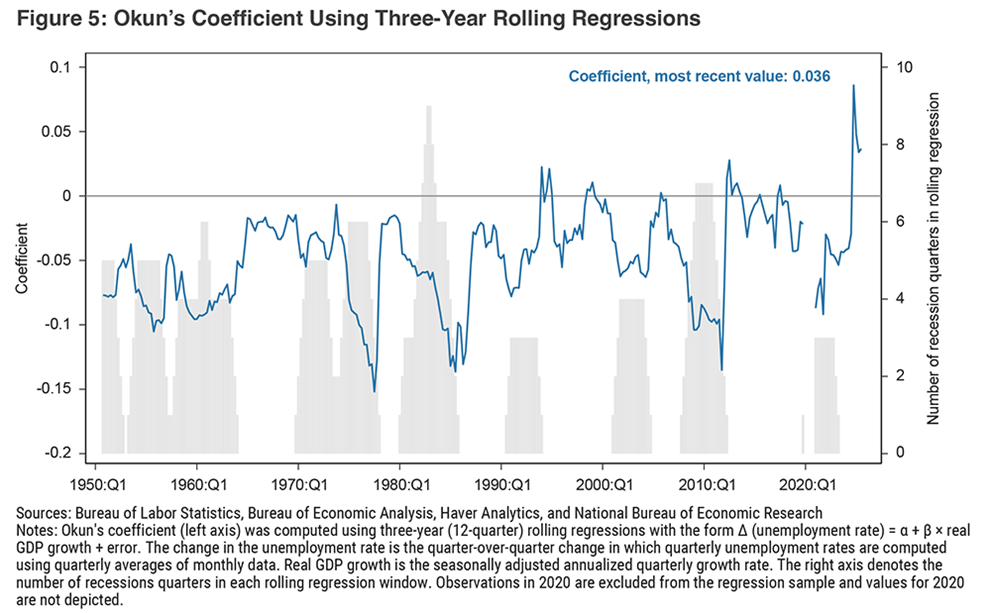
Recent data seem to violate this negative relationship. Figure 4 also shows data from 2022:Q3 through 2025:Q3 (red dots): GDP growth has been mostly robust, but the unemployment rate has been mostly flat or rising slightly. This recent three-year period produces a positive Okun's coefficient (0.036). To examine whether this shift is truly anomalous, Figure 5 tracks how Okun's coefficient (left axis) has evolved over time using rolling windows—that is, re-estimating the coefficient for every consecutive three-year period—together with the number of recession quarters in each window (right axis). The coefficient typically becomes more negative during recessions and less negative (and occasionally positive) during expansions, as in Knotek (2007) and Meyer and Tasci (2012). But some of the recent positive coefficients have reached unprecedented levels.
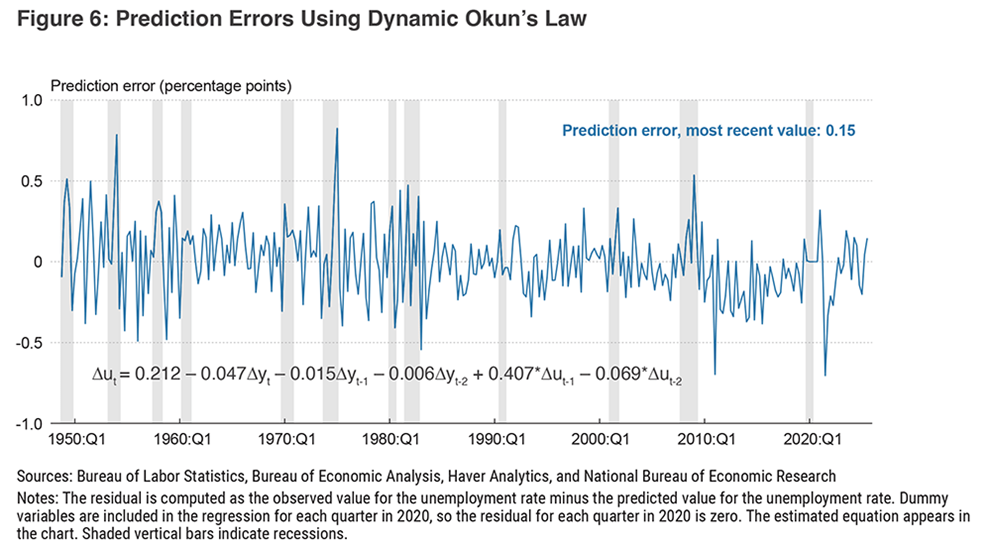
However, this apparent violation of Okun’s law disappears once we account for lagged GDP growth. Unemployment rate changes in any given quarter typically depend not just on GDP growth in the same quarter but also on growth in prior quarters. This dynamic relationship could be explained by slow employment adjustments because of search frictions, for example. Similarly, changes in the unemployment rate today could depend on previous unemployment rate changes because of gradual worker reallocation. Dynamic specifications that include these lagged effects are preferred in forecasting models because they improve accuracy (Knotek, 2007).
Using a specification with two lags of GDP growth and two lags of unemployment rate changes (as in Knotek, 2007), we find that the recent data are not unusual. Figure 6 shows the prediction errors from this model. If the recent period were truly anomalous, we would see large differences between predicted and actual unemployment rate changes. However, in recent quarters, these errors have been relatively small and consistent with historical patterns. Notably, the small 2025:Q3 prediction error reflects the model’s ability to account for GDP weakness in 2025:Q1, demonstrating how lagged effects help explain recent unemployment rate dynamics.
Our conclusions are robust to alternative specifications. For example, the findings also hold when estimating the model over rolling windows rather than the full sample. Estimating the relationship using gaps rather than changes does produce larger prediction errors in recent data, but these changes remain within historical norms.
Conclusion
Historical revision patterns provide no evidence that recent elevated labor productivity will be revised away, indicating that the overall economy is as strong as GDP data suggest. Once we account for how past GDP growth affects current unemployment rate changes, recent data are consistent with historical patterns and do not signal hidden weakness. Together, these findings suggest that the apparent tension in recent data may be less severe than it first appears. Contrary to the concern that either output or labor market data must move into line with the other, both robust GDP growth and a gradually rising unemployment rate are consistent with strong labor productivity growth and historical relationships.
References
- Bognanni, Mark J., and John Zito. 2016. “New Normal or Real-Time Noise? Revisiting the Recent Data on Labor Productivity.” Economic Commentary, no. 2016-16 (December). doi.org/10.26509/frbc-ec-201616.
- FOMC. 2025a. “Minutes of the Federal Open Market Committee, October 28–29, 2025.” Board of Governors of the Federal Reserve System. federalreserve.gov/monetarypolicy/files/fomcminutes20251029.pdf.
- FOMC. 2025b. “Minutes of the Federal Open Market Committee: December 9–10, 2025.” Board of Governors of the Federal Reserve System. federalreserve.gov/monetarypolicy/files/fomcminutes20251210.pdf.
- Knotek, Edward S., II. 2007. “How Useful Is Okun’s Law?” Economic Review 92(Q IV): 73–103. fedinprint.org/item/fedker/31566.
- Meyer, Brent, and Murat Tasci. 2012. “An Unstable Okun’s Law, Not the Best Rule of Thumb.” Economic Commentary, no. 2012-08 (June). doi.org/10.26509/frbc-ec-201208.
- Okun, Arthur M. 1962. “Potential GNP: Its Measurement and Significance.” Reprinted as Cowles Foundation Paper 190. milescorak.com/wp-content/uploads/2016/01/okun-potential-gnp-its-measurement-and-significance-p0190.pdf.
- Waller, Christopher J. 2025. “Cutting Rates in the Face of Conflicting Data.” Speech at the Council on Foreign Relations, New York, New York, October 16. Board of Governors of the Federal Reserve System. federalreserve.gov/newsevents/speech/waller20251016a.htm.
Endnotes
- Labor productivity is defined as output divided by hours worked so that labor productivity growth is output growth less growth in hours worked. We use 25-quarter moving averages to smooth through volatile quarter-to-quarter fluctuations. This choice, and the analysis and charts in this section, is motivated by choices in Bognanni and Zito (2016). Return to 1
- We use data through 2025:Q3 available as of January 8, 2026, throughout. Our main messages are unaffected by including 2025:Q4 data. Return to 2
- Because the most recent observation has not been revised, the two series coincide for the most recent quarter. Return to 3
- These conclusions also hold when using 12-quarter moving averages, though they are less definitive with noisier four-quarter moving averages. Return to 4
Suggested Citation
Jacobs, Dylan C., and Pawel M. Krolikowski. 2026. “Reconciling Recent Strong Output Growth with Rising Unemployment.” Federal Reserve Bank of Cleveland, Economic Commentary 2026-06. https://doi.org/10.26509/frbc-ec-202606
This work by Federal Reserve Bank of Cleveland is licensed under Creative Commons Attribution-NonCommercial 4.0 International


Related resources

About Us
The Federal Reserve Bank of Cleveland (commonly known as the Cleveland Fed) is part of the Federal Reserve System, the central bank of the United States.

Economic Commentaries
Economic Commentaries provide analysis of relevant economic issues and are written for an informed but nonspecialist audience.