

- Share
Immigration and the Unemployment Rate in 2023–2024
The increase in the US unemployment rate observed from early 2023 until late 2024 primarily reflected a decline in the job-finding rate. Using the share of noncitizens in the US labor market as a measure of immigration, this Economic Commentary evaluates two mechanisms through which a higher share of noncitizens coming from post-pandemic immigration could hypothetically affect the job-finding rate. First, noncitizens may have systematically lower job-finding rates than citizens. Second, during slowdowns, noncitizens’ job-finding and other transition rates may deteriorate more rapidly and extensively than those of US citizens. Evaluating both mechanisms, we find no evidence that the higher share of noncitizens in the labor market contributed to the rise in the unemployment rate during 2023 and 2024.


The views authors express in Economic Commentary are theirs and not necessarily those of the Federal Reserve Bank of Cleveland or the Board of Governors of the Federal Reserve System. The series editor is Tasia Hane. This paper and its data are subject to revision; please visit clevelandfed.org for updates.
Introduction
Following the pandemic recession, the unemployment rate (UR) declined rapidly. The first half of 2023 saw a local trough in the unemployment rate, dipping down to 3.5 percent in 2023:Q2. It subsequently began rising again, reaching 4.1 percent in 2024:Q4. Simultaneous with the increase in the UR, the share of non-US citizens ages 16 or older, the proxy for immigrants we use throughout this article,1 rose from 7.7 percent in 2021:Q3 to a historic high of 9.2 percent in 2024:Q4.
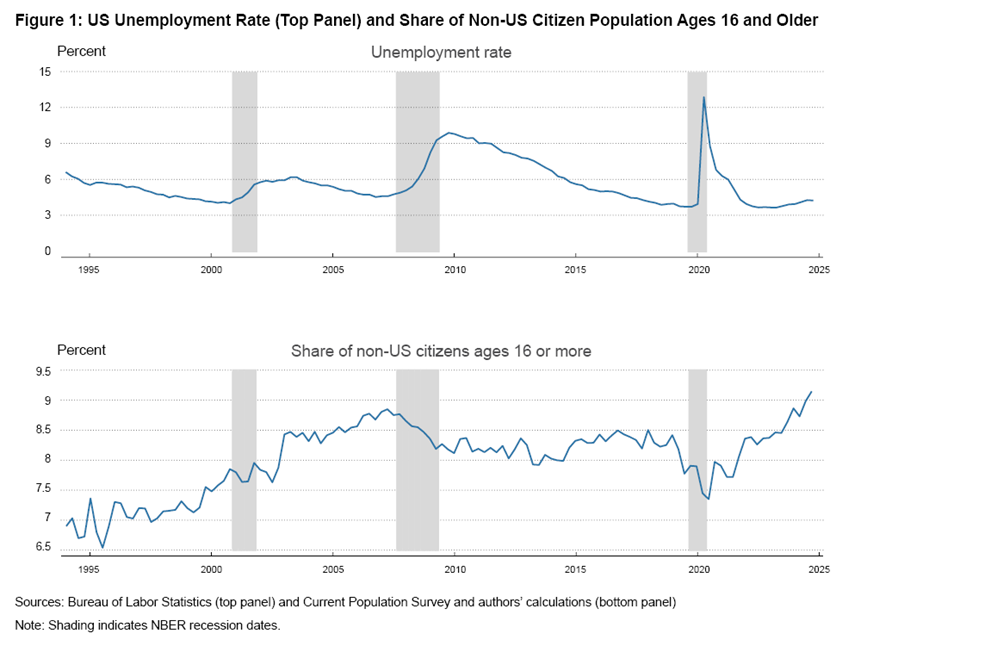
Can the increase in the share of noncitizens in the labor market explain the rise in the UR in 2023 and 2024? Avaradi et al. (2025) analyze the reasons behind the increase in the UR in 2023 and 2024 and conclude that the increase was primarily driven by a decline in the job-finding (UE) rate. Two mechanisms could connect the rise in the share of noncitizens in the US labor market with the decrease in the job-finding rate in this period. First, noncitizens may have lower job-finding rates than citizens; second, when the labor market softens, the job-finding rate of noncitizens could deteriorate more rapidly and significantly than that of citizens. However, we find no evidence that a higher share of noncitizens in the labor market contributed to the rise in the unemployment rate during 2023 and 2024.
Data
To test the importance of the two mechanisms proposed above, we use micro data from the Current Population Survey (CPS),2 restricting our sample to individuals ages 16 and older. We rely on CPS data on labor force status and citizenship status. For citizenship status, each person in the CPS is categorized as follows: born in the United States; born in the United States, outlying; born abroad of American parents; naturalized citizen; or not a citizen. We refer to individuals in the first four categories as “citizens” and those in the fifth category as “noncitizens.” As explained above, throughout this article we use “noncitizens” as a proxy term for immigrants.3
Because of the availability of CPS data on citizenship status, we begin our analysis in 1994. All magnitudes referenced below use five-period moving averages of the transition rates4 centered on the quarter of interest.5 Because of this aggregation, we end our period of analysis in 2024:Q4.6
Method
To analyze whether there exist any differences in the level or in the business-cycle evolution of the transition rates between citizens and noncitizens, we follow the work of Shimer (2012), whose flow approach we use to construct job-finding rates for citizens and noncitizens. The flow approach examines the flows between employment states of employed (E), unemployed (U), and inactive (I) (that is, not in the labor force) and uses these flows to construct a “flow-consistent” unemployment rate. In practice, this rate closely tracks the standard unemployment rate.7
While all flows will affect the flow-consistent unemployment rate, we concentrate our analysis on the UE rate because Avaradi et al. (2025) show that this is the primary component driving the rise in the UR observed from 2023 to 2024. Nevertheless, in the final part of our analysis, we consider all transition rates (EU, EI, UE, UI, IE, IU8) to assess the maximum possible relevance of a higher share of noncitizens in the post-pandemic labor market for the UR.
Is the job-finding rate of noncitizens systematically lower than that of citizens?
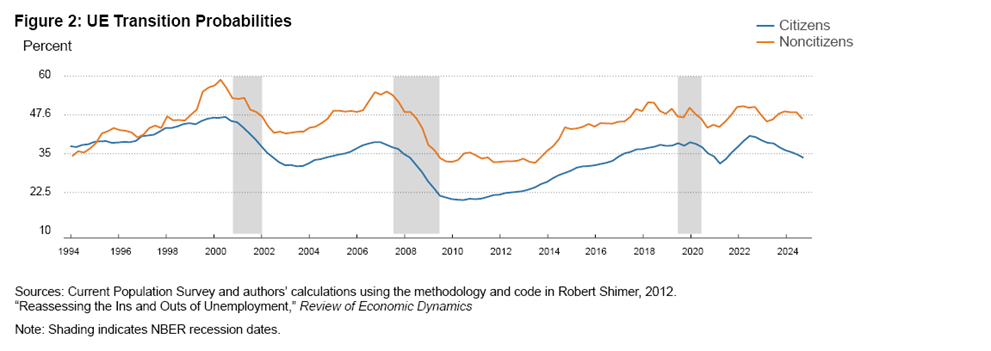
The first potential mechanism concerns whether changes in the labor market composition can explain the increase in the UR observed since early 2023 until late 2024. If the UE rate of noncitizens is lower on average than that of citizens, an increase in the proportion of noncitizens in the labor market would decrease the overall UE rate, thus increasing the UR. As shown in Figure 2, however, the UE rate for noncitizens is higher than that for citizens, with citizens having an average UE rate of 34.8 percent from 1994:Q1 to 2024:Q4 and noncitizens having an average rate of 44.2 percent during that same period. A composition effect would therefore imply that a rising share of noncitizens mechanically raises the aggregate UE rate since noncitizens have higher UE rates than citizens in the United States. Because the UR falls as the UE rate increases, the composition effect would lower the UR, not raise it.
Does the job-finding rate deteriorate more intensively for noncitizens than citizens during labor market slowdowns?
The second potential mechanism concerns the evolution of the UE rates of noncitizens and citizens when the labor market deteriorates. Our interest in this exercise remains in the period of increase in the UR that started in early 2023. We compare this period with earlier periods of rising UR. Because it is highly uncommon for the UR to rise significantly outside recessions, we compare the recent period to earlier recessions.9
All else equal, if the UE rate of noncitizens falls faster and further than that of citizens during recessions, a higher share of noncitizens in the labor market would exacerbate the deterioration of the aggregate UE rate in these periods, putting upward pressure on the UR. Figure 3 shows the evolution of the UE rate from peak to trough during recession periods and in the labor market slowdown that started in early 2023, separately for citizens and for noncitizens. To facilitate the interpretation of the figure, we normalize all predecline local maximums (by group) to zero.
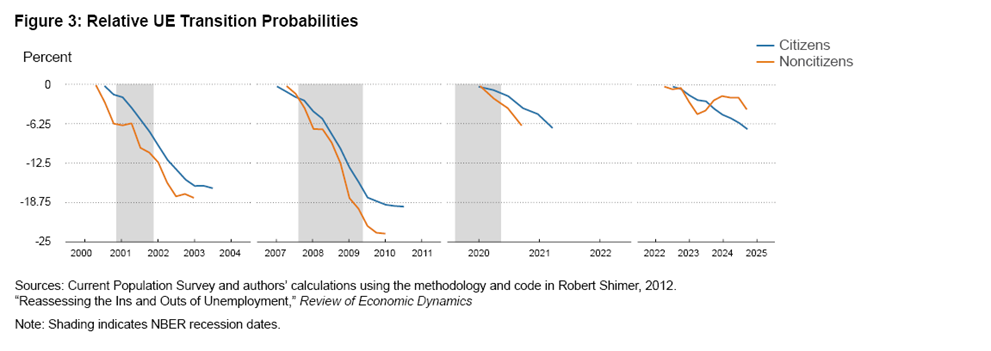
The evolution of the UE rate for citizens and noncitizens presents a different pattern during the 2023 labor market slowdown from that observed during recessions. While during recessions, we see the UE rate of noncitizens deteriorate further and faster than that of citizens, for the period starting in early 2023, this pattern does not hold. After the COVID-19-pandemic recession, the UE rate peaked in 2022:Q2 for noncitizens and did the same in 2022:Q3 for citizens. From there until 2024:Q4, it declined sustainedly by 7.5 percentage points for citizens. On the other hand, the decline in the UE rate was significantly more volatile for noncitizens. While within the first few quarters their decline was more pronounced, the UE rate of noncitizens saw a partial recovery in late 2023 and early 2024, followed by additional deterioration in the last half of 2024. All in all, at the end of our period of interest the UE rate of noncitizens had declined by only 4.3 percentage points, a smaller magnitude than that observed for citizens. Therefore, we see no evidence that a more significant decline in the UE rate among noncitizens is a potential cause behind the overall deterioration of the UE rate and consequent rise in the UR since early 2023 until late 2024.
To illustrate this point more clearly, we present a counterfactual exercise in which we estimate a hypothetical UR in which the UE rate of noncitizens evolves (from its peak point before the 2023 slowdown) to match that of citizens. This exercise allows us to answer the question of what would have been the UR at the end of 2024 if noncitizens’ UE rate had evolved from its 2022 peak identically to the UE rate of citizens. That is, we simulate what would happen if noncitizens had been affected by the recent labor market slowdown to the same degree as citizens.
Figure 4 shows our results. We find minimal differences between the flow-consistent UR (green) and the hypothetical UR (blue) in which the UE rate of noncitizens evolved at the same rate as that of citizens. The difference between the two fluctuates by a maximum of three basis points (or 0.03 percentage points) for the entire counterfactual period.
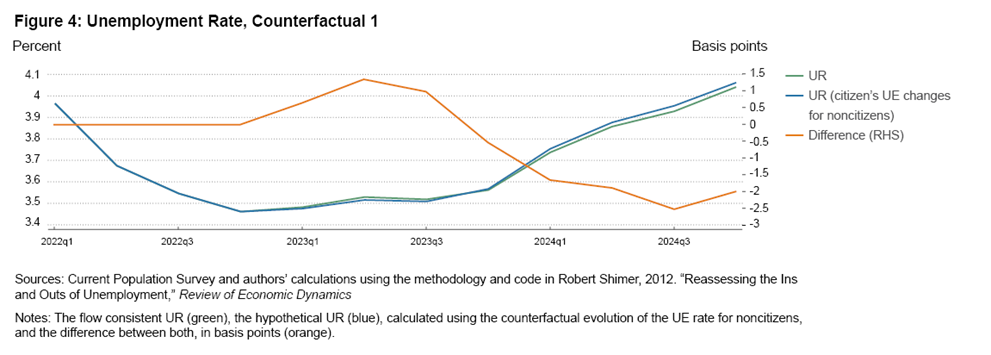
In summary, the uptick in the share of noncitizens did not exacerbate the decline in the UE rate observed since early 2023 until late 2024 relative to what the decline would have been had this share remained constant. The change in the UE rate of noncitizens during the latest labor market slowdown is very similar to the change citizens experienced. As such, a counterfactual UR that uses citizens’ UE evolution as that of noncitizens’ displays an almost identical UR to that observed in the data.
Other transition rates
Our previous analysis centered on the UE rate for noncitizens and citizens because previous work shows that most of the increase in the UR can be explained by changes in the job-finding rate. As shown above, the UE rate deteriorated similarly for noncitizens and citizens during the latest labor market slowdown. However, other transition rates could have evolved differently between noncitizens and citizens during this period. Combined with an increased share of noncitizens, a differential evolution of these flows for noncitizens and citizens could have mechanically affected the UR relative to a situation in which the share of noncitizens did not increase.
To assess the importance of a higher share of noncitizens for the UR from the perspective of the differential movements between noncitizens and citizens across all transition rates since early 2023, we present a second counterfactual exercise. Following our previous exercise, we alter the evolution of noncitizens’ transition rates to match those of citizens. However, instead of doing so for just the UE rate, we do it for all transition rates. Furthermore, we fix the share of noncitizens at its level in 2022:Q4. Thus, our counterfactual exercise answers the question of what would have been the UR if the evolution of all transition rates for noncitizens had been the same as that of citizens and had their share remained constant starting in late 2022.
A simpler counterfactual would fix only the noncitizen share at its 2022:Q4 level while maintaining noncitizens’ observed transition rates. However, this would ignore the substantial compositional changes within the noncitizen population as the share increased. For this reason, our counterfactual adjusts both the share and the transition rates.10
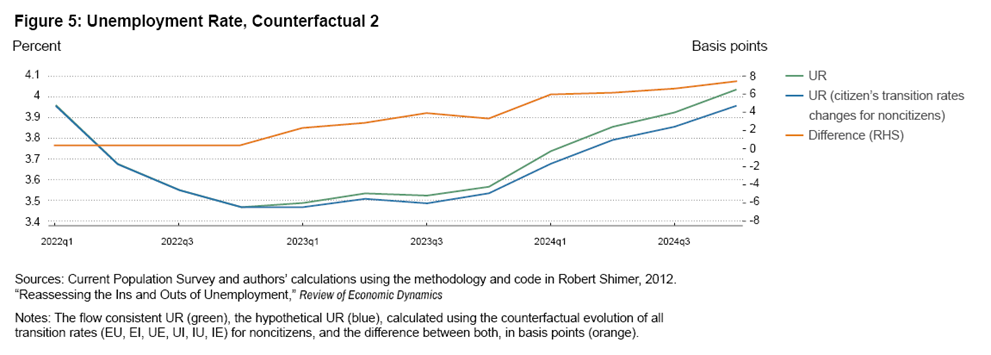
Figure 5 shows the results of our counterfactual exercise that adjusts both share and transition rates. Applying citizens’ transition rates to noncitizens and fixing the latter’s share in the labor market together has little impact on the hypothetical UR. At its peak difference, the hypothetical UR would have been just eight basis points (0.08 percentage points) lower in the counterfactual scenario compared to the actual flow-consistent UR. That is, compared with the 0.6 percentage point increase in the UR, differences in flow rates and the higher share of noncitizens explain only 13 percent of the total.
Conclusion
The UR rose in 2023 and 2024, coinciding with a rise in immigration. Using non-US citizens as a proxy for immigrants, we document that the evolution of labor market flows for noncitizens and citizens has been slightly different since late 2022. However, we find no evidence that the recent increase in the share of noncitizens has put significant upward pressure on the unemployment rate during 2023 and 2024. Noncitizens’ UE transition rate is higher than that of citizens. Furthermore, noncitizens’ flows saw only a slightly worse deterioration relative to the flows of citizens, something not substantial enough to create a meaningful difference in the UR. In other words, the increase in the unemployment rate that we have seen over the last couple of years appears mainly to be the result of macroeconomic conditions affecting all individuals and is not explained by an increased share of noncitizens in the US labor market in the last few years.
References
- Avaradi, Greeshma, Marianna Kudlyak, Brandon E. Miskanic, and David Wiczer. 2025. “Assessing the Recent Rise in Unemployment.” FRBSF Economic Letter 2025(09): 1–6. frbsf.org/research-and-insights/publications/economic-letter/2025/04/assessing-recent-rise-in-unemployment/.
- Bratsberg, Bernt, Ragan James F., Jr., and Zafar M. Nasir. 2002. “The Effect of Naturalization on Wage Growth: A Panel Study of Young Male Immigrants.” Journal of Labor Economics 20(3): 568–597. doi.org/10.1086/339616.
- Gathmann, Christina Monscheuer. 2020. “Naturalization and Citizenship: Who Benefits?” IZA World of Labor. doi.org/10.15185/izawol.125.
- Shimer, Robert. 2012. “Reassessing the Ins and Outs of Unemployment.” Review of Economic Dynamics 15(2): 127–148. doi.org/10.1016/j.red.2012.02.001.
Endnotes
- While naturalized US citizens are immigrants, for the purpose of this Economic Commentary, we include them with US-born citizens in our analysis. We discuss the reasons behind this choice in the “Data” section. Return to 1
- See Bureau of Labor Statistics’ “Labor Force Statistics from the Current Population Survey: Handbook of Methods” (bls.gov/opub/hom/cps/) for a description of the Current Population Survey. Return to 2
- The difference between both the citizen/noncitizen and immigrant/native categorizations lies in the group of naturalized US citizens, who are immigrants but also US citizens. Naturalized US citizens represented 9 percent of the US population aged 16 or older in 2024. However, because their labor market outcomes are significantly closer to those of natives than those of the remaining immigrants (Bratsberg, Ragan, and Nasir, 2002; and Gathmann and Monscheuer, 2020), we include them along with US-born citizens in the US-citizen group for our analysis. This leaves only non-US citizens as a separate group in our analysis. The composition and outcomes of this group more closely resemble those of the immigrants who have arrived in the last few years. Return to 3
- The transition rates represent the instantaneous probability of moving between labor market states. These labor market states are employment, unemployment, and out-of-the-labor-force. Return to 4
- We use five-period moving averages to minimize the month-to-month volatility in the UE rate of non-US citizens in the CPS. Using monthly rates or three-period moving averages does not change our conclusions. Return to 5
- Additionally, following previous work, we use NBER recession dates in our analysis. Return to 6
- The flow-consistent unemployment rate is sometimes referred to as the steady-state unemployment rate. Return to 7
- These are the employed-to-unemployed (EU), employed-to-inactive (EI), unemployed-to-employed (UE), unemployed-to-inactive (UI), inactive-to-employed (IE), and inactive-to-unemployed (IU) transition rates. Return to 8
- We additionally looked at periods of labor market slowdowns, which we define as the eight quarters following a local minimum in the unemployment rate. Of the seven local minimums in the UR in the last 50 years, six correspond approximately to the onset of a recession and the remaining one corresponds to the onset of our period of interest. We use recessions in the main text because of their familiarity to the reader and because their causes and effects have been widely studied. Nevertheless, doing the same analysis using minimums instead of recessions does not alter our conclusions. Return to 9
- This counterfactual is likely unrealistic because it ignores how the immigrant pool changed as its share increased after the COVID-19-pandemic recession, when the US received a large influx of low-skill immigrants. The transition rates observed under the higher share reflects this new composition. Therefore, assuming the share remained at its lower 2022:Q4 level while applying transition rates from a compositionally different (lower-skilled) pool is internally inconsistent; it implicitly assumes the original immigrant pool had the same labor market characteristics as the larger, compositionally distinct pool that materialized. This assumption would likely underestimate any potential negative effect of immigration on the UR. Nevertheless, for completeness, we estimated this simpler counterfactual. This scenario yields essentially no difference in the UR (approximately 1 basis point). Return to 10
Suggested Citation
Hernandez Martinez , Victor, and Geena Panzitta. 2026. “Immigration and the Unemployment Rate in 2023–2024.” Federal Reserve Bank of Cleveland, Economic Commentary 2026-05. https://doi.org/10.26509/frbc-ec-202605
This work by Federal Reserve Bank of Cleveland is licensed under Creative Commons Attribution-NonCommercial 4.0 International



About Us
The Federal Reserve Bank of Cleveland (commonly known as the Cleveland Fed) is part of the Federal Reserve System, the central bank of the United States.