

- Share
Residual Seasonality in Some Components of PCE Inflation
Policymakers and economists sometimes examine the components of inflation to better understand inflation’s behavior. We study the primary components of core PCE inflation for evidence of residual seasonality. To do this, we examine the average one-month percent changes in three categories of seasonally adjusted price data that have been discussed by policymakers: goods excluding food and energy, services excluding energy and housing, and housing. Inflation for goods excluding food and energy and services excluding energy and housing tends to be economically and statistically higher in January than in November and December. Housing inflation does not exhibit residual seasonality. When assessing if inflation has been high or low over short stretches of time, policymakers and economists may want to account for residual seasonality in goods excluding food and energy and services excluding energy and housing.


The views authors express in Economic Commentary are theirs and not necessarily those of the Federal Reserve Bank of Cleveland or the Board of Governors of the Federal Reserve System. The series editor is Tasia Hane. This paper and its data are subject to revision; please visit clevelandfed.org for updates.
Introduction
To monitor inflation, the growth rate of the overall level of prices, policymakers and economists often use the price index for personal consumption expenditures (PCE). Further, policymakers and economists may focus on the core PCE price index because it excludes generally volatile components such as food and energy prices. Core PCE inflation is typically computed as a one-month or 12-month percent change in this price index. To better understand the behavior of core PCE inflation, policymakers sometimes examine its underlying categories or components.1 In academic research, Clark, Gordon, and Zaman (2025) find that a statistical model with PCE inflation components can be effective for forecasting inflation.
Seasonality inherent in one-month percent changes, as a result of weather or holiday patterns for example, can pose challenges.2 The Bureau of Economic Analysis (BEA) attempts to address this issue by removing the seasonal patterns. However, the procedure may be imperfect, and some seasonal fluctuations may remain in seasonally adjusted data. Lunsford (2025) provides evidence of this residual seasonality in both PCE price inflation and core PCE price inflation.
In this Economic Commentary, we study the presence of residual seasonality in three components of core PCE inflation, which we will refer to as “major components.” The first is goods excluding food and energy, which we call “core goods.” The second is services excluding energy and housing, or “core services ex housing.” The third is housing.3 We show that seasonally adjusted one-month inflation rates of core goods and core services ex housing depict strong evidence of residual seasonality; however, we find no evidence of residual seasonality in housing inflation.
We start our analysis by computing average one-month inflation rates by category from 1987 to 2025, a sample period that has spells of both high and low inflation. Based on seasonally adjusted data, core goods prices on average experience larger increases in January and larger decreases in November and December than they do in other months. Prices for core services ex housing increase more on average in January than in November and December. In an exercise that restricts the sample to 1993 to 2020, we show that even in relatively low-inflation conditions, this pattern in core goods and core services ex housing inflation remains.
Our finding that residual seasonality appears in two of three major core inflation components implies that residual seasonality in PCE inflation is broad based. This implication is consistent with Lunsford (2025), who finds residual seasonality in several other broad measures of PCE inflation. Hence, economists and policymakers may want to account for residual seasonality when using one-month percent changes of PCE prices to assess inflation.
We build on previous research on residual seasonality in inflation measures, including analyses on residual seasonality in core CPI and PCE inflation from Lunsford (2025), Peneva (2014), and Peneva and Sadée (2019). Atkinson and Mau (2025) provide an additional analysis of data from recent years. However, this previous research does not study the components of inflation measures as we do in this Economic Commentary. Karamon (2023) studies residual seasonality in housing prices but does not use the BEA price index that we do.4
Data
The data we use are the BEA’s price index measures for different components of PCE aggregates in the National Income and Product Accounts tables. These price indexes are already seasonally adjusted by the BEA.5 The three components of core PCE price indexes we use are core goods, core services ex housing, and housing;6 these major components underlie the core PCE price index, which comprises part of the headline PCE price index. Our inflation rates are one-month percent changes of these indexes. Our sample comprises computed inflation rates from February 1987 through January 2025, resulting in our having 38 years’ worth of monthly data to draw from.7 We note that the years prior to 1993 and after 2020 had generally higher inflation, while inflation was lower and relatively stable from 1993 through 2020.
Monthly Averages
Table 1 has month-specific averages for the three PCE components. It also has month-specific averages of core PCE inflation for comparison purposes. The number of observations by month is the same across all months, comprising 38 observations, one each year for the duration, for each specific month. In subsequent tables, we alter the sample window to compare evidence for residual seasonality between different subperiods.
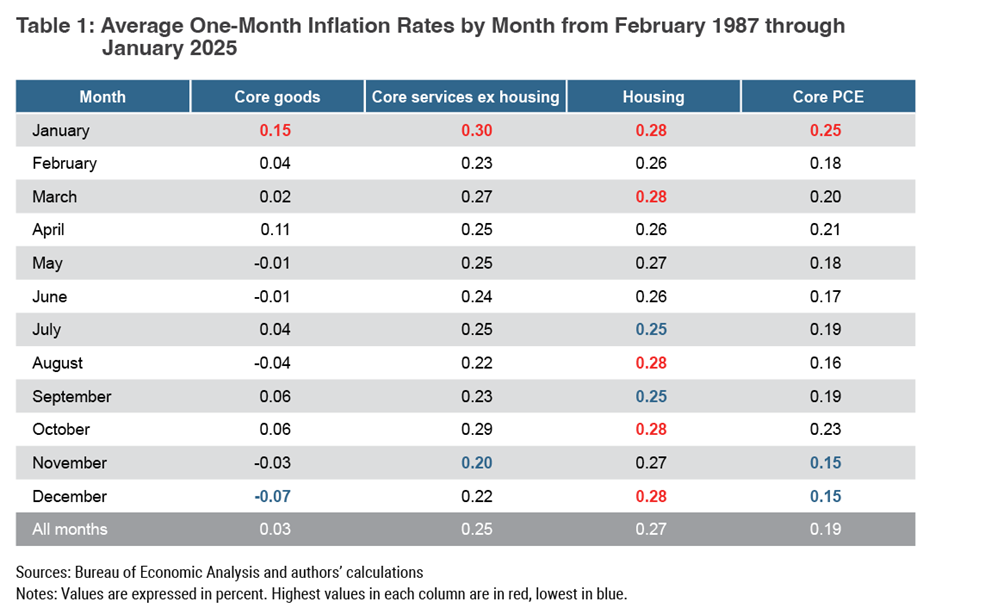
In Table 1, we highlight the highest (red) and lowest (blue) average monthly inflation values for each major component and for core PCE. For both core goods and core services ex housing, the highest level of monthly inflation is in January. Core inflation is also the highest in January. The lowest level of monthly inflation, on average, is in December for goods and November for core services ex housing, and core inflation has its lowest values in November and December. Housing inflation, on the other hand, tends to be similar throughout the year, causing it to have its highest average level (rounded to two digits) in no specific month or in months across the sample. Similarly, housing has its lowest average level of inflation in multiple months.
It is useful to quantitatively compare the differences between relevant months. Core goods one-month inflation in January is 18 basis points and 22 basis points higher than inflation in November and December, respectively. These are large differences. At an annualized rate, core goods inflation averaged about 1.8 percent in January but -0.4 percent in November and -0.8 percent December.
The differences across months for inflation in core services ex housing are smaller. Inflation was on average 10 basis points and 8 basis points higher in January than in November and December, respectively. Note that goods prices experience deflation in five months, on average, whereas services and housing do not experience any deflation on average for a specific month in the sample period. The last row in Table 1 shows the total average inflation rate across all months in the sample. Core goods inflation was materially lower over our sample than inflation in core services ex housing or in housing.
Table 2 repeats the exercise in Table 1 but restricts the sample to February 1993 to January 2020. This period has lower inflation relative to the sample used in Table 1, as seen by comparing the bottom rows of each table. Despite this, we document similar results to those in Table 1 for core goods, wherein some of the highest average inflation readings appear in January and some of the lowest appear in December, with the difference being economically significant. However, similarly high (low) values appear in April (August). Core services ex housing in column 2 experiences some of the lowest monthly inflation readings in December. The highest readings appear in October on average, but January is the month with the second highest value. Lastly, housing’s highest value is in January and the lowest in February, but the values in these (and other months) are not meaningfully different from each other.
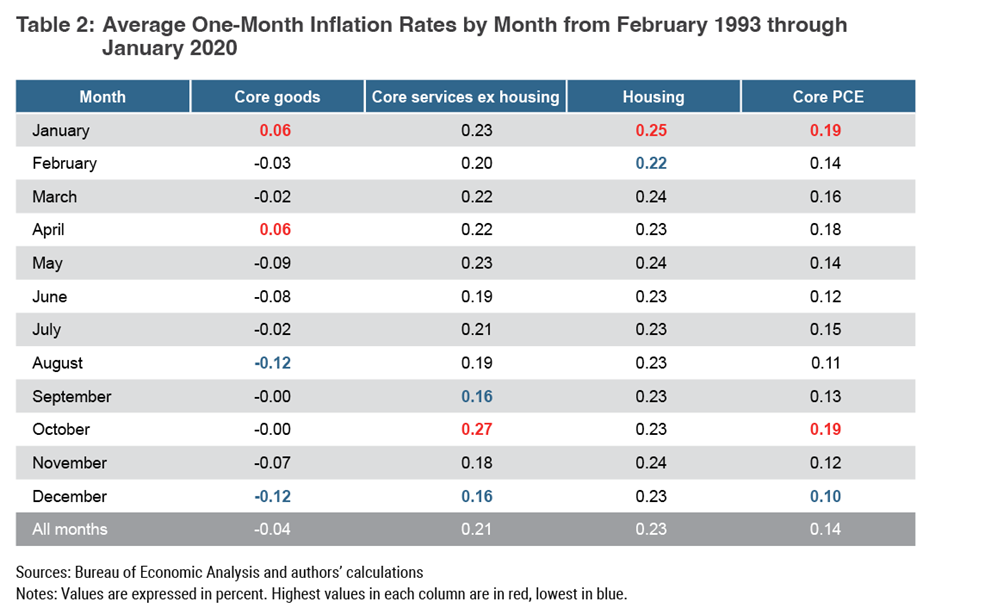
Average inflation for core goods in January compared with November and December in the restricted sample is 13 basis points and 18 basis points higher, respectively. Average core services ex housing inflation is 5 basis points and 7 basis points higher in January than in November or December, respectively. As in Table 1, the only seasonally adjusted component of the three that experiences deflation for certain months on average is the goods category. Ten out of 12 months of goods prices experienced deflation, on average, with January and April as the only months to experience inflation.
Comparing Inflation in January to Inflation in November and December
Tables 1 and 2 show that core goods inflation differed between January and November or December in an economically large way. Drilling down into these three categories of inflation shows that the difference in average inflation rates across months is quite large for core goods. The monthly differences for core services ex housing have not been as large as for core goods but are still economically meaningful. On the other hand, housing inflation has not varied materially on average across months.
In this section, we study the statistical significance in the differences across these months. Specifically, we study inflation rates that are separated by two months (November to January) or one month (December to January) in adjacent years. We do these near-month comparisons in order to compare inflation rates in generally similar economic circumstances, after having attempted to take into account normal seasonal patterns such as holidays and weather. Any residual seasonality we would expect to see would arise if seasonally adjusted inflation in a given January is systematically different than inflation in the near-preceding month(s). In Figures 1 and 2, we document these near-month comparisons for the full sample. Figure 1 shows the comparisons of January to the preceding November for the three seasonally adjusted major core PCE inflation categories. Figure 2 shows the comparison between January and the preceding December for each inflation measure.8
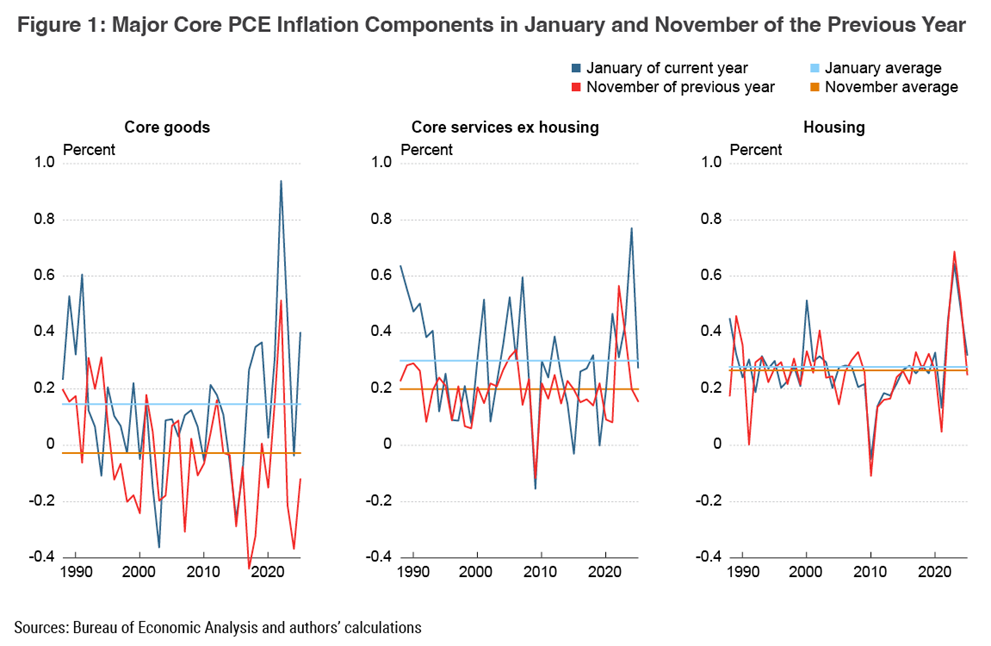
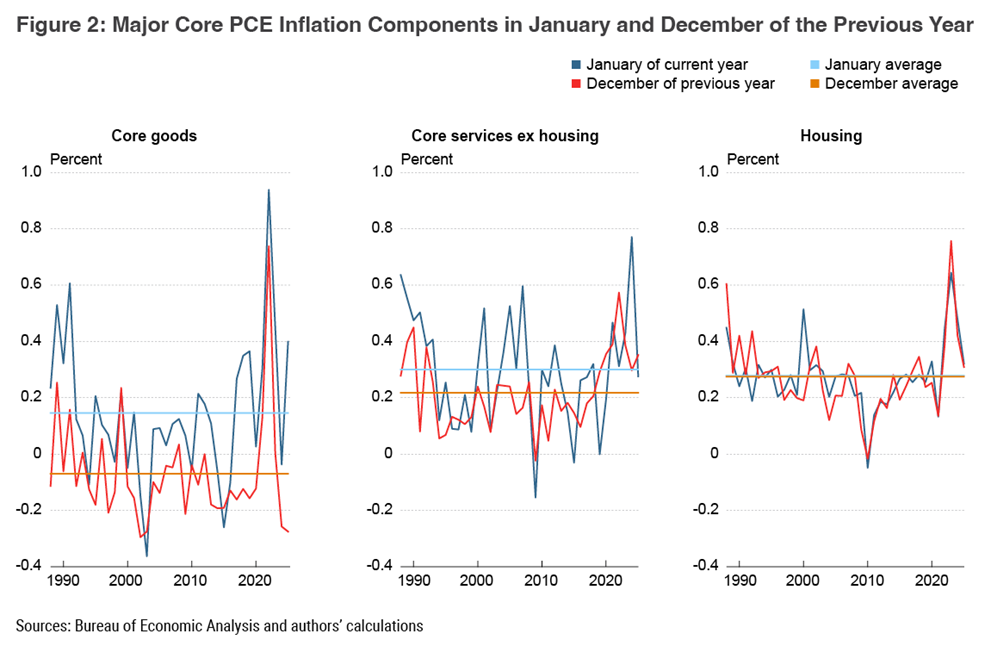
Figures 1 and 2 show that one-month inflation rates in January are typically higher than both preceding November and December months for core goods and core services ex housing. Housing inflation in January closely mirrors that of the preceding November and December inflation rates. Figures 1 and 2 also show the sample averages as horizontal lines, which correspond to the averages for November, December, and January displayed in Table 1.
For core goods, November and December one-month inflation rates are often negative (deflationary), while January is often inflationary. Core services excluding housing is less volatile for the three months across years. Nevertheless, the gap between January and the preceding two months still tends to exist despite being relatively smaller. By contrast, housing inflation in January tends to closely follow inflation in the prior November or December.
To tabulate how often January has higher inflation than the preceding few months, it is useful to document a few simple ratios using the data shown in Figures 1 and 2. Core goods inflation in January is higher than in the preceding November 76 percent of the time and core services ex housing for 74 percent of the time. Housing inflation in January is higher than in November 58 percent of the time. Compared to December, we find that core goods inflation in the subsequent January is higher 89 percent of the time, while core services ex housing is higher 68 percent of the time. Housing inflation in January is higher than December in only just over half of the sample. Regardless of having a common economic environment, residual seasonality in the core goods and core services ex housing components persists.
We compute formal statistical tests to help verify these findings. Given that the data are seasonally adjusted, the assumption is that inflation rates in a given January should not be systematically different than inflation rates in the previous two months. Our null hypothesis for our statistical tests is that the change in inflation rates from November or December to January is zero. In Table 3, we document the average change in inflation from November to January for each of the three major core PCE inflation categories. We also show the corresponding standard errors and t-statistics, with the standard error giving an idea of how much uncertainty there is around the mean. The t-statistic larger than 1.96 is used to reject our null hypothesis. This statistical test is repeated in Table 4 for the average change in inflation from December to January of the same sample range.
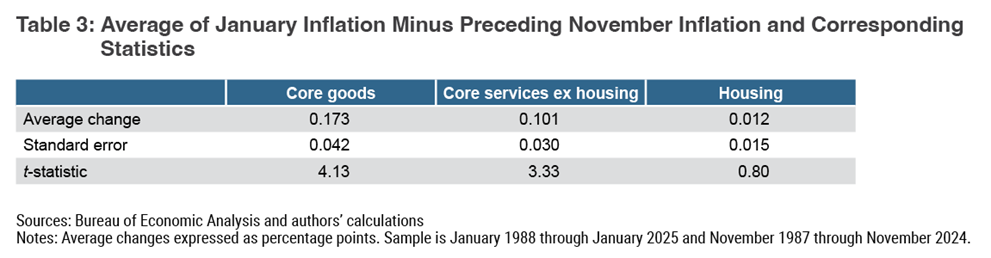
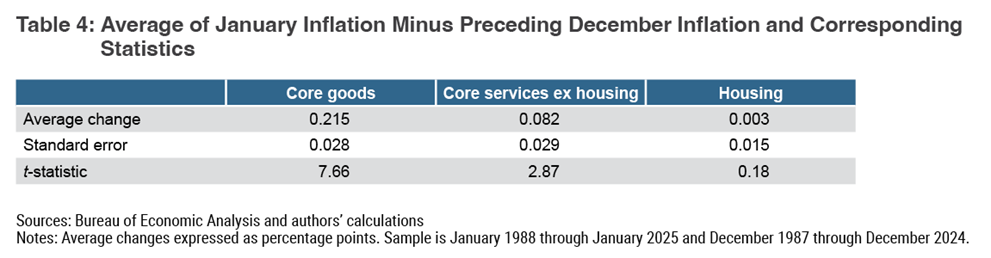
Table 3 shows that the average of January inflation less the preceding November inflation for the three components are all positive. The standard errors for core goods and core services ex housing are low, and the t-statistics are above 1.96. Housing is the exception for which we cannot statistically distinguish this average change from zero. Table 4 shows the average of January inflation less the preceding December inflation, with results similar to those of Table 3. Core services ex housing has a slightly lower average in Table 4 compared to the change from November to January, and housing inflation changes remain insignificant. The positive average inflation changes in the goods and services categories do not appear to be driven by randomness; rather, the January inflation readings appear to be systematically different compared to that of the preceding two months.
Conclusion
The difference in average PCE inflation rates from November or December to January for core goods and core services ex housing are both economically and statistically significant. Core goods inflation is 18 basis points and 22 basis points higher on average in January than in November and December, respectively. Core services ex housing inflation is on average 10 basis points and 8 basis points higher in January than in November and December, respectively. Over the span of 38 years, we find that January core goods inflation is higher than inflation in the preceding November or December more than three-quarters of the time. Core services ex housing inflation in January is higher than inflation in either of the previous two months at least two-thirds of the time. In contrast, we find that housing inflation rates do not change significantly from November and December to the subsequent January.
References
- Atkinson, Tyler, and Ron Mau. 2025. "Is Inflation Still Slowing? Early 2025 Data Pivotal to Outlook." Dallas Fed Economics, February 11, 2025. dallasfed.org/research/economics/2025/0211.
- Clark, Todd E., Matthew V. Gordon, and Saeed Zaman. 2025. "Forecasting Core Inflation and Its Goods, Housing, and Supercore Components." International Journal of Central Banking 21(4): 351–403. ijcb.org/journal/v21n4/forecasting-core-inflation-and-its-goods-housing-and-supercore-components.
- Consolvo, Victoria, and Kurt G. Lunsford. 2019. "Residual Seasonality in GDP Growth Remains after Latest BEA Improvements." Economic Commentary, no. 2019-05 (April). doi.org/10.26509/frbc-ec-201905.
- Cook, Lisa D. 2025. "The Economic Outlook and Path of Policy." Speech at the 2025 McKay Lecture, University of Pittsburgh, Pittsburgh, Pennsylvania, April 3. federalreserve.gov/newsevents/speech/cook20250403a.htm.
- Jefferson, Philip N. 2025. "Economic Outlook and the Fed's Monetary Policy Framework." Speech at the Drexel Economic Forum, Drexel University LeBow College of Business, Philadelphia, Pennsylvania, October 3. federalreserve.gov/newsevents/speech/jefferson20251003a.htm.
- Karamon, Kadiri. 2023. "Seasonal Adjustment in House Price Indices in the COVID-19 Period: A Study of Residual Seasonality." doi.org/10.2139/ssrn.4473796.
- Lunsford, Kurt G. 2017. "Lingering Residual Seasonality in GDP Growth." Economic Commentary, no. 2017-06 (March). doi.org/10.26509/frbc-ec-201706.
- Lunsford, Kurt G. 2025. "Residual Seasonality in Five Measures of PCE Inflation." Economic Commentary, no. 2025-03. doi.org/10.26509/frbc-ec-202503.
- Peneva, Ekaterina. 2014. "Residual Seasonality in Core Consumer Price Inflation." FEDS Notes. Board of Governors of the Federal Reserve System. doi.org/10.17016/2380-7172.0030.
- Peneva, Ekaterina, and Nadia Sadée. 2019. "Residual Seasonality in Core Consumer Price Inflation: An Update." FEDS Notes. Board of Governors of the Federal Reserve System. doi.org/10.17016/2380-7172.2318.
- Powell, Jerome H. 2022. "Inflation and the Labor Market." Speech at the Hutchins Center on Fiscal and Monetary Policy, Brookings Institution, Washington, DC, November 30. federalreserve.gov/newsevents/speech/powell20221130a.htm.
- Rudebusch, Glenn D., Daniel J. Wilson, and Benjamin Pyle. 2015. "Residual Seasonality in Monetary Policy." Federal Reserve Bank of San Francisco Economic Letter, No. 2015-27 (August). frbsf.org/research-and-insights/publications/economic-letter/2015/08/residual-seasonality-and-monetary-policy/.
- US Bureau of Economic Analysis. 2025. "National Income and Product Accounts." Accessed April 29, 2025. apps.bea.gov/iTable/?reqid=19&step=2&isuri=1&categories=survey#eyJhcHBpZCI6MTksInN0ZXBzIjpbMSwyLDNdLCJkYXRhIjpbWyJjYXRlZ29yaWVzIiwiU3VydmV5Il0sWyJOSVBBX1RhYmxlX0xpc3QiLCI4MSJdXX0=
Endnotes
- As examples, see Powell (2022), Cook (2025), and Jefferson (2025). Return to 1
- Seasonality does not apply to 12-month percent changes. Return to 2
- These measures are commonly used by economists and have been referenced by policymakers in recent years. For example, see research by Clark, Gordon, and Zaman (2025) and speeches by Powell (2022), Cook (2025), and Jefferson (2025). Return to 3
- Residual seasonality has been documented in other macroeconomic indicators such as GDP measures, as shown by Consolvo and Lunsford (2019), Lunsford (2017), and Rudebusch, Wilson, and Pyle (2015). Return to 4
- The source data received by the BEA from other agencies is first checked for seasonality using the Census Bureau’s X-13 ARIMA software and then seasonally adjusted if needed from there. Documentation for this process can be found at bea.gov/resources/methodologies/nipa-handbook/pdf/chapter-04.pdf; recent updates to their methodology can also be found at apps.bea.gov/scb/issues/2018/08-august/pdf/0818-gdp-seasonality.pdf. Return to 5
- Specifically, monthly goods excluding food and energy index is from row 375 of Table 2.4.4U and both services excluding energy and housing, and housing indexes are from rows 28 and 29 of Table 2.8.4, respectively. The data are available at bea.gov/itable/national-gdp-and-personal-income. Return to 6
- The sample starts in February 1987 and ends in January 2025, respectively, so that we have a balanced panel of specific months for our computed inflation rates. This sample matches the sample used in Lunsford (2025). Return to 7
- We do not suppress any observations during documented recessions during the sample period. Return to 8
Suggested Citation
Hamlette, James, and Kurt G. Lunsford. 2026. “Residual Seasonality in Some Components of PCE Inflation.” Federal Reserve Bank of Cleveland, Economic Commentary 2026-04. https://doi.org/10.26509/frbc-ec-202604
This work by Federal Reserve Bank of Cleveland is licensed under Creative Commons Attribution-NonCommercial 4.0 International


