

- Share
The Accounts of the Unbanked and Underbanked
We conducted focus groups with financially underserved Americans to learn more about how they manage their money. We spoke with 36 unbanked and underbanked individuals in Houston, Texas, and Cleveland, Ohio, about how they make and receive payments, the challenges they encounter in managing their finances, and how these experiences shape their views of financial service providers. While several participants described negative experiences with bank fees and concerns about security vulnerabilities, they acknowledged that alternative financial service providers were not always adequate substitutes.

The views authors express in Economic Commentary are theirs and not necessarily those of the Federal Reserve Bank of Cleveland or the Board of Governors of the Federal Reserve System. The series editor is Tasia Hane. This paper and its data are subject to revision; please visit clevelandfed.org for updates.
Introduction
More than 18 percent of US households don’t participate fully in the banking system. They are either unbanked—meaning nobody in the household has a bank or credit union account—or underbanked—meaning someone in the household has an account, but the household also uses alternative financial services.1 Studying the financial behavior of unbanked and underbanked households supports the Federal Reserve’s interest in understanding payments and credit. What are the reasons behind their limited participation in the banking system? How do they make and receive payments? Do nonbank alternatives meet their needs? And what difficulties, if any, do they face in managing their finances? To learn more, we convened four focus groups comprising 36 people who qualified as either unbanked or underbanked. This Economic Commentary summarizes the key themes that emerged from these conversations.2
Our research reveals new insights. Despite using bank accounts partially or not at all, several participants placed a high value on having relationships with banks, believing that such relationships could improve their access to credit. Likewise, while several participants used prepaid cards, they did not see them as a full substitute for bank-issued debit cards, not least because prepaid card transactions are sometimes declined and because these cards may not provide access to credit. Safety was also a key concern: many respondents worried that their nonbank accounts could be hacked. While they viewed bank accounts as more secure than alternatives, they saw all providers as somewhat vulnerable to cyberattacks. Several participants valued interoperability; that is, compatibility among payment methods. Finally, some participants expressed confusion about whether certain accounts—particularly those offered by new financial technology companies (fintechs)—were indeed bank accounts.
Several of our findings are consistent with those of previous qualitative studies, such as Bank On and CFE Fund (2019), Prescott and Tatar (1999), and Rengert and Rhine (2016). For example, our focus group participants reported that they valued financial products that offer fast and secure payments, insurance against loss, and transparent fee structures.
Given the small sizes of our focus groups and the nature of qualitative research, our findings may not necessarily be representative of the views of all unbanked or underbanked people in the United States. Nevertheless, focus groups can offer valuable insights since they allow for in-depth conversations with participants to better understand their opinions and the reasons behind their choices (see, for example, Merton et al., 1990).
Recruitment and Execution of the Focus Groups
The Federal Reserve Bank of Cleveland contracted a market research firm to recruit participants and conduct our focus groups. The discussion guide, which we developed in collaboration with the firm’s experts, drew from existing surveys and literature on those who are unbanked and underbanked in the United States and was designed to explore gaps not addressed by existing large-scale surveys (see FDIC, 2024; Boel and Zimmerman, 2022). Two focus groups took place in Houston, Texas, on July 28, 2022, and another two in Cleveland, Ohio, on August 18, 2022. We chose these two cities to ensure diversity by geography and ethnicity. In particular, we selected Houston because of its higher than average unbanked and underbanked rates, while we chose Cleveland because of the Cleveland Fed’s interest in conditions in the Fourth District.3 Moreover, Houston has a large Hispanic population and Cleveland a large Black population; these demographic groups are associated with higher unbanked and underbanked rates (FDIC, 2024).4
For recruitment, the market research firm partnered with local agencies that contacted and screened individuals listed in their databases to ensure they met the study criteria. The research firm also recruited participants via advertisements placed at alternative financial services providers such as local check-cashing storefronts and pawn shops. The research firm screened potential participants using a questionnaire and excluded individuals if they were neither unbanked nor underbanked; if they did not actively manage their household finances (to ensure they made decisions about which financial tools to use); or if they or a family member worked in market research, advertising, or finance (as this could bias their responses in favor of or against financial services or focus groups). Ethnicity and geography were considered in selecting participants to ensure Black, Hispanic, and rural consumers were included in each of the focus groups. Each focus group contained a mix of unbanked and underbanked participants.5
The market research firm invited qualified individuals to participate in the focus groups and offered standard compensation for their time. Recognizing that the unbanked and underbanked populations often face uncertain work schedules that can make it difficult for them to reliably attend focus groups scheduled in advance, the firm intentionally over-recruited to mitigate the impact of no-shows.6 In cases in which too many people turned up, some individuals were compensated in full and dismissed.7
Each Houston group consisted of 10 participants, for a total of 20, and each group in Cleveland had eight participants, for a total of 16 and a combined total of 36. The focus groups each lasted two hours, including breaks, and were moderated by an experienced facilitator from the market research firm. We observed the conversations from behind a one-way mirror and did not directly participate. Participants were informed that researchers were watching the session from behind a one-way mirror. To minimize response bias, participants were told neither the affiliations of the researchers nor the organizations that had arranged the focus groups.8
Demographic Characteristics of Focus Group Participants
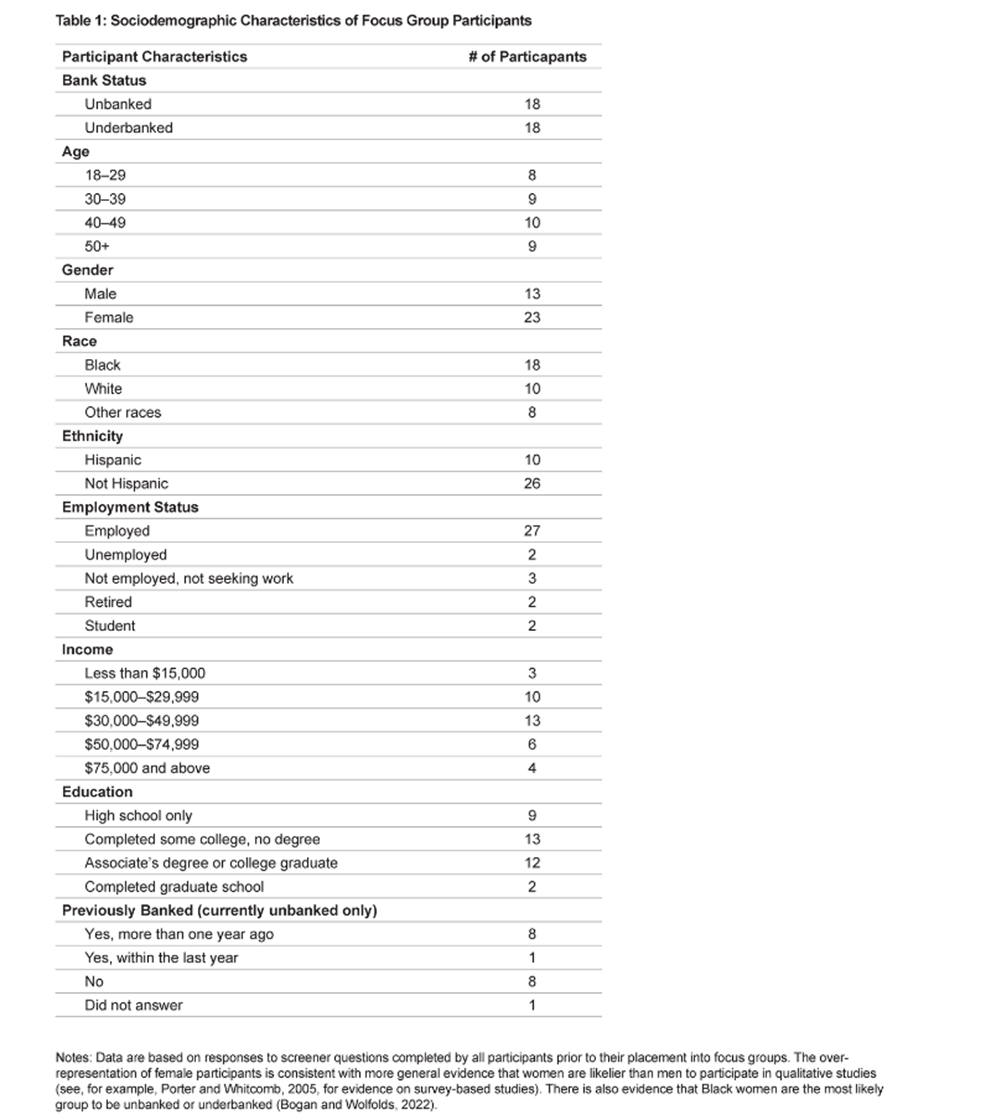
By design, our participants had a range of sociodemographic characteristics, as summarized in Table 1. We had equal numbers of unbanked and underbanked participants. Thirteen individuals were male, and 23 were female. Participants were asked separately about their race and whether they identify as Hispanic; for example, they could identify as both Black and Hispanic. Regarding race, 18 of the 36 participants identified as Black, 10 as white, and eight as other races. Ten of the 36 participants identified as Hispanic. Most (27) of our participants were employed, while the others were unemployed, retired, pursuing education, or out of the labor force. Fourteen individuals had sent remittances in the previous three months. One participant identified as having a disability. The median participant was 40 to 49 years old, had an annual income of between $30,000 and $49,999, and had completed some college coursework but had not earned a college degree.
Key Lessons
In the remainder of this Economic Commentary, we outline some of the main lessons learned from our focus groups. We analyzed the conversations using a three-stage process. First, we used the discussion guide to identify broad topics in the focus group conversations. Second, we watched the eight hours of video footage and read the transcripts to find common themes in the groups’ discussions of each topic. Third, we applied an open-weight large language model to the transcripts, allowing us to double-check that we had identified the most common themes around each topic.9 Additionally, some of our findings come from participants’ responses to the screener questionnaire prior to the day of the focus groups and from the intake survey carried out on the day of the focus groups.
Making and receiving payments
We began by asking participants how they paid for regular expenses such as bills and groceries and how they received payments. Participants mentioned using a wide variety of methods, including cash, fintech tools (especially payment apps), checks, money orders, prepaid cards, and credit cards. Underbanked participants also mentioned bank debit cards. Generally, participants preferred to use methods that had low fees and were convenient, fast, and secure. Privacy, interoperability, and protection against the risk of being hacked were also important considerations. In the subsections below, we highlight specific comments regarding the most frequently mentioned payment methods.
Cash
Cash was a popular means of payment, with our participants citing its immediacy, tangibility, and lack of transaction fees. Several noted that cash helps them to better manage their spending, with one participant saying, “You always know what you have, so you know what you can spend.” Some reported keeping an emergency stash of cash—sometimes organized in envelopes set aside for specific expenditures—to ensure that funds are readily available when needed. Others noted that they often get a discount when they pay in cash. Many mentioned the ability of cash to preserve privacy. One noted, “Cash can’t really be tracked, unlike other electronic transactions.”
However, participants also acknowledged that cash is subject to the risk of loss and theft, and it is increasingly not accepted everywhere; for example, “I have gone to places where, even restaurants, they’ve got a sign outside, we do not accept cash anymore.” The lack of record-keeping compared to other payment methods was a problem for some. Others complained that when paying with cash during the pandemic-induced coin shortage, they received less change than owed. One noted, “I work hard for my money, and my money is important to me. I cannot stand it, with the coin shortage and stuff, when people are like, ‘Do you want your penny back?’ Yes, I do.”
Prepaid cards
Some participants liked prepaid cards for their low and transparent fees.10 As one participant explained, “You just load whatever, however much you need, and then that’s pretty much it. You don’t have to pay any annual fees.” However, others complained about the costs of prepaid cards, citing, for example, fees to load money onto them.
Some participants also appreciated that prepaid cards could be used anonymously and were not tied to other accounts. As one participant noted, “It’s not traceable. You don’t have to use any of your real identity. You can just make up whatever name, whatever number, whatever you want, go spend it.” Some participants received wages on their prepaid cards via direct deposit.
However, our participants noted limitations as well, for example, those around acceptance for credit purchases. One participant said that, using a prepaid card, “I applied for this loan online to purchase some furniture. They said you’re accepted, you can choose your items. I did all that, got to the end, entered my card number, and they said you can’t use that kind of card. You have to have it attached to a bank. I don’t have a bank account, so they couldn’t give me the loan because I have no way of securing.” And some participants explained that some merchants don’t accept prepaid cards that lack a chip.
Bank debit cards and credit cards
Bank debit cards were popular among underbanked participants since they can be linked to the accounts into which participants receive their direct deposits. Participants also valued the digital record of card purchases. One commented that “It’s easy to find at the end of the month how much I overspent.”
While some participants had credit cards, these were generally reserved for emergencies. Some participants used credit cards for rewards, while others appreciated being able to pay off outstanding credit card balances with prepaid cards. But credit cards were also viewed as expensive. A participant running a small business mentioned, “My clients pay me with a lot of checks. I do a lot of Cash App. I used to do credit cards, but because the fees were so high, I got rid of the credit card machine.”
Overall, participants felt more comfortable carrying a card than large amounts of cash, citing concerns about loss or theft.
Fintech tools
Participants highlighted the convenience of fintech tools such as Cash App, Chime, PayPal, Venmo, and Zelle, particularly for peer-to-peer money transfers.11 One participant noted, “Before all this, if I had to send my daughter cash at college, you might have to go to Western Union. Now you don’t have to do the Western Union. You don’t have to fill out the paperwork. You have all those Cash App, Zelle, whatever it is to get there in two seconds right into their account to where it might be [needed in] an emergency.” Some others also valued the privacy offered by these tools, preferring them over bank transactions for online purchases. One said, “If I’m doing stuff on the internet, I don’t like giving out my actual bank information, so I’ll take those funds, and I’ll transfer them to a Cash App and then pay it with that Cash App card or a prepaid card that I know that I don’t keep money in.” Some participants appeared unsure about whether these tools were bank accounts or not.
Despite the advantages of apps, many participants reported negative experiences, including instances of hacking and scams. One participant’s experience of using a payment app was that it “is very easy and loose, and I think a bank is more structured.” Another said that with nonbank apps, “it's easier for people to get your personal information and use that.” Hacking was consistently raised as a concern, with one participant saying, “I’d rather be robbed in person than be hacked, because I have a chance [to fight back].”
Some said they found app providers’ customer service to be lacking; one noted that “They basically put their hands up and say, ‘I don’t know what to tell you.’” Complaints also included a lack of interoperability among apps, with one participant saying that “Some of the apps themselves don’t talk to each other.” Also, not all payment apps are universally accepted. “It all depends on the provider you are paying because some of them don’t accept Cash App,” said one participant, and “some of them don’t take Venmo.” For others, age appeared to be a barrier, with one remarking, “I’m not good with apps. I feel like I’m too old to have all these.” Some were disappointed that not all payment apps could be used in physical stores.
Money orders and check-cashing
Several participants reported using money orders and checks, primarily for large expenses such as rent. Indeed, some of these participants said that their rent could be paid only via money orders. However, money orders were seen as inconvenient, with one pointing out “It’s a lot of work to put stuff on money order.” Transaction limits and fees were a particular problem, as another participant explained: “My rent is $550. Most places only let you get $500. Then I’ve got to purchase a second money order for $50, which [costs] a buck or two or whatever. But then you’ve got to fill out the second one, explain to the landlord why I have two.”
Some participants had experiences with check-cashing stores but preferred to avoid them because of higher fees, with one saying she had used them “because I had no choice at one point, when I just didn’t have a checking account, and I had to go there and pay that insane amount for them to cash your check.” Others, however, said that they valued the customer service.
Buy Now, Pay Later
We asked participants how they would handle unexpected expenses. Some said they would rely on savings accounts or cash kept at home, while others would borrow from relatives, credit cards, or payday lenders. For larger expenses, some mentioned buy now, pay later services such as Afterpay, Affirm, and Klarna. As one participant shared, “It’s my go-to. I’ve been surviving with that.” Many appreciated the immediate access to goods and services and the ability to pay in installments, often without being charged interest for a period of time.
Cryptocurrencies
A few participants mentioned using cryptocurrencies, though mostly for investment purposes rather than day-to-day payments. However, many acknowledged the risks involved, with one noting, “You're gambling your money all the time.” Some participants appreciated the privacy that cryptocurrencies offer; one said that “You don’t have to put much of your personal information. For me with a bank, they ask for your Social Security number, your address, all of that. With crypto, I don’t remember putting that information in when I did it.” A few highlighted the ease of acquiring crypto, even paying for it with prepaid cards or payment apps.
Some participants expressed concerns about the lack of institutional backing. “The downfall of crypto is that there’s no bank backing it,” one observed. Others pointed out the difficulty—or even impossibility—of recovering lost funds.
Views on banks, credit unions, and other financial service providers
Next, we asked participants about what types of financial institutions and companies they rely on to access financial services and carry out everyday transactions, why they use them, and what they like or dislike about them. Participants articulated their opinions on banks, credit unions, and retail stores, the latter often used to buy prepaid cards, send money orders, or cash checks. In the subsections below, we summarize the views expressed on each of these financial service providers.
Banks
Figure 1 presents a word cloud summarizing the sentiments expressed by participants about banks. Positive sentiments are presented in green and negative sentiments in red, and the size of each word reflects the frequency with which the sentiment was expressed. Overall, sentiment toward banks tended to be negative, with participants expressing concerns about information security and high fees, along with a lack of trust in banks. However, some participants found banks more trustworthy and convenient than alternatives.
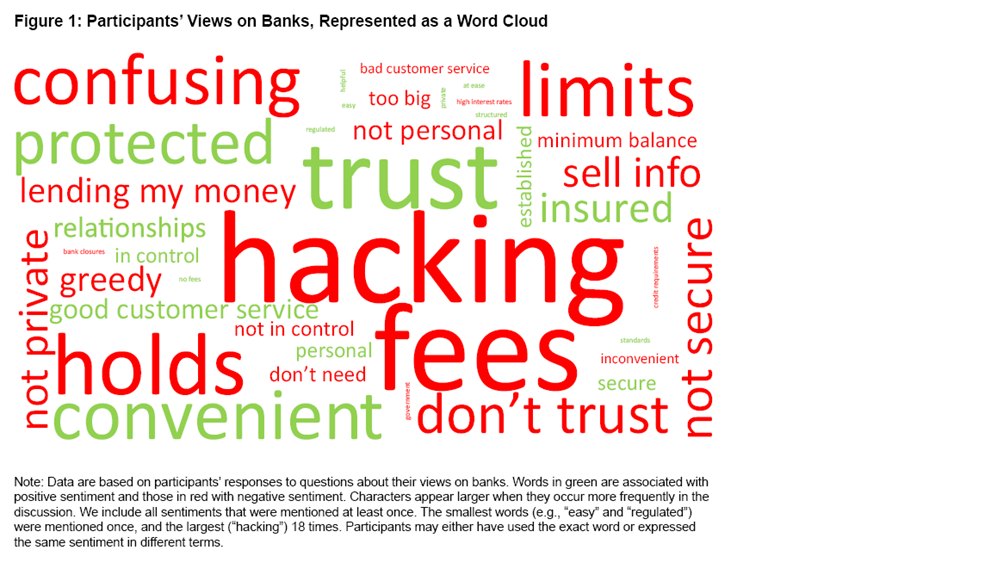
Digging into the detail, participants expressed concerns about bank account security, particularly the risk of being hacked, with one sharing, “I think my bank account had gotten hacked three or four times within a year span or something.” While this concern was shared by many, participants generally recognized that the risk of being hacked isn’t unique to bank accounts. They did appreciate banks’ ability to address incidents of fraud when detected early enough. “If they find or think something is fraudulent,” one said, “they won't let it go through. They'll immediately shut it down. Stop on your card. I like that, I like that a lot.” Some, however, expressed frustration over the challenges of resolving fraudulent bank account transactions and the financial consequences that can follow. One participant noted that “Because my son had his bank account checked. . . then, he had to prove that it wasn't him and that he was at home and didn't make these charges. . . . It negatively impacted his credit.”
Participants liked that banks are regulated, with some saying it helps them trust banks more. Deposit insurance was mentioned and highly valued, though some were unclear whether coverage extended to fraud protection. On the other hand, they felt that traditional banks have less predictable, less transparent, and sometimes higher fees than other providers they use. Some opined that policies such as deposit holds gave them less access to and control over their money than they would have liked. One participant said, “How are you going to tell me how much of my money I can get? I can’t take $10,000 out of my account. I can only take out $1,000.”
However, participants also expressed a good deal of distrust in traditional banks, especially with regard to customer service and data protection. One summed it up as “You’re not a person, and if you’re not going to treat me like I’m a person and I matter, then I can’t trust you.” Several were concerned about banks’ privacy policies, with one saying, “They sell your information. They are very quick to sell your information. My husband refinanced at his bank, which I hate, and all of a sudden we’re getting all this stuff in the mail about a car warranty.” Several participants remarked that the terms and conditions for opening bank accounts were complex and confusing. One said, “I feel like the reason why those legal terms are in place is to conceal from the individuals that only know layman’s terms.”
For those participants without a bank account, we asked for the reasons why they did not have an account. High fees emerged as a major deterrent. Some participants shared negative past experiences with banks’ charging what they felt were excessive minimum balance and overdraft fees. One said, “For the first three days they charge $7, and then after that, it was just $35 each day, each day, each day. The first time they waived the fees, but then it was miscommunication, and they just kept charging, kept charging.” Some participants acknowledged that some bank fees have been declining, with one opining, “I believe it’s the competition.”
Many of our participants had previously had bank accounts but had closed them, either by their choice or the bank’s.12 Several complained about banks’ abruptly suspending or closing their accounts for apparently arbitrary reasons. One participant reported, “Now I’m on something called ChexSystems, where I’m not allowed to have a bank account for however many years or whatever.” Both unbanked and underbanked participants remarked about how long it takes bank deposits to clear, saying, “You may put a check in your account or pay a bill on Friday. If you don’t know any better, you think it might clear Friday or Saturday or Sunday if you’re just new to banking. It doesn’t even clear on Monday. It clears the whole next business day.”
Some unbanked participants expressed interest in opening a bank account in the future, even preferring it to their current arrangements. “I trust customer service through an actual bank,” one told us. “I myself don’t have one because I lost my ID, my wallet, which had my Social Security card, my ID card. Can’t open a bank account without all of that info. Since then I just haven’t tried. Eventually, in the future, yes, sure, just because, again, they’re known companies. There’s trust, customer service.” Several participants didn’t see a need for a bank account since they were able to manage their finances through other methods—such as cash, apps, or prepaid cards—that they felt gave them more control over their money and allowed them to access it more quickly.
Both unbanked and underbanked participants emphasized the importance of maintaining a relationship with a bank, with one saying, “When you develop a relationship with a bank, when you’re there for years, you can get a lot more things accomplished, I think.” Participants were especially interested in how this relationship might improve credit access. “If you have good credit with a bank,” one said, “you have good credit anywhere.” Others noted that, for example, landlords might request to view bank statements when evaluating tenants, particularly when they are without a job. One participant summed it up as “like a social credit system.” Several participants appreciated the convenience of bank locations, noting that “they are everywhere I go.” Others valued easy access to cash, particularly at ATMs.
Credit unions
Several participants expressed a preference for credit unions over banks, particularly because they felt they could build a relationship with the institution. One noted, “You’re not just a customer. You’re an actual person, if that makes sense.” Others highlighted financial benefits, noting that credit unions often offer better credit terms and additional perks. “I like my credit unions, too,” said one, “because you get discounts on a lot of stuff and way better interest rates as opposed to just regular banks or just going and getting a credit card from anybody.”
Retail stores
Many participants reported using large retailers or local convenience stores to obtain prepaid cards, purchase money orders, and cash checks. Participants emphasized the convenience of being able to carry out these activities at the place where they obtain their groceries, especially given the long opening hours. One said, “They’re not closed on Sundays like banks are.” Additionally, participants noted that large retailers typically charge lower fees than banks for check-cashing and money orders.
Conclusion
This Economic Commentary summarizes the insights we learned from focus groups about how the unbanked and underbanked manage their finances. While participants had a range of experiences and views regarding financial institutions and payment methods, several common themes emerged. First, many participants described negative experiences with banks, particularly around high and unexpected fees, most often overdraft charges. Despite these drawbacks, several participants still viewed bank accounts as valuable, noting that building a relationship with a bank can facilitate access to credit. Second, prepaid cards were commonly used but generally not seen as adequate substitutes for bank debit cards, especially given frustrations around declined transactions and credit denial when using them. Third, nonbank payment apps were widely used and valued for their convenience, though participants expressed dissatisfaction with limited customer service and poor interoperability between platforms. Fourth, participants mentioned security vulnerabilities as a concern for accounts at both banks and nonbank financial institutions, and many expressed doubts about banks’ incentives to protect customer privacy.
References
- Bank On and CFE Fund. 2019. “Making the Case for Banking Access: Talking to Unbanked People about Bank Accounts.” cfefund.org/wp-content/uploads/2019/11/Making-the-Case-for-Banking-Access-Brief-Oct-2019.pdf.
- Boel, Paola, and Peter Zimmerman. 2022. “Unbanked in America: A Review of the Literature.” Economic Commentary (Federal Reserve Bank of Cleveland), no. 2022-07 (May). doi.org/10.26509/frbc-ec-202207.
- Bogan, Vicki L., and Sarah E. Wolfolds. 2022. “Intersectionality and Financial Inclusion in the United States.” AEA Papers and Proceedings 112(May): 43–47. doi.org/10.1257/pandp.20221016.
- Federal Deposit Insurance Corporation (FDIC). 2024. “2023 FDIC National Survey of Unbanked and Underbanked Households.” Report. fdic.gov/household-survey.
- Hayashi, Fumiko, and Emily Cuddy. 2014. “General Purpose Reloadable Prepaid Cards: Penetration, Use, Fees and Fraud Risks.” RWP 14-1. Federal Reserve Bank of Kansas City. fedinprint.org/item/fedkrw/40776/original.
- Merton, Robert K., Marjorie Fiske, and Patricia L. Kendall. 1990. The Focused Interview: A Manual of Problems and Procedures. 2nd edition. New York: Free Press.
- Porter, Stephen R., and Michael E. Whitcomb. 2005. “Non-Response in Student Surveys: The Role of Demographics, Engagement and Personality.” Research in Higher Education 46(2): 127–152. doi.org/10.1007/s11162-004-1597-2.
- Prescott, Edward S., and Daniel D. Tatar. 1999. “Means of Payment, the Unbanked, and EFT ’99.” Economic Quarterly (Federal Reserve Bank of Richmond) 85(4): 49–70. richmondfed.org/publications/research/economic_quarterly/1999/fall/prescott.
- Rengert, Kristopher M., and Sherrie L. W. Rhine. 2016. “Bank Efforts to Serve Unbanked and Underbanked Consumers.” Federal Deposit Insurance Corporation (FDIC). fdic.gov/consumer-research/bank-efforts-serve-unbanked-and-underbanked-consumers.
- Toh, Ying Lei. 2021. “Prepaid Cards: An Inadequate Solution for Digital Payments Inclusion.” Economic Review (Federal Reserve Bank of Kansas City) 106(4). doi.org/10.18651/ER/v106n4Toh.
- US Census Bureau. 2026a. “QuickFacts Cleveland City, Ohio.” Accessed Feb 20, 2026. census.gov/quickfacts/fact/table/clevelandcityohio.
- US Census Bureau. 2026b. “QuickFacts Houston City, Texas.” Accessed Feb 20, 2026. census.gov/quickfacts/fact/table/houstoncitytexas.
Endnotes
- According to FDIC (2024), 4.2 percent of US households were unbanked and 14.2 percent underbanked in 2023. To classify underbanked households, the FDIC considers nonbank transaction services (nonbank money orders, check-cashing, and international remittances) as well as alternatives to mainstream credit (rent-to-own services and payday, pawn shop, auto title, and tax refund anticipation loans). Return to 1
- The authors thank Ashley Clark, Christian Garciga, Grant Rosenberger, Amber Sherman, and Stephanie Tulley for outstanding methodological support. The focus groups were approved by the Indiana University IRB, protocol #15540. Return to 2
- According to FDIC (2024), 9.4 percent of households were unbanked and 17.1 percent were underbanked in the Houston metropolitan statistical area (MSA) in 2023. The corresponding figures for the Cleveland MSA are 5.4 percent and 10.2 percent, respectively. Return to 3
- According to FDIC (2024), among Black US households, 10.6 percent were unbanked and 23.8 percent were underbanked. Among Hispanic US households, 9.5 percent were unbanked and 21.7 percent were underbanked. In 2025, according to the US Census Bureau (2026a, 2026b), 45.9 percent of the population in the city of Cleveland was Black, and 44.2 percent of the population in the city of Houston was Hispanic. The Census treats Hispanic origin separately from race, so a person may identify as both Hispanic and Black. Return to 4
- When selecting the participants, we designated people as “unbanked” if neither they nor anyone else in their household had an account at a bank or credit union, while “underbanked” designates people who have an account but who had also used alternative financial services for payment transactions—check-cashing, money orders, or international remittances—at least twice in the previous three months. Return to 5
- FDIC (2024) finds that unbanked rates are higher among households with more volatile incomes: the unbanked rate is 8.3 percent for survey respondents who say their income varies a lot from month to month, compared to 4.2 percent for the population at large. Return to 6
- In these cases, the market research firm determined which participants joined the group based on two factors: adequate representation of Black, Hispanic, and rural participants; and selecting a range of people with different ages, genders, ethnicities, and geographic locations to ensure a wider array of opinions. Return to 7
- All participants were asked to sign a consent form before participation. This form emphasized that their participation was voluntary and that they had the right to stop participation at any time. It also told participants that audio and video from the session would be recorded for research purposes, that all participants’ identities would be kept confidential, and that recordings would not be made public. In line with IRB approval procedures requiring a research contact, the consent form also mentioned that any questions about the study could be directed to Daniela Puzzello at Indiana University, so participants would have been able to infer the identity and affiliation of one of the authors of this study. Return to 8
- The large language model was run locally on the Cleveland Fed’s own systems, so no data from the focus groups was shared externally. We thank Christian Garciga for help with this task. Return to 9
- See, for example, Hayashi and Cuddy (2014) and Toh (2021) for discussions on prepaid cards and related fees. Return to 10
- Focus group participants frequently referred to these tools as “apps,” so we use that term throughout this Economic Commentary. However, it’s important to note that some of these platforms can also be accessed through websites, and some can be funded in person at retail locations such as check-cashing stores. Return to 11
- As shown in Table 1, of the 18 participants who are unbanked, nine reported that they or someone else in their household had previously had a bank account. Eight reported that nobody in their household had ever had an account, and one did not answer the question. Return to 12
Suggested Citation
Boel, Paola, Geena Panzitta, Daniela Puzzello, and Peter Zimmerman. 2026. “The Accounts of the Unbanked and Underbanked.” Federal Reserve Bank of Cleveland, Economic Commentary 2026-02. https://doi.org/10.26509/frbc-ec-202602
This work by Federal Reserve Bank of Cleveland is licensed under Creative Commons Attribution-NonCommercial 4.0 International


Related resources

About Us
The Federal Reserve Bank of Cleveland (commonly known as the Cleveland Fed) is part of the Federal Reserve System, the central bank of the United States.