

- Share
SORCE Insights: 2026 Update on Employment Conditions and Outlook for Fourth District Firms
The Cleveland Fed’s Survey of Regional Conditions and Expectations (SORCE) fielded from October 29 through November 5, 2026, included a set of special questions focused on firms’ employment and hiring. This question set was last fielded during October and November 2025 and detailed in SORCE Insights: Employment Conditions and Outlook for Fourth District Firms. The 2026 survey included an additional question that asked firms to describe the impact of AI on their employment and hiring. This District Data Brief discusses the top-line results from these questions.



The views authors express in District Data Briefs are theirs and not necessarily those of the Federal Reserve Bank of Cleveland or the Board of Governors of the Federal Reserve System. The series editor is Harrison Markel.
Recent Changes to Firms’ Headcounts
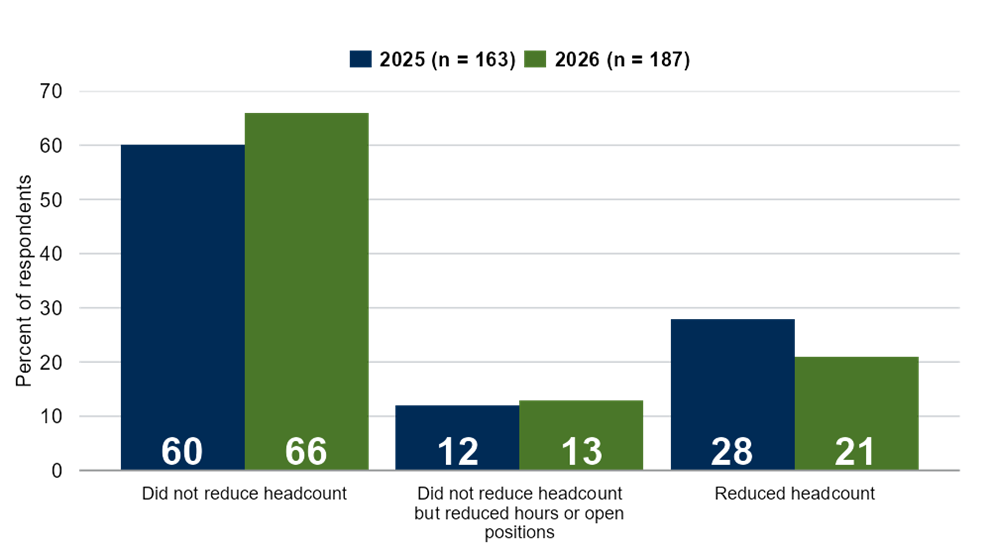
Most firms surveyed said they had not reduced their headcount in the last three months. The share of firms that reduced their headcount declined from 28 percent in the 2025 survey to 21 percent in the most recent survey. Thirteen percent of firms reduced hours or open positions without reducing their headcount.
Source: Cleveland Fed SORCE
Question: Over the last three months, has your firm reduced its headcount? (Choose as many as apply)
Note: Categories shown are condensed from more specific answer choices.
Difficulty Hiring
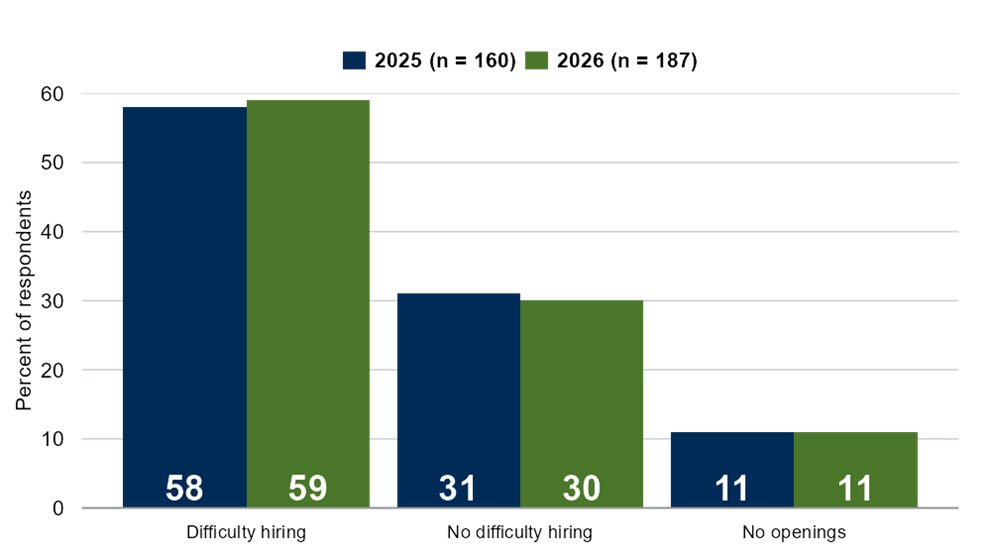
Fifty-nine percent of firms reported difficulty hiring in the last three months, while 30 percent had no difficulty hiring, and 11 percent had no open positions. These shares were nearly the same as those from the 2025 survey.
Source: Cleveland Fed SORCE
Question: Thinking of positions your firm has filled or attempted to fill, have you had difficulty hiring workers in the last three months? (Choose as many as apply)
Note: Categories shown are condensed from more specific answer choices.
Factors Restraining Firms’ Hiring Plans
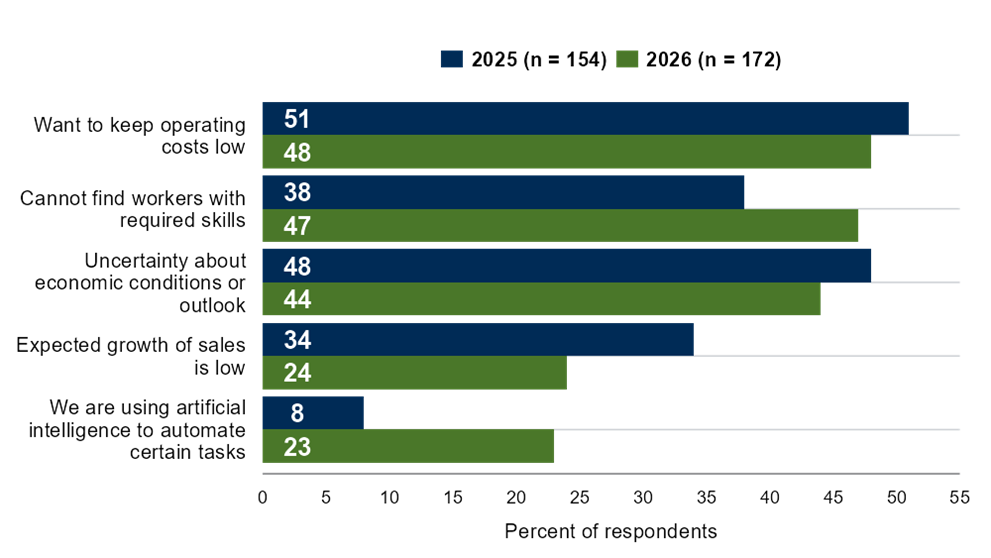
When asked about factors restraining their hiring plans, firms most commonly cited a desire to keep their operating costs low (48 percent), followed closely by an inability to find workers with the required skills (47 percent). The share of firms citing low expected sales growth declined since last year (from 34 to 24 percent). There was a noticeable increase (from 8 to 23 percent) in the share of firms citing AI automation as an important factor restraining hiring plans.
Source: Cleveland Fed SORCE
Question: What are the three most important factors, if any, restraining your hiring plans?
Note: Includes the five responses most frequently selected in 2026.
Expected Employment Change over the Next 12 Months
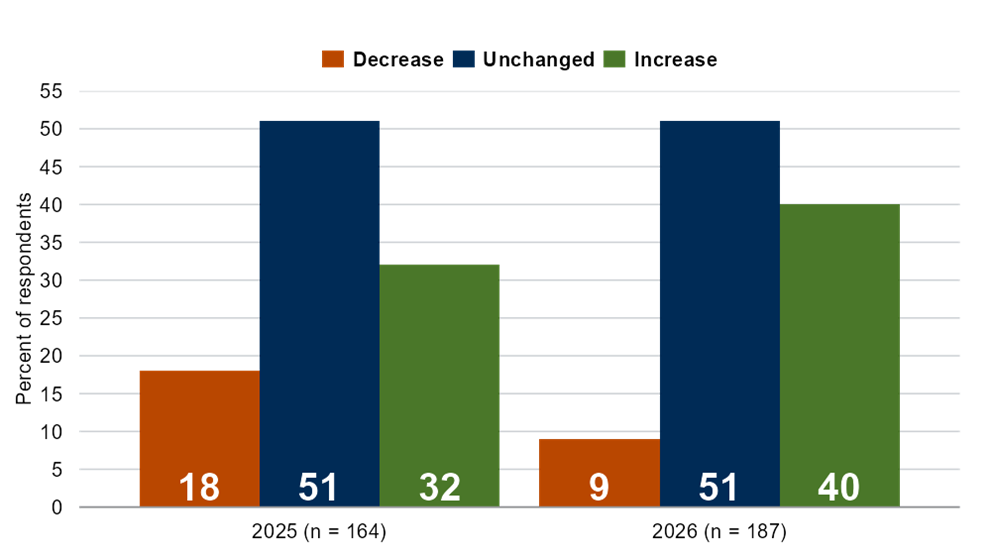
Over the next 12 months, 40 percent of firms said they plan to increase employment, compared to 32 percent in the 2025 survey. The share of firms planning to decrease employment over the next 12 months fell from 18 percent in 2025 to 9 percent in 2026. The share of firms not planning to adjust employment levels was unchanged at 51 percent.
Source: Cleveland Fed SORCE
Question: Do you expect your firm to increase employment, leave employment unchanged, or decrease employment over the next 12 months?
Note: Totals may not sum to 100 because of rounding.
Impact of AI on Hiring and Employment
In the March and September 2026 surveys, we asked firms how the use of AI had affected their overall staffing levels, with response options of increased, unchanged, or decreased. In both surveys, over 85 percent of firms reported no change in their overall staffing levels as a result of AI. The most recent survey included a question that instead asked firms to select from several descriptive responses (left column) about how AI use was affecting their employment. The table below groups these responses by their impact on the workforce (center column).
Fifty-two percent of firms reported that AI was having a transformative effect on their workforces (for example, they were retraining existing workers or hiring for different skills). Fifty-one percent of firms said AI was having no impact on their employment or hiring, while 12 percent reported that it was reducing employment or hiring, and 10 percent said it was increasing employment.
| Survey response | Impact on workforce | Share of firms |
|
Reducing employment or hiring |
12% |
|
No impact on employment or hiring |
51% |
|
Increasing employment |
10% |
|
Transforming workforce |
52% |
|
None of the above | 7% |
Source: Cleveland Fed SORCE (n = 186)
Question: Select all the ways AI is affecting employment at your firm. (Choose as many as apply)
The Cleveland Fed’s Research Department gathers and analyzes timely economic information from businesses and community contacts to inform our Beige Book contribution and to prepare for Federal Open Market Committee (FOMC) meetings. One way we obtain this information is through the Survey of Regional Conditions and Expectations (SORCE), a business conditions survey sent to firms across the Fourth District, which comprises Ohio, western Pennsylvania, eastern Kentucky, and the northern panhandle of West Virginia. The SORCE is administered eight times per year. In addition to the set of standard questions asked during each round of the survey, the Cleveland Fed routinely asks a set of “special questions” to explore timely issues that may be impacting businesses across the Fourth District. The SORCE Insights District Data Briefs share the results from the “special questions.” For more information on SORCE, visit https://clevelandfed.org/SORCE.
Suggested Citation
Hillier, Caydn, Brett Huettner, and Mitchell Isler. 2026. “SORCE Insights: 2026 Update on Employment Conditions and Outlook for Fourth District Firms.” Federal Reserve Bank of Cleveland, Cleveland Fed District Data Brief. https://doi.org/10.26509/frbc-ddb-20261123
This work by Federal Reserve Bank of Cleveland is licensed under Creative Commons Attribution-NonCommercial 4.0 International


Related resources

Survey of Regional Conditions and Expectations (SORCE)
SORCE indexes are based on our survey of business and community leaders and provide a timely summary of economic activity in our region, which includes all of Ohio and parts of Pennsylvania, Kentucky, and West Virginia. Released twice each quarter.

Regional Data, Analysis, and Engagement
Explore economic trends and the circumstances impacting the economy and diverse communities of the Federal Reserve’s Fourth District, which includes all of Ohio, western Pennsylvania, eastern Kentucky, and the northern panhandle of West Virginia.

About Us
The Federal Reserve Bank of Cleveland (commonly known as the Cleveland Fed) is part of the Federal Reserve System, the central bank of the United States.