

- Share
SORCE Insights: Tracking Operating Margins in the Fourth District
The Cleveland Fed’s Survey of Regional Conditions and Expectations (SORCE) fielded from June 18 through June 25, 2026, included a set of special questions focused on firms’ operating margins. This District Data Brief discusses the top-line results from these questions.

The views authors express in District Data Briefs are theirs and not necessarily those of the Federal Reserve Bank of Cleveland or the Board of Governors of the Federal Reserve System. The series editor is Harrison Markel.
The Cleveland Fed’s Survey of Regional Conditions and Expectations (SORCE) fielded from June 18 through June 25, 2026, included a set of special questions focused on firms’ operating margins. A company’s operating margin is the percentage of money it keeps from sales after paying operating costs like salaries, supplies, and rent but before considering interest or taxes. This District Data Brief discusses the top-line results from these questions.
Past-Year Change in Operating Margins
Compared to the same quarter in the previous year, 36 percent of firms said their operating margins decreased, 28 percent reported no change, and 37 percent reported an increase.
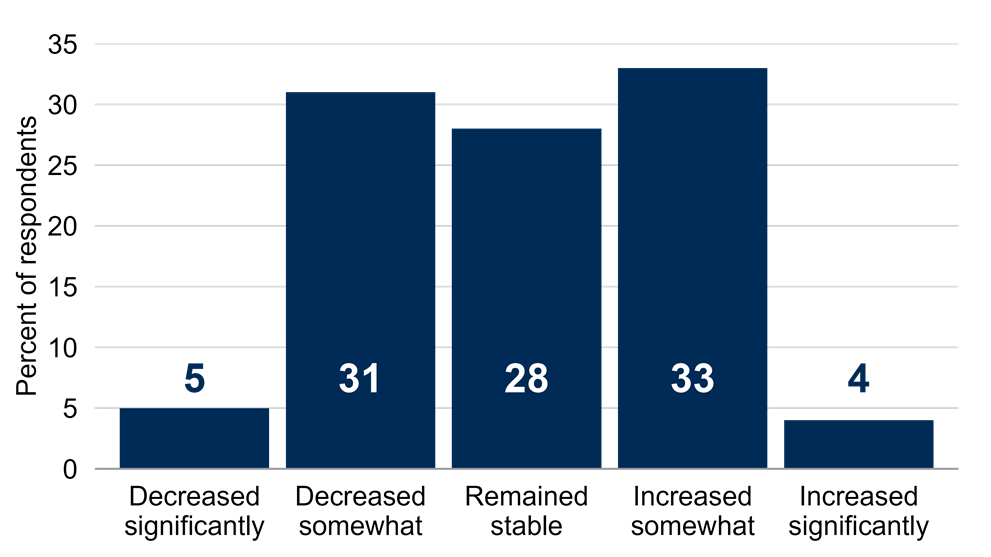
Source: Cleveland Fed SORCE (n = 167). Total may not sum to 100 because of rounding.
Question: Compared to the same quarter last year, how has your organization's operating margin changed?
Expected One-Year Change in Operating Margins
Compared to the current quarter, 20 percent of firms anticipated that their operating margins would decrease in the coming year, 38 percent expected no change, and 41 percent anticipated an increase.
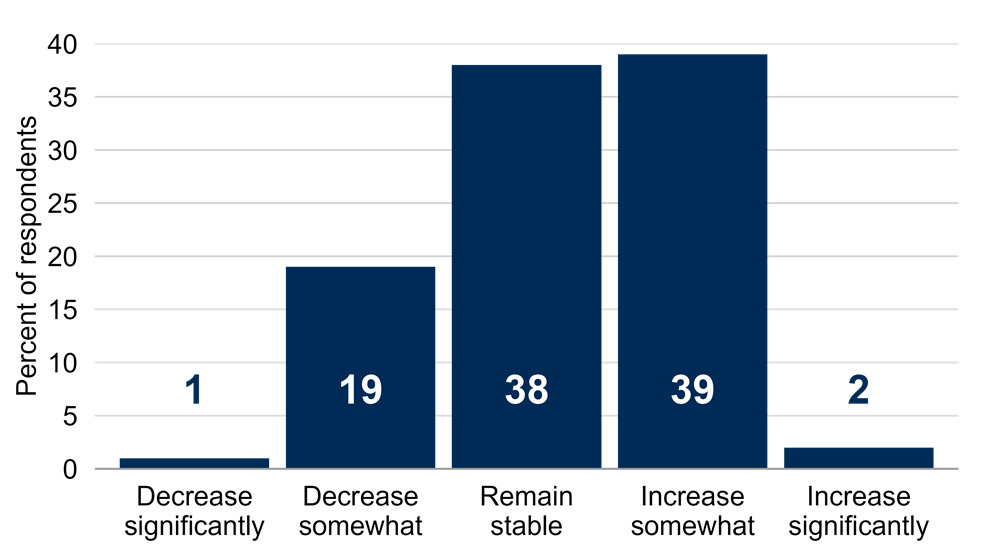
Source: Cleveland Fed SORCE (n = 167). Total may not sum to 100 because of rounding.
Question: Compared to this quarter, how do you expect your organization's operating margin to change over the next year?
Operating Margins Compared to Target
Fifty-two percent of firms said their operating margins were at or above target, 40 percent said they were somewhat below target, and 7 percent said they were significantly below target.
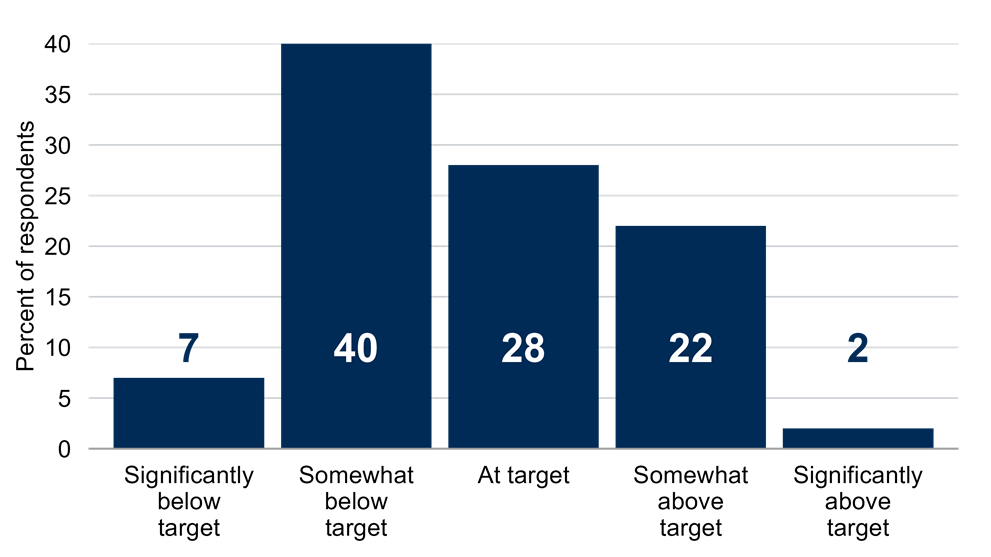
Source: Cleveland Fed SORCE (n = 167). Total may not sum to 100 because of rounding.
Question: How would you describe your organization’s current operating margin?
Note: One percent of respondents selected “Prefer not to say” (counted but not shown).
Actions Taken to Manage Operating Margins
Asked how they intended to manage their operating margins in the coming year, most firms planned to focus on improving operational efficiencies or productivity or increasing the prices of their products or services. The next most common actions were reducing nonlabor costs and negotiating better terms with suppliers.
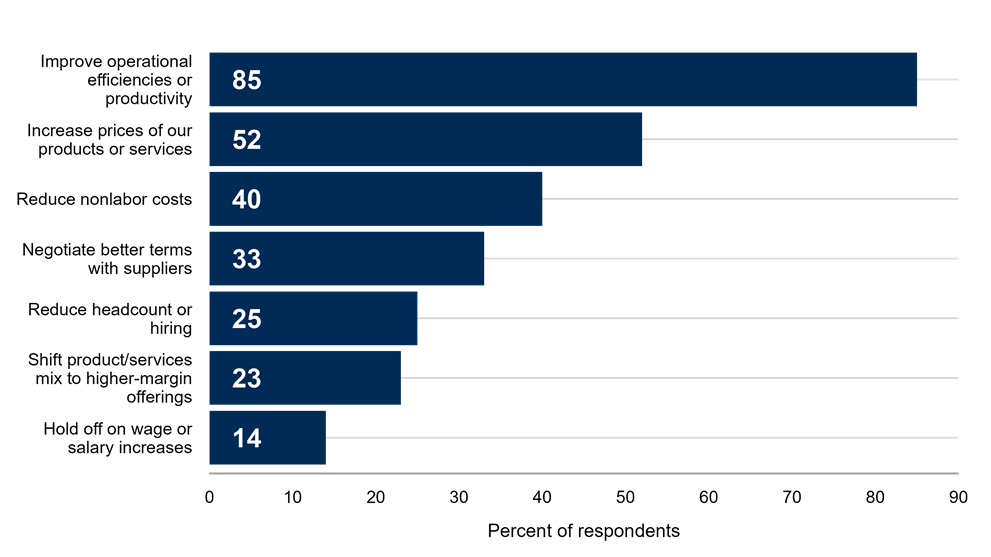
Source: Cleveland Fed SORCE (n = 161)
Question: Over the next year, which of the following actions is your firm planning to take, if any, to manage your operating margin? Select all that apply.
Note: Seven percent of respondents selected “Other.”
Compared to firms that reported operating margins at or above target, firms that reported margins below their target more frequently planned to increase the prices of their products or services, reduce nonlabor costs, reduce headcount or hiring, or hold off on wage or salary increases.
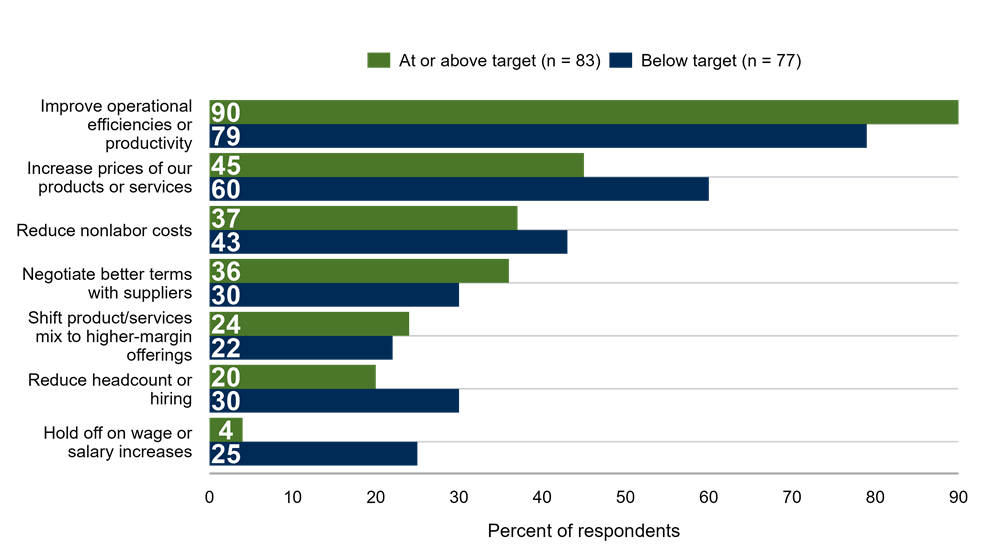
Source: Cleveland Fed SORCE
Question: Over the next year, which of the following actions is your firm planning to take, if any, to manage your operating margin? Select all that apply.
Note: Six percent and 8 percent of respondents who reported at-or-above-target and below-target margins selected “Other,” respectively.
The Cleveland Fed’s Research Department gathers and analyzes timely economic information from businesses and community contacts to inform our Beige Book contribution and to prepare for Federal Open Market Committee (FOMC) meetings. One way we obtain this information is through the Survey of Regional Conditions and Expectations (SORCE), a business conditions survey sent to firms across the Fourth District, which comprises Ohio, western Pennsylvania, eastern Kentucky, and the northern panhandle of West Virginia. The SORCE is administered eight times per year. In addition to the set of standard questions asked during each round of the survey, the Cleveland Fed routinely asks a set of “special questions” to explore timely issues that may be impacting businesses across the Fourth District. The SORCE Insights District Data Briefs share the results from the “special questions.” For more information on SORCE, visit https://clevelandfed.org/SORCE.
Suggested Citation
Huettner, Brett. 2026. “SORCE Insights: Tracking Operating Margins in the Fourth District.” Federal Reserve Bank of Cleveland, Cleveland Fed District Data Brief. https://doi.org/10.26509/frbc-ddb-20260715
This work by Federal Reserve Bank of Cleveland is licensed under Creative Commons Attribution-NonCommercial 4.0 International


Related resources

Survey of Regional Conditions and Expectations (SORCE)
SORCE indexes are based on our survey of business and community leaders and provide a timely summary of economic activity in our region, which includes all of Ohio and parts of Pennsylvania, Kentucky, and West Virginia. Released twice each quarter.

Regional Data, Analysis, and Engagement
Explore economic trends and the circumstances impacting the economy and diverse communities of the Federal Reserve’s Fourth District, which includes all of Ohio, western Pennsylvania, eastern Kentucky, and the northern panhandle of West Virginia.

About Us
The Federal Reserve Bank of Cleveland (commonly known as the Cleveland Fed) is part of the Federal Reserve System, the central bank of the United States.