

- Share
SORCE Insights: How Fourth District Firms Are Using AI
The Cleveland Fed’s latest edition of the Survey of Regional Conditions and Expectations (SORCE), administered from March 19 to 26, 2026, included a set of special questions focused on the use of artificial intelligence among Fourth District firms. This District Data Brief discusses the top-line results from these questions.


The views authors express in District Data Briefs are theirs and not necessarily those of the Federal Reserve Bank of Cleveland or the Board of Governors of the Federal Reserve System. The series editor is Harrison Markel.
The Cleveland Fed’s latest edition of the Survey of Regional Conditions and Expectations (SORCE), administered from March 19 to 26, 2026, included a set of special questions alongside the standard question set that informs the SORCE indexes. These special questions focused on firms’ use of artificial intelligence (AI), including their recent and planned adoption of AI, how they are using it, and barriers to adoption.
Firms’ Recent and Anticipated Use of AI
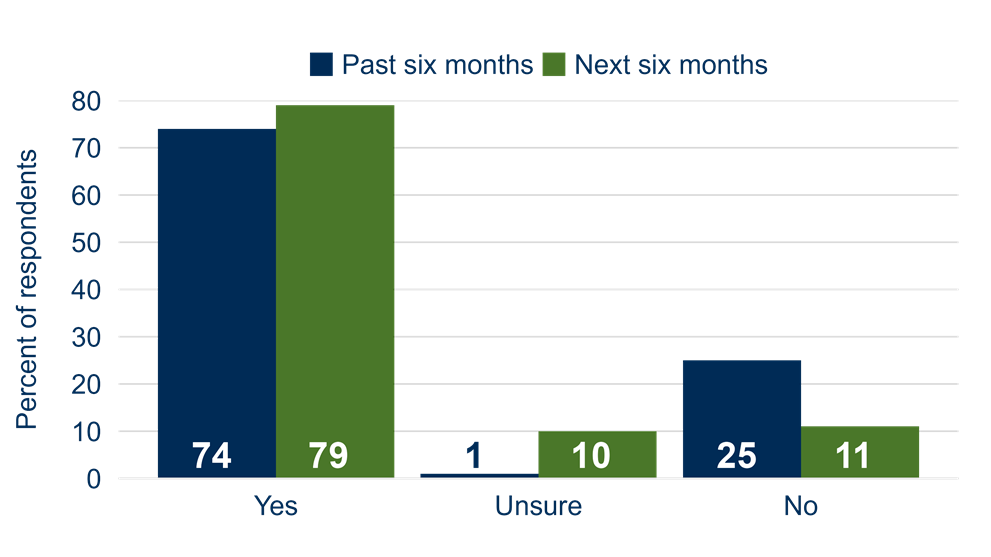
Just under three-fourths of respondents said that their organization had used AI as part of its business processes over the past six months, and a slightly higher share (79 percent) expected their organization to do so in the coming six months.
Source: Cleveland Fed SORCE
Question 1: In the past six months, has your organization used AI as part of your business processes or tasks? (n = 194)
Question 2: Over the next six months, does your organization plan to use AI as part of your business processes or tasks? (n = 195)
Level of AI Implementation in Organizations
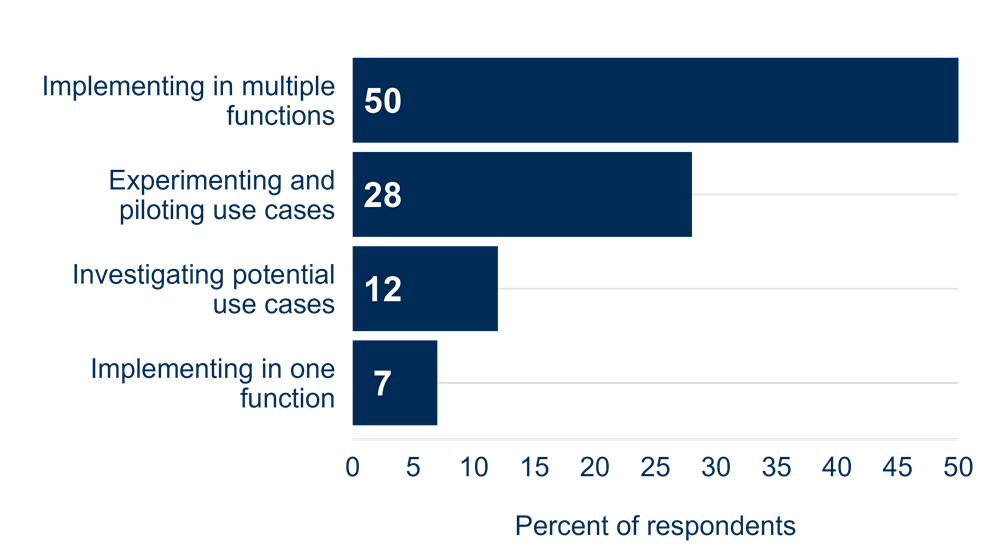
Among respondents who reported that their organization had used AI for business processes in the last six months, half said their organization was implementing AI across multiple business functions. Smaller shares said their organization was still experimenting and piloting use cases (28 percent), investigating potential use cases (12 percent), or implementing AI in a single business function (7 percent).
Source: Cleveland Fed SORCE
Note: Chart excludes “Unsure,” which was chosen by 3 percent of respondents.
Question: Which of the following best describes the level of AI use in your organization? (n = 143)
Processes and Tasks for Which Organizations Use AI
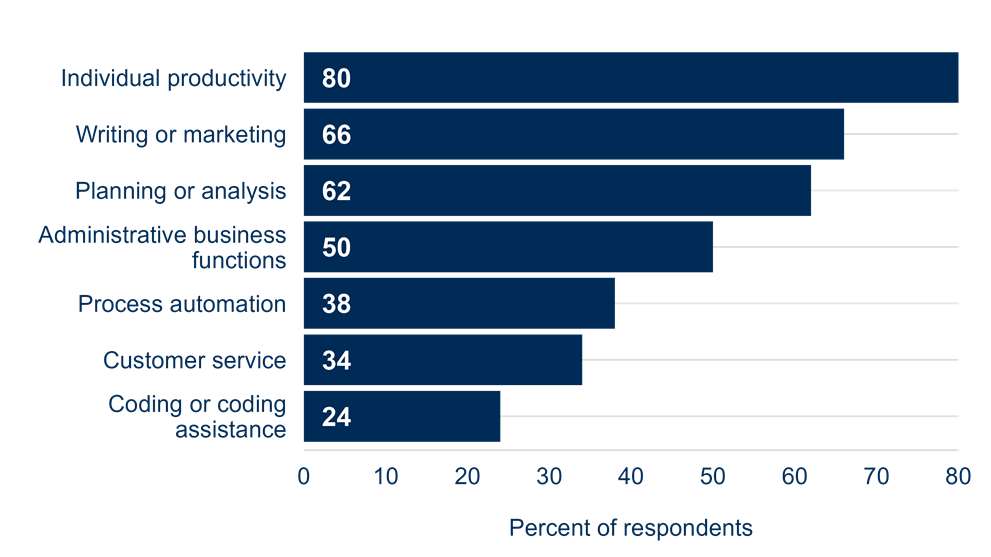
Eighty percent of respondents whose organization had used AI for business processes in the last six months said their organization was using AI for individual productivity. Smaller majorities said their organization was using AI for writing or marketing (66 percent) or planning or analysis (62 percent). Half said their organization was using AI for administrative functions.
Source: Cleveland Fed SORCE
Note: Respondents could select multiple options. Chart excludes “Other,” which was chosen by 9 percent of respondents.
Question: In the past six months, for which processes or tasks has your organization used AI? Select all that apply. (n = 143)
Effect of AI Use on Staffing Levels
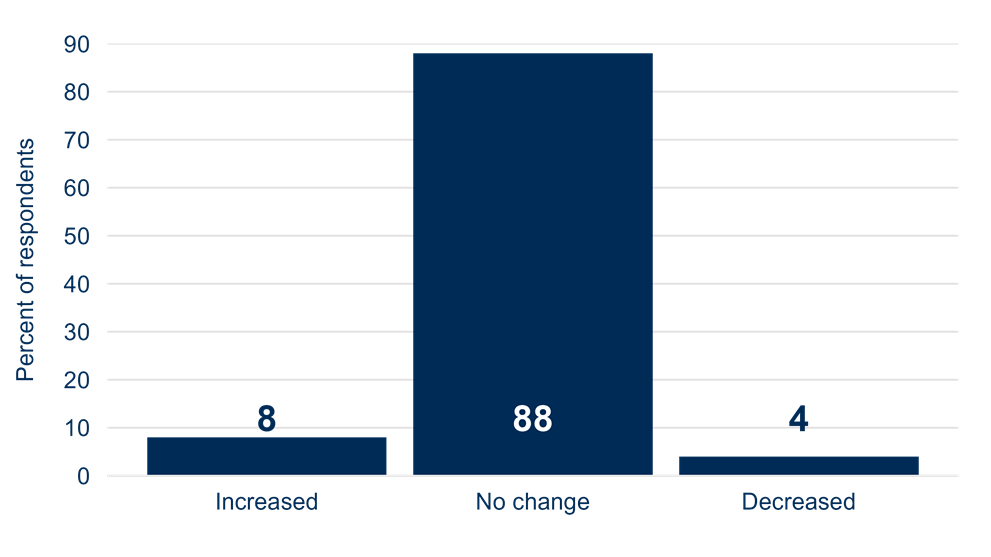
Among respondents whose organization had used AI for business processes in the last six months, most (88 percent) said their organization’s use of AI did not affect staffing levels. A much smaller share (8 percent) said their organization’s AI use increased staffing levels, while four percent said it decreased staffing levels.
Source: Cleveland Fed SORCE
Question: In the past six months, how did the use of AI affect your organization’s staffing levels? (n = 143)
Anticipated Benefits of AI Adoption
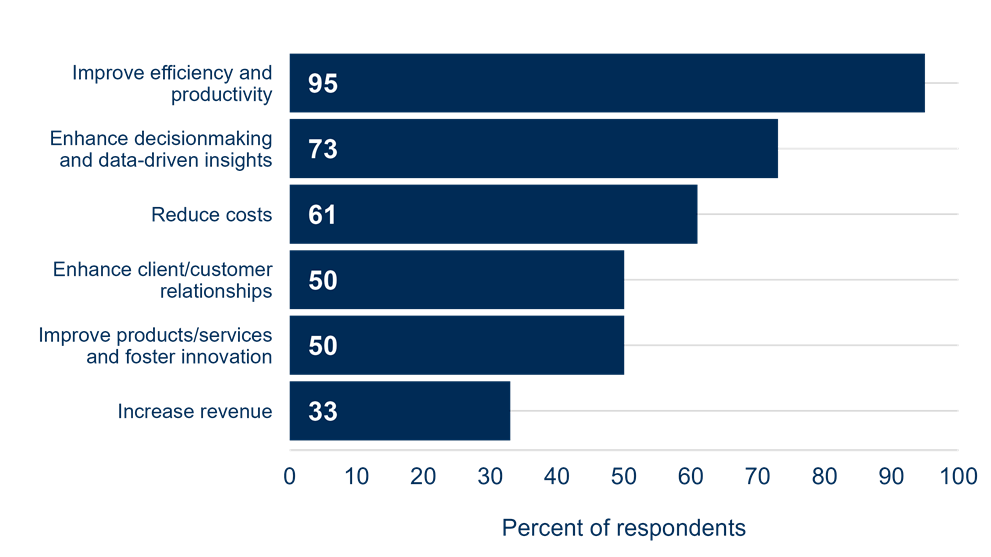
Of the respondents whose organization planned to use AI for business processes in the coming six months, nearly all (95 percent) said they hope to improve efficiency and productivity as a result. Additionally, majorities said they hope to enhance decisionmaking (73 percent) and reduce costs (61 percent). Half of respondents hoped to enhance client or customer relationships, and the same share hoped to improve products or services and foster innovation.
Source: Cleveland Fed SORCE
Note: Respondents could select multiple options. Chart excludes “Unsure” and “Other,” which were each chosen by 1 percent of respondents.
Question: Which benefits do you hope to achieve [from AI adoption]? Select all that apply. (n = 153)
Barriers to AI Adoption in the Next Six Months
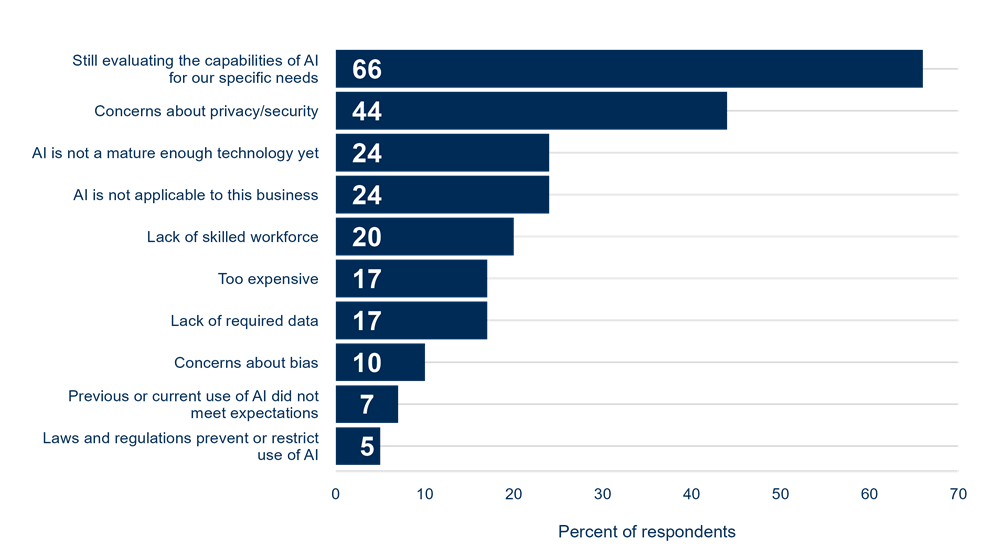
Among respondents whose organization was unsure about using AI or did not plan to use it for business processes over the next six months, the most cited barrier was that their organization was still evaluating AI capabilities for their specific needs (66 percent). The next most common barrier was concern about privacy or security (44 percent). Twenty-four percent of respondents said AI is not a mature enough technology, and the same share said it is not applicable to their business.
Source: Cleveland Fed SORCE
Note: Respondents could select multiple options. Chart excludes “Other,” which was chosen by 10 percent of respondents.
Question 1: Why does your organization not plan to use AI during the next six months? Select all that apply. (n = 22)
Question 2: Why is your organization unsure about using AI during the next six months? Select all that apply. (n = 19)
The Cleveland Fed’s Research Department gathers and analyzes timely economic information from businesses and community contacts to inform our Beige Book contribution and to prepare for Federal Open Market Committee (FOMC) meetings. One way we obtain this information is through the Survey of Regional Conditions and Expectations (SORCE), a business conditions survey sent to firms across the Fourth District, which comprises Ohio, western Pennsylvania, eastern Kentucky, and the northern panhandle of West Virginia. The SORCE is administered eight times per year. In addition to the set of standard questions asked during each round of the survey, the Cleveland Fed routinely asks a set of “special questions” to explore timely issues that may be impacting businesses across the Fourth District. The SORCE Insights District Data Briefs share the results from the “special questions.” For more information on SORCE, visit https://clevelandfed.org/SORCE.
Suggested Citation
Isler, Mitchell, and Brett Huettner. 2026. “SORCE Insights: How Fourth District Firms Are Using AI.” Federal Reserve Bank of Cleveland, Cleveland Fed District Data Brief. https://doi.org/10.26509/frbc-ddb-20260415
This work by Federal Reserve Bank of Cleveland is licensed under Creative Commons Attribution-NonCommercial 4.0 International


Related resources

Survey of Regional Conditions and Expectations (SORCE)
SORCE indexes are based on our survey of business and community leaders and provide a timely summary of economic activity in our region, which includes all of Ohio and parts of Pennsylvania, Kentucky, and West Virginia. Released twice each quarter.

Regional Data, Analysis, and Engagement
Explore economic trends and the circumstances impacting the economy and diverse communities of the Federal Reserve’s Fourth District, which includes all of Ohio, western Pennsylvania, eastern Kentucky, and the northern panhandle of West Virginia.

About Us
The Federal Reserve Bank of Cleveland (commonly known as the Cleveland Fed) is part of the Federal Reserve System, the central bank of the United States.