

- Share
West Virginia’s International Trade Relationships
This District Data Brief is part of a four-report series examining the international trade relationships of the US states that are either partially or entirely contained within the Fourth District of the Federal Reserve System: Ohio, Kentucky, Pennsylvania, and West Virginia.1


The views authors express in District Data Briefs are theirs and not necessarily those of the Federal Reserve Bank of Cleveland or the Board of Governors of the Federal Reserve System. The series editor is Harrison Markel.
Overview: West Virginia's Product Imports and Exports
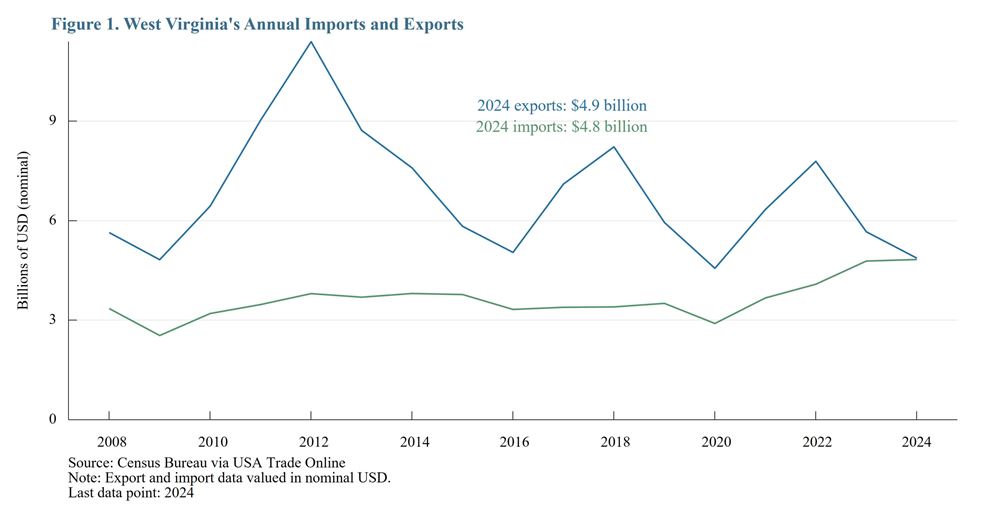
Figure 1 shows the total nominal value of West Virgina’s product imports and exports from 2008 through 2024.2 For each year during this period, the state was a net exporter of goods to other countries because the value of its exports exceeded that of its imports. However, as of 2024, the gap between West Virginia’s exports and imports had nearly disappeared. The value of its exports was only $0.1 billion greater than the value of its imports that year.3
Where Do West Virginians Import Products from, and What Are They Buying?
Figure 2 shows the percentage of West Virginia’s total imports from 2008 through 2024 by trading partner of origin. The figure’s inset table provides information on the US dollar value and percentage share of West Virginia’s total imports by trading partner of origin in 2024. Both the figure and corresponding inset table are filtered to include only West Virginia’s top five import sources (in descending order as of 2024): Canada, Japan, the European Union, China, and Mexico. In 2024, Canada alone accounted for 42.4 percent of West Virginia’s total imports at a value of $2.1 billion. That year, aerospace products and parts was by far the state’s largest import category from Canada at a value of $842 million.
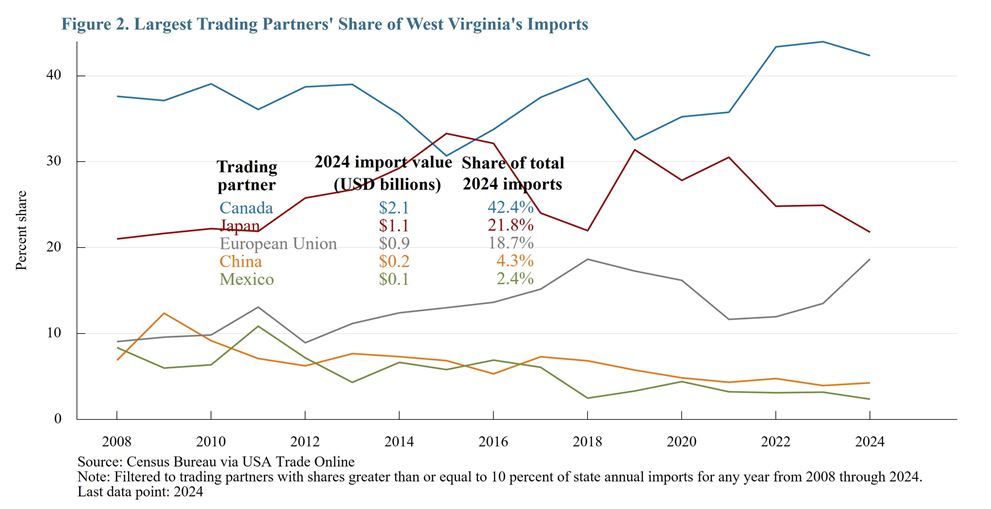
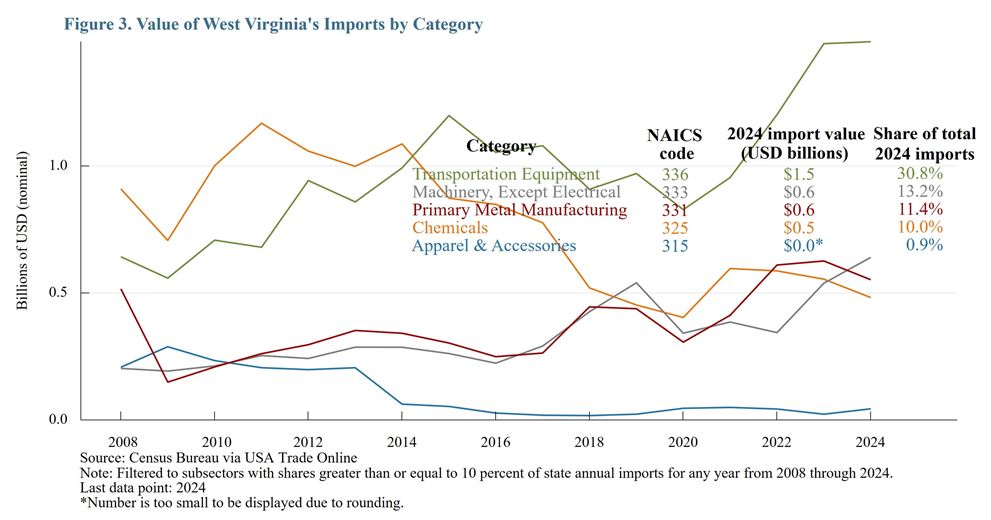
Figure 3 shows the US dollar value of West Virginia’s imported products from the largest North American Industry Classification System categories from 2008 through 2024. Both the figure and corresponding inset table are filtered to include only West Virginia’s top five imported product categories (in descending order as of 2024): transportation equipment, machinery (except electrical), primary metal manufacturing, chemicals, and apparel and accessories. From 2015 through 2024, transportation equipment was the state’s largest import category by US dollar value. In 2024, this category represented nearly one-third (30.8 percent) of West Virginia’s total imports at a value of $1.5 billion. Aerospace products and parts accounted for about 70 percent of West Virginia’s transportation equipment imports that year.
Where Do West Virginia’s Exports Go, and What Products Does the State Sell?
Figure 4 shows that, from 2008 through 2024, Canada and the European Union traded off as West Virginia’s largest export market. The share of West Virginia’s exports sent to Canada rose strongly in 2023 and 2024, driven by an increase in exports of transportation equipment. In 2024, 40.9 percent of the state’s exports went to Canada. The next three largest markets for West Virginia’s exports in 2024—the European Union, China, and India—together represented nearly one-third (31.2 percent) of total exports that year, collectively valued at $1.5 billion. Chemicals accounted for the largest share of the state’s exports to these three trading partners.
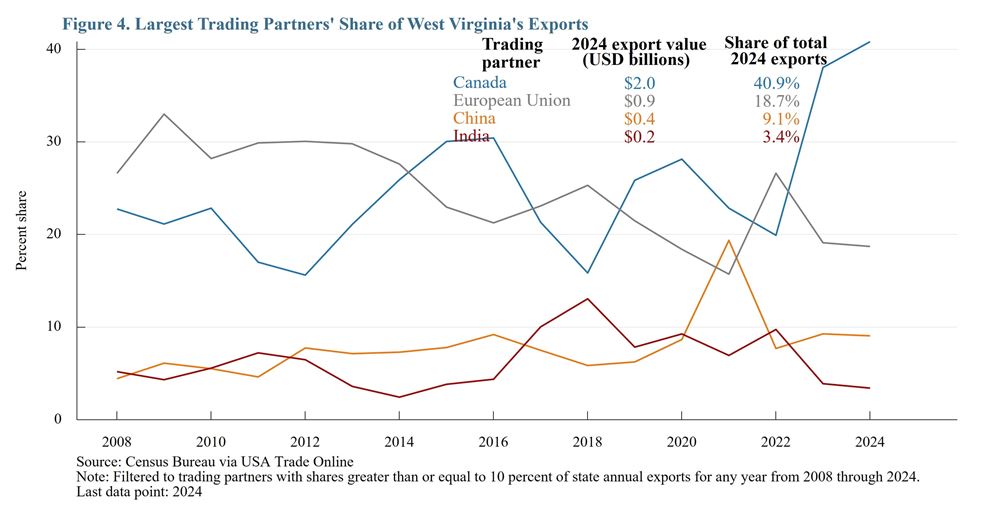
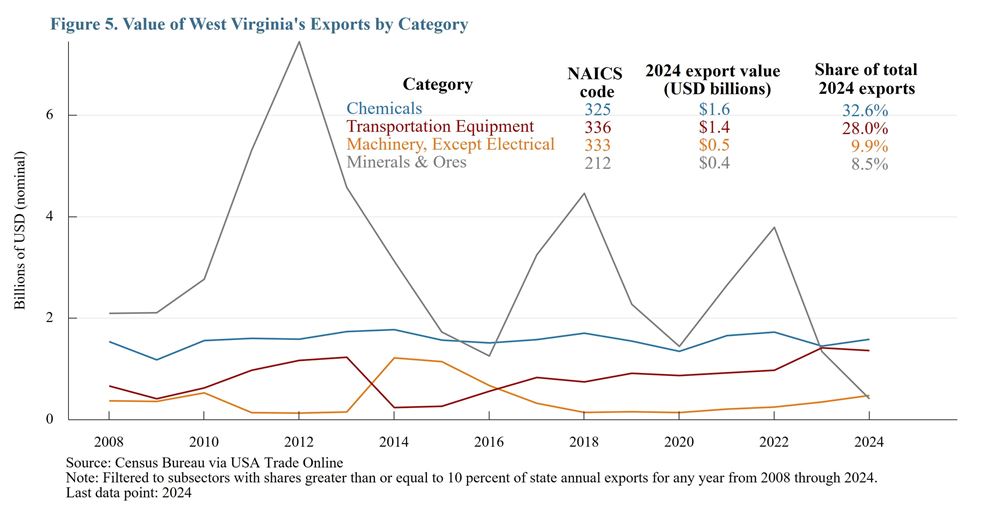
Figure 5 shows that, from 2008 through 2024, West Virginia’s largest export category was most commonly minerals and ores, with coal and petroleum gases accounting for the lion’s share of these exports. However, during this period, there was a large variation in the US dollar value of West Virginia’s minerals and ores exports. In 2012, the value of these exports peaked at $7.5 billion. This peak was partly due to greater international demand for West Virginia’s coal after heavy rains disrupted Australia’s coal production. The increased international demand helped boost the value of West Virginia’s minerals and ores exports despite the downtrend in the state’s coal production that coincided with its increased production of natural gas.
Conclusion
From 2008 through 2024, Canada and the European Union were typically the largest destinations for West Virginia’s exports. For all but one year during this period, Canada was the biggest source of the state’s imports. Minerals and ores was generally West Virginia’s largest export category during this period, despite a decline in recent years. Transportation equipment was also a key import and export category for the state.
Footnotes
- The Fourth District covers Ohio, the eastern half of Kentucky, parts of western Pennsylvania, and the northern panhandle of West Virginia. Return to 1
- The data collected for this District Data Brief were sourced from the Census USA Trade Online data tool, which is subject to revisions. The data contained in the figures’ inset tables have been rounded. Return to 2
- Whether something is classified as an import depends on where the product is manufactured or where it undergoes “substantial transformation,” not where the company is headquartered. For example, when a pharmaceutical company that is headquartered in the United States manufactures products in Ireland or Singapore and then ships those products to the United States, those products would be considered imports from Ireland or Singapore.
Return to 3
Appendix
Table A1. Top Categories and Industry Groups for West Virginia’s Imports in 2024
| 2024 import value (USD billions) | ||
| Apparel and Accessories | Knit Apparel |
0.04 |
| Apparel |
0.01 | |
| Apparel Accessories |
0.00* | |
| Total | 0.04 | |
| Chemicals | Basic Chemicals | 0.31 |
| Resin, Synthetic Rubber, and Artificial and Synthetic Fibers and Filaments | 0.13 | |
| Pesticides, Fertilizers, and Other Agricultural Chemicals | 0.01 | |
| Pharmaceuticals and Medicines | 0.00* | |
| Paints, Coatings, and Adhesives | 0.00* | |
| Soaps, Cleaning Compounds, and Toilet Preparations | 0.01 | |
| Other Chemical Products and Preparations | 0.02 | |
| Total | 0.48 | |
| Primary Metal Manufacturing | Iron, Steel, and Ferroalloy | 0.14 |
| Steel Products from Purchased Steel | 0.00* | |
| Alumina, Aluminum, and Processing | 0.24 | |
| Nonferrous Metal (except Aluminum) and Processing | 0.18 | |
| Foundries | 0.00* | |
| Total | 0.55 | |
| Machinery, Except Electrical | Agriculture, Construction, and Machinery | 0.05 |
| Industrial Machinery | 0.04 | |
| Commercial and Service Industry Machinery | 0.01 | |
| Heating, Ventilation, Air-Conditioning, and Commercial Refrigeration Equipment | 0.05 | |
| Metalworking Machinery | 0.13 | |
| Engines, Turbines, and Power Transmission Equipment | 0.14 | |
| Other General Purpose Machinery | 0.22 | |
| Total | 0.64 | |
| Transportation Equipment | Motor Vehicles | 0.03 |
| Motor Vehicle Bodies and Trailers | 0.00* | |
| Motor Vehicle Parts | 0.43 | |
| Aerospace Products and Parts | 1.03 | |
| Railroad Rolling Stock | 0.01 | |
| Ships and Boats | 0.00* | |
| Transportation Equipment, Not Elsewhere Specified or Included |
0.00* | |
| Total | 1.49 |
Source: Census Bureau via USA Trade Online
Note: Subsector totals may not sum to sector totals due to rounding.
*Number is too small to be displayed due to rounding.
Table A2. Top Categories and Industry Groups for West Virginia’s Exports in 2024
| 2024 export value (USD billions) | ||
| Minerals and Ores | Coal and Petroleum Gases | 0.37 |
| Metal Ores | 0.04 | |
| Nonmetallic Minerals | 0.00* | |
| Total | 0.41 | |
| Chemicals | Basic Chemicals | 0.29 |
| Resin, Synthetic Rubber, and Artificial and Synthetic Fibers and Filaments | 1.05 | |
| Pesticides, Fertilizers, and Other Agricultural Chemicals | 0.00* | |
| Pharmaceuticals and Medicines | 0.01 | |
| Paints, Coatings, and Adhesives | 0.03 | |
| Soaps, Cleaning Compounds, and Toilet Preparations | 0.13 | |
| Other Chemical Products and Preparations | 0.07 | |
| Total | 1.59 | |
| Machinery, Except Electrical | Agriculture, Construction, and Machinery | 0.08 |
| Industrial Machinery | 0.01 | |
| Commercial and Service Industry Machinery | 0.00* | |
| Heating, Ventilation, Air-Conditioning, and Commercial Refrigeration Equipment | 0.00* | |
| Metalworking Machinery | 0.00* | |
| Engines, Turbines, and Power Transmission Equipment | 0.33 | |
| Other General Purpose Machinery | 0.05 | |
| Total | 0.48 | |
| Transportation Equipment | Motor Vehicles | 0.00* |
| Motor Vehicle Bodies and Trailers | 0.01 | |
| Motor Vehicle Parts | 1.04 | |
| Aerospace Products and Parts | 0.31 | |
| Railroad Rolling Stock | 0.00* | |
| Ships and Boats | 0.00* | |
| Transportation Equipment, Not Elsewhere Specified or Included | 0.00* | |
| Total | 1.37 |
Source: Census Bureau via USA Trade Online
Note: Subsector totals may not sum to sector totals due to rounding.
*Number is too small to be displayed due to rounding.
References
- Bowen, Eric and Christiadi. 2017. Fossil Fuel Opportunities for West Virginia: 2017 Update. Bureau of Business & Economic Research, West Virginia University College of Business and Economics. https://energywv.org/wp-content/uploads/2024/07/Fossil-Fuel-Opportunities-for-West-Virginia-2017-Update.pdf.
Suggested Citation
Moseley, Carol, and Julianne Dunn. 2026. “West Virginia’s International Trade Relationships.” Federal Reserve Bank of Cleveland, Cleveland Fed District Data Brief. https://doi.org/10.26509/frbc-ddb-20260224
This work by Federal Reserve Bank of Cleveland is licensed under Creative Commons Attribution-NonCommercial 4.0 International


Related resources

About Us
The Federal Reserve Bank of Cleveland (commonly known as the Cleveland Fed) is part of the Federal Reserve System, the central bank of the United States.