

- Share
Akron leaders explain challenges, opportunities, and goal to transform the Rubber City to the Polymer Capital of the world
Cleveland Fed president and chief executive officer Beth Hammack spoke with business leaders and toured the National Polymer Innovation Center.
More than 100 years ago, Akron, Ohio—the Rubber Capital of the World—was the fastest-growing city in the United States.1 The city's population reached nearly 300,000 in 1960.
By 2024, the city's population had fallen to less than two-thirds of its peak, with nearly 190,000 residents.
During a roundtable event with area business leaders, Cleveland Fed president Beth Hammack heard that changing demographics, combined with immigration policies, have made it difficult for area businesses to find workers.
"I could hire 10 people today if I could find them—it's a matter of finding qualified, skilled labor," one business owner said.
Evolving priorities
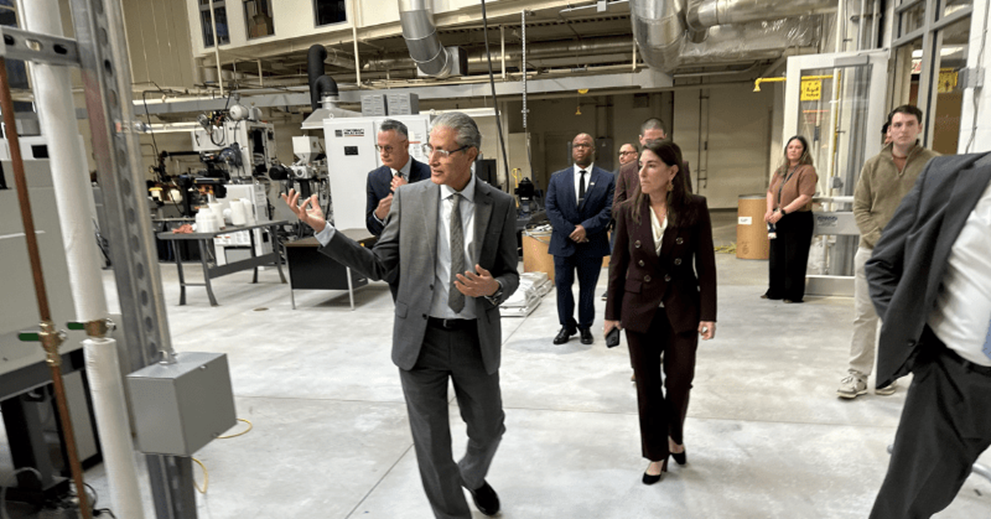
Ali Dhinojwala (left), a professor at the University of Akron School of Polymer Science and Polymer Engineering, describes the National Polymer Innovation Center to Cleveland Fed president Beth Hammack (February 20, 2026).
Rubber and plastics manufacturing still account for a significant number of jobs—more than 16,000—in the Cleveland–Akron–Canton area, according to research from the Cleveland Fed's regional analysis team. To build on that legacy, area leaders Akron will eventually be recognized as the world’s polymer capital.
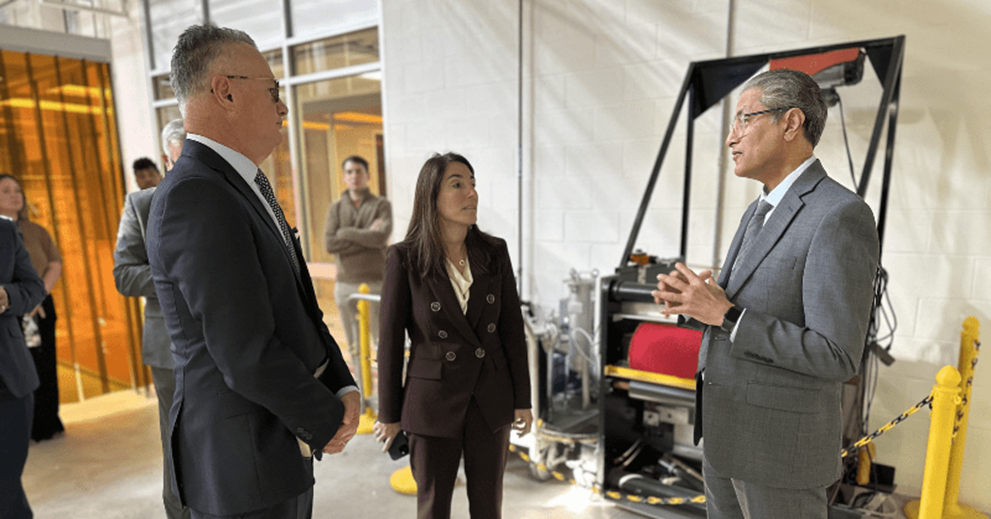
Rich Kramer (left), the chairman of the board of the Federal Reserve Bank of Cleveland, Hammack, and Dhinojwala discuss the National Polymer Innovation Center (February 20, 2026).
In 2021, dozens of companies representing rubber, plastics, and chemical subsectors of the polymer industry joined with higher education institutions and economic development partners to launch the Akron-based Polymer Industry Cluster. The goal of the initiative is to conduct a deeper examination of the region's polymer industry and develop a framework to help it achieve its full potential.2
One member of the cluster is the University of Akron, home to the National Polymer Innovation Center. Hammack visited the hands-on training and testing facility and learned about the research and experimentation students and businesses are pursuing to gain insights into the future of polymers.
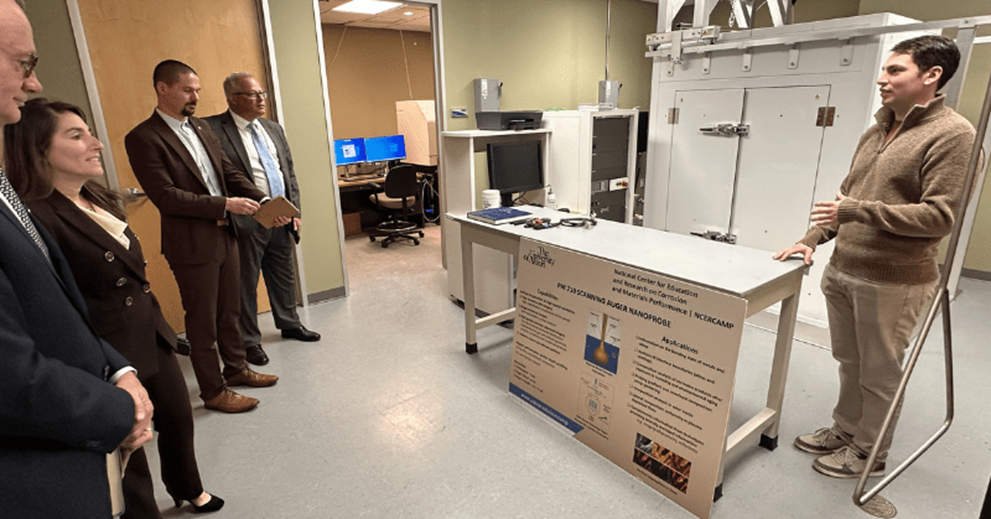
Hammack listens to a student discuss his research at the National Polymer Innovation Center (February 20, 2026).
About President Beth M. Hammack’s Around the District tour
President Hammack is visiting communities across the Fourth District as part of her Around the District tour to meet and connect with the people who live and work in all corners of the region and to gain a better understanding of how the economy is working in different communities. The Cleveland Fed, with branches in Cincinnati and Pittsburgh, serves an area that comprises Ohio, western Pennsylvania, eastern Kentucky, and the northern panhandle of West Virginia. Hammack will use this information to inform her policy views and better represent the Fourth District around the Federal Open Market Committee table.
Footnotes
- Bhatia, Kabir. 2019. “Why Did Rubber Come To Akron?” WOSU Public Media, March 7. https://www.wosu.org/news/2019-03-07/why-did-rubber-come-to-akron. Return to 1
- Polymer Industry Cluster. “Polymer Industry Cluster.” Accessed July 3, 2026. https://polymerindustrycluster.org/. Return to 2
Related resources
President and CEO
Learn about the work of Beth M. Hammack, president and CEO of the Federal Reserve Bank of Cleveland.
Beth M. Hammack
Beth M. Hammack is the president and chief executive officer of the Federal Reserve Bank of Cleveland, one of 12 regional Reserve Banks in the Federal Reserve System.