| |
|
 |
Printer friendly version
Building a Future as Bright as Our Past
Sandra Pianalto
President and Chief Executive Officer
Federal Reserve Bank of Cleveland
Say Yes! to Cleveland — A Celebration
Intercontinental Hotel and Conference Center
Cleveland, Ohio
November 17, 2004
Introduction
The Federal Reserve Bank of Cleveland has
an ongoing interest in understanding developments in the local economy so that these regional issues become
a part of the national monetary policymaking process.
But in addition to this policy role, the Bank
wears a lot of other hats in our region. We also function
as a corporate citizen, a center of economic
expertise, a bank supervisor, a payments provider, and a
community development advisor. We want to provide a strong
voice in the public dialogue that is so important to our
continuing economic success as
a city and a region.
In my two decades at the Bank, I have witnessed major changes
in the regional economy:
- the downsizing of manufacturing industries,
- the global transformation of the auto industry,
- the growth of the health care and polymer industries,
- and a host of start-ups in information technology, bioscience and
now even nanotechnology.
I wish I could say that all of these experiences
have had positive effects for everyone in our region, but
as you know, some of these changes have been difficult. We have faced
challenges, and we face them still.
This morning, I would like to focus on how we as a city
and region can work together to understand what it will take
to create the conditions for growth and prosperity that we
will need to keep us moving forward in the 21st century.
- First, I will give a bit of history
about our region’s
economic development.
- Then I will review some of the latest thinking on the
factors that drive innovation and lead to economic growth
and prosperity.
- Finally, I will explore some ideas
for how we can work together to create the necessary conditions for innovation right here
in Cleveland — to build a future as bright as our past.
I. History of innovation in Cleveland
Let me begin my remarks by taking you
back to a time when the whole world seemed to say Yes!
to Cleveland — during
the first part of the twentieth century. For this discussion,
I will draw heavily on the work of Mike Fogarty, Gasper
Garofolo, and David Hammack, who produced
an outstanding study on the history of our region for the
Center for Regional Economic Issues at Case Western Reserve
University.
Cleveland grew steadily from its founding
in 1796. It was blessed with a great location— with
ready access to timber, iron ore, coal and other raw materials — and
a critical infrastructure of that period — first the
canals and then the railroads. If Cleveland’s story
had ended there, this city would have remained a substantial
commercial
and manufacturing
center based on its transportation links between important
resources. But our progress did not end there.
Cleveland also benefited tremendously from
the knowledge, skill and energy of its citizens and of new
people who kept
streaming in, drawn by the opportunities our region offered.
By the end of the Civil War, Cleveland had developed a healthy
concentration of entrepreneurs, firms, and experts who were
skilled in metal-working and other technologies.
Working together, people in this community created a major center for industrial
innovation, and this enabled Cleveland to really take off.
I am sure that many of you have taken a Lolly the Trolley
tour and can name some of the inventions developed in our
city: electric streetlights and traffic lights come to mind.
But these are just part of the story.
More mundane innovations often created even greater wealth. For
example, the process that allowed Rockefeller's Cleveland
oil refinery to remove sulphur from petroleum led to the
rise of Standard Oil. The Hulett Ore Unloaders improved the
efficiency of the transport of materials across the Great Lakes. This helped
make Cleveland a giant in the steel industry.
According to records from the patent office at the turn of the century, Cleveland accounted
for 2.6 percent of all “important” patents
between 1870 and 1890. This may sound like a small percentage,
but it set Cleveland ahead of almost all of the up-and-coming
cities of the day.
Innovation remained robust well into the 20th century, and Cleveland’s
wealth rose accordingly. We all know the stories behind names
like Rockefeller and Carnegie. And we are fortunate to have lasting evidence of
that grand era in landmarks like the Terminal Tower.
In 1929, the first passenger train arrived at Union Terminal, and
the Terminal Tower complex was dedicated the following
year. This was the tallest building outside New York City
and gave Cleveland a national presence.
The history of my organization is also tied to this period of
vibrancy. The Federal Reserve Bank of Cleveland began operations
in 1914 in leased space in the Williamson Building on Public
Square, on the land now occupied by the BP Building. We moved
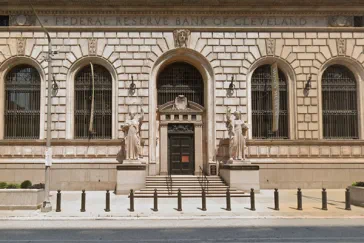
into our magnificent pink marble building on East Sixth Street
and Superior in 1923, and it continues to inspire
visitors, as well as employees, to this day.
One of the great privileges of working for the Federal Reserve
is to draw strength from that long history. Our employees
have lived through 17 business cycles and a century of economic
transformation. Through it all, our
living standard and quality of life have steadily improved
from one generation to the next.
But we all recognize that the glory days
of our regional prominence have faded. Today, we are more
likely to hear stories about our region’s problems than about its
promises. Over the past couple of decades, we have been struggling
to come to terms with a structural shift in both the regional
and the national economy — including more global trade,
greater innovation, changing technology, the shrinking share
of manufacturing jobs, and a growing wage differential between high school
and college graduates.
As painful as these short-term adjustments
may be, we know that we must keep pace with the changes around
us if we are to move forward. We need to continue to identify the factors
that will drive economic growth and prosperity for our citizens.
And in fact, our economists at the Federal Reserve Bank of
Cleveland have begun to focus their research efforts on
economic transformation.
II. What factors drive innovation?
So let’s consider exactly what
these experts have to say on the factors that drive regional
growth and prosperity.
In our Bank’s 2003 Annual Report,
we discuss our research findings in this area. We propose
that innovation is the true engine of economic
prosperity, and we argue that our greatest strength will
be our ability to embrace change, from integrating new technologies
to welcoming new people. If we hope to remain vital as a
region, then flexibility is likely to be our most valuable
asset.
Indeed, the key to maintaining a region’s
economic vibrancy is its ability to sustain a community of
innovators. Some of the factors that may help an economy
nurture growth and innovation are a skilled labor force,
access to natural
resources, commitment to the rule of law, and openness to
trade with the rest of the world. But perhaps even more important
is an openness to new ideas and different perspectives. We
simply cannot survive on our past successes.
As you know, an entrepreneurial spirit is
a critical driving force for innovation. We are glad to
hear that some new industries are emerging in greater Cleveland. The
Plain Dealer recently reported a study by the BioEnterprise
Corporation. This study found that we already have a surprisingly
solid base in the bioscience industry, with 362 companies
and about 15,000 employees. And I was very pleased to
read about last month’s
conference on nanotechnology here in Cleveland. This is a
fascinating new industry, and most of it is driven by entrepreneurs.
It is really no exaggeration to say that the
American psyche is hard-wired for entrepreneurship. My friend
and colleague Bill Poole, president of the Federal Reserve
Bank of St. Louis, recently co-wrote a research article
on this subject with Howard Wall. They note that Americans
are more than twice as willing to become entrepreneurs than
are people in western Europe and Japan. They emphasize that
in order for this American entrepreneurial spirit to lead
to success, it must be accompanied by an environment that
allows it to thrive. Entrepreneurship does not
usually come from without — it
is likely to be home-grown and based on experiences within
a community.
So what are some of the environmental factors
that promote entrepreneurship? Again I will draw on the findings
of one of my colleagues, Randy Eberts, who was an economist
at the Federal Reserve
Bank of Cleveland and is now executive director of the Upjohn
Institute for Employment Research.
Earlier this year, Randy made a presentation to the Harvard Business
Club of Northeast Ohio. In his remarks, he cited
the results of a survey on the four essential ingredients
in fostering an entrepreneurial culture:
- First, entrepreneurs need
access to people — they
need a critical mass of highly educated and open-minded
people
of all varieties, such as scientists, educators, managers
and workers.
- Second, entrepreneurs need access to seed capital or venture
funds.
- Third, they need access
to information and infrastructure. This includes
public education, universities, businesses, and transportation
and communication networks. It also includes
some intangibles like entrepreneurial attitudes and leadership.
- Finally, they need government
to play a proper role — a
role that gives entrepreneurs the space and opportunity
to innovate and that manages taxes, investments and
regulations
wisely.
III. Creating the conditions for innovation, growth and prosperity in Greater Cleveland
So now let’s bring this discussion back
around to the question that we all really want to address
today — what
can we do to create the conditions for innovation, growth
and prosperity here in Cleveland?
Please keep in mind that I am a Federal Reserve Bank president
and a monetary policymaker. I am not an elected official
or an economic development director, so I am not proposing
specific policies or projects.
What I can do today is tell you what I have
learned from the work of my research staff and from many
of the organizations
that I am a part of, such as the Cleveland Foundation, the
Greater Cleveland Partnership, the Northeast Ohio Council
on Higher Education, and Leadership Cleveland. All of these
groups feature outstanding people who have expressed some
great ideas for moving this region forward. I will borrow from
some of these ideas and share with you what I consider to
be our strengths and opportunities in
building a regional culture of innovation.
The good news
The good news is that we already have a lot going right
for us here in Greater Cleveland.
- We have outstanding health care facilities and public and
private universities.
- We have a concentration of first-rate legal and financial
enterprises.
- We have a set of established companies that want to remain
here, and some exciting emerging technology sectors,
as I mentioned earlier.
- We have begun bringing early-stage investment to local
entrepreneurs through the excellent efforts of organizations
like JumpStart.
- Our
region also has a small-town feel, an affordable lifestyle,
and big-city cultural amenities. These assets sustain
our residents and provide a huge draw for newcomers to
our area.
The not-so-good news
Of course, there are also many things we need to do better
if we are to regain a truly vibrant regional economy like
the one we enjoyed a century ago.
- First, we need to focus on improving educational attainment.
- Evidence shows that the Cleveland-Akron area lags behind other regions
in levels of educational attainment. In an economy that increasingly runs on brainpower, we must
invest in our most important asset — our people.
- Education and workforce development must be broad-based, and we must
be realistic about the level of change that is needed. Ohio’s manufacturing tradition once gave many people a path to high earnings without the need for higher education. We all know that day is over. Service-sector jobs typically require more education than do manufacturing jobs to reach the same levels of income.
- Our Bank is already at work on the education front. On November 18-19, we are sponsoring a two-day conference on the role of education in economic development. I am confident that the discussions with hold with prominent academics, civic leaders and educational policymakers will bear fruit in additional research and policy directions.
- Second, we must find a way to stem the loss of young people from our community.
- We can draw on the programs we already have in place — internships for young people and organizations like Say Yes! To Cleveland, Leadership Cleveland, and Bridge Builders — to keep people engaged and energized to stay here.
- But we also need to think about new ways to tell the story about why our region is a great place to build a personal and professional future.
- Third, if state and local regulations and taxes are hampering
regional investment, we must find a way to ease these
burdens.
- Some reports indicate that not enough public dollars are being invested in economic development that could bring tax relief for our consumers and businesses. We also need to find new sources of public and private revenue for investment without imposing greater burdens on our already stretched tax base.
- Fourth, we need to do more to attract
venture capital in our region.
- We know the rate
of job creation from business startups or expansions
is slower in the Midwest than in other parts of the country. Entrepreneurs are telling us that
it can still be difficult to get early-stage capital for new
ventures.
- At our Bank, we are preparing to investigate the financing climate,
along with several other Reserve Banks and with
Scott Shane, a professor from the Weatherhead School of Management
at Case Western Reserve University. Each of these Reserve
Banks will convene a panel of so-called “angel
investors” and ask them a common set of questions to
learn how and where they invest, and what kinds of business
ventures they are looking for. We hope to identify some next
steps to promote better access to capital for small businesses.
- Finally, we need to take an honest
look at the role of government in promoting innovation
and growth.
-
Recent efforts to cooperate at a regional level might lead to a better business climate, and we should urge government leaders to engage in that conversation.
What I think we should not do
is to dictate the brand of innovation or the industries we “think” we
might need. We need to let the marketplace define those
specifics.
On a broader level, we also need to let go of what might have worked well for us in the past. Innovation, by its very nature, requires us to be open to change. Think of the steady, upward march of our economic prosperity as climbing a ladder, where each ung is a new stage of our economic development. Until we are willing to release our grasp on the rung we’re holding and reach for the next one, we cannot hope to reach greater heights.
Conclusion
All of us have a vested
interest in our region’s economic
growth. We all have a role to play, and that includes those
of us at the Federal Reserve Bank of Cleveland. We will continue
to conduct research on issues that are important to our
region, and we have begun partnering with
universities, foundations, and business groups that are engaged
in economic growth and development.
The Cleveland area has seen industries and fortunes rise and
fall over the past century, and today we are in a long
transition toward a more service-oriented economy. Let us
work together to create the conditions for innovation, growth
and prosperity that will bring the new entrepreneurs
and energies of the 21st century to our city. Let us also find
the way to help our citizens prepare themselves for this
future with better education and training.
Say Yes! to Cleveland provides an important voice in building
the partnerships we need to move forward as a city and region.
We all want to build a future that is as bright, or even
brighter, than our past. Working together, we
will make the difference.
Printer friendly version
|